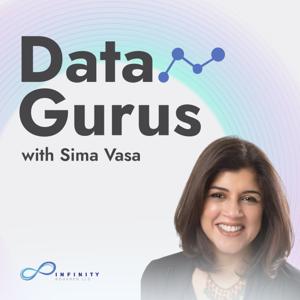
Data Gurus Podcast | Insights on Business Strategy, Mergers and Acquisitions, Market Research & Data Collection

Data Gurus Podcast | Insights on Business Strategy, Mergers and Acquisitions, Market Research & Data Collection

By Sima VasaBusinessInvesting
Download on the App Store

Data Gurus Podcast | Insights on Business Strategy, Mergers and Acquisitions, Market Research & Data Collection episodes

  • Understanding the Psychology of Sales (Part 1) with Calista Corley and Tacie Avedikian | Ep. 114
    One of the biggest components for scaling any business is sales, and yet so many companies tend to struggle with it. It involves finding a balance between the right personality, the right leader, and ensuring that there’s lockstep with the product.
    Adam Jolley is joining Sima in presenting this two-part podcast series on sales.
    Much of the sales piece tends to be forgotten in all industries, and there are no white papers or conferences just on sales. Adam feels that people don’t even want to talk about sales, so, he decided that it would be very helpful to talk about sales in terms of what it takes, and also in terms of some of the intangibles that people have when it comes to sales.
    Sima’s goal for this podcast series is to help senior leaders understand the psychology of sales. She would like to help sales leaders understand how they need to think about sales as a profession, how sales integrate into an organization, and the psychology behind what makes a salesperson tick.
    Today, we have Calista Corley, the Chief Revenue Officer of Fuel Cycle, and Tacie Avedikian, the Senior Director of Customer Development at Innovate MR, joining us as our first panel of sales professionals. They talk to us about their journeys, people’s misperceptions around sales, and what it takes to be a successful sales professional.
    Why Tacie is in sales
    Tacie did not start her career in sales. As her career progressed, she realized how much she enjoyed connecting with people and gaining a deeper understanding of their problems, their likes, and their lives. And people used to go and talk to her because they trusted her. Eventually, her boss suggested that she should go into sales because he thought she would enjoy it and she was well suited to it. So she gave it a run, and she’s still doing it and loving it now, seven years later.
    Why Calista is in sales
    Calista started her career in operations, and she progressed to leading operations teams. She was always front-facing and dealing with escalations. Although she excelled in that area, she realized that she was able to connect with people and solve problems, and that is what sales is all about for her.
    People tend to get the wrong image of sales
    Calista thinks that when people think about sales jobs, they often get the wrong image. The truth is that many of the best sales leaders and salespeople want to learn constantly.
    A thirst for knowledge
    A thirst for knowledge and improvement should drive people towards having in-depth conversations about solving problems.
    Tacie’s initial reservation around sales
    Tacie never wanted to lose herself in pitching something cheesy or something that she did not believe in.
    Sales is about sharing
    Sales is about sharing something with people that can change things positively for them.
    A stigma
    Tacie feels that the sales title has an unfortunate tendency to create a stigma.
    Sales is a hard job
    Calista finds sales harder than ever right now. She believes that you cannot be a great sales talent or leader without being intelligent, thoughtful, educated, researched, and able to identify patterns and pivot quickly. And you need to be competitive as well.
    Calista loves mentoring people
    It means a lot to Calista when young women approach her to find out about her journey to becoming a CRO. That motivates her to keep on doing what she is doing in her profession.
    The qualities of a successful salesperson
    A successful salesperson primarily needs to be able to connect and engage with people. They also need to be real, authentic, and curious, have a desire to keep learning and growing, and have the ability to self-motivate and pivot if necessary.
    Men and women differ in terms of sales
    Diversity is necessary for a sales team. Men and women have certain differences in the way that they sell, and together, they work better.
    Calista finds that women naturally have empathy and a sense of connection when it comes to selling. And that works very well.
    Tacie feels that the different perspectives brought by men and women work well together in a sales environment.
    Handling the ups and downs
    Sales is a rollercoaster, so people need to be open to talking about their emotional ups and downs. Calista thinks the best salespeople are those who can remind themselves that an up will come after a down, and focus on that. They also always learn something from the down.
    Good leadership
    Tacie thinks that a supportive boss, or manager, who is empathetic and allows their salespeople to have autonomy, is essential for a successful sales team.
    Work hard, play hard 
    Working hard and playing hard is very real in sales because it is such a rollercoaster.
    Sales culture
    You are unlikely to succeed in sales if you are not working in a team, so companies need to focus on creating a kickass sales culture! Transparency and clarity are vital for creating that kind of culture.
    Good leadership
    Good leadership requires the ability to view each individual in the long term, in their right role within the organization.
    Links:
    Email me your thoughts!
    LinkedIn
    Twitter
    infinity-2.com
    Sima is passionate about data and loves to share, learn, and help others that share that passion. If you love data as much as she does, subscribe on iTunes, and don’t forget to leave a rating and review!

    Books mentioned:
    Traction by Gino Wickman
    35 min
  • The “Quest” for Purpose with Tim Hoskins | Ep. 113
    We are excited to welcome Tim Hoskins today. Tim is the President of Quester, an insights and strategies company. He is joining us today to talk about his journey and driving business results.
    Tim’s journey
    While in college, Tom needed a job, so he answered an ad for a lead-generation specialist at an information security startup. He worked there for two years while he was in college, and then post-college, he got hired by the same company and started as a sales rep.
    In the startup world, you get to do everything, and Tim did not like not knowing all the answers, so he read the entire manual. He also started taking all the developers out to lunch to pick their brains, and that led to him becoming the Sales Engineer. His final role there was as a Product Manager.
    A consultant doing some work for Quester reached out to Tim, so he left the startup world to join Quester. He did not realize at the time that the company was, in fact, a forty-year-old startup. There, he worked in client services, became the head of sales and marketing, and about five or six years ago, he got promoted to President.
    The history of Quester
    Dr. Charles Cleveland, the founder of Quester, was a professor at Drake University. He started the company as a communications company with a foundation in linguistics, and they spent years doing qualitative research. They always applied linguistic analysis techniques to help drive communication.
    The founder’s dream was for executives on the client-side to look at a qualitative insight with the same confidence as a quantitative insight, someday.
    Dr. Cleveland passed away suddenly in 2005. The company was then purchased by three partners who kept on pushing forward with the technology and the same vision. In 2006, they launched the first, simple version. In 2007, they started to develop artificial intelligence, and the team has been working on that ever since.
    The current technology at Quester
    Today, Questor’s technology fully automates a one-on-one interview of up to forty minutes with a consumer. Those interviews are chat-based, or consumers can leverage the voice-based software on their phones.
    What their technology does
    Their technology analyses people’s responses and identifies a key or interesting idea that they are communicating. It then delivers a contextual-based follow-up question to find even more information.
    2011
    In 2011, the industry was not ready for artificial intelligence.
    Proving themselves
    There are always clients out there who know that you can’t solve the same problem with the same solution every single time. Those people give companies like Quester a chance to prove themselves. And that gives the rest of the market the confidence that those companies can do what they say they can do.
    The culture
    The average tenure of a Quester employee is seven years. Their culture is one of a family, and they do their best to have the mentality of a startup every single day.
    Insurgent mission
    The book, The Founder’s Mentality: How to Overcome the Predictable Crises of Growth, helped Tim and his team to focus on finding their insurgent mission and the reason for their existence.
    Driving business results
    They came to realize that their mission was not about the technology or the linguistic and qualitative analysis. It was about driving business results for their clients. You can’t have a business result unless you have strong and differentiated insights. And you can’t get strong and differentiated insights unless you have a different methodology to collect and analyze data.
    The company that delivers business results
    Tim and his team decided that they wanted to stand for the company that delivers business results. Behind every business result is a great strategy, and behind every great strategy is a consumer-centric insight.
    Changing in one year
    In 2018 and 2019, they changed their marketing. They doubled down on strategic insights, and they empowered their team by hyper-focusing them on micro-battles.
    The results in 2020
    In 2020, Tim and his team have more success than they have had in all the other years that Tim has been with the company in terms of client feedback and business results.
    Sales
    The sales team at Quester has the title of “Client Services”, and they are essentially strategists. They are trained and highly talented in understanding everything about the business, the questions, challenges, objectives, and identifying and working with the research teams to propose the right solutions. They stay with the project from front to back.
    New accounts
    They got ingrained into the conference circuit for bringing in new accounts. About two years ago, they decided to change the format of their presentations. Now, they try to spend thirty to forty percent of any presentation at a conference talking about the facts and figures of their business results. Those business results combined with conferences and the traditional outreach has been how they have acquired new business.
    Involvement in industry associations
    Tim believes that involvement in industry associations is vital for your personal and professional development. And everyone should get involved to the extent that they want to be committed to growing personally and professionally.
    Links:
    Email me your thoughts!
    LinkedIn
    Twitter
    infinity-2.com
    Sima is passionate about data and loves to share, learn, and help others that share that passion. If you love data as much as she does, subscribe on iTunes, and don’t forget to leave a rating and review!
    Book mentioned:
    The Founder’s Mentality: How to Overcome the Predictable Crises of Growth by Chris Zook and James Allen
    22 min
  • The Rule of 40 with Mark Simon | Ep. 112
    We have the pleasure of welcoming Mark Simon, the Managing Partner for Hawkmoon Advisors, as our guest for today’s podcast.
    Mark is joining us to talk about his journey and share his experiences with the kind of work he has been doing to help small businesses scale, grow, and reach their goals. He also talks about what ten-million-dollar companies need to be thinking about if they want to scale.
    About Mark
    Mark disappeared off the research industry radar for a while after leaving Toluna at the end of 2019 and moving back to the UK. He joined an IT SaaS business in the UK called Datto, and after that gig came to a close, he set up a consulting business that helped small SaaS businesses get going.
    Mark’s journey
    After finishing university, Mark spent a few years in Paris, teaching English at a high school. After that, he spent most of the rest of his twenties playing the guitar in a rock and roll band, touring around, and having lots of fun. Then he went to work for a marketing agency that won a contract to take AOL to the UK. At the time, Mark was about to get married, and being a bit bored with the work he was doing, he started looking around for something new. He ended up spending an enjoyable year as an individual contributor for a company called Greenfield Online in Europe, where he learned a lot. He then got a call from someone at Toluna, saying that they were about to list the company on the London Stock Exchange, and they wanted him to lead them in doing that.
    Toluna
    Mark took a risk and joined Toluna. He now feels that was one of the smartest things that he has ever done. He set up a digital practice there, and they went to market properly. He had great fun getting them up to eight figures.
    An issue
    Toluna had an issue in their North American business, and they asked Mark to go there to turn it around, which he did. He managed to turn things around fairly quickly, and he ended up staying there for another six years before returning to the UK.
    What ten-million-dollar companies need to think about in terms of scaling
    Mark explains that at any point in your company’s trajectory, you have to think and act like you’re bigger than you are, and that applies from the CEO down to the people who you hire.
    Hiring is critical
    In Mark’s experience with fast-moving companies, he was spending 70-80 percent of his time hiring or coaching people. He points out that if you don’t do that as a leader, and you’re trying to scale, you are probably focusing on the wrong things.
    The people you hire
    Look for people who can act one level up but could also be capable of thinking two levels up.
    Recurring business
    Think about some way to get recurring business and repeatable, predictable cash flow. That will build value in your company.
    Incentives
    For a ten-million-dollar business, all your incentives need to be in line. It is vital to over-emphasize rewards for long-term contracts.
    Customers
    Your customers’ satisfaction needs to be ahead of your acquisitions.
    The Rule of Forty
    At ten million, you need to make sure that your company can exceed the Rule of Forty. That is very important for any recurring revenue business.
    Expanding internationally
    You should not expand your company internationally too quickly because that could be dangerous if you don’t have a cultural understanding of what works well in different places.
    A framework for hiring salespeople
    Interviewing salespeople can be difficult to do, so it helps to build a framework for hiring salespeople. Three things that are important to include in that process, regardless of the environment you’re in, are:
    Coachability
    A competitive streak
    Empathy, rapport-building, listening, and cultural alignment
    Also, any toxic high-achievers need to get removed from the team.
    Hiring a Head of Sales
    Hiring the right Head of Sales can be a scary decision for a CEO to have to make, especially if that CEO does not come from a sales background. The CEO should choose someone who has been a successful individual contributor rather than the best sales performer. And someone good at hiring and coaching, someone whose values align with those of the company, and someone who can move people along if they do not perform. They should also hire someone analytical and numerate.
    Evaluating a company from the employee side
    On the employee-side, when someone is evaluating a company, they should make sure that whatever the company stands for is in line with their values and culture. They should also look at the investment structure of the company, who the investors are, and how consistently successful they have been.
    Links:
    Email me your thoughts!
    LinkedIn
    Twitter
    infinity-2.com
    Sima is passionate about data and loves to share, learn, and help others that share that passion. If you love data as much as she does, subscribe on iTunes, and don’t forget to leave a rating and review!
    24 min
  • Enabling Insights with Paul Gaudette | Ep. 111
    Today, we have the second part of the podcast series Data Gurus for IEX. We have been focusing on the concept of the last mile. In our industry, the last mile relates to empowering and getting the insights and value that clients want to get from research.
    Today, we invited Paul Gaudette, the co-founder of Dig Insights, to give us his perspective on how he looks at his clients from that perspective, to be able to empower and enable his client base to garner the value they need.
    Bio
    Paul Gaudette is co-founder of Dig Insights, Toronto-based consumer insights, and technology company. Started 10 years ago, Dig continues to be one of the fastest-growing insights companies and has been rated as one of the most innovative research companies globally for the past four years. Paul has worked in the industry for over 15 years and has led/executed projects for clients across a range of industries (including CPG, QSR, Technology, Financial, Retail, Alcohol, and Cannabis). He is a strategic thinker with an analytical background; a combination that allows him to understand complex business issues and address them creatively. A passion for strategy and innovation lead Paul into consumer insights after finishing his degree in Strategic Management at EDHEC Business School in France. Paul currently spends most of his time focused on strategic growth opportunities, which includes private equity investment opportunities, acquisition opportunities for geographic and portfolio expansion, and additional revenue-generating opportunities within Dig’s current operations.
    Paul’s background
    Paul’s background was mostly educational before he got into market research. He did a business degree, followed by a master’s degree in strategic management. He then joined a company focused more on the innovation side of consumer insights. It was from there that he started Dig Insights, ten years ago.
    Starting Dig Insights
    He started Dig Insights because he saw a need in the market to focus more on consumer behaviors rather than attitude. It was almost a game-changer at the time.
    Expertise
    Their expertise since their inception was around their sophisticated knowledge of data and their analytics capabilities.
    Dig Insights 
    Dig Insights is based in Toronto, and they have offices in Chicago, on the west coast of Canada, and in London. They are slowly migrating to the rest of the world.
    Client base
    Dig Insights typically serve Fortune 500-type clients. That is evolving, as there are currently two aspects to the business. One is the consulting side, where the majority of their work happens, and the other is more of a tech side.
    Tech platform
    Dig Insights has developed a tech platform that is much more focused on early-stage innovation testing. Their clients range from McDonald’s, Pepsi, and global retail to small and medium enterprises that are looking to gain access to more cost-effective and faster insights through their tech platform.
    The consumer side
    On the consumer side, they are speaking to consumers and leveraging the technology that they use on a day-to-day basis to get that insight.
    The client-side
    On the client-side, they are speaking to clients as if they are running a business.
    A need in the marketplace
    Paul saw a need in the marketplace to develop a tool that would allow them to get those insights quicker, using technology that consumers were already familiar with, and delivering those insights to the clients faster.
    Playing in both places
    They made a strategic choice to play in both places, and they made an active effort to focus on the higher end customer work that was competing more with the big firms and also Accenture and Deloitte that were living in that space. That is where they built up their client base.
    Grow and scale
    To grow and scale, they needed to invest in some technology.
    Early-stage innovation testing
    The technology that they are investing in, and developing, is in the early stage innovation testing area where they have a lack of cost-effective, quick methods to get the insights faster.
    Custom
    The majority of the work they do is custom and designed to address whatever complex business needs their clients may have.
    An online dashboard
    For large multi-country projects with vast amounts of data, they have always provided an option for an online dashboard to access the data. And they have always believed in empowering their clients to get access to the data in the most efficient way.
    Evaluating different tools
    For a long time, they were providing dashboards and allowing access to the information through several different methods, some of which they built themselves and others that they partnered with.
    A complex blend of requirements
    They looked for a blend of being able to manipulate the data to create the variables and increase the charting while having appealing visualization of the data at the same time.
    Experts in data and data visualization
    The people that they put onto their large project, especially when it came to building out the tool with Harmoni, were experts in data and data visualization. Together with the team at Harmoni, they created an easy step-by-step process for accessing, interpreting, and using the data.
     
    Paul’s quotes:
    “Fortune 500-type clients are who we typically serve.”
    “There are two aspects to our business right now. One is the consulting side, and the other is more of a tech side.”
    “We have a tech platform that we developed, called Upside, which is much more focused on early-stage innovation testing.”
    “We are speaking to consumers and leveraging the technology that they use on a day-to-day basis to get that insight.”
    “We saw a need in the marketplace to develop a tool that allowed us to get those insights quicker using technology that consumers were already familiar with, and delivering those insights to the clients faster.”
    Links:
    Email me your thoughts!
    LinkedIn
    Twitter
    infinity-2.com
    Sima is passionate about data and loves to share, learn, and help others that share that passion. If you love data as much as she does, subscribe on iTunes, and don’t forget to leave a rating and review!

    23 min
  • Key Takeaways of the Impact of Covid-19 on Middle Market Firms with Nicole Schmidt and Chuck Mitchell | Ep. 110
    Nicole Schmidt and Chuck Mitchell are joining Sima today as panelists for a webinar on the impact of Covid 19 on middle-market firms.
    People have been impacted by Covid 19 all over the world. The purpose of this webinar is to provide context, perspective, and some key takeaways for executives to consider as they plan for the future beyond 2020.
    About Sima 
    Sima Vasa is a Senior Advisor at Oberon Securities. She has over ten years of entrepreneurial experience, operator experience, running a business unit of 45 million dollars for one of the largest market research firms, and also as an executive at IBM. Currently, she has an advisory services firm called Infinity Squared Ventures.
    About Nicole
    Nicole Schmidt is the managing partner and co-founder of Oberon Securities. She is a member of Oberon’s management team, and she brings more than 22 years of entrepreneurial experience and leadership to the firm. She spearheads Oberon’s consumer and retail group and is actively involved in the firm’s TMT practice. Before co-founding Oberon in 2001, Nicole was a partner at a software incubator. She also spent eight years as a senior equity analyst on both the buy-side and sell-side, covering a range of technologies.
    About Chuck
    Chuck Mitchell is the executive director at The Conference Board. Since he joined The Conference Board in 1997, as the head of publishing, he has authored dozens of reports on business and economic issues. They include the most recent, Beyond Technology, Building a New Organizational Culture to Succeed in an Era of Digital Transformation and Inclusion Plus Innovation, Leveraging Diversity of Thought to Generate Business Growth. Chuck also co-authors The Conference Board’s annual CEO Challenge Report. He recently completed a two-and-a-half-year assignment, Asian Pacific, based in Hong Kong.
    Transforming organizations into digitally-driven enterprises
    C-level executives see an opportunity to transform their organizations into digitally-driven enterprises that will make them leaner and more agile.
    Being digitally driven
    The mandate of being digitally driven requires the acquisition of new skills and investment. Chuck points out that the trend was already underway pre Covid, and Covid has accelerated the movement towards it. It requires a thoughtful and strategic plan to avoid sacrificing the long term for the short-term.
    Collaboration through technology
    Nicole points out that today, people are no longer centralized, so they have to collaborate through technology. A lot of companies currently think that the physical space might not be quite as important as they historically thought.
    A cultural challenge
    The challenge in the Covid era is about cultural transformation within organizations. And operating remotely compounds the difficulty of transforming that culture internally.
    The function level in digitally transformed organizations
    Artificial intelligence and robotic processes will start to replace routine tasks, so the function will be impacted by changing the jobs people do and how they interact with technology. Things are likely to become smaller and leaner to cut costs.
    Business travel
    Business travel is unlikely to come back as robust as it was pre-Covid.
    Cost-cutting strategies
    Travel and marketing budgets are getting cut. And another cost-cutting strategy, according to the CEOs who responded to Chuck’s survey, is a movement towards a more contingent and flexible workforce, or fewer full-timers.
    Manufacturing abroad
    More C-suite executives appear to be re-evaluating whether their manufacturing should be abroad, particularly of products that are critical for consumers, like pharmaceuticals and auto supplies.
    Empowering workers
    Chuck sees that empowering workers is going to be one of the changes in the workplace going forward.
    Changes in leadership style
    Leaders have to adjust and find ways of leading in the new and unproven territory. They also need to be empathetic, help their employees to become more resilient, and check-in with their remote staff, rather than checking on them.
    Major consumer trends that will stick 
    By making things very easy for consumers and catering to everybody’s desires, online stores like Amazon have created a perfect backdrop for accelerating their market penetration. Companies like Netflix and Amazon Prime have also accelerated.
    Mom and pop retail stores
    Nicole sees a re-emergence of smaller, mom and pop-type retail stores in the longer term.
    Consumer expectation is raising the online bar 
    The online bar is becoming much higher now because consumers can compare the digital experience they are getting from small firms with the very best digital experience they have had online.
    Corporations adopting a new philosophy
    More corporations seem to want to be authentic and purpose-driven and represent a higher purpose than they did before.
    New types of industries
    That could give rise to new types of industries, like ones that are cleaning up the environment and replacing the fossil fuel industry. And we are also likely to see more green companies coming into existence and more greening of existing companies.
    Millennials
    Millennials have indicated that they want to connect with brands and companies. And that moves companies in the direction of embracing a more ethical code on the business side.
    Social safety nets and public health issues
    Societies will invest more in social safety nets and pay more attention to public health issues.
    Social issues
    A lot of Chuck’s research points to the rising expectations of customers, consumers, and employees for organizations to take a stand on social issues and become agents for social change.  
    How recovery will look 
    With the possible exception of China and Japan, the virus is likely to dictate the speed of the recovery. Depending on the way that the virus is managed, we are looking to 2021 and beyond for any kind of return to meaningful growth.
    Links:
    Email me your thoughts!
    LinkedIn
    Twitter
    infinity-2.com
    Sima is passionate about data and loves to share, learn, and help others that share that passion. If you love data as much as she does, subscribe on iTunes, and don’t forget to leave a rating and review!

    41 min
  • The Role of Consumer Insights with Danielle Blugrind | Ep. 109
    We are excited to have Danielle Blugrind, a Senior Consumer Insights Manager at Roku, joining us today. In today’s episode, Danielle talks to us about her journey in the field of market research. She discusses the difference between the client and the supplier sides of the industry, company culture, creative solutions, pivoting, how traditional survey research compares with big data, and how things have changed in the research space since Covid.
    Danielle’s background
    Danielle has a background in Consumer Behavior, which is very similar to psychology but is more focused on real-life behavior than on laboratory testing. She also loves math and statistics, and many years ago, several people suggested that she should look into a career in the field of market research.
    Danielle looked into it, and she made a conscious decision to embark on a career in consumer research as soon as she completed her MBA.
    Starting with fun brands with fun products
    Danielle started working for Mattel, and she went straight into the fun or the client-side of the business. After about eight years, she left Mattel and went on to join Taco Bell, where she remained for the next eight years.
    Doing her own thing
    After leaving Taco Bell, Danielle became a consultant for a while, and then she went on to do some research on the supplier side of the industry.
    Back on the client-side
    After joining Roku, Danielle found herself back in her happy place on the client-side.
    A love of research
    Danielle feels that a love of research should be central to both the supplier and the client sides of the industry.
    The client-side
    Danielle explains that on the client-side, you get to go deeply into your industry, your brand, and the consumer. She loves that everything she does on the client-side builds on itself. And every time she does another project, she is adding to her knowledge base, and it is like adding another piece to the same puzzle. Everything comes together into one big picture, so she knows what happened before, and she knows the action that is resulting from her research.
    The client-side versus the supplier side
    On the client-side, you become an expert in an industry or a brand. On the supplier side, however, you become more of an expert in the methodology or the approach.
    The consumer
    The longer Danielle works at a brand, the more that consumer starts to come to life in her head.
    The research piece
    Danielle says she would always love the research piece, no matter which company she is working for or the industry she is in. She loves the feeling she gets when she hears from consumers who have an opinion about a brand that is meaningful to them.
    Culture is important to Danielle
    Culture is a big part of why Danielle chooses to work where she does. From the consumer point of view, if a company seems like a great place to work, but it gets run in an old-school or an unfriendly way, then it is not the right brand for her.
    Proactive
    At Raku, Danielle is proactive in driving people to try new things.
    Creative solutions
    If a client needs something done urgently, Danielle is happy to do several different things to address their immediate needs and get them up and running as soon as possible. She then takes some time to develop a full report and a presentation, which she usually delivers a week or two later.
    Talking things through is critical
    After her presentation, Danielle talks everything through with all the relevant parties. That is critical because it ensures that her research has the most impact possible.
    Accessing internal data
    Danielle loves having access to the various pieces of data that have been collected internally over the years because it helps her to survey exactly the people she wants to and it also gives her some behavioral information to go with her survey data.
    Traditional survey research versus big data
    Danielle is not doing any less traditional online survey research because she has more behavioral data accessible to her. That is because, with big data, she cannot probe, follow up, or ask any more questions related to what she sees.
    New product launches
    Recently, Roku launched their new Ultra Player and Stream Bar, which is a soundbar and player in one. They always ask people about their experience, how happy they are with the product, and if they have encountered any issues with the product. All the data gets looked at daily, and any problems get addressed and solved as soon as possible.
    Focus groups
    At Roku, they love focus groups. To substitute for those during the pandemic, they pivoted to using online bulletin boards and one-on-one webcam interviews and focus groups.
    Human behavior
    Danielle has noticed that people are rising to the occasion and becoming adaptable. And they are making these changes with a good attitude.
    Shifts in research since Covid
    The number of projects has increased, but the content has shifted since Covid. More strategic projects about the state of the world and the way that people are shopping now have come up. And as a whole, there is more research getting done now than there was in February.
    Danielle loves research
    Danielle loves research as part of a bigger picture. She sees research as a combination of art and science, and she loves it that every project has a different balance of art and science aspects.
    Links:
    Danielle on LinkedIn
    Email me your thoughts!
    LinkedIn
    Twitter
    infinity-2.com
    Sima is passionate about data and loves to share, learn, and help others that share that passion. If you love data as much as she does, subscribe on iTunes, and don’t forget to leave a rating and review!

    27 min
  • Democratizing Insights with Ant Franklin | Ep. 108
    We are honored to be part of the special video podcast series for IEX, which is part of the Data Gurus platform. We are focusing on something a little different today, related to trends in the market research or analytics space.
    We have Anthony Franklin, the CEO of Infotools, joining us from New Zealand to talk about data visualization, data processing, and his experience.
    Ant’s story
    Ant has a degree in social science. He married a New Zealander in London, thirty-two years ago, and they decided to settle in Auckland. Unfortunately, his wife passed away a few years ago.
    An introduction to market research
    Ant had previously worked in sales and marketing in the UK, so he was able to use that experience in his role at a company called AGB McNair, the largest research company at the time in New Zealand. He did a lot of syndicated work, ad hoc work, and media there. Working for AGB McNair in the syndicated area was interesting, and it was Ant’s introduction to the world of market research.
    A revolutionary platform
    Infotools was founded to transform the manual process of data collection into something completely different. It can capture data and interrogate it easily. The platform was revolutionary because nothing like it had ever existed before, and the market was open and ready for it.
    The early days
    Infotools used to do a lot of work with some of the big multinationals in the early days. BAT was an early supporter of Infotools, and they ended up working with BAT worldwide because BAT wanted to empower their researchers. In those days, Infotools did a lot of work to utilize the power of the computer to sift and find information through the data.
    Changing the perception
    Infotools was trying to harness the power of the computer to change the perception about cross tabs and give the individual the ability to use the computer and the desktop platform to find the necessary information in the data automatically.
    Infotools’s programs
    Infotools’ programs have always been designed specifically by market researchers for market researchers. So, although the developers are cutting the code, they still need a market researcher to explain the end that the result is trying to achieve.
    Moving into the cloud
    Six years ago, Infotools made a conscious decision to move into the cloud and to build a platform that allows their knowledge to be accessible in that way. They decided to do that because market research data is very complex, and it does not easily fit into the normal IT world.
    The power of machine learning
    Using the power of machine learning is a very efficient way to do data updates.
    Clients
    When Ant works with a corporate client or an enterprise brand, huge numbers of people have access to the data he has collected.
    Value
    All the value and the treasure is in the collected data, and Infotools’s software allows organizations to keep their data alive and fresh and get a return on their investment in the research.
    The right fit
    The clients who get what the data is revealing are the right fit for Infotools.
    Changes for the future in the market research space
    Business intelligence tools have moved into the market research space, and they are primarily driven by IT budgets, which are substantial when compared with the relatively modest budgets allocated for market research. So there is a promise of delivery. Aggregated data, however, does not hit the mark for market research.
    Data lakes
    The tools required for getting information in and out of data lakes have not quite worked as yet, for market research.
    Tools
    As a company, Infotools used Waterfall tools for many years. To a great extent, Waterfall is reflective of market research projects in that all the work and the planning gets done upfront, and the data is available at the end of it. With interactive tools like the Harmoni Platform, however, they can get into the data much earlier on, and they can be more agile in helping organizations to get started more efficiently than ever before.
    Old software and tools
    Much of the market research industry is still working with software that is twenty or thirty years old, and the rooms full of tables persist today. The digital revolution has arrived, however, and things are slowly changing.
    Company culture
    The people, company culture, and values are the key to Infotools.
    Links:
    Infotools website
    ———————————–
    Email me your thoughts!
    LinkedIn
    Twitter
    infinity-2.com
    Sima is passionate about data and loves to share, learn, and help others that share that passion. If you love data as much as she does, subscribe on iTunes, and don’t forget to leave a rating and review!
    24 min
  • Wantrepreneur vs. Entrepreneur with Michael McCrary | Ep. 107
    We’re excited to welcome Michael McCrary, the CEO, and Founder of PureSpectrum, as our guest for the podcast.
    Michael helps to solve business, economic, and even social issues with the valuable data and insights that he provides for companies and organizations. He is joining us today to talk about his choice to take the risk of becoming an entrepreneur, rather than remaining a wantrepreneur.
    Michael’s bio
    PureSpectrum is a modern-day sample automation platform based in Los Angeles, California.
    In 2003, Michael joined Greenfield Online, where he became the company’s SVP of North America Sales. He played an instrumental role in Greenfield’s public offering and eventual sale to Microsoft. From 2008 to 2014, Michael helped pioneer Cint as Managing Director, and Lucid as President.
    In 2015 Michael went full time as an entrepreneur and founded PureSpectrum, which is one of the fastest-growing consumer insight tech firms.
    Michael’s background
    Michael started with market research and data collection about seventeen or eighteen years ago, and since then, he has had a wonderful journey within the market research industry.
    The last jump he took just before that was working for the Meredith Corporation in their Direct Response to Advertising group, where he had the pleasure of representing the Mid-West Living magazine. It was not an easy sell to the agencies, however, and Michael had to use a lot of data to support the magazine’s claims about its readers.
    Taking the leap
    In the early days of Greenfield Online, Keith Price was looking for salespeople, and he contacted Michael, who decided to take the leap. Ever since then, Michael has very much enjoyed working in the industry.
    A stimulating industry
    The umbrella of the insight industry, in general, is filled with great and intelligent people, and Michael finds it intellectually stimulating to know that the work he is participating in helps solve business, economic, or even social issues.
    An entrepreneur, versus a wantrepreneur
    Michael spent much of his life as a wantrepreneur, which is somebody who talks about wanting to be an entrepreneur. Later on, he had to decide whether he wanted to remain a wantrepreneur or become an entrepreneur, who is someone who attempts to do it.
    Making a tough decision
    Deciding to become an entrepreneur is risky. It was a big choice for Michael to make because he is married with three children and a mortgage, so he spent about six months thinking about it before deciding to become an entrepreneur.
    A supportive ecosystem
    Having a supportive ecosystem is vital for entrepreneurs. Michael’s wife encouraged him to go for it, and he also had the support of his investors, yet he still felt he needed some support from someone who was exclusively in his corner.
    A mentor
    Michael very much appreciated getting the support of his late mentor, who did not expect getting anything in return for his mentorship.
    The dark years
    Michael’s first years as an entrepreneur were so tough that he refers to that time as ‘the dark years’.
    Online sample and data collection
    Michael has spent his time in the industry on the online sample and data collection side of things.
    PureSpectrum
    PureSpectrum is a programmatic platform that provides a lot of value to several agencies. It is very nuanced and complicated because it involves many different and exacting technology connections to suppliers. The focus of the platform is on being simple and easy for anyone to use, and on improving the efficiency automation of the data collection process.
    An automated sampling platform
    PureSpectrum has an automated sampling platform that brings all the different pieces together to change the trajectory of the speed and time in which everything gets done. It saves business owners a lot of time and money.
    The future of survey data collection
    The survey research process provides data that doesn’t already exist, so Michael feels confident that survey data collection will find a space in the future, as the industry evolves.
    The biggest takeaway
    The biggest takeaway for Michael in his career so far is to be humble and genuine.
    The best thing about PureSpectrum 
    For Michael, the most valuable thing about PureSpectrum is the people who work there and their passion.
     
    Links:
    PureSpectrum website
    ———————————–
    Email me your thoughts!
    LinkedIn
    Twitter
    infinity-2.com
    Sima is passionate about data and loves to share, learn, and help others that share that passion. If you love data as much as she does, subscribe on iTunes and don’t forget to leave a rating and review!
    27 min
  • The Mindset for Analytics with Ravi Parmeswar | Ep. 106
    Ravi Parmeswar is a VP at Johnson & Johnson. He's in charge of global strategic insights and analytics. He has significant experience in CPG (Consumer Packaged Goods).
    "The Chinese proverb 'May you live in interesting times.' we certainly are." - Ravi Parmeswar
    The Changing Face of Analytics
    Ravi's responsibilities take global strategic insights and analytics to drive insights from any source. It's a global responsibility across all of the consumer business at J&J.
    In the last 3 years, things have changed drastically thinking about big data. It's becoming more real for CPG. When you get access to first body data the game changes significantly.
    Ravi Parmeswar Personalized Analytics
    Ravi thinks the way marketing is moving right now is the model of more data and more personalized data. It's better to look at the landscape of data we have right now and how to better connect and how best to use that for targeted marketing.
    The traditional way for brand positioning marketing was using attitudinal segments. It was about what people feel and need but that is going away.
    Behavioral segments are a lot more actionable. For instance, you'll have data of what a person bought, if he bought mine or a competitor's product, what else he buys, what are his media habits and what his digital habits are. With this information, you can target your market more accurately.
    To hear what Ravi has to say about working in teams using the left and right side of the brain, download and listen to Ravi Parmeswar Winning the CPG Analytics Race!
    Sima loves to hear from her listeners with input, questions, suggestions, and just to connect! You can find her at the links below!
    LinkedIn
    Twitter
    infinity-2.com
    I’m passionate about data and I love to share, learn, and help others that share my passion. If you love data as much as I do, subscribe on iTunes and don't forget to leave a rating and review!
    17 min
  • The Role of Research at Comcast with Christa Chaffinch | Ep. 105
    We are delighted today to welcome Christa Chaffinch, the Qualitative Research Manager at Comcast Business, as our guest.
    Christa is joining us today to talk about quantitative research
    Christa’s bio
    Christa has a background in psychology, sociology, and new product development. She has a master’s degree in creative writing, as well as an MBA.
    About ten years ago, she started her career in market research, where she uncovers insights in customer experiences and journeys, product messaging and positioning, and market intelligence, using mainly qualitative methods.
    Christa is currently managing qualitative research and competitive intelligence across all areas of Comcast Business.
    Christa loves her job
    Christa loves her job! And she has a unique way of describing market research in terms of what it means, as well as in terms of the skills that are required to deliver insightful and actionable research.
    What Christa does at Comcast
    Christa is part of a relatively small, but mighty team at Comcast Business. Her role revolves mainly around qualitative research, and it involves focus groups, in-depth interviewing, and any kind of sentiment analysis. She also takes care of certain aspects of competitive intelligence gathering, to figure out where Comcast Business sits in the marketplace at large.
    Doing valuable qualitative work
    Christa feels very fortunate to work at a place where qualitative research is highly valued.
    A lot of what Comcast Business sells is what people tend to think of as commodities, like voice-lines and the internet. And a lot of what they do there, especially when they’re looking for new product development sites, and different ways of segmenting their customers and messaging to them, is thought of in their qualitative research.
    Where quantitative research is used
    Hearing people’s opinions about how they run their businesses, what their values are, how they decide which vendors to use, and even about their hiring processes, helps Christa to learn about the different ways that people run businesses. And that’s why the team at Comcast Business makes use of so much qualitative research.
    WhyComcast Business does qualitative research 
    Christa’s research is focused mainly on businesses, and she explains that by doing qualitative research, her team can gain some deep insights. She hopes that the depth of those insights makes what they have to offer to their customers a little different.
    Focusing on virtual focus groups
    Currently, Christa’s team has switched over to doing only virtual focus groups. They have even managed to complete two or three projects, from start to finish, doing all their qualitative research virtually.
    The virtual focus groups have worked out so well that Christa doesn’t think that her team will ever go back to doing their research in the way they did it before.
    Doing different types of quantitative research
    With small businesses, Christa’s team likes to get a lot of different people in the room, so that they can all bounce their ideas off of each other.
    With universities, health systems, and large companies, their interviews are more in-depth, to give her team more insight into how those large enterprises make their decisions.
    The way they do their research depends on what they want to learn, and to whom they are talking.
    The total number of projects 
    In 2019, Christa’s team managed a total of about hundred-and-fifty projects, from beginning to end.
    At any given time, Christa usually has about two qualitative projects going on at once. And, over a year, she averages out at around twenty-five projects.
    Things are changing
    The way that Christa’s internal clients are consuming the results of qualitative research has been changing over the last year or so. And, over time, people seem to be coming to understand the value of qualitative research more.
    Working with every department in the company
    Christa’s team does a lot of varied and interesting projects, and they are proud to have done qualitative research work for every single department within Comcast Business.
    Being as user-friendly as possible
    Her team has also done a lot of work to ensure that their coverage of the way that people search for things is as user friendly as possible.
     
    Links:
    Comcast Business
    -----------------------------------
    Email me your thoughts!
    LinkedIn
    Twitter
    infinity-2.com
    Sima is passionate about data and loves to share, learn, and help others that share that passion. If you love data as much as her, subscribe on iTunes and don’t forget to leave a rating and review!
    31 min

About Data Gurus Podcast | Insights on Business Strategy, Mergers and Acquisitions, Market Research & Data Collection

From the publisher's feed

Welcome to the the Data Gurus Podcast! The world around us is changing faster than ever before. From automation, artificial intelligence, big data, geo-location to every aspect of how we work and…

More shows like Data Gurus Podcast | Insights on Business Strategy, Mergers and Acquisitions, Market Research & Data Collection

Pivot by New York Magazine

Pivot

9,598 Listeners