
Sign up to save your podcasts
Or

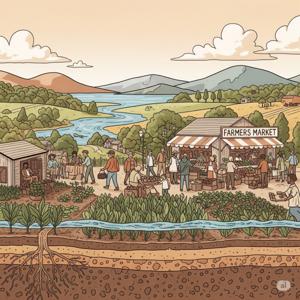


This podcast explores critical dynamics in the U.S. organic agriculture sector, focusing on the widening gap between rising consumer demand and stagnant domestic production. It examines systemic barriers facing organic producers, such as the high economic burden of the three-year transition period, increased agronomic complexity, and exposure to market risks like import competition and fraud. The discussion also highlights emerging solutions, including precision agriculture, biological inputs, and regenerative soil and ecosystem management practices. Concluding with a forward-looking strategy, the podcast calls for comprehensive policy support, risk-mitigation tools for transitioning farmers, and investments in market transparency and infrastructure to drive growth and enhance domestic self-reliance.
Data: https://github.com/Saurav12das/Deep---Dive---Soil---Science/tree/main/Episode%20-%2009%20-%20Organic%20Farming
Imagine a farm in the future, with the rise of autonomous machines and AI.
🎙️ Welcome to “Deep Dive into Soil Science” — today’s special episode: The Future of Food: Navigating the Convergence of Crisis, Innovation, and Transformation. As we look toward 2050, the global food system stands at a critical inflection point. This episode unpacks the growing crisis of food insecurity—driven by climate extremes, conflict, and economic volatility—and the widening gap between food supply and demand. We’ll examine the deep-rooted stressors on agriculture, from land and water scarcity to systemic inefficiencies and food loss across supply chains. But this story isn’t just about challenges—it’s also about innovation and transformation. We explore emerging solutions, from regenerative practices and precision agriculture to vertical farming, gene editing technologies like CRISPR, and the evolving protein landscape that includes plant-based and cellular agriculture. We’ll also delve into the human dimension: shifting consumer behavior, regulatory hurdles for novel foods, and what all this means for the livelihoods of farmers and rural communities. Join us as we unpack how a portfolio of science-driven strategies and systemic shifts can redefine the future of food.
This podcast discusses the critical interconnectedness between soil health and human well-being, often referred to as the soil-human health nexus. They explain how healthy soils are vital for producing nutrient-dense food, fostering a beneficial microbial exchange with the human gut, and mitigating environmental risks like air and water pollution. Conversely, soil degradation, driven by conventional agricultural practices and contamination, leads to reduced food security, malnutrition, and exposure to harmful substances, posing a global public health emergency. The texts advocate for regenerative agriculture as a solution, emphasizing practices that improve soil vitality, enhance crop nutrition, and support overall human and planetary health through integrated approaches and policy changes.
References; https://github.com/Saurav12das/Deep---Dive---Soil---Science/tree/main/Soil%20Health%20%26%20Human%20Health
Knowing the origin of food plays a critical role in ensuring safety, sustainability, and fairness across the food system. It enables rapid responses to contamination, supports stricter quality control, and helps trace foodborne outbreaks. Origin transparency empowers consumers to make environmentally responsible choices by considering food miles, carbon footprints, and sourcing from deforestation-free regions. It also supports local economies by boosting smallholder incomes, creating rural jobs, and promoting fair trade. Culturally, it protects traditional foods through geographic indications, preserving heritage and authenticity. For farmers, origin-based labeling opens access to premium markets, better prices, and investment opportunities. At the policy level, traceability improves enforcement of safety, sustainability, and ethical sourcing standards. Additionally, transparent supply chains enhance brand trust and meet growing ESG and consumer expectations. Together, these benefits highlight how origin awareness drives healthier, more equitable, and sustainable food systems—empowering both consumers and educators to advocate for informed choices.
A few references:
reference material: https://journals.plos.org/plosone/article?id=10.1371/journal.pone.0301296
This podcast discusses challenges and motivations in soil health management, especially in adopting cover crops. This podcast is based on this study: https://cropwatch.unl.edu/2022/motivation-and-challenges-adopting-soil-health-practices
and
https://www.jswconline.org/content/early/2022/02/09/jswc.2022.00058
In this episode, we dive into the critical role of reference site selection in soil health evaluation, featuring a discussion on innovative frameworks like State-and-Transition Models (STMs) and Cropland Reference Ecological Units (CREUs). We explore how these tools are reshaping soil health assessments by providing a structured approach to evaluating and bridging soil health gaps between cropland and natural ecosystems. Tune in as we unpack the science behind these models, their application in diverse agricultural landscapes, and the potential they hold for informing sustainable management practices. Whether you’re a soil scientist, agronomist, or just curious about how science is pushing agriculture toward resilience, this conversation will deepen your understanding of the complex interactions within our soils and the tools we can use to measure, compare, and improve them.
Reference material: https://doi.org/10.1016/j.soisec.2024.100142
Soil carbon sequestration is real, but it’s not limitless, and the “how” matters. This episode breaks down the mechanistic constraints that determine whether carbon inputs become stable SOC or return to the atmosphere as CO₂.
Using a recent mechanistic review as the backbone, we walk through five limitation domains that set the ceiling on SOC gains:
Biotic limits (photosynthesis, root architecture, rhizosphere interactions, microbial carbon-use efficiency)
Abiotic controls (temperature, moisture variability, nutrient constraints, elevated CO₂ effects)
Structural/physical limits (texture, aggregation, pore architecture that governs protection)
Chemical/mineral constraints (stabilization kinetics, MAOM formation, and mineral surface saturation)
Human dimension (management, policy, MRV, and why scalability depends on incentives and verification)
Key takeaway: soils store enormous carbon (often cited at ~1500–2400 Pg globally), but the practical sequestration potential depends on site-specific mechanisms and finite stabilization capacity, so expectations and MRV need to be grounded in process, not slogans.
Reference Material:
Soil C Sequestration Limitations and Possibilities
From the publisher's feed