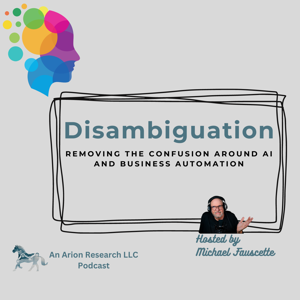
Disambiguation

Disambiguation

By Michael FauscetteBusinessNewsTechnologyTech News
Download on the App Store

Disambiguation episodes

  • Securing the Agentic Coding Era: When AI Writes Code, Who Guards the Gate?
    Up to 30% of enterprise code is now AI-generated. Microsoft's CTO projects 90% by 2030. But here's the problem: AI coding tools are optimized for speed and functionality, not security. Research shows AI-assisted development introduces roughly 45% more bugs and 40% more security vulnerabilities. And only 13% of AI-generated code is attributed back to a developer.

    So who's accountable? And who guards the gates?

    In this episode, Michael Fauscette sits down with Nir Valtman, co-founder and CEO of Arnica, to unpack why the speed gains from agentic coding come with hidden security costs, how to move from "vibe coding" to viable coding, and what a mature, secure AI-assisted development workflow actually looks like.

    TIMESTAMPS:
    00:00 - Introduction
    00:43 - Nir Valtman's Journey: From Hacker to Security CEO
    03:08 - The SolarWinds Turning Point
    06:02 - The Hidden Risk of AI-Generated Code
    08:17 - 45% More Bugs, 40% More Vulnerabilities: The Research
    09:00 - The Attribution Problem: Only 13% Traced to Developers
    10:00 - The Hidden Cost of Faster Code Generation
    10:50 - Guiding Coding Agents to Write Secure Code
    12:55 - Why Security at the Model Level Is Cost-Prohibitive
    15:16 - Arnica's Agentic Rules Enforcer and AI SAST
    20:33 - Pipeline-Based vs. Event-Driven Security Scanning
    24:00 - From Vibe Coding to Viable Coding
    24:57 - The Vision: Autonomous Software Development Done Right
    27:40 - Where Humans in the Loop Still Matter
    29:55 - What Keeps a Security CEO Up at Night
    32:02 - The Cost Challenge of Enterprise-Scale AI Scanning
    35:15 - Agents as a Digital Workforce for Development
    35:57 - Where CISOs Should Start Right Now
    38:23 - Governance by Design Meets AppSec
    41:13 - Nir's Recommendation: The Acquired Podcast
    42:35 - Wrap-Up

    ABOUT THE GUEST:
    Nir Valtman is the co-founder and CEO of Arnica, a software supply chain security company. He holds seven patents in software security and has held security leadership roles including CSO at Kabbage and VP of Security at Nostra. Nir brings a hacker's mindset to enterprise application security.

    ABOUT DISAMBIGUATION:
    AI clarity for business leaders. New episodes every Wednesday.
    Host: Michael Fauscette, CEO & Chief Analyst at Arion Research
    Author of "Building the Digital Workforce"

    SUBSCRIBE & follow for weekly episodes on AI strategy, agentic AI, and enterprise technology.

    Website: https://www.disambiguationpod.com/
    Arion Research: https://www.arionresearch.com/
    LinkedIn: https://www.linkedin.com/in/mfauscette/
    44 min
  • The Missing Layer: Why Your AI Agents Need a Governance Plane
    Your AI agents are running. But can you go to sleep at night knowing they won't send 3,000 emails to the same person, run up a $3,000 bill overnight, or give away refunds your business can't afford?

    In this episode, Michael Fauscette sits down with Logan Kelly, CEO of Waxell AI, to explore why governance for agentic systems is not observability, not guardrails, and not something you bolt on after deployment. It's a dedicated plane that has to be there from the start.

    TIMESTAMPS:
    00:00 - Introduction
    00:45 - Logan's journey from CallSine (autonomous sales agents) to Waxell AI
    03:55 - What a governance plane actually does and why the distinction matters
    07:06 - Why "we'll deal with governance later" is a dangerous bet
    09:34 - 26 governance categories and 200-300 policies per agent fleet
    10:20 - Deterministic observability vs. probabilistic agent governance
    13:14 - Failure modes don't have to be terminal: the manager-employee model
    14:05 - The Gong analogy: why agents need real-time coaching, not post-game review
    16:42 - Making governance accessible to non-engineers
    18:12 - Real-time semantic interception: filtering outputs before they reach the customer
    21:17 - The air traffic controller analogy: governing upstream, not at the gate
    23:11 - Business operations teams setting agent policies without writing code
    25:43 - Digital employees: why business leaders need to be in the governance loop
    28:00 - "Go to sleep at night" as the real value proposition of governance
    29:47 - MCP layer security vulnerabilities and the rug pull attack
    31:16 - Governance by design: building it into infrastructure from day one
    34:07 - How governance actually makes agents faster and more creative
    35:31 - Protecting customer experience and brand at machine speed
    39:29 - The next 12-18 months: autonomy at scale vs. co-work at scale
    43:02 - Thought leader recommendation: Dharmesh Shah (HubSpot)

    ABOUT THE GUEST:
    Logan Kelly is the CEO of Waxell AI, a governance plane for agentic systems. Previously, he founded CallSine, an AI-driven sales engagement platform that deployed fully autonomous agents, where he experienced firsthand the cost, quality, and security challenges that emerge when agents operate without a governance layer. That experience drove him to build the infrastructure that lets organizations run agents safely at scale.

    CONNECT WITH LOGAN:
    LinkedIn: https://www.linkedin.com/in/logankkelly/
    Company: https://www.waxell.ai/

    ABOUT DISAMBIGUATION:
    AI clarity for business leaders. New episodes every Wednesday.
    Host: Michael Fauscette, CEO & Chief Analyst at Arion Research
    Author of "Building the Digital Workforce"

    SUBSCRIBE & follow for weekly episodes on AI strategy, agentic AI, and enterprise technology.

    Website: https://www.disambiguationpod.com/
    Arion Research: https://www.arionresearch.com/
    LinkedIn: https://www.linkedin.com/in/mfauscette/

    #AI #ArtificialIntelligence #AgenticAI #AIGovernance #EnterpriseAI #AIStrategy #AIAgents #Podcast

    45 min
  • March 2026 AI Pulse
    A US AI company designated a supply chain risk by its own government. An executive order to override state AI regulation. A paper that stunned the math world. March was one of the most consequential months in AI yet.

    In this episode, Michael Fauscette and co-host Tom Pringle break down the biggest AI stories of March 2026, from the Anthropic-DoD standoff and its fallout, to OpenAI's GPT-5.4, NVIDIA's Vera Rubin platform, Yann LeCun's world models startup, Gemini's Apple partnership, the state of AI regulation on both sides of the Atlantic, and why governance by design isn't optional anymore.

    TIMESTAMPS:
    00:00 - Introduction
    01:05 - Anthropic vs. the Department of Defense: Supply Chain Risk Designation
    06:15 - The #UninstallChatGPT Movement and Claude's Surge
    08:20 - Red Lines: Autonomous Weapons and Mass Surveillance
    14:45 - OpenAI GPT-5.4 and Autonomous Multi-Step Workflows
    17:50 - Governance by Design: Why After-the-Fact Doesn't Work at Machine Speed
    23:20 - Rethinking Corporate Structure for a Hybrid Workforce
    25:15 - NVIDIA Vera Rubin: 10x Performance Per Watt Over Blackwell
    28:10 - Yann LeCun Leaves Meta, Launches World Models Startup
    33:48 - Gemini 3.1 Pro, Apple Intelligence, and the Model Race
    43:25 - Donald Knuth's "Cloud Cycles" Paper: Claude Opus 4.6 Stuns Mathematicians
    45:55 - AI Regulation: Trump's Executive Order vs. EU AI Act Delays
    53:00 - Cool Tech: Lego's AI-Powered Smart Brick
    57:35 - Wrap-Up

    ABOUT THE CO-HOST:
    Tom Pringle is Director of Pilot Research, bringing a sharp, skeptical perspective on AI hype and a deep background in enterprise technology.

    ABOUT DISAMBIGUATION:
    AI clarity for business leaders. New episodes every Wednesday.
    Host: Michael Fauscette, CEO & Chief Analyst at Arion Research
    Author of "Building the Digital Workforce"

    SUBSCRIBE & follow for weekly episodes on AI strategy, agentic AI, and enterprise technology.

    Website: https://www.disambiguationpod.com/
    Arion Research: https://www.arionresearch.com/
    LinkedIn: https://www.linkedin.com/in/mfauscette/
    59 min
  • The Human Operating System: Why People Infrastructure Is the Missing AI Investment
    We spend millions upgrading our technology infrastructure. We budget for servers, software, security. But what if the most critical infrastructure in your organization has no line item at all?

    In this episode, Michael Fauscette sits down with Barbara Wittmann, Founder of Digital Wisdom Collective, to explore why "human infrastructure" should be on every CIO's budget, why change management is an outdated concept, and what it actually takes to prepare people for AI at the speed the technology demands.

    TIMESTAMPS:
    00:00 - Introduction
    00:48 - Barbara's 25 years rescuing broken digital transformations
    02:46 - The moment she decided to flip the equation
    03:54 - Human infrastructure: what it includes and why it belongs on the IT budget
    05:23 - Why AI failures are almost always human failures
    06:10 - Change management is dead; continuous upgrade is what works
    07:15 - Lessons from SAP's Business Process Renovation team and Hasso Plattner
    10:03 - Why workers still keep Excel backups next to their enterprise systems
    11:39 - Survival of the wisest: wisdom vs. knowledge in the AI era
    14:58 - Wayfinding artifacts: shared maps that give organizations a compass
    17:52 - Adaptive agency: the skill nobody is training for
    20:58 - Human in the lead, not human in the loop
    22:26 - Values-based AI governance and the ego problem
    25:17 - The biggest breaking point is on the human side, not the tech side
    28:44 - What 5,000+ IT leaders say about their AI adoption struggles
    31:36 - Continuous upgrade: why one-and-done transformation is broken
    34:12 - Judgment as the fastest-eroding human capability
    37:09 - Thought leader recommendation: Unreasonable Hospitality by Will Guidara

    ABOUT THE GUEST:
    Barbara Wittmann is the Founder of Digital Wisdom Collective, where she helps organizations upgrade their human infrastructure for the AI era. With 25 years of experience rescuing broken digital transformation projects, including work on SAP's Business Process Renovation team alongside Hasso Plattner, Barbara brings a practitioner's perspective on why technology is rarely the problem and people always are.

    CONNECT WITH BARBARA:
    LinkedIn: https://www.linkedin.com/in/barbarawittmann/
    Company: Digital Wisdom Collective

    ABOUT DISAMBIGUATION:
    AI clarity for business leaders. New episodes every Wednesday.
    Host: Michael Fauscette, CEO & Chief Analyst at Arion Research
    Author of "Building the Digital Workforce"

    SUBSCRIBE & follow for weekly episodes on AI strategy, agentic AI, and enterprise technology.

    Website: https://www.disambiguationpod.com/
    Arion Research: https://www.arionresearch.com/
    LinkedIn: https://www.linkedin.com/in/mfauscette/

    #AI #ArtificialIntelligence #HumanInfrastructure #ChangeManagement #AIGovernance #DigitalTransformation #Leadership #EnterpriseAI #Podcast
    40 min
  • From SEO to AEO: Preparing Your Content for AI Discovery
    Your website traffic is dropping, your click-through rates are falling, and your PDF lead magnets are dying in email inboxes. The way people search has changed, and if your content isn't structured for AI discovery, you're becoming invisible.

    In this episode, Michael Fauscette sits down with Jenna Nelson, Founder of Her Agency, to explore the shift from SEO to AEO and GEO, why static content strategies are failing, and how to structure your brand for the way people actually search in 2026.

    TIMESTAMPS: 
    00:00 - Introduction 
    00:46 - Jenna's background in digital marketing and AI implementation 
    01:58 - The AI adoption timeline: why two years from now is too late 
    04:01 - The leveling effect: small businesses can leapfrog right now 05:45 - Change management: why AI breaks bad processes faster 07:09 - The shift from keyword search to query-and-answer content
    10:17 - Zero-click search and why the top three results are all that matter 
    11:39 - Writing for machines and humans: structured schemas and FAQs 
    13:36 - AEO vs GEO: answer engines vs generative engines explained 
    15:53 - The generational shift: LLM-first search is already here 
    17:21 - Tools for testing your AI visibility: Squarespace, Search Atlas 
    18:55 - Static lead magnets are dead: what replaces the PDF 
    22:38 - Michael's readiness assessment tool as a live example 24:30 - How AI-powered qualification tools transformed Jenna's sales process 
    26:29 - Speed to market: test offers in an hour, not six months 27:54 - Brand-trained AI vs out-of-the-box: the difference is night and day 
    30:29 - Reinforcement learning: feed your edits back into the system 
    32:40 - Hyper-personalized lead gen: segmentation at the individual level 
    35:43 - Advice for SMBs: start with visibility, then internal tools, then client-facing 
    38:23 - Leadership and AI adoption: it should come from the top 40:42 - Thought leader recommendation: vibe coding tools like Lovable and Cursor

    ABOUT THE GUEST: Jenna Nelson is the Founder of Her Agency, a digital marketing and AI implementation firm that helps businesses optimize their visibility for the AI-driven search landscape. With a background in brand strategy and digital marketing, Jenna specializes in AEO/GEO optimization, AI-powered lead generation tools, and helping companies train AI on their brand voice.

    CONNECT WITH JENNA: LinkedIn: https://www.linkedin.com/in/jennalnelson/ Company: Her Agency
    ABOUT DISAMBIGUATION: AI clarity for business leaders. New episodes every Wednesday. Host: Michael Fauscette, CEO & Chief Analyst at Arion Research Author of "Building the Digital Workforce"
    SUBSCRIBE & follow for weekly episodes on AI strategy, agentic AI, and enterprise technology.Website: https://www.disambiguationpod.com/
    Arion Research: https://www.arionresearch.com/ LinkedIn: https://www.linkedin.com/in/mfauscette/
    43 min
  • MCP, AI Agents, and the Future of Network Infrastructure
    What happens when a 25-year network engineer discovers that AI agents can talk directly to infrastructure? The answer is reshaping how we think about network operations, governance, and the future of IT.

    In this episode, Michael Fauscette sits down with John Capobianco, Head of AI and Developer Relations at Itential, to explore how Model Context Protocol (MCP) is becoming the connective tissue between AI agents and enterprise systems, why network infrastructure needs a governance layer before autonomy, and what happens when you let 500 engineers loose on an AI agent in Slack.

    TIMESTAMPS:
    00:00 - Introduction
    00:47 - John's journey from aluminum factory to network engineering
    03:08 - MCP explained: why it's as significant as SMTP or HTTP
    07:37 - Why business leaders should care about MCP
    10:06 - Michael's personal MCP use case: content retrieval bot
    12:40 - Democratizing access: you don't need a CS degree to start
    14:03 - Web MCP: the future of agent-driven web interaction
    16:12 - The Pyats MCP server: agents talking to Cisco devices
    19:44 - How natural language changes network troubleshooting
    22:01 - Itential's Flow AI and Flow MCP Gateway: the governance control layer
    25:52 - Human in the loop, on the loop, and in the lead
    26:34 - Governance by design: baking in guardrails, not bolting them on
    30:10 - The digital workforce paradigm for agent deployment
    33:28 - Open Claude bot: 1.5 million agents in six weeks
    35:04 - MCP security: shadow AI, vetting tools, and common sense
    39:02 - The Open Claude bot story: 30 social engineering attacks defeated
    43:42 - Advice for IT leaders who feel they're falling behind
    45:48 - The NOC in two years: Gartner's 70% augmentation prediction
    50:30 - Thought leader recommendation: Damon Lightfoot

    ABOUT THE GUEST:
    John Capobianco is Head of AI and Developer Relations at Itential, with 25 years of network engineering experience spanning public and private sector roles, including senior network architect at the Parliament of Canada. He's authored two books on network automation, including a Cisco Press title on Pyats, and is a leading voice on blending AI agents with infrastructure management.

    CONNECT WITH JOHN:
    LinkedIn: https://www.linkedin.com/in/john-capobianco-644a1515/
    Company: https://www.itential.com/

    ABOUT DISAMBIGUATION:
    AI clarity for business leaders. New episodes every Wednesday.
    Host: Michael Fauscette, CEO & Chief Analyst at Arion Research
    Author of "Building the Digital Workforce"

    SUBSCRIBE & follow for weekly episodes on AI strategy, agentic AI, and enterprise technology.

    Website: https://www.disambiguationpod.com/
    Arion Research: https://www.arionresearch.com/
    LinkedIn: https://www.linkedin.com/in/mfauscette/
    53 min
  • Building Visibility: How Personal Brand Drives Business Growth
    Jimi Gibson, VP of Brand Communication at Thrive Internet Marketing Agency, joins the show to explain why executives and subject matter experts need to build personal brands in the age of AI-driven search, and how a professional magician's framework for capturing attention translates directly into business communication strategy.

    Jimi shares his Magic Script framework (connectivity, curiosity, conversion) with a live card trick demonstration that breaks down the neuroscience of engagement: oxytocin for trust, dopamine for curiosity, serotonin for satisfaction. He walks through his first 90 days of building personal visibility for Thrive and shares research showing that executives who post on LinkedIn just 10 times a year see 30% more referrals and larger deal sizes. The conversation dives into how the shift from SEO to generative engine optimization (GEO) and answer engine optimization (AEO) is changing how companies get found, with 37% of searches now originating in LLM platforms and AI-driven traffic converting at 3.5 to 4 times the rate of traditional search traffic.
    Guest: Jimi Gibson, VP of Brand Communication, Thrive Internet Marketing Agency

    Timestamps: 00:00  
    Intro 00:32  
    Welcome Jimi Gibson 01:13  
    From professional magician to marketing strategist 03:57  
    How a performer mindset shapes brand visibility 08:18  
    The Magic Script: connectivity, curiosity, conversion 08:29  
    Live card trick demonstration 15:42  
    The neuroscience behind the Magic Script 21:49  
    Why storytelling beats data dumps 23:44  
    Becoming the face of Thrive: the first 90 days 30:44  
    How personal brand drives company growth 34:45  
    From SEO to GEO and AEO: how AI changed search 42:46 
    Finding answers vs. finding a way to find answers 44:39 
    Activating subject matter experts as thought leaders 47:41  

    Book recommendation: "Story Worthy" by Matthew DixDisambiguation is an Arion Research production. New episodes weekly.Website: https://arionresearch.com Host: Michael Fauscette
    50 min
  • AI in the Back Office: Where the Real Enterprise Value Is Hiding
    The biggest AI opportunity in enterprise isn't in your sales team or your chatbot. It's buried in the back office, where inefficiencies have been hiding for decades. What happens when seed-stage startups start solving those problems with 35 people instead of 35,000?

    In this episode, Michael Fauscette sits down with Matt Ober, Managing Partner at Social Leverage, to discuss where the real enterprise value is hiding in AI, why go-to-market matters more than ever, and what separates the founders who break through from those who stall.

    TIMESTAMPS:
    00:00 - Introduction
    00:52 - Matt's background and Social Leverage's 17-year investing journey
    01:53 - How AI changed what matters at the seed stage
    04:41 - What AI capabilities are actually delivering results vs. hype
    06:58 - Why outbound sales automation is working again
    08:52 - Slash Experts and the power of verified client references in B2B
    12:40 - Middle and back office AI: where the biggest inefficiencies live
    15:06 - Voice AI in recruiting and why Ribbon AI is changing hiring
    17:21 - Leah AI and document intelligence for wealth management
    21:01 - Data moats, data pipes, and the opportunity in information services
    24:34 - Common mistakes AI-native founders make
    28:09 - Social Leverage's $85M fund and where the big bets are going
    32:21 - Why vertical-first beats horizontal in AI
    33:24 - Advice for prospective founders building in the AI era
    36:04 - Matt's recommendation: Patrick O'Shaughnessy's Invest Like the Best

    ABOUT THE GUEST:
    Matt Ober is Managing Partner at Social Leverage, a seed-stage venture capital firm focused on fintech and vertical AI. Founded 17 years ago by Howard Lindzon (creator of StockTwits) and Tom Peterson, Social Leverage has invested across six funds, most recently closing an $85 million seed fund. Matt spent most of his career in public markets on the hedge fund side before joining Social Leverage.

    CONNECT WITH MATT:
    LinkedIn: https://www.linkedin.com/in/obermattj/
    Company: https://www.socialleverage.com/

    ABOUT DISAMBIGUATION:
    AI clarity for business leaders. New episodes every Wednesday.
    Host: Michael Fauscette, CEO & Chief Analyst at Arion Research
    Author of "Building the Digital Workforce"

    SUBSCRIBE & follow for weekly episodes on AI strategy, agentic AI, and enterprise technology.

    Website: https://www.disambiguationpod.com/
    Arion Research: https://www.arionresearch.com/
    LinkedIn: https://www.linkedin.com/in/mfauscette/

    #AI #ArtificialIntelligence #Fintech #VentureCapital #EnterpriseAI #VerticalAI #BackOffice #AIStrategy #Podcast
    38 min
  • The Human Blind Spot: Why Trust Is Your Biggest Cybersecurity Vulnerability
    Most cybersecurity breaches aren't caused by bad technology. They're caused by humans doing what humans are biologically wired to do: trust. Robert Siciliano explains why your biggest security vulnerability isn't in your firewall, it's in your people's wetware.

    In this episode, Michael Fauscette sits down with Robert Siciliano, bestselling author and cybersecurity expert, to discuss why traditional security awareness training is failing and how organizations can close the "security appreciation gap" by making cybersecurity personal.

    TIMESTAMPS: 00:00 - Introduction 
    01:04 - Robert's origin story: getting hacked in 1995 
    03:19 - The wetware vulnerability: what leaders miss about human security 
    05:06 - The human blindspot: why we're biologically wired to trust 
    07:32 - Why distrust is harder than trust 
    08:56 - The home security question that changes everything 12:13 - Security awareness vs. security appreciation 
    14:40 - The shift from knowing to caring 
    16:28 - The kitchen table effect: when security goes home with the employee 
    18:07 - Arms crossed to hands up: how body language reveals the shift 
    20:27 - "The only way to change minds is to change hearts" 
    21:26 - Making the case to the C-suite that all security is personal 
    24:39 - How AI, deepfakes, and voice cloning are reshaping the threat landscape 
    28:29 - The strategic human firewall: from passive targets to active detection 
    33:12 - Parenting, empathy, and what security training can learn from raising kids 
    35:22 - The 97/3 rule: good versus evil by the numbers 
    37:34 - Why compliance training is failing and what to do instead 
    47:26 - First steps for building a culture of security appreciation 51:41 - Robert's recommendation and closing thoughts
    ABOUT THE GUEST: Robert Siciliano is a #1 bestselling Amazon author, CEO of Safr.Me, and Head of Cyber Security Employee Training at Protect Now. With 30+ years in security, he is the architect of the Strategic Human Firewall and the CSI Protection certification, and has appeared on Good Morning America, CNN, Today Show, and Howard Stern.
    CONNECT WITH ROBERT:
    LinkedIn: https://www.linkedin.com/in/robertsiciliano
    Website: https://safr.me
    Protect Now: https://protectnowllc.com
    ABOUT DISAMBIGUATION: AI clarity for business leaders. New episodes every Wednesday. Host: Michael Fauscette, CEO & Chief Analyst at Arion Research Author of "Building the Digital Workforce"

    SUBSCRIBE & follow for weekly episodes on AI strategy, agentic AI, and enterprise technology.

    Website: https://www.disambiguationpod.com/ Arion Research: https://www.arionresearch.com/ LinkedIn: https://www.linkedin.com/in/mfauscette/
    56 min
  • Building Trust Through Empathy: How AI Companions Support Grief Work
    In this episode of Disambiguation, host Michael Fauscette sits down with John Kammer, founder of Guardian [AI]ngels, to explore how AI chatbots can serve as emotional support tools for people navigating grief and loss.

    After losing three of his closest friends, John struggled for over a decade with substance-fueled avoidance before accidentally discovering that building an AI persona based on his late best friend unlocked a breakthrough in his own healing. That personal experience became the foundation for Guardian [AI]ngels, a structured grief support tool built on Worden's Four Tasks of Mourning and developed with licensed therapists.

    In this conversation, we cover:🔹 Why interactive AI dialogue goes beyond traditional journaling for processing grief 
    🔹 How Guardian [AI]ngels complements therapy rather than replacing it 
    🔹 The ethical guardrails that prevent users from falling into delusion or unhealthy attachment 
    🔹 Why the AI never claims to be the lost loved one and how that distinction matters 
    🔹 The role of transparency and trust in building responsible AI companions 
    🔹 How AI can serve as a bridge to deeper human connection, not a substitute for it 
    🔹 Where we are on the journey of using AI for emotional wellness and what comes next

    Whether you're curious about AI companions, interested in mental health technology, or exploring how AI can better the human condition beyond the workplace, this episode offers a thoughtful and personal look at what's possible.

    📌 Recommended by our guest: Look up Bill Thornberry on LinkedIn for insights on rethinking how we approach AI.📌 For more AI and software research, visit ArionResearch.com 📌 Want to be a guest? Email [email protected]
    47 min

About Disambiguation

From the publisher's feed

"Disambiguation is the process of removing confusion around terms that express more than one meaning and can lead to different interpretations of the same string of…