
Sign up to save your podcasts
Or



This hour, we are taking a look at how race has impacted agriculture and the environmental movement. Leah Penniman, Co-Executive Director and Farm Director at Soul Fire Farm, talks about her new book Black Earth Wisdom: Soulful Conversations with Black Environmentalists. The discussion touches on everything from Leah's childhood to how the creation of some of the most prominent national parks in the U.S. is linked to the eugenics movement. And Dr. Dorceta Taylor, a professor at the Yale School of the Environment, explains what environmental justice is, and why we need to think about marginalized communities when we think about the environment.
For more information on Soul Fire Farm, you can visit their website: https://www.soulfirefarm.org/.
You can read Dorceta Taylor's research on disparities in environmental grantmaking through ResearchGate: https://www.researchgate.net/publication/369261149_Examining_Disparities_in_Environmental_Grantmaking_Where_the_Money_Goes.
GUESTS:
See omnystudio.com/listener for privacy information.
Video games have a history of racist and sexist stereotypes, from damsels in distress to Asian martial artists. With the recent releases of The Super Mario Bros. Movie and HBO's television adaptation of The Last of Us, we wanted to take a closer look at representation in the video game industry. Sheri Graner Ray, CEO of Zombie Cat Studios and author of Gender Inclusive Game Design: Expanding the Market, explains what it's like to be a woman game designer pushing for the industry to broaden its perspective. And Professor Edmond Y. Chang talks about queerness and racial stereotypes in video games.
GUESTS:
Special thanks to our intern Melody Rivera, who helped produce this episode. Special thanks also go to our intern Elizabeth Van Arnam.
See omnystudio.com/listener for privacy information.
When journalist Stephanie Foo was 30, she finally learned her mental health diagnosis. She had complex post-traumatic stress disorder or C-PTSD, a condition caused by repeated exposure to trauma. At first, learning that fact made Stephanie feel hopeless. But she soon embarked on a journey of healing that helped her better understand what having C-PTSD really meant. In the process, she not only learned about herself, but also about the broader societal implications of trauma and how trauma in her family's past still affects her today. She chronicles that journey in her book What My Bones Know: A Memoir of Healing from Complex Trauma.
This hour, we return to our discussion with Stephanie. We talk about her book and how mental health care in the U.S. often ignores the pain of people of color. Since this episode first aired in February, the paperback version of the book was released and entered the New York Times Best Sellers list.
GUEST:
This episode originally aired on February 1, 2023.
See omnystudio.com/listener for privacy information.
This hour, we look at how media is understood across generations and why media literacy is more than just identifying misinformation on the news or social media. Global media literacy educator Dr. Belinha De Abreu talks about the evolving relationship between people and the platforms they use. She also explains Connecticut's policy surrounding media literacy education. Later in the show, we hear a roundtable discussion with college journalism students as we learn how they approach finding accurate news.
GUESTS:
Special thanks to our interns Melody Rivera and Elizabeth Van Arnam who hosted the roundtable discussion.
See omnystudio.com/listener for privacy information.
This hour on Disrupted, we hear from three women who are rewriting narratives around death and dying in the U.S. The COVID-19 pandemic forced many of us to confront death head-on. At the same time, we’re also seeing major changes in the death care industry — from the emergence of things like green burials and human composting to the diversification of funeral directors.
GUESTS:
See omnystudio.com/listener for privacy information.
This hour, we listen to a panel discussion that Khalilah hosted for The Nature Conservancy in Connecticut’s annual Nature Talks series. The discussion was called “Oceans: Our Global Watchdog.” It was recorded in front of a live audience at Grace Farms in New Canaan, CT. The panelists talked about topics like how some communities are disproportionately affected by climate change and why we need to act now to protect the planet. The guests were Dr. Sylvia Earle, Explorer-in-Residence at the National Geographic Society, first woman Chief Scientist at NOAA and Time Magazine’s first “Hero for the Planet;” Dr. Camille Gaynus, Board Chair of Black in Marine Science and Assistant Teaching Professor of Biology at Penn State Brandywine; Dr. Lizzie McLeod, Global Reef Systems Lead at The Nature Conservancy and Dr. Tiara Moore, Founder and CEO of Black in Marine Science and the Black in Marine Science Program Lead at the Nature Conservancy.
To learn more about the impact of climate change on our state, watch Cutline: Climate Change Along Connecticut's Coast.
GUESTS:
See omnystudio.com/listener for privacy information.
This hour, we highlight disruptors using their storytelling skills to create change. After the murder of Eric Garner, Mercy Quaye organized a conversation about who controls the Black narrative at a New Haven coffee shop. Her work ultimately led her to start The Narrative Project, an anti-racist communications organization. CBS Saturday Morning's Michelle Miller also joins us to discuss her new book Belonging: A Daughter’s Search for Identity Through Loss and Love, which details her journey to understand herself and learn more about her mother, who didn't raise her. And we listen back to our interview with Mónica Guzmán, who talks about the power of sharing stories with people you disagree with and her book I Never Thought Of It That Way: How To Have Fearlessly Curious Conversations in Dangerously Divided Times.
GUESTS:
See omnystudio.com/listener for privacy information.
This hour on Disrupted, we talk to Connecticut Kid Governor Ellie Mendez. The Kid Governor program teaches civics to 5th graders who elect one of their peers to the office. Ellie was elected on a platform that focuses on anxiety and depression. She is joined by her teacher, Mr. Michael Rinn. Then, we talk to Patricia Russo from The Campaign School at Yale University. The Campaign School seeks to increase the number of women holding political offices. Also part of the conversation is Earnestine Dawson, an alumna of the school who most recently served as the Digital Director and Advisor to the Chairman for the House Democratic Caucus Rep. Hakeem Jeffries in the U.S. House of Representatives.
You can read more about the Penn State panel ‘Politics Unequal: The State of Women in Elected Office’ here: https://penntoday.upenn.edu/news/politics-unequal-state-women-elected-office, and you can listen to the panel here: https://www.youtube.com/watch?v=SNrK2HCfd00. To learn about The Campaign School at Yale University's training options, you can click here: https://www.tcsyale.org/about-trainings.
GUESTS:
Special thanks this week to Meg Fitzgerald.
See omnystudio.com/listener for privacy information.
This hour on Disrupted, we are looking at Black cartoonists who have pushed their medium forward despite the reluctance of newspapers outside of the Black press to nationally syndicate their work. Jerry Craft talks about his banned, award-winning graphic novel New Kid, in addition to his upcoming book School Trip. Barbara Brandon-Croft discusses her pioneering comic strip Where I'm Coming From and her new book, a collection of her comic strips. That book is also titled Where I'm Coming From.
GUESTS:
See omnystudio.com/listener for privacy information.
Titus Kaphar and Jason Price co-founded NXTHVN, a nonprofit that brings artists from around the world to New Haven. They talk about how that organization is empowering young people.
See omnystudio.com/listener for privacy information.
From the publisher's feed
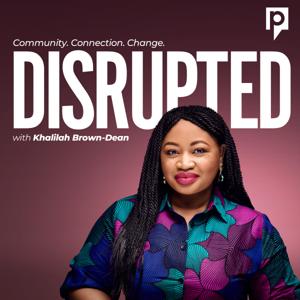
Disrupted is about the changes we all encounter and the forces driving those changes. Some disruptions spark joy and possibility. Others move us to take action and re-evaluate our world. But the show isn't just about those disruptions; it’s about embracing them, exploring new perspectives, and feeling more connected to ourselves and our communities. Host and political scientist Khalilah Brown-Dean creates a place where changemakers come together to help us see the world differently and challenge us to grow together.
Visit ctpublic.org/disrupted for more!

90,622 Listeners

26,817 Listeners

25,774 Listeners

8,424 Listeners
58 Listeners

56 Listeners

111,832 Listeners
13 Listeners
3 Listeners

47 Listeners
18 Listeners

6,348 Listeners

2 Listeners

0 Listeners
78 Listeners
29 Listeners

16,026 Listeners
0 Listeners

10,696 Listeners
498 Listeners

4,220 Listeners

10 Listeners

2,295 Listeners

21 Listeners
0 Listeners

0 Listeners

0 Listeners

0 Listeners

0 Listeners
45 Listeners