
Sign up to save your podcasts
Or



When we think about yellow perch, it’s usually about watching a slip bobber
disappear and the scrumptious fillets that follow. But yellow perch are one
of the most important fish in freshwater, often fuelling entire aquatic
ecosystems.
From giant walleyes and northern pike to muskies and countless other
predators, some of the most sought-after fish in North America owe their
growth, success and existence to yellow perch. Yet despite their
importance, most of us know surprisingly little about them.
Saskatchewan fisheries biologist Jeff Matity has spent years studying
yellow perch and yellow perch populations and he is going to take us inside
their secret life, reveal their biology and behaviour and tell us why they
matter so much.
Send us a message
Dr. Trevor Keyler has spent years investigating what the underwater world looks like through the eyes of a walleye. His research reveals a fish with an astonishingly sophisticated visual system — one perfectly adapted to hunting in the low-light world beneath the surface.
Trevor explains how walleye eyes capture incredibly faint light, why they're most sensitive to the blue-green wavelength and how water clarity dramatically changes the underwater light environment. And then there's this jaw-dropping finding: under ideal conditions, a walleye can detect light at depths approaching 77 metres .... or 250 feet.
But there's much more to the story than simply, "How deep can a walleye see? " Trevor explains the crucial difference between detecting light and seeing prey well enough to capture it — and his findings offer fascinating insights into lure colour, contrast, silhouette, water colour, twilight, moonlight and why walleyes come alive as the sun is disappearing.
Send us a message
It is a fisheries science story that has biologists shaking their heads in disbelief.
In this episode of Doc Talks Fishing, Dr. Joe Langan takes us on an extraordinary journey—from the surprising history of how pink salmon first arrived in the Great Lakes, to the mystery of where they disappear for most of their lives, to bizarre "Pinook" (pink/chinook) hybrids that exist nowhere else on Earth. t's an unforgettable story of adaptation, evolution and a remarkable fish that simply refuses to follow the rules.
Send us a message
During the COVID shutdowns, fishing pressure on nesting bass dropped dramatically, creating an amazing natural experiment. Nesting success soared, recruitment exploded and fisheries scientists Dr. David Philipp and Dr. Steven Cooke suddenly had compelling evidence that protecting bass during the spawning period could dramatically strengthen future year classes.
The discovery led to one of the most exciting fisheries management experiments underway anywhere in North America. Philipp and Cooke have been testing whether protecting carefully selected small spawning areas in Lake Opinicon can rebuild bass populations while maintaining outstanding fishing opportunities.
Today, David and Steven return to Doc Talks Fishing with the latest findings from Year Three of The Great Bass Sanctuary Experiment. What they've discovered could change the future of bass management across much of North America.
Send us a message
Think giant walleyes, muskies, bass and pike spend their days chasing giant meals? Think again. In one of the largest predator-prey studies ever assembled, fisheries scientist Dr. Jereme Gaeta analyzed more than 9,000 fish stomachs and over 22,000 prey fish from lakes across North America.
What he discovered stunned us.
Even the biggest predators spend most of their lives feeding on prey far smaller than most anglers imagine. In fact, much of the forage consumed by trophy-size fish measures only a few inches long.
In this fascinating episode of Doc Talks Fishing, Dr. Gaeta explains why "big fish eat big fish" is only part of the story and why downsizing your presentation — think finesse — often works when the fishing gets tough.
If you've ever wondered whether lure size really matters, this episode may completely change the way you fish.
Send us a message
Most anglers think that the wind simply pushes baitfish around the lake. But what
if the fish aren’t just drifting with the current? What if they actually know where the food is going to be?
In this fascinating episode of Doc Talks Fishing, Dr. Derrick (Dak) de
Kerckhove reveals his groundbreaking research from Algonquin Park’s
legendary Lake Opeongo that shows how sustained winds create
underwater conveyor belts that concentrate plankton, attract ciscoes and
ultimately draw hungry lake trout to an all-you-can-eat buffet. The result is a
remarkable chain reaction that totally reshapes the entire lake ecosystem.
Using cutting-edge telemetry, hydro-acoustics and decades of fisheries
research, Dak explains why the windy side of the lake typically becomes a
predator hotspot. And why one of the most overlooked forces in nature is
one of your most important fish-finding tools. After listening to this episode,
you’ll never look at wind the same way again.
Send us a message
We spend years as anglers, learning how to catch fish and we often selectively harvest a few smaller ones to enjoy for shore lunch or dinner with our friends and families. But most of us never learn how to truly cook fish properly.
In this fascinating crossover episode, gold medal winning World Culinary Olympic chef and passionate angler Cameron Tait reveals the science behind unforgettable fish meals - from perfect shore lunch over a campfire to restaurant-quality dishes at home. Learn why heat control changes everything, how anglers accidentally ruin great fish and the simple techniques world-class chefs use to transform walleye, trout, salmon, yellow perch and crappies into extraordinary meals.
Send us a message
For decades, we've cast muskies as shadows lurking in the weeds. Ambush predators waiting to pounce on our baits. But what if everything we thought we knew about these apex fish is only half the story? In this eye-opening episode, Dr. Sean Landsman pulls back the curtain on a hidden world where giant fish roam the open water, suspending over deep basins, hunting in ways that challenge what we thought was gospel.
Drawing on cutting-edge telemetry and firsthand observations, Sean reveals how these fish are not just structure-bound predators-but highly adaptable hunters capable of tracking prey through vast, seemingly empty expanses. From mysterious deep-water movements to explosive encounters far from shore, you'll hear how this behaviour has probably been happening all along, right under our noses.
This is more than just a new pattern, it's a paradigm shift. So whether you're a die-hard muskie angler or simply fascinated by the science of fish behaviour, this episode will change the way you think about where muskies live, how they hunt and what it really takes to find — and catch — the fish of a lifetime.
Send us a message
If you've been on the water lately and thought your favourite lake looks darker than it used to... you're not imagining things. Lakes are quietly "browning" as dissolved organic carbon turns clear water into a tea-stained mystery-and it's changing fishing in ways anglers have never considered.
In this fascinating episode of Doc Talks Fishing, Dr. Allison Roth breaks down what browning water means for fish—and the answers will surprise you. Some species, like walleye and northern pike, are thriving in these darker conditions... while others, including bass and lake trout, are struggling— even when they're still feeding as much as ever. From shrinking "perfect light zones" to shifts in prey, growth, and even entire fish communities, this is science that will completely change how you think about your favourite lakes.
If you want to understand why some lakes are producing giants, why others seem to be declining, and how these changes could impact your success on the water, you can't afford to miss this episode.
Send us a message
In this episode of Doc Talks Fishing, master brook trout angler, Mark Stiffel joins us to explain how he turns cutting-edge trout biology into success on the water. Building on the fascinating science shared by Nipigon biologist Rob Swainson in our previous episode, Mark reveals how he finds big specks throughout the seasons - from cold-water upwellings and shallow spring flats to the subtle structural clues most anglers overlook.
If you've ever wondered how to translate fish behaviour into more trout in the net, this episode is packed with insights you can use the next time you chase brookies. And as the photo proves... Mark knows what he's talking about.
Send us a message
From the publisher's feed
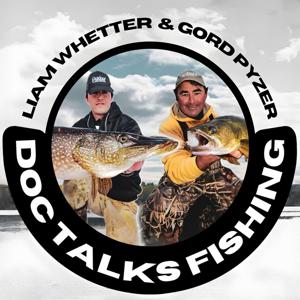
Welcome to DOC TALKS FISHING, the podcast dedicated to exploring cutting-edge fisheries projects with renowned biologists from around the world. Join Liam Whetter and Gord Pyzer as they…
RAPALA CANADA
WILLIAMS LURES
-------------------------------------------------
Intro song: Cold World by Jackson Klippenstein
https://open.spotify.com/artist/0aUhZMbG1nz102PvP9HKdW?si=bkcx3z_SQqebvK1WazBwFA

227,562 Listeners
4,840 Listeners

2,145 Listeners
38,071 Listeners

5,861 Listeners
149 Listeners

1,677 Listeners
36 Listeners
10 Listeners

194 Listeners

678 Listeners
30 Listeners
23 Listeners
20 Listeners

7 Listeners