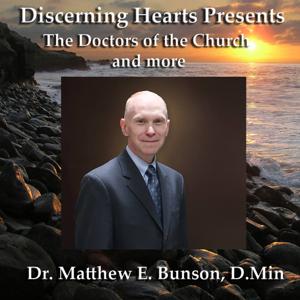
Dr. Matthew Bunson - Discerning Hearts Catholic Podcasts

Dr. Matthew Bunson - Discerning Hearts Catholic Podcasts

Download on the App Store

Dr. Matthew Bunson - Discerning Hearts Catholic Podcasts episodes

  • DC6 St. Gregory of Nazianzus – The Doctors of the Church: The Charism of Wisdom with Dr. Matthew Bunson

    Dr. Matthew Bunson discusses the life, times and teachings of  St. Gregory of Nazianzus


    Born: 329 AD


    Died: January 1, 390 AD


    For more on St. Gregory of Nazianzus and his teachings

    Gregory Nazianzen
    – Orations
    – Letters


    From Vatican.va, an excerpt from the teachings of Pope Benedict XVI  General Audience 2007:


    It was because of these orations that Gregory acquired the nickname: “The Theologian”.
    This is what he is called in the Orthodox Church: the “Theologian”. And this is because to his way of thinking theology was not merely human reflection or even less, only a fruit of complicated speculation, but rather sprang from a life of prayer and holiness, from a persevering dialogue with God. And in this very way he causes the reality of God, the mystery of the Trinity, to appear to our reason.
    In the silence of contemplation, interspersed with wonder at the marvels of the mystery revealed, his soul was engrossed in beauty and divine glory.
    While Gregory was taking part in the Second Ecumenical Council in 381, he was elected Bishop of Constantinople and presided over the Council; but he was challenged straightaway by strong opposition, to the point that the situation became untenable. These hostilities must have been unbearable to such a sensitive soul.
    What Gregory had previously lamented with heartfelt words was repeated: “We have divided Christ, we who so loved God and Christ! We have lied to one another because of the Truth, we have harboured sentiments of hatred because of Love, we are separated from one another” (Orationes 6: 3; SC 405: 128).
    Thus, in a tense atmosphere, the time came for him to resign.
    In the packed cathedral, Gregory delivered a farewell discourse of great effectiveness and dignity (cf. Orationes 42; SC 384: 48-114). He ended his heartrending speech with these words: “Farewell, great city, beloved by Christ…. My children, I beg you, jealously guard the deposit [of faith] that has been entrusted to you (cf. I Tm 6: 20), remember my suffering (cf. Col 4: 18). May the grace of Our Lord Jesus Christ be with you all” (cf. Orationes 42: 27; SC 384: 112-114).
    Gregory returned to Nazianzus and for about two years devoted himself to the pastoral care of this Christian community. He then withdrew definitively to solitude in nearby Arianzo, his birthplace, and dedicated himself to studies and the ascetic life.
    It was in this period that he wrote the majority of his poetic works and especially his autobiography: the De Vita Sua, a reinterpretation in verse of his own human and spiritual journey, an exemplary journey of a suffering Christian, of a man of profound interiority in a world full of conflicts.
    He is a man who makes us aware of God’s primacy, hence, also speaks to us, to this world of ours: without God, man loses his grandeur; without God, there is no true humanism.
    Consequently, let us too listen to this voice and seek to know God’s Face.
    In one of his poems he wrote, addressing himself to God: “May you be benevolent, You, the hereafter of all things” (Carmina [dogmatica] 1: 1, 29; PG 37: 508).
    And in 390,

    33 min
  • DC7 St. Ambrose of Milan (part 1) – The Doctors of the Church: The Charism of Wisdom with Dr. Matthew Bunson

    Dr. Matthew Bunson discusses the life, times and teachings of  St.  Ambrose of Milan (part  1)


    Born: 340 AD


    Died: January 1, 397  AD


    For more on St. Ambrose of Milan and his teachings

    Ambrose 
    – On the Christian Faith (De fide)
    – On the Holy Spirit
    – On the Mysteries
    – On Repentance
    – On the Duties of the Clergy
    – Concerning Virgins
    – Concerning Widows
    – On the Death of Satyrus
    – Memorial of Symmachus
    – Sermon against Auxentius
    – Letters


    From Vatican.va, an excerpt from the teachings of Pope Benedict XVI  General Audience 2007


    Until that moment, Ambrose had been the most senior magistrate of the Empire in northern Italy. Culturally well-educated but at the same time ignorant of the Scriptures, the new Bishop briskly began to study them. From the works of Origen, the indisputable master of the “Alexandrian School”, he learned to know and to comment on the Bible. Thus, Ambrose transferred to the Latin environment the meditation on the Scriptures which Origen had begun, introducing in the West the practice of lectio divina. The method of lectio served to guide all of Ambrose’s preaching and writings, which stemmed precisely from prayerful listening to the Word of God. The famous introduction of an Ambrosian catechesis shows clearly how the holy Bishop applied the Old Testament to Christian life: “Every day, when we were reading about the lives of the Patriarchs and the maxims of the Proverbs, we addressed morality”, the Bishop of Milan said to his catechumens and neophytes, “so that formed and instructed by them you may become accustomed to taking the path of the Fathers and to following the route of obedience to the divine precepts” (On the Mysteries 1, 1). In other words, the neophytes and catechumens, in accordance with the Bishop’s decision, after having learned the art of a well-ordered life, could henceforth consider themselves prepared for Christ’s great mysteries. Thus, Ambrose’s preaching – which constitutes the structural nucleus of his immense literary opus – starts with the reading of the Sacred Books (“the Patriarchs” or the historical Books and “Proverbs”, or in other words, the Wisdom Books) in order to live in conformity with divine Revelation.
    It is obvious that the preacher’s personal testimony and the level of exemplarity of the Christian community condition the effectiveness of the preaching. In this perspective, a passage from St Augustine’s Confessions is relevant. He had come to Milan as a teacher of rhetoric; he was a sceptic and not Christian.
    0 min
  • DC8 St. Ambrose of Milan (part 2) – The Doctors of the Church: The Charism of Wisdom with Dr. Matthew Bunson

    Dr. Matthew Bunson discusses the life, times and teachings of St. Ambrose of Milan (part 2)


    Born: 340 AD


    Died: January 1, 397 AD


    For more on St. Ambrose of Milan and his teachings

    Ambrose
    – On the Christian Faith (De fide)
    – On the Holy Spirit
    – On the Mysteries
    – On Repentance
    – On the Duties of the Clergy
    – Concerning Virgins
    – Concerning Widows
    – On the Death of Satyrus
    – Memorial of Symmachus
    – Sermon against Auxentius
    – Letters


    From Vatican.va, an excerpt from the teachings of Pope Benedict XVI General Audience 2007


    Dear brothers and sisters, I would like further to propose to you a sort of “patristic icon”, which, interpreted in the light of what we have said, effectively represents “the heart” of Ambrosian doctrine. In the sixth book of the Confessions, Augustine tells of his meeting with Ambrose, an encounter that was indisputably of great importance in the history of the Church. He writes in his text that whenever he went to see the Bishop of Milan, he would regularly find him taken up with catervae of people full of problems for whose needs he did his utmost. There was always a long queue waiting to talk to Ambrose, seeking in him consolation and hope. When Ambrose was not with them, with the people (and this happened for the space of the briefest of moments), he was either restoring his body with the necessary food or nourishing his spirit with reading. Here Augustine marvels because Ambrose read the Scriptures with his mouth shut, only with his eyes (cf. Confessions, 6, 3). Indeed, in the early Christian centuries reading was conceived of strictly for proclamation, and reading aloud also facilitated the reader’s understanding. That Ambrose could scan the pages with his eyes alone suggested to the admiring Augustine a rare ability for reading and familiarity with the Scriptures. Well, in that “reading under one’s breath”, where the heart is committed to achieving knowledge of the Word of God – this is the “icon” to which we are referring -, one can glimpse the method of Ambrosian catechesis; it is Scripture itself, intimately assimilated, which suggests the content to proclaim that will lead to the conversion of hearts.
    Thus, with regard to the magisterium of Ambrose and of Augustine, catechesis is inseparable from witness of life. What I wrote on the theologian in the Introduction to Christianity might also be useful to the catechist. An educator in the faith cannot risk appearing like a sort of clown who recites a part “by profession”. Rather – to use an image dear to Origen,
    0 min
  • DC12 St. Cyril of Alexandria – The Doctors of the Church: The Charism of Wisdom with Dr. Matthew Bunson

    Dr. Matthew Bunson discusses the life, times and teachings of St. Cyril of Alexandria


    *

    Born: 378 AD, Alexandria, Egypt


    *

    Died: June 27, 444 AD, Alexandria, Egypt


    For more on St. Cyril of Alexandria and his teachings

    Clement of Alexandria
    – Who is the Rich Man That Shall Be Saved?
    – Exhortation to the Heathen
    – The Instructor
    – The Stromata, or Miscellanies
    – Fragments


    From Vatican.va, an excerpt from the teachings of Pope Benedict XVI General Audience 2007


    Cyril’s writings – truly numerous and already widely disseminated in various Latin and Eastern translations in his own lifetime, attested to by their instant success – are of the utmost importance for the history of Christianity. His commentaries on many of the New and Old Testament Books are important, including those on the entire Pentateuch, Isaiah, the Psalms and the Gospels of John and Luke. Also important are his many doctrinal works, in which the defence of the Trinitarian faith against the Arian and Nestorian theses recurs. The basis of Cyril’s teaching is the ecclesiastical tradition and in particular, as I mentioned, the writings of Athanasius, his great Predecessor in the See of Alexandria. Among Cyril’s other writings, the books Against Julian deserve mention. They were the last great response to the anti-Christian controversies, probably dictated by the Bishop of Alexandria in the last years of his life to respond to the work Against the Galileans, composed many years earlier in 363 by the Emperor known as the “Apostate” for having abandoned the Christianity in which he was raised.
    The Christian faith is first and foremost the encounter with Jesus, “a Person, which gives life a new horizon” (Deus Caritas Est, n. 1). St Cyril of Alexandria was an unflagging, staunch witness of Jesus Christ, the Incarnate Word of God, emphasizing above all his unity, as he repeats in 433 in his first letter (PG 77, 228-237) to Bishop Succensus: “Only one is the Son, only one the Lord Jesus Christ, both before the Incarnation and after the Incarnation. Indeed, the Logos born of God the Father was not one Son and the one born of the Blessed Virgin another; but we believe that the very One who was born before the ages was also born according to the flesh and of a woman”. Over and above its doctrinal meaning, this assertion shows that faith in Jesus the Logos born of the Father is firmly rooted in history because, as St Cyril affirms, this same Jesus came in time with his birth from Mary, the Theotò-kos, and in accordance with his promise will always be with us. And this is important: God is eternal, he is born of a woman,
    28 min
  • DC18 St. John Damascene pt 1 – The Doctors of the Church: The Charism of Wisdom with Dr. Matthew Bunson Podcast

    Dr. Matthew Bunson discusses the life, times and teachings of St. John Damascene pt 1


    *

    Born: 676 AD, Damascus, Syria


    *

    Died: December 4, 749 AD, Mar Saba, Jordan


    For more on St. John Damascene and his teachings

    From Vatican.va, an excerpt from the teachings of Pope Benedict XVI General Audience 2008


    Today I should like to speak about John Damascene, a personage of prime importance in the history of Byzantine Theology, a great Doctor in the history of the Universal Church. Above all he was an eyewitness of the passage from the Greek and Syrian Christian cultures shared by the Eastern part of the Byzantine Empire, to the Islamic culture, which spread through its military conquests in the territory commonly known as the Middle or Near East. John, born into a wealthy Christian family, at an early age assumed the role, perhaps already held by his father, of Treasurer of the Caliphate. Very soon, however, dissatisfied with life at court, he decided on a monastic life, and entered the monastery of Mar Saba, near Jerusalem. This was around the year 700. He never again left the monastery, but dedicated all his energy to ascesis and literary work, not disdaining a certain amount of pastoral activity, as is shown by his numerous homilies. His liturgical commemoration is on the 4 December. Pope Leo XIII proclaimed him Doctor of the Universal Church in 1890.
    In the East, his best remembered works are the three Discourses against those who calumniatewhich were condemned after his death by the iconoclastic Council of Hieria (754). These discourses, however, were also the fundamental grounds for his rehabilitation and canonization on the part of the Orthodox Fathers summoned to the Council of Nicaea (787), the Seventh Ecumenical Council. In these texts it is possible to trace the first important theological attempts to legitimise the veneration of sacred images, relating them to the mystery of the Incarnation of the Son of God in the womb of the Virgin Mary.
    John Damascene was also among the first to distinguish, in the cult, both public and private, of the Christians, between worship (latreia), and veneration (proskynesis): the first can only be offered to God, spiritual above all else, the second, on the other hand, can make use of an image to address the one whom the image represents. Obviously the Saint can in no way be identified with the material of which the icon is composed. This distinction was immediately seen to be very important in finding an answer in Christian terms to those who considered universal and eternal the strict Old Testament prohibition against the use of cult images. This was also a matter of great debate in the Islamic world, which accepts the Jewish tradition of the total exclusion of cult images. Christians, on the other hand, in this context, have discussed the problem and found a justification for the veneration of images. John Damascene writes, “In other ages God had not been represented in images, being incorporate and faceless. But since God has now been seen in the flesh, and lived among men, I represent that part of God which is visible. I do not venerate matter, but the Creator of matter,
    28 min
  • DC19 St. John Damascene pt 2 – The Doctors of the Church: The Charism of Wisdom with Dr. Matthew Bunson

    Dr. Matthew Bunson discusses the life, times and teachings of St. John Damascene pt 2


    *

    Born: 676 AD, Damascus, Syria


    *

    Died: December 4, 749 AD, Mar Saba, Jordan


    For more on St. John Damascene and his teachings


    From Vatican.va, an excerpt from the teachings of Pope Benedict XVI General Audience 2008


    John Damascene extends these fundamental ideas to the veneration of the relics of Saints, on the basis of the conviction that the Christian Saints, having become partakers of the Resurrection of Christ, cannot be considered simply “dead”. Numbering, for example, those whose relics or images are worthy of veneration, John states in his third discourse in defence of images: “First of all (let us venerate) those among whom God reposed, he alone Holy, who reposes among the Saints (cf. Is 57: 15), such as the Mother of God and all the Saints. These are those who, as far as possible, have made themselves similar to God by their own will; and by God’s presence in them, and his help, they are really called gods (cf. Ps 82[81]: 6), not by their nature, but by contingency, just as the red-hot iron is called fire, not by its nature, but by contingency and its participation in the fire. He says in fact : you shall be holy, because I am Holy (cf. Lv 19: 2)” (III, 33, col. 1352 a). After a series of references of this kind, John Damascene was able serenely to deduce: “God, who is good, and greater than any goodness, was not content with the contemplation of himself, but desired that there should be beings benefited by him, who might share in his goodness: therefore he created from nothing all things, visible and invisible, including man, a reality visible and invisible. And he created him envisaging him and creating him as a being capable of thought (ennoema ergon), enriched with the word (logo[i] sympleroumenon), and orientated towards the spirit (pneumati teleioumenon)” (II, 2, pg 94, col. 865a). And to clarify this thought further, he adds: “We must allow ourselves to be filled with wonder (thaumazein) at all the works of Providence (tes pronoias erga), to accept and praise them all, overcoming any temptation to identify in them aspects which to many may seem unjust or iniquitous, (adika), and admitting instead that the project of God (pronoia) goes beyond man’s capacity to know or to understand (agnoston kai akatalepton), while on the contrary only he may know our thoughts, our actions, and even our future” (ii, 29, pg 94, col. 964c). Plato had in fact already said that all philosophy begins with wonder. Our faith, too, begins with wonder at the very fact of the Creation, and at the beauty of God who makes himself visible.The optimism of the contemplation of nature (physike theoria), of seeing in the visible creation the good, the beautiful, the true, this Christian optimism, is not ingenuous: it takes account of the wound inflicted on human nature by the freedom of choice desired by God and misused by man, with all the consequences of widespread discord which have derived from it. From this derives the need, clearly perceived by John Damascene, that nature, in which the goodness and beauty of God are reflected, wounded by our fault,
    27 min
  • DC20 St. Peter Damian – The Doctors of the Church: The Charism of Wisdom with Dr. Matthew Bunson

    Dr. Matthew Bunson discusses the life, times and teachings of St. Peter Damian


    Born: 1007, Ravenna, Italy


    Died: February 23, 1072, Faenza, Italy


    For more on St. Peter Damian and his teachings

    From Vatican.va, an excerpt from the teachings of Pope Benedict XVI General Audience 2009


    St Peter Damian, who was essentially a man of prayer, meditation and contemplation, was also a fine theologian: his reflection on various doctrinal themes led him to important conclusions for life. Thus, for example, he expresses with clarity and liveliness the Trinitarian doctrine, already using, under the guidance of biblical and patristic texts, the three fundamental terms which were subsequently to become crucial also for the philosophy of the West: processio, relatio and persona (cf. Opusc. XXXVIII: PL CXLV, 633-642; and Opusc. II and III: ibid., 41 ff. and 58 ff). However, because theological analysis of the mystery led him to contemplate the intimate life of God and the dialogue of ineffable love between the three divine Persons, he drew ascetic conclusions from them for community life and even for relations between Latin and Greek Christians, divided on this topic. His meditation on the figure of Christ is significantly reflected in practical life, since the whole of Scripture is centred on him. The “Jews”, St Peter Damian notes, “through the pages of Sacred Scripture, bore Christ on their shoulders as it were” (Sermo XLVI, 15). Therefore Christ, he adds, must be the centre of the monk’s life: “May Christ be heard in our language, may Christ be seen in our life, may he be perceived in our hearts” (Sermo VIII, 5). Intimate union with Christ engages not only monks but all the baptized. Here we find a strong appeal for us too not to let ourselves be totally absorbed by the activities, problems and preoccupations of every day, forgetting that Jesus must truly be the centre of our life.
    Communion with Christ creates among Christians a unity of love. In Letter 28, which is a brilliant ecclesiological treatise, Peter Damian develops a profound theology of the Church as communion. “Christ’s Church”, he writes, is united by the bond of charity to the point that just as she has many members so is she, mystically, entirely contained in a single member; in such a way that the whole universal Church is rightly called the one Bride of Christ in the singular, and each chosen soul, through the sacramental mystery, is considered fully Church”. This is important: not only that the whole universal Church should be united, but that the Church should be present in her totality in each one of us. Thus the service of the individual becomes “an expression of universality” (Ep 28, 9-23). However, the ideal image of “Holy Church” illustrated by Peter Damian does not correspond as he knew well to the reality of his time. For this reason he did not fear to denounce the state of corruption that existed in the monasteries and among the clergy, because, above all, of the practice of the conferral by the lay authorities of ecclesiastical offices; various Bishops and Abbots were behaving as the rulers of their subjects rather than as pastors of souls.
    28 min
  • DC21 St. John Chrysostom – The Doctors of the Church: The Charism of Wisdom w/ Dr. Matthew Bunson

    Dr. Matthew Bunson discusses the life, times and teachings of St. John Chrysostom pt 1


    Born: 347 AD, Antioch, Turkey


    Died: September 14, 407 AD, Comana Pontica


    For more on St. John Chrysostom and his teachings

      – Homilies on the Gospel of St. Matthew   – Homilies on Acts   – Homilies on Romans   – Homilies on First Corinthians   – Homilies on Second Corinthians   – Homilies on Ephesians   – Homilies on Philippians   – Homilies on Colossians   – Homilies on First Thessalonians   – Homilies on Second Thessalonians   – Homilies on First Timothy   – Homilies on Second Timothy   – Homilies on Titus   – Homilies on Philemon   – Commentary on Galatians   – Homilies on the Gospel of John   – Homilies on the Epistle to the Hebrews   – Homilies on the Statues   – No One Can Harm the Man Who Does Not Injure Himself   – 
    27 min
  • DC22 St. John Chrysostom pt 2 – The Doctors of the Church: The Charism of Wisdom w/ Dr. Matthew Bunson

    Dr. Matthew Bunson discusses the life, times and teachings of St. John Chrysostom pt 2


    Born: 347 AD, Antioch, Turkey


    Died: September 14, 407 AD, Comana Pontica


    For more on St. John Chrysostom and his teachings

      – Homilies on the Gospel of St. Matthew   – Homilies on Acts   – Homilies on Romans   – Homilies on First Corinthians   – Homilies on Second Corinthians   – Homilies on Ephesians   – Homilies on Philippians   – Homilies on Colossians   – Homilies on First Thessalonians   – Homilies on Second Thessalonians   – Homilies on First Timothy   – Homilies on Second Timothy   – Homilies on Titus   – Homilies on Philemon   – Commentary on Galatians   – Homilies on the Gospel of John   – Homilies on the Epistle to the Hebrews   – Homilies on the Statues   – No One Can Harm the Man Who Does Not Injure Himself   – 
    28 min
  • DC24 St. Anslem pt 2 – The Doctors of the Church: The Charism of Wisdom w/ Dr. Matthew Bunson

    Dr. Matthew Bunson discusses the life, times and teachings of St. Anslem pt 2


    *
    Born: 1033, Aosta, Italy

    *
    Died: April 21, 1109, Canterbury, United Kingdom

    *
    Full name: Anselmo d’Aosta

    *
    Books: Proslogion, More


    From Vatican.va, an excerpt from the teachings of Pope Benedict XVI General Audience 2009


    Anselm immediately became involved in a strenuous struggle for the Church’s freedom, valiantly supporting the independence of the spiritual power from the temporal. Anselm defended the Church from undue interference by political authorities, especially King William Rufus and Henry I, finding encouragement and support in the Roman Pontiff to whom he always showed courageous and cordial adherence. In 1103, this fidelity even cost him the bitterness of exile from his See of Canterbury. Moreover, it was only in 1106, when King Henry I renounced his right to the conferral of ecclesiastical offices, as well as to the collection of taxes and the confiscation of Church properties, that Anselm could return to England, where he was festively welcomed by the clergy and the people. Thus the long battle he had fought with the wea...
    28 min

About Dr. Matthew Bunson - Discerning Hearts Catholic Podcasts

From the publisher's feed

With spiritual depth and theological richness, Dr. Matthew Bunson examines the lives the saints and the history of the Church. “The Doctors of the Church: The Charism of Wisdom is a premium offering…

More shows like Dr. Matthew Bunson - Discerning Hearts Catholic Podcasts

Way of the Fathers by CatholicCulture.org

Way of the Fathers

238 Listeners