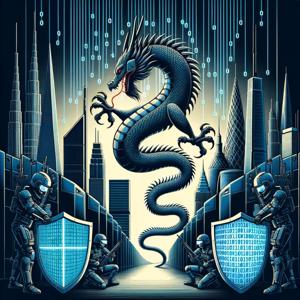
Dragon's Code: America Under Cyber Siege

Dragon's Code: America Under Cyber Siege

By Inception Point AINewsTechnologyPoliticsTech News
Download on the App Store

Dragon's Code: America Under Cyber Siege episodes

  • Chinese Cyber Ops Strike Again: CBO Breached, DC Nonprofits Targeted, and Industrial Secrets Swiped!
    This is your Dragon's Code: America Under Cyber Siege podcast.
    Hey listeners, it's Ting—your one-stop source for witty banter and the hard truth about Chinese cyber ops. The past week has been, well, another episode of Dragon’s Code: America Under Cyber Siege, and you’d better believe the script is jam-packed with intrigue, attribution drama, and some deeply nerdy hacking tactics.
    All eyes were on Washington when the Congressional Budget Office was hit by a cyberattack that sent shockwaves through Capitol Hill. According to a briefing seen by CNN, the prime suspects are—you guessed it—Chinese state-linked groups. The CBO, which keeps lawmakers in the cost-estimate and budget loop, suddenly found its communications and projections floating in the cyber ether. Caitlin Emma, their spokesperson, said they've contained the breach and ramped up monitoring and controls, but the attack is “ongoing” and staffers have been warned: don’t click CBO links unless you love roulette with legislative secrets! What makes this even more dramatic? The entire federal government just went through a record 37-day shutdown, so CISA—the agency meant to keep cyber thugs at bay—had furloughed a majority of its team. So, if you were betting on “good time for foreign intelligence fishing”—congratulations, you win a Red Team trophy.
    Meanwhile, Symantec and Carbon Black uncovered a campaign against a D.C. nonprofit not just dabbling, but dunking in policy influence. The week’s most sophisticated ops relied on big exploit classics: Log4j, Atlassian OGNL Injection, Apache Struts, and GoAhead RCE. Attackers scanned for vulnerable servers, then used scheduled tasks and legitimate binaries like msbuild.exe to inject code directly into Windows systems—talk about ‘living off the land.’ Techies will appreciate that DLL side-loading via Vipre AV components was a popular trick, with payload delivery and persistence hinging on system-level scheduled tasks. The threat actors, connected to names like Salt Typhoon (aka Kelp), Space Pirates, and APT41, kept their toolkit modular and masquerading as trusted processes, making attribution a forensic nightmare.
    Not only were systems breached, but domain controllers—the crown jewels for network-wide privilege escalation—were on the menu. Imjpuexc, an obscure Microsoft utility for East Asian script input, popped up in the logs, adding another telltale sign of Chinese involvement, according to Broadcom and GBHackers. What’s really new here is how these groups didn’t just rely on old espionage. In addition to theft, we saw disruptive capabilities, a step up in scale—think infrastructural prep for conflict rather than mere data heists.
    Industrial sectors felt the heat, too. Cyble reported a surge in supply chain attacks, with ransomware gangs piggybacking on compromised update servers. Chinese-aligned PlushDaemon, for example, poisoned network devices and hijacked DNS traffic to serve up SlowStepper malware to unsuspecting energy and defense tar
    This content was created in partnership and with the help of Artificial Intelligence AI.
    5 min
  • China's Power Grid Ploys: Cyber Nerds Spill the Tea on APT41's Shadowy Schemes
    This is your Dragon's Code: America Under Cyber Siege podcast.
    Listeners, it’s Ting! If you’ve spent the past week anxiously tracking breaches in US infrastructure, congratulations on surviving the latest episode of Dragon’s Code: America Under Cyber Siege. Let’s skip the pleasantries and jump in, because these past few days have been a masterclass in Chinese cyber-ops wizardry—equal parts terrifying and fascinating for cyber nerds like me.
    Late last Friday, the Department of Energy—yes, again!—spotted malicious scanning on power grid management networks from IP addresses linked to the threat group APT41, a notorious cyber collective with deep ties to China’s Ministry of State Security. According to cybersecurity teams briefed by CrowdStrike analysts, this campaign used a blend of zero-day privilege escalation exploits and classic spear-phishing, but with a twist: the delivery mechanism bypassed traditional email gates by weaponizing legitimate energy supply chain vendor portals. As one Red Team lead at Forescout Technologies mused, “If the vendors can’t tell friend from foe, neither can you.” Chilling.
    Attackers prioritized stealth. They deployed “pre-positioning” malware—basically ghost code that just sits dormant, a tactic increasingly employed by advanced states. Experts like Roy Kamphausen from The National Bureau of Asian Research warn this enables sabotage on demand and is straight out of the Volt Typhoon and Salt Typhoon playbook. Pre-positioning not only threatens downtime, but also signals that adversaries can flick the off switch for critical systems—think water, power, transport—whenever they choose.
    Let’s talk attribution. Forensic evidence pointed directly to salted payloads compiled with Mandarin-language build environments and time stamps aligning with China’s business hours. DefenseOne’s panel of experts, including former DOD advisor Sean Berg, described China as “already in phase three” of the Pacific data war, dominating not by brute force but by knowing exactly when, where, and how to strike for maximum chaos. They weren’t kidding; the attackers also leveraged analytics on bulk-collected employee metadata to simulate legitimate operational traffic—a move only made possible by years of slow, silent exfiltration.
    Government response moved fast this time. The Department of War (yes, that’s a new Trump-era name—roll with it), under Austin Dahmer, immediately issued a sector-wide threat directive: inventories of xIoT (that’s “everything Internet of Things,” by the way) endpoints, network traffic segmentation, and rapid rollouts of anomaly-based intrusion detection fed by AI. White House officials openly admitted to exploiting regulatory loopholes to counter China’s tempo—a bit of deregulation to make us nimbler, one staffer winked.
    Lessons? Even advanced detection is no substitute for supply chain integrity and interagency drills. Officials emphasized burden-sharing; allies patched in as critical logs showed attempted pivots
    This content was created in partnership and with the help of Artificial Intelligence AI.
    5 min
  • China's Cyber Tricks: Tricking Treats, Hacking Heats, and Blurry Beats
    This is your Dragon's Code: America Under Cyber Siege podcast.
    Today’s episode of Dragon’s Code: America Under Cyber Siege, I’m Ting, your trusted cyber-bard on all things China. So buckle up, listeners—this week has been a wild ride for America’s digital defenses.
    Let’s start with the real headline-grabber: a fresh Chinese campaign using a zero-day vulnerability in Motex Lanscope, which nailed several US utility networks on Halloween, no less. Security analysts at SC World report these attacks weren’t your garden variety—attackers leveraged the Lanscope bug to hopscotch laterally across internal networks, evade traditional endpoint protection, and exfiltrate operations data tied to energy control systems. Now, all signs point to a suspected group with ties to China’s Ministry of State Security, building on a pattern seen in the notorious 2021 Hainan State Security Department hack that targeted aviation and marine R&D with surgical precision.
    Here’s the kicker: China’s playbook keeps evolving. According to the Information Technology and Innovation Foundation, phishing’s never gone out of style—it just got an upgrade. We’re talking AI-sculpted spear phishing emails that mimic a colleague’s digital voice better than you can say “Inbox Zero.” Doppelganger domains and deepfake profile pics made it almost too easy for stressed-out employees to click the wrong link. And don’t forget the old-school subterfuge: a “consultant” inside a US defense supplier planted a poisoned USB drive, revisiting tactics straight out of the Operation Aurora saga.
    America’s affected systems? This week, it’s a sobering list: water treatment facilities in the Midwest, an airline’s ticketing backend in Atlanta, and a logistics firm supporting military supply chains out of New Jersey. Even as the focus remains on digital, experts like Adam Segal from the Council on Foreign Relations warn that the line between cyber and physical is blurring—shutting down a logistics network can ground planes and starve cities, fast.
    How did the US respond? Even with no confirmed permanent head at Cyber Command or the NSA—a vacuum making some folks in Congress pull their hair out—temporary leader Lt. Gen. William Hartman greenlit “active defense.” Analysts at SecurityWeek note that American countermeasures included isolating compromised subnets within minutes of detection, deploying rolling credential resets, and, in some cases, manually disconnecting critical SCADA components. Industry giants stepped in too, with Google and Microsoft launching zero-trust patches and rolling out global push-alerts for vulnerable configurations.
    But here’s where the lesson bites hardest: Attribution is rarely a smoking gun, yet the tell-tale language choices in command-and-control servers, coupled with patterns reminiscent of previous PLA-affiliated hacks, make the source nearly impossible to deny. Still, don’t expect indictments to solve the issue—experts say the threat’s not going anywhere, any time soon.
    This content was created in partnership and with the help of Artificial Intelligence AI.
    4 min
  • Chinese Hackers Gone Wild: Zero-Days, Cisco Routers, and Spies in the Ivy League
    This is your Dragon's Code: America Under Cyber Siege podcast.
    It’s Ting here—your friendly cyber sleuth and specialist on all things China and hacking. Let’s dive straight into the wildest week yet in America’s ongoing cyber drama: Dragon’s Code—America Under Cyber Siege. The past few days have delivered no shortage of high drama, zero-day acrobatics, and government handwringing as Chinese APTs basically played “Capture the Flag” on US, and yes, allied, digital turf.
    The talk of the threat intel community is all about BRONZE BUTLER, also tracked as Tick, a Chinese state-sponsored group that Secureworks’ CTU caught actively exploiting a zero-day—CVE-2025-61932—in Motex’s LANSCOPE Endpoint Manager used massively in Japan, but security experts warn the same tactics are being spotted among vendors to US critical infrastructure. This zero-day allowed SYSTEM-level remote code execution, turning whole fleets of endpoints into malware launchpads. Analysts pointed out the two-variant Gokcpdoor backdoor communicating via tricky TCP ports, plus the deployment of tools like Havoc C2 and goddi for Active Directory snooping. Data exfiltration? Ingeniously done via browser uploads to rare services like Piping Server, completely sidestepping your grandma’s DLP solution. The warning here, according to JPCERT/CC and CISA, is internal exploitation—attackers now fish with a spear, not a net.
    But the American side is not just watching Japan’s back. Back home, Cisco’s infamous CVE-2023-20198—the IOS XE web UI bug—refuses to die, despite patches being a year old. SALT TYPHOON, another Chinese operator, and friends are still dropping the BADCANDY web shell on unpatched Cisco routers, including those controlling network traffic for water and power utilities. We’re talking privileged backdoors, rogue tunnel interfaces, mass credential harvesting. Even after rebooting and “cleaning up,” many orgs aren’t patching root issues, so attackers simply walk right back in. The Australian Signals Directorate says hundreds of compromised routers in late 2025 prove just how poor global patch hygiene still is.
    If you like international intrigue, Mustang Panda’s newer offshoot, UNC6384, just pulled off a high-impact phishing campaign targeting Western diplomats and aviation authorities—this time with a fresh zero-day, CVE-2025-9491 in Windows LNK files, to smuggle PlugX malware onto systems. It’s clever, customized, and timed to real-world events, with phishing emails built around current EU defense topics. PlugX is old but gold; its modularity helps it dodge endpoint defenses, and the group still loves PowerShell and DLL sideloading for stealthy control.
    These incidents highlight hallmarks of Chinese cyber tradecraft: fast exploit adoption, precise targeting, leveraging hybrid tooling—custom plus open source. Attribution poles—according to experts at CISA and Secureworks—point to overlapping infrastructure, recurring C2 patterns, and PLA-linked researchers in US academic programs
    This content was created in partnership and with the help of Artificial Intelligence AI.
    6 min
  • Salt Typhoon Snoops on Candidates: Chinese Hackers Eavesdrop on 2024 Campaign Calls via Telecom Wiretap Systems
    This is your Dragon's Code: America Under Cyber Siege podcast.
    Listeners, it’s Ting—yes, your go-to for everything China, cyber-intrigue, and flaming-hot hacking updates. You want this week in America’s cyber defense? Buckle in, because Dragon’s Code has written a blockbuster chapter.
    This week, Salt Typhoon, the Chinese cyberespionage crew backed by China’s Ministry of State Security, didn’t just knock on our digital doors—they blew them off the hinges. According to the FCC, Salt Typhoon breached the wiretap request systems at dozens of US telecom companies. That’s right, the lawful intercept tools that let law enforcement snoop on suspected criminals? Chinese hackers found a way to use these against us, targeting everyone from candidates like President Donald Trump and Vice President JD Vance to campaign teams of Kamala Harris. Imagine Xi Jinping’s agents eavesdropping on America’s latest campaign strategy sessions—makes Watergate look analog.
    How’d they do it? Methodology: sophisticated spear phishing, zero-day exploits in obscure telecom systems, and a little old-school credential stuffing. Chinese operators leaned on exploiting vulnerabilities in Cisco’s Adaptive Security Appliance firewalls—those beefy gatekeepers supposedly guarding government and private infrastructure alike. According to The Record, their scan-and-exploit routine hit network perimeters, with some success in government and defense contractor domains.
    Attribution wasn’t just guesswork. The FBI, working alongside CISA, followed forensic breadcrumbs—unique malware signatures, command-and-control infrastructure bouncing through .cn domains, and operational overlap with known Salt Typhoon campaigns. Key evidence included identical malware samples found across 600 organizations in over 80 countries, but traced right back to this Chinese crew.
    So, did Uncle Sam take it lying down? Absolutely not. Emergency patches from Cisco flew out the door; telecoms isolated affected systems, and the FBI started a rolling notification campaign to compromised organizations. The patchwork, per FCC Chair Brendan Carr and NIST’s tech team, included tighter network segmentation and forced multi-factor authentication. But the FCC threw drama into the mix—next month, they’ll vote to reverse some security requirements put in after the attacks. Cybersecurity pros like Jessica Rosenworcel, former FCC Chair, think rolling back these protections now is like locking your doors after the burglar leaves, then removing the locks altogether.
    Let’s talk lessons. First, no law-enforcement tool is too mundane for foreign cyber ops; second, never underestimate persistence—Salt Typhoon spent months mapping systems before striking. Experts like NIST’s Dr. Sonia Lin say automation, AI-driven monitoring, and continuous systems audit are now “non-negotiable” in this new normal, while infosec consultant Marcus Flynn insists public-private threat info sharing must shift from monthly memos to real-time alerts.
    And
    This content was created in partnership and with the help of Artificial Intelligence AI.
    5 min
  • Cyber Showdown: U.S. vs China - Inside the Digital Battlefield of Hacks, Spies, and Sanctions
    This is your Dragon's Code: America Under Cyber Siege podcast.
    Hello, listeners I'm Ting, and welcome to Dragon's Code: America Under Cyber Siege. Let's dive straight into the exciting world of cyber espionage. Over the past week, China's cyber operations have been making headlines, with sophisticated attacks targeting critical U.S. infrastructure.
    The McCrary Institute just released a report detailing China's evolving cyber strategy. It highlights campaigns like Volt Typhoon, Salt Typhoon, and Flax Typhoon, which are part of a coordinated effort by the Chinese Communist Party to prepare the battlefield and exploit infrastructure gaps. These attacks aren't isolated; they're strategic, aiming to disrupt military mobility, economic productivity, and public health systems.
    According to the report, China is inside U.S. systems, using tactics like hiding in plain sight and exploiting older technology. Former FBI Director James Comey has testified about China targeting systems critical to military mobility and economic stability. The U.S. has responded with sanctions, such as geo-targeted cyber sanctions, which limit access to digital tools and can slow down cyberattacks, making them riskier for perpetrators.
    Cybersecurity experts emphasize the importance of proactive measures. Sanctions might not stop cyberattacks, but they can make them more expensive and slower. The U.S. has also tightened regulations on Chinese telecom companies, blocking new device approvals. China has amended its cybersecurity law to address AI and infrastructure risks.
    So, what can we learn from this? Cybersecurity is not just about technology; it's about understanding the strategic intent behind these attacks. The U.S. and China are engaged in a cyber war of wits, with AI and infrastructure risks becoming central.
    Thanks for tuning in, everyone If you want more insights into the world of cyber threats, be sure to subscribe. This has been a quiet please production, for more check out quiet please dot ai.
    For more http://www.quietplease.ai
    Get the best deals https://amzn.to/3ODvOta
    This content was created in partnership and with the help of Artificial Intelligence AI.
    3 min
  • Lights Out! China's Cyber Smackdown Leaves US Scrambling for Fixes
    This is your Dragon's Code: America Under Cyber Siege podcast.
    Listeners, let’s dive right into America’s wildest cyber week yet—Dragon’s Code: America Under Cyber Siege! I’m Ting, your guide through the shadiest server rooms, and this time the headline reads: the most sophisticated, relentless attacks we’ve ever seen, with all digital arrows pointing straight back to China.
    This week, “Operation Slipstream” hit the U.S. power grid and water utilities in Texas and Florida—no, really, I’m talking actual ransomware-for-hire groups flagged by Mandiant and Palo Alto Networks who blended living-off-the-land tactics with zero-day exploits. The attackers mimicked legitimate administrator traffic, making it a nightmare to spot their handprints until the lights started flickering in real homes. Cybersecurity researcher Katie Nickels told Reuters these intrusions screamed PLA tradecraft: they used obfuscated command-and-control channels routed via hijacked Japanese edge servers and, get this, cranked out customized ALPHA RAT payloads that slipped past baseline EDR.
    As for affected systems, the campaign targeted ICS and SCADA controls—the backbone of power and water infrastructure. Forensics indicated the bad actors exploited unpatched PLC firmware and pivoted through legacy VPNs that hadn’t seen a patch since “Baby Shark” was a hit. According to the Department of Homeland Security, at least two municipal systems suffered data exfiltration: schematic layouts and incident-response playbooks wound up on dark web forums within hours.
    Now, why point the finger at Beijing? The assembled evidence is damning. Jared Maeda from CISA highlighted overlapping infrastructure with the infamous Volt Typhoon group—yes, the ones who popped Guam power last year. The attackers’ tools matched malware families previously tied to PLA Unit 61398: specifically, the signature handshake in the beacon packets and Mandarin-language code comments referencing State Grid protocols. Also, threat intelligence flagged some C2 servers registering traffic patterns during Chinese business hours—almost like they’re clocking in.
    How did America counter this onslaught? The Cybersecurity and Infrastructure Security Agency, CISA, launched rapid-response teams, deploying traffic segmentation and rolling out emergency Yara rules across critical sectors. National Cyber Director Sean Cairncross told SC Media they fast-tracked multi-factor authentication and “network enclaving” at providers that had brushed off CISA’s security advisories for months. Plus, DOE’s OT Defender program got every utility on secure-boot updates by Friday morning, which, for government, is warp speed.
    So, what are the takeaways? According to Jen Easterly of CISA, this operation exposed how slow patch management and ignored advisories crack the door wide open. Experts call for a “whole-of-nation” approach: not just tech fixes, but restoring funding, leadership, and real authority to CISA and the State Department’s cyber-di
    This content was created in partnership and with the help of Artificial Intelligence AI.
    5 min
  • Volt Typhoon Strikes! Is Your Network Raccoon-Proofed for Chinas Cyber Siege?
    This is your Dragon's Code: America Under Cyber Siege podcast.
    Listeners, it’s Ting, your expert cyber sleuth—and today I am deep in Dragon’s Code: America Under Cyber Siege. Buckle up, because the last few days have been wild in the digital underbelly of US infrastructure.
    Let’s cut to the chase—Chinese cyber operations have leveled up yet again. The name every expert can’t stop saying is Volt Typhoon, and trust me, you do not want them in your networking closet. CISA Director Jen Easterly warned this week that what you’ve seen is merely the “tip of the iceberg.” She says China isn’t just after espionage anymore—they’re prepping to wreak havoc if a crisis erupts, especially over Taiwan. Their objective is disruption: pipeline shutdowns, water systems offline, trains stopped cold, telecom chaos that would make your Grandma’s landline nostalgic. Not a drill, folks.
    The methodologies are downright crafty. We’re talking *living off the land attacks*: Volt Typhoon burrows in, blending with normal network traffic, exploiting legitimate admin tools like PowerShell and WMI. They avoid traditional malware—so classic antivirus is useless—and focus on persistence. Salt Typhoon is another favorite: after six months, Chinese spies are still lingering inside US telecom systems, according to the Cyber Initiatives Group. That means backdoors remain, and kicking them out has been like, well, trying to evict a raccoon from your attic during mating season.
    But that’s not all. Advanced Persistent Threat 41—yes, APT41—popped up with a fresh trick this week, targeting US trade negotiation strategies. The Wall Street Journal exposed their malware-laced email campaign, designed to dupe trade groups and law firms into opening attachments that’d let hackers snoop on US-China trade deals. Not subtle, but unfortunately, very effective. FBI and Capitol Police are actively investigating.
    Let’s talk targets. From water treatment plants to solar panel management software, power grids, and even port cranes—Chinese influence runs deep. Eighty percent of US port cranes are made in China and potentially rigged for remote shutdown. Even stranger: New York SIM farms run by Chinese entities, ready to disrupt telecom on demand. Grant Newsham, a seasoned Marine and China watcher, pointed out that besides virtual hacks, physical assets and even proxies—hello, Chinese truckers and “police” service centers—are scattered across the American heartland, adding layers to the siege.
    Attribution is always slippery. Chinese officials, predictable as a WeChat meme, denied everything, saying they “firmly oppose cybercrime.” Meanwhile, evidence from digital forensics, unique code patterns, infrastructure links, and behavior profiling has left experts in little doubt—these operations bear all the hallmarks of groups run by China’s Ministry of State Security.
    How do you defend against this? Easterly and her team are layering in zero trust models, rapid incident response, and asset segmentation
    This content was created in partnership and with the help of Artificial Intelligence AI.
    8 min
  • Cyber Siege: Chinese Hackers Gone Wild! Ninja Moves, Stolen Billions, and a Global Hacking Frenzy
    This is your Dragon's Code: America Under Cyber Siege podcast.
    Ting here, listeners! Buckle up because the past few days in the cyber trenches have been nothing short of Hollywood-level drama. If you thought last week’s phishing wave was wild, this week, we entered a new chapter: Dragon’s Code—America Under Cyber Siege.
    Let’s start with Monday, when reports from Palo Alto Networks and Fortra confirmed what many in Washington had been whispering—Chinese-linked actors have gone beyond headline-grabbing data dumps. This time, it’s all about surgical strikes on US infrastructure. Take the Smishing Triad, for example: since January, these folks have spun up over 194,000 domains, blasting everything from financial brokers to logistics firms with SMS phishing—sending Americans into a spam-induced panic. The payoff? Over $1 billion in stolen credentials and emptied accounts, and this week, they upped the ante by mimicking government disaster alerts, baiting targets into tapping sketchy links and giving up banking codes.
    Switching to the back end, Symantec and Trend Micro both confirmed a new attack vector—exploiting the ToolShell vulnerability, a Windows flaw that was patched by Microsoft just two days before Chinese groups like Glowworm and UNC5221 started their scans. Here’s the kicker: they didn’t just smash and grab. They blended in, using legit software like Trend Micro and BitDefender tools to deliver malware—think Zingdoor and KrustyLoader—straight into telecom and energy networks. Pure ninja stuff. The sophistication points to high-level coordination, with Microsoft also fingering Budworm and Storm-2603 as key players. Affected systems include everything from state grids in Texas to water utilities in the Midwest, with forensics showing credential theft and persistent backdoor access.
    Now, attribution—it’s always the spicy part. Department of Homeland Security analysts this week rolled out evidence of command-and-control nodes lighting up across Asia, many registered to known Chinese APT infrastructure. Beijing’s Foreign Ministry, fronted by Guo Jiakun, of course doubled back, accusing the NSA and the US of being the “number-one hacking state”—classic pot-calling-the-kettle cyber geopolitics.
    The defensive playbook has been frantic but not hopeless. CISA’s John Keller outlined the immediate response: isolating affected segments, rolling out behavioral AI detection to spot ToolShell abuse, and enforcing strict backup credential rotation. Manufacturing took the heaviest hit—61% more ransomware incidents this year, says KELA—so Houston’s refineries and Detroit’s plants are running triple audits on remote access and backup tools. Jacob Santos at Trend Micro stressed the need for continuous monitoring: perimeter security just won’t cut it when the attackers use “BYOVD”—bring your own vulnerable driver—and sneak in through your own antivirus software.
    The big lesson this week? The adversary is cross-platform, creative, and ruthless. Prominent ana
    This content was created in partnership and with the help of Artificial Intelligence AI.
    5 min
  • Salt Typhoon Storms the US: China's Epic Hack Attack Rocks Telecoms and Campaigns
    This is your Dragon's Code: America Under Cyber Siege podcast.
    Listeners, strap in. I’m Ting—cyber sleuth, China whisperer, and lover of real-time packet captures. Today’s episode? Dragon’s Code: America Under Cyber Siege, where the only firewall that truly matters is the one you haven’t patched.
    Let’s dig right in—because as of this week, America’s digital infrastructure has been under siege by what Senator Mark Warner aptly described as “the worst telecom hack in our nation’s history.” The culprit? Salt Typhoon—a Chinese state-backed cyber-espionage juggernaut. We’re talking breaches at Verizon, AT&T, and T-Mobile. That's nearly 400 million subscribers in the blast radius, which means if you’ve dialed, texted, or stepped within cell tower range, Salt Typhoon probably has your number, literally. Former FBI director Christopher Wray didn’t sugarcoat it; he called this “the most significant cyber espionage campaign in history.”
    Now, how did Salt Typhoon pull it off? They surfed on the back of zero-days—those digital unicorns—hitting Microsoft SharePoint servers with a vulnerability known as CVE-2025-53770, a.k.a. ToolShell. Before Microsoft got the patch out, Salt Typhoon, along with crews like Linen Typhoon and Violet Typhoon, broke in, targeting not just telecoms but government agencies, universities, and even the US Energy Department. Once inside, they unleashed custom malware like Zingdoor and weaponized sideloading tricks, where a legit bug-tracking app called ‘mantec.exe’ helped sneak in nasty code. Bonus points for using legitimate software to hide the mayhem.
    Attribution is no longer a whodunit. Microsoft, Symantec, and Carbon Black trace the attacks right to Beijing’s doorstep and even name the groups—APT27, APT31, Salt Typhoon, and their shadowy affiliate UNC5221. These folks went after not just infrastructure but the political process. That’s right: 2024 election interference included efforts to compromise candidates’ personal devices and sniff out confidential law enforcement communications.
    How did American defenders fare? CISA, the FBI, and Treasury’s OFAC ran coordinated countermeasures—targeting compromised routers, probing command-and-control servers, and hitting Chinese front firms with sanctions. In fact, Sichuan Juxinhe and other network tech companies are now persona non grata for providing the digital getaway cars.
    Anne Neuberger, national security wizard, pointed out “these threat actors can geolocate millions, record phone calls at will.” Basically, Salt Typhoon doesn’t just break in—they set up shop. Offense is tempting, but experts like Erica Lonergan urge, don't start a cyber slugfest unless your own servers are Fort Knox. Congress is debating clearer red lines: cross them and we’ll respond in kind, no more guessing games.
    What are we learning? Lesson one: Information-sharing is not optional. CISA’s rapid alerts made a dent. Number two: Patch everything—today, not “tomorrow.” Number three: Sanctions work, but thes
    This content was created in partnership and with the help of Artificial Intelligence AI.

    4 min

About Dragon's Code: America Under Cyber Siege

From the publisher's feed

This is your Dragon's Code: America Under Cyber Siege podcast.