
Sign up to save your podcasts
Or

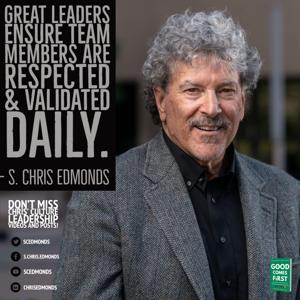


For decades, talented people have tolerated old-school leaders that put results before respect. Now is the time for leaders to create a work culture where good comes first for every employee—in every interaction – and where the doing of good leads directly to improved productivity, better customer service, increased retention rates, passionate employees, and higher profits.
Employees – your team leaders and team members – deserve a work environment that treats them, their efforts, their ideas, their contributions, and their accomplishments with respect.
And yet employees experience far more disappointment than good in today's workplaces. Pent up frustration with unjust systems and practices, demeaning treatment, self-serving decisions, unfair or unequal compensation, rare recognition, bullying, and worse have led employees to the boiling point.
In the coming years, employees will seek out and join organizations and leaders that validate employees' efforts, serve their communities, and make life better for their customers. Like metal to magnets, employees will seek out companies where good comes first.
The problem is that we've always been driven by results, so we've never asked leaders to change their work cultures. Even if we did, most leaders don't know how.
My upcoming book with Mark Babbitt is titled Good Comes First. Step by step, this book provides proven, actionable strategies for leaders to create and sustain a vibrant, uncompromising work culture.
Good Comes First guides you to successfully implement three phases of our culture refinement process:
Culture refinement is not easy. As a leader, you already know most change efforts stall or fail. But after reading this book, you will see that, done right, change is not just possible . . . change is practical, powerful, and profitable.
And you—the reader—will be the right person, at the right time, to make that change happen.
Good Comes First is available for preorder now. The publication date is September 28, 2021.
This is episode ninety-four of my Culture Leadership Charge series. In these concise episodes, I present the best practices for creating and maintaining a purposeful, positive, productive culture - at work, at home, and in your community.
This content was released in video format on my website, http://DrivingResultsThroughCulture.com, on March 19, 2021.
Check out my YouTube channel to view all of my 3-minute Culture Leadership Charge video episodes.
What is your stress level? What are your employees' stress levels? The pandemic has placed tremendous burdens on every human—and every company – on the planet.
Closed businesses and lost jobs have taken a significant toll on the economy and human wellbeing.
Stress is at an all-time high. A 2020 Harris Poll found that US adults' average stress level was 5.4 (on a 10-point scale). This rating is significantly higher than the 2019 average stress level of 4.9.
Parents with children under the age of 18 rated their stress level at 6.7. That's unfortunate, but not surprising.
Effective leaders know that one of the most important things they can do to support team members is to remove employee frustrations.
During pre-pandemic times, lousy systems, poor communication, disrespect, and poor follow-through typically generated employee frustrations.
During the pandemic, employee frustrations have grown. Working remotely doesn't solve the above issues—it amplifies them.
Leaders can do three things to help address employee frustrations:
First, ASK. Proactively engage with employees. Ask them how they're doing. Ask what their biggest frustrations are with getting work done today.
This is episode ninety-three of my Culture Leadership Charge series. In these concise episodes, I present the best practices for creating and maintaining a purposeful, positive, productive culture - at work, at home, and in your community.
This content was released in video format on my website, http://DrivingResultsThroughCulture.com, on February 18, 2021.
Check out my YouTube channel to view all of my 3-minute Culture Leadership Charge video episodes.
You measure results religiously. How often do you measure how well you and your company's formal leaders treat others in your work culture?
Just as you measure progress towards desired results regularly, you must measure progress towards desired respect regularly.
You must gather objective feedback through regular assessments – at least twice annually – that enable employees to rate how well your company's leaders model your values and behaviors.
By measuring values and respect in a formal way, you can then refine every leader's efforts and, ultimately, improve the quality of your company's culture.
The problem is that very few leaders have been asked to measure values or respect across their organization. Most don't know how. Doing a values survey poorly is worse than not doing a values survey at all. Lousy questions result in lousy data that is not helpful or actionable.
You need proven expertise to help you build a values assessment platform to gather insightful feedback and to act on the objective data you collect. I have that expertise. I've been helping clients measure values and respect for decades.
Our values assessment platform helps you:
In today's three minute episode of my Culture Leadership Charge podcast series, I describe how important it is to properly structure your survey items (questions).
This is episode ninety-two of my Culture Leadership Charge series. In these concise episodes, I present the best practices for creating and maintaining a purposeful, positive, productive culture - at work, at home, and in your community.
This content was released in video format on my website, http://DrivingResultsThroughCulture.com, on January 11, 2021.
Check out my YouTube channel to view all of my 3-minute Culture Leadership Charge video episodes.
The 2020 election presents a constitutional opportunity for the USA.
Voter turnout - about 65% as of today's counts - is the highest it's been here in over 100 years! And - that high mark here falls short of the voter participation in other developed countries like Belgium (87% in 2014), Sweden (82% in 2014), and Denmark (80% in 2015).
Our states have the responsibility to ensure that every citizen of voting age casts their vote in every election.
What is required of states to increase voter turnout? Three things. In today's 3-minute culture leadership charge, Chris shares those three things, all of which are well within states' power and authority.
In today's three minute episode of my Culture Leadership Charge podcast series, I share those three things - all of which are within states' power and authority.
Business leaders can boost voter participation by ensuring they and their companies model these three things in their organizations.
This is episode ninety of my Culture Leadership Charge series. In these concise episodes, I presents the best practices for creating and maintaining a purposeful, positive, productive culture - at work, at home, and in your community.
This content was released in video format on my website, http://DrivingResultsThroughCulture.com, on October 21, 2020.
Check out my YouTube channel to view all of my 3-minute Culture Leadership Charge video episodes.
Us Westerners have the unfortunate tendency to link our identity to what we do for a living. "I'm a plumber," one says, or "I'm a teacher," another says.
When someone asks me what I do – often on an airplane – I might answer, "I'm a speaker," or "I'm an author," or "I'm an executive consultant."
I'm answering truthfully; those are things I do. Often. And, I might add, I do them really well.
But I am not what I do. Neither are you. Who we are is different than what we do.
Sometimes I'm presenting my culture leadership concepts in a speech on a stage. Sometimes I'm doing my working musician thing, playing guitar on a stage. Sometimes I'm doing the laundry. Sometimes I'm exercising or stretching. Sometimes I'm cooking. Sometimes I'm writing.
I "do" a number of things every day. But I don't think of myself as a "doer of things" as much as I think of myself as a person of faith trying to keep aligned to my personal constitution, every day.
If I didn't have a formal declaration of my personal constitution – my servant purpose, values, behaviors, and leadership philosophy – I'd probably see myself as a "doer of things" instead of a focused being on a journey of service.
It's easy to fall into that tactical view of our world and our lives. There is a better way – a more inspiring, engaging, productive way of viewing our reason for being on this planet.
During these uncertain, trying times for everyone, take the time to formalize your personal constitution.
In today's three minute episode of my Culture Leadership Charge podcast series, I present greater detail on what to include in your personal constitution and how to live in alignment with those elements.
This is episode eighty-nine of my Culture Leadership Charge series. In these concise episodes, I presents the best practices for creating and maintaining a purposeful, positive, productive culture - at work, at home, and in your community.
This content was released in video format on my website, http://DrivingResultsThroughCulture.com, on October 21, 2020.
Check out my YouTube channel to view all of my 3-minute Culture Leadership Charge video episodes.
The pandemic has caused immeasurable harm to the economy. Some businesses are operating at 50% capacity while others are closing – or are on the verge. Some employees are able to work from home while many have been laid off.
And social injustice and racial inequity are at the forefront. These issues can no longer be ignored – in our society, in our workplaces . . . anywhere.
Moving forward, employees expect companies to make morally just decisions. They expect respect. They expect to have a voice. They expect companies and their leaders to be a force for good in the world.
That's a high standard. It requires leaders to shift their organization to being a great place to work – by ensuring that Good Comes First: good people doing good work in a good organization.
Creating a Good Comes First work culture requires leaders to evolve beyond an exclusive focus on results. It requires new beliefs, new behaviors, and new degrees of engagement from leaders. It requires new skills, including listening, validating, mentoring, delegating, and celebrating.
A Good Comes First work culture is based on a foundational principle and four cornerstones.
The foundational principle is "Value Respect and Results," which asks leaders to create and sustain a work environment that expects respect and drives results.
The four Culture Cornerstones include:
In today's three minute episode of my Culture Leadership Charge video series, I describe each cornerstone in more depth and explain why leaders should create a Good Comes First work culture.
This is episode eighty-eight of my Culture Leadership Charge series. In these concise episodes, I presents the best practices for creating and maintaining a purposeful, positive, productive culture - at work, at home, and in your community.
This content was released in video format on my website, http://DrivingResultsThroughCulture.com, on September 17, 2020.
Check out my YouTube channel to view all of my 3-minute Culture Leadership Charge video episodes.
In July 2020, results of an investigation reveal multiple current and former employees of The Ellen Degeneres Show reporting racism, bullying, sexual harassment, and intimidation by executive producers and other senior staff.
Her show is deep in a crisis of culture.
Ellen herself was not the cause of the toxic environment – but she was insulated from the day-to-day employee experiences.
Ellen wrote a letter to staff members expressing her disappointment at the toxicity of the show's culture. "On day one of our show, I told everyone in our first meeting that 'The Ellen DeGeneres Show' would be a place of happiness – no one would ever raise their voice, and everyone would be treated with respect," she wrote. "Obviously, something changed, and I am disappointed to learn that this has not been the case. And for that, I am sorry."
At the core of this culture crisis is a senior leader who was disconnected from the employee experience, who did not keep her "fingers on the pulse" of whether or not employees were happy working on the show, whether they were treated respectfully in every interaction, or not.
Degeneres is not alone in this "miss." Far too few senior leaders have an authentic understanding of the experiences employees have daily in their organizations.
To address this crisis, Ellen needs to actively engage with the show's primary customers – employees – now and regularly. The show's secondary customers – guests and viewers – will be well served by show employees who experience a purposeful, positive, productive work culture on set.
In today's 3-minute episode of my Culture Leadership Charge video series, I describe how formalizing the show's work culture can help build respect, monitor respect, and ensure respect on set.
This is episode eighty-seven of my Culture Leadership Charge series. In these concise episodes, I presents the best practices for creating and maintaining a purposeful, positive, productive culture - at work, at home, and in your community.
This content was released in video format on my website, http://DrivingResultsThroughCulture.com, on August 16, 2020.
Check out my YouTube channel to view all of my 3-minute Culture Leadership Charge video episodes.
How often do you receive praise or recognition at work? We've had bosses that expressed gratitude well and bosses that never did it.
To understand the impact of expressed gratitude, let's look at three common types: praise, recognition, and validation.
By praise, I mean the communication of appreciation for a person's ideas, efforts, or contributions. Expressing praise can be as simple as writing or emailing a thank you note or calling a person up to thank them verbally.
Praise has the least beneficial, sustained impact of the three types. It is typically one-way communication - from you to the receiver. It is often a simple expression of thanks without delving into the actions you are praising or the benefits of their actions.
Praise is better than no communication of gratitude, but there are better ways to inspire.
In today's 4-minute culture leadership charge episode, Chris shares the benefits of recognition and validation, and directs leaders to leverage the positive impact of only one of these two types.
This is episode eighty-six of my Culture Leadership Charge series. In these concise episodes, I presents the best practices for creating and maintaining a purposeful, positive, productive culture - at work, at home, and in your community.
This content was released in video format on my website, http://DrivingResultsThroughCulture.com, on July 8, 2020.
Check out my YouTube channel to view all of my 3-minute Culture Leadership Charge video episodes.
This is an important point in time for our country's republic.
Society is bent, if not broken.
George Floyd's death has generated international protests - most of them peaceful, calling for an end to racial bias and discrimination from police.
Society has a bigger problem, I believe - and the time has come to address the broader implications of discrimination.
We must eliminate systematic racial bias and discrimination from our society.
Now is the time for white people to work together to eliminate privilege and implement fairness, inclusion, justice, and opportunity for every human.
In today's 3.5-minute episode of my Culture Leadership Charge video & podcast series, I outline how leaders can inspire change in their organizations - and their communities - to create justice, equality, and opportunity for every human.
This is episode eighty-five of my Culture Leadership Charge series. In these concise episodes, I presents the best practices for creating and maintaining a purposeful, positive, productive culture - at work, at home, and in your community.
This content was released in video format on my website, http://DrivingResultsThroughCulture.com, on June 8, 2020.
Check out my YouTube channel to view all of my 3-minute Culture Leadership Charge video episodes.
We're living in unprecedented times. With non-essential businesses closed and many people working from home, the world of work looks very different than it did three months ago.
The demands on folks working from home are extensive. Besides experiencing anxiety about the well-being of their family, friends, and community, team members are juggling multiple requirements that are new, different, and exhausting.
To lead effectively under normal circumstances is not easy. To do so under these circumstances is much more demanding.
A great practice for all leaders to embrace is to conduct a regular audit of their leadership efforts and impact.
A leadership audit helps leaders to:
In today's 3.5-minute episode of my Culture Leadership Charge video & podcast series, I describe exactly how leaders can conduct a leadership audit and what to look for when analyzing your data.
This is episode eighty-four of my Culture Leadership Charge series. In these concise episodes, I presents the best practices for creating and maintaining a purposeful, positive, productive culture - at work, at home, and in your community.
This content was released in video format on my website, http://DrivingResultsThroughCulture.com, on May 14, 2020.
Check out my YouTube channel to view all of my 3-minute Culture Leadership Charge video episodes.
From the publisher's feed