
Sign up to save your podcasts
Or

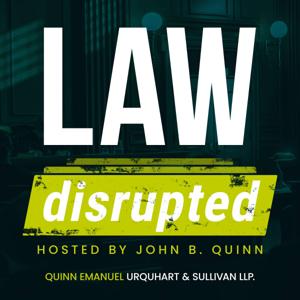

John is joined by Patrick D. Curran, Partner in Quinn Emanuel’s Boston and New York offices. They discuss the emerging issues regarding artificial intelligence currently before the courts, legislatures and government regulators and that, while many critical questions are pending before courts and regulators, clear answers are still few and far between. First, they discuss how despite the billions of dollars being invested in developing large language AI models, patent law often does not protect those investments because patents generally do not cover general ideas, mathematical concepts, or algorithms. They also discuss the question of whether an AI generated invention may be cited as prior art that would invalidate a human-generated invention. Patrick then explains that companies are increasingly relying on trade secret protections to safeguard their AI innovations, even though this approach comes with challenges. Patrick further explains that trade secret protection may extend indefinitely, unlike patents which expire after a defined term, but notes the difficulty inherent in detecting when competitors might be using proprietary models, making trade secrets harder to enforce. They also discuss AI's role in invention, noting that while AI may create invent things, such as new molecules, if there is no human involvement in the process, the discovery cannot be patented. They then examine the legal challenges regarding the use of copyrighted material in training AI models, including whether using copyrighted material for AI training constitutes fair use, the degree to which companies can limit data scraping through their terms of service, and the role that technical safeguards against scraping might play in future disputes. They also discuss recent defamation claims based upon AI generated content and the difficulties of proving intent when human input to the content is minimal. The discussion then turns to recent regulatory developments, including recent legislation in US cities such as cities like New York City and Portland, Oregon, states including Colorado and California and international efforts like the European AI Act and the “Brusselization” of GDPR requirements. Patrick describes the industry's divided stance on regulation, with some companies calling for stricter oversight while others fearing that regulation will stifle innovation. Finally, both John and Patrick agree that as courts and regulators tackle these complex issues, the legal landscape surrounding AI will continue to evolve rapidly.
Podcast Link: Law-disrupted.fm
Host: John B. Quinn
Producer: Alexis Hyde
Music and Editing by: Alexander Rossi
 View all episodes
 By Law, disrupted

4.7
6767 ratings
John is joined by Patrick D. Curran, Partner in Quinn Emanuel’s Boston and New York offices. They discuss the emerging issues regarding artificial intelligence currently before the courts, legislatures and government regulators and that, while many critical questions are pending before courts and regulators, clear answers are still few and far between. First, they discuss how despite the billions of dollars being invested in developing large language AI models, patent law often does not protect those investments because patents generally do not cover general ideas, mathematical concepts, or algorithms. They also discuss the question of whether an AI generated invention may be cited as prior art that would invalidate a human-generated invention. Patrick then explains that companies are increasingly relying on trade secret protections to safeguard their AI innovations, even though this approach comes with challenges. Patrick further explains that trade secret protection may extend indefinitely, unlike patents which expire after a defined term, but notes the difficulty inherent in detecting when competitors might be using proprietary models, making trade secrets harder to enforce. They also discuss AI's role in invention, noting that while AI may create invent things, such as new molecules, if there is no human involvement in the process, the discovery cannot be patented. They then examine the legal challenges regarding the use of copyrighted material in training AI models, including whether using copyrighted material for AI training constitutes fair use, the degree to which companies can limit data scraping through their terms of service, and the role that technical safeguards against scraping might play in future disputes. They also discuss recent defamation claims based upon AI generated content and the difficulties of proving intent when human input to the content is minimal. The discussion then turns to recent regulatory developments, including recent legislation in US cities such as cities like New York City and Portland, Oregon, states including Colorado and California and international efforts like the European AI Act and the “Brusselization” of GDPR requirements. Patrick describes the industry's divided stance on regulation, with some companies calling for stricter oversight while others fearing that regulation will stifle innovation. Finally, both John and Patrick agree that as courts and regulators tackle these complex issues, the legal landscape surrounding AI will continue to evolve rapidly.
Podcast Link: Law-disrupted.fm
Host: John B. Quinn
Producer: Alexis Hyde
Music and Editing by: Alexander Rossi
2,201 Listeners

1,967 Listeners
376 Listeners

111,948 Listeners

32,328 Listeners

7,230 Listeners

646 Listeners
5,866 Listeners

10,182 Listeners

15,950 Listeners
749 Listeners

188 Listeners

1,049 Listeners
403 Listeners
187 Listeners