
Sign up to save your podcasts
Or



Based on Podcast App listening data
It was a rough week for the Trump administration’s relationship with credentials… and email. New White House Press Secretary Katie Zacharia spent years on cable news billed as a “lawyer,” but there was no record of her being licensed anywhere. It’s the move every law clerk has been tempted to make, except she also called herself “General Counsel.” Turns out she took the California bar exam, failed, and called herself a lawyer anyway. By the time she was out of the job, her defenders had settled on the argument that Hillary Clinton and Kamala Harris also failed the bar. That defense ignores two things: both of them went back and passed, and neither claimed to be anyone’s general counsel in the meantime. Meanwhile, DHS kept airing its $20 million taxpayer-funded Trump ad campaign after a federal judge ordered it pulled. DOJ’s own status report explained that agency counsel didn’t see the email with the order until the next morning. Sorry, just seeing this!
Over in Biglaw, the news was considerably cheerier. Cooley became the latest firm to hop aboard the Milbank money train, moving all U.S. associates to the new market salary scale. Quinn Emanuel scaled back its famous Work From Anywhere policy, even so, it’s still the most flexible deal in Biglaw. And Lowenstein Sandler earned some well-deserved applause with a new paid leave policy for parents whose newborns face extended NICU stays.
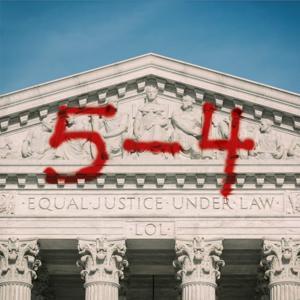
Supreme Court auditions are just down the hall and to the extreme right.
-----
That headline is a tad overdramatic, but Kirkland & Ellis did announce that it would no longer help journalists reporting on its financial strength. For years, most law firms have volunteered key data about their businesses to reporters to facilitate the rankings. Does Kirkland's move signal a trend? Judge James Ho hijacked a judicial opinion to complain that people accuse judges (read: him) of using his job as an auditioning platform for the Supreme Court. Then he immediately turned around to turn another judicial opinion into a rant about pronouns to... audition for the Supreme Court. Finally, Ropes & Gray announced a new policy to allow attorneys time to experiment with AI, and everyone should follow suit.
And the inevitable -- if stupid -- return of Richard Nixon
-----
In a display that could only be described as cartoonish, Senator Eric Schmitt thought he had Jack Smith dead to rights, before he tripped over himself and fell into a heap of mousetraps. After the special prosecutor denied attending an Atlanta Hawks game, Schmitt cried perjury. Eventually Smith revealed he'd gone to an Iowa Hawkeyes game, blowing up Schmitt's conspiracy addled theory. And the faceplant somehow managed to drag Harvard Law and George Mason's ASSLaw down with it. Meanwhile, Biglaw may be inching closer to matching the Milbank scale, with a since-removed White & Case job posting teasing the new salary range. And the Justice Department is eyeing an indirect exoneration of Richard Nixon. If that sounds like a ridiculous way for the DOJ to spend 2026, it is.
And the fashion police have too much time on their hands.
-----
The Supreme Court finally put down the dead horse that the Eighth Circuit kept beating, ruling for the third time that Missouri can't impose an illegal gerrymander in time for this election. But this farce highlights a growing problem as conservative -- primarily Trump-appointed -- judges use the federal courts as a staging ground for polishing their resumes. It's not just the Eighth Circuit either. The Fifth and even the Second have seen these antics. Also the fashion police arrived in Texas and attacked a lawyer for her sleeveless dress. And, how long are Biglaw lawyers working in London?
And how AI and college sports are basically running the same terrible playbook.
-----
More fallout from the big Weil departures. Joe and Kathryn talk about balancing business and why "values" is not necessarily the corporate speak language law firms should adopt all the time. Plus new speculation that Weil is considering merger partners -- has the music stopped on merger musical chairs, or does the industry have another blockbuster left in it. Then we discuss ChatGPT, college sports, Ted Cruz, conference realignment, the AI regulation freakout, ESPN, and the Protect College Sports Act. All of that fits into one story by the way. Finally, Brett Kavanaugh crashed a Notre Dame dorm and... wait, he did what?
When you think of this firm, do you think 'smaller platform'?
-----
Weil labels Cravath a "smaller platform" following partner departure, vaulting to the top of the leaderboard as the most passive aggressive statement a law firm has made this year. Which is saying a lot. Meanwhile, Missouri Republicans spent the week putting on a civil procedure issue spotter exam as they tried to ram through a gerrymandered map that even the Supreme Court wouldn't bless. Finally, we ask when a judge's style crosses the line to become too informal.
No generative AI required!
-----
With AI hallucinations dominating the legal ethics headlines for years now, it's nice to see lawyers landing in hot water without having to rely on technology. For example, Holland & Knight got itself removed from a case in Rhode Island after accidentally putting opposing counsel on their internal emails about "dumb" Rhode Island judges. Meanwhile, Skadden and Kirkland caught a $2 million sanction after repeatedly withholding evidence and the Lewis Rice bankruptcy lead is out following allegations of serving the wrong client. All that and somehow the Golden Girls manage to work their way into the conversation.
This episode is sponsored by Smith.ai.
-----
Discussing what we learned about legal technology in Nashville.
-----
The International Legal Technology Association conference broke its own attendance records as the legal world flocked to Nashville to figure out what's going on with the technology that promises to revolutionize the practice of law... and can't quite stop producing fake cases. Maddy Martin, Senior VP of Growth at Smith.ai -- the sponsor of this episode of Thinking Like A Lawyer -- stops by to recreate the sort of exhibit hall floor conversation she and Joe have had at these conferences for the last several years. Catching up on the state of the industry, what it means for both Biglaw and the small and solo market, and trying to figure out what happens next.
The murder trial of Lindsay Clancy, the Massachusetts mother accused of strangling her three young children, has spawned a courtroom subplot with real legal stakes: prosecutor Shanan Buckingham has spent weeks in Plymouth Superior Court in a rotating collection of hair bows, widely read as a tribute to five-year-old Cora, who loved them. But even a well-meant gesture is a gamble, handing the defense a ready-made argument that the state is leaning on sympathy over substance and potentially seeding an appeal. Over in the business of law, private equity finally got the yes it's been chasing: Wood Smith Henning & Berman, a 500-plus-lawyer insurance-defense shop, reportedly signed a letter of intent to sell a stake to Charlesbank Capital Partners at a roughly $700 million valuation. Structured through a management services organization to sidestep Rule 5.4's ban on non-lawyer ownership, it would be the largest PE investment in an American law firm to date -- a toehold, not yet a takeover.
And in the category of career moves we can't recommend, a prominent Pittsburgh attorney landed himself in a fraternity drug scandal. Paul Robinson, a practice-group chair at Meyer, Darragh, Buckler, Bebenek & Eck, was charged with tampering and hindering apprehension for allegedly making evidence disappear from a multistate cocaine ring that prosecutors say his son helped run out of Penn State's Delta Upsilon and Sigma Chi houses -- where, per the AG, packaging kilos doubled as a pledge task.
Also, Yale Law School grads have a side chat to discuss their infamous classmates.
-----
Luigi Mangione's lawyers say their client can't be tried for murder now that he's pleaded guilty to federal stalking charges. At issue is a voluntary admission that his stalking led to the death of UnitedHealthcare CEO Brian Thompson, which is not an element of stalking but can be a sentencing enhancement. And his team hope this is enough to trigger New York's broad double jeopardy restrictions. Why is the Department of Justice going along with this? Meanwhile, Biglaw giants are taking meetings about taking private equity money, opening the door to investors buying stakes in law firms. The proposal revolves around the "management services organization," the same structure that put private equity in charge of your dentist. And J.D. and Usha Vance's Yale Law classmates maintain a private Signal group to compare notes on a couple they sat next to in Contracts.
From the publisher's feed

30,660 Listeners

25,751 Listeners

3,465 Listeners
380 Listeners
14 Listeners
11 Listeners

660 Listeners
3,981 Listeners

22 Listeners

116 Listeners
8 Listeners

1,100 Listeners
9 Listeners

39 Listeners

14,651 Listeners
54 Listeners
32 Listeners

6,271 Listeners
26 Listeners
9 Listeners
34 Listeners
62 Listeners

111,825 Listeners
9,060 Listeners
639 Listeners
47 Listeners

5,723 Listeners

3,920 Listeners
3,532 Listeners
32 Listeners

741 Listeners
5 Listeners
51 Listeners
7 Listeners