
Sign up to save your podcasts
Or



Going Through Changes
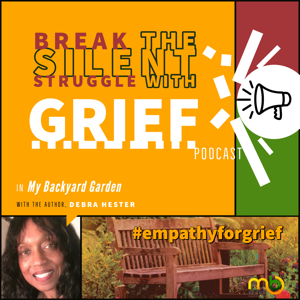
Welcome to Mother's Backyard Buzz and #empathyforgrief Episode #12, where I want to focus on "Going Through Changes." Each topic is all about "breaking the silent struggle" around grief.
My podcasts are based on my personal grief journey from my book: My Backyard Garden - A Memoir of How Love Conquers Grief. I share current insights into this life-changing journey called grief. Thanks for joining me, Debra Hester, as the author and your host of #empathyforgrief podcast.
March 2020 and COVID-19 is Deep
I'm still reflecting on Chapter 1, "A Change of Planes." in my book if you're following along. And this is the beauty of reflection; it takes into account our past and our present state. I'm sure if you're listening to this episode #12 in March of 2020, the current state of the world is changing faster than any of us could have imagined.
COVID-19, the coronavirus is a pandemic, and we in the U.S. are experiencing a different lifestyle. Information is coming from inside and outside of our borders, and we have daily reports on changing laws, decisions, requirements, progress, and events that affect our lifestyle. Right now, going through changes is an understatement.
To make my point, I'm going to share my podcast writing process. What I do is, I reread my book and the topics that I want to focus on I highlight and put them in a schedule. When the time and subject gets close, I spend some time reflecting on the topic and share my current insights. So basically, I plan my topics ahead. So months ago, I knew I would be writing my 12th podcast on the subject of "Going Through Changes."
March Madness Redefined
Looking back five years ago on my grief journey, I'm not sure if I understood the magnitude of this single word: change. For me, the term "change" was enough five years ago because that's how I felt; that's all I knew, and that's what I wrote in my book. At that time, five years ago, I had to make travel changes so I could go see my mother alive one last time. A somewhat simple task for a frequent flyer became challenging.
But even then, I had to keep my emotions under control. I consciously focused my mind, eyes, and hands on my laptop and that travel change website versus calling. If only for a short time, I needed to change what seemed like every detail of my life. I felt my mother's life coming to an end, and I wanted to spend every moment with her.
Life is change. 2020 is a new decade and has brought with it more change than most of us have witnessed in quite a while, if ever. Even the term March Madness has a dual meaning to me now with COVID-19.
The world, people, organizations, friends, and loved ones require us to change now. Believe me, I'm not knocking change. Actually, I sort of love changing. I believe in transitions, but it is still a process. Sometimes and some of us handle change better than others. I ask you to think back. When you reflect on the most change you've experienced, the offer to change often comes with rewards.
But, the collective we, including me, are going through so very much change right now, I don't even want to use the word "change." So for the rest of this podcast, when I talk about "change," I'm just going to say "goin' thru." That's how I feel right now, that going through changes in the world has stepped it up a notch or two, maybe three. We are "goin' thru" more than ever before.
Is "goin' thru" a bad thing? I believe not. But I believe it's a big thing, and an important thing to do, reflect on and as always show yourself and others some empathy during these times. As if we can just change. I've learned on my grief journey, we don't instantly change, we "go thru," then we, it or something happens that is different.
Goin' Thru Something Broader
On top of your grief, how do you feel amidst all this COVID-19 happening in the world? Many are encouraging people to be positive, and that is always good. That's what I'm doing too, remaining positive. I believe that positive thoughts and actions help our immune system. I try to laugh every day to keep my endorphins high. Exercise and stretching help me some. But laughing is easier.
Truthfully, I try to stay positive, regardless. And while I remain positive, I also can't ignore and rose color glass what's happening around me either, or I won't get the help my mind and body needs right now. I have to admit how I'm really feeling right now. My truth is, still, I'm goin' thru. Let me break it down this way:
I need to eliminate the word change, drop the letter "g" in the word "going" to make it "goin" and reduce the term "t-h-r-o-u-g-h" to "t-h-r-u." Yes, in my mind, we are all at this point in time, "goin thru."
When my mother died, I have now realized that I was "goin' thru" the beginning of a life event. A life-altering, mind-blowing event that on the front end started with trying not to cry while changing airline tickets. Somehow I was able to go thru without crying and get that task done.
I believe we all have untapped abilities that are released in times like these, and when life events demand it. They build us up, mold us, and alter us. If you haven't experienced the loss of a loved one, then grief and loss are one of those life events that call on some type of untapped reserve.
Even though I don't like to say "be strong" to people who have lost a loved one. I believe this is what people mean when they say "be strong." Personally, I'd rather say "be you" because I've found that grief requires many emotions. Usually, the person knows what they need, and when they need it. And with empathy, I work to be there for them.
Episode #12, "Goin' Thru," shares my perspective on our redefined March Madness 2020. As always, I hope that it is helpful. I believe we are in a time of "goin thru"; when we must adapt, modify, revise, and transform our lives right now more than ever. Remembering that many words will describe this time in our world, that it's more than that one word I didn't use and definitely more words than "goin' thru."
For me, defining these times this way, using "goin' thru," leaves it open and flexible for me to throw whatever I need in and take whatever I need out. Maybe thinking of it this way can help you through your journey too.
The Real Deal
Loved ones, I believe we are in the process of substituting the lifestyle we use to know to hopefully a lifestyle that is better. And that is going to take some "goin' thru." Grief and loss are real, whether it's losing a loved one or a lifestyle. So as always, I encourage you to show yourself and others more empathy than sympathy.
I want to thank you loved ones for listening to #empathyforgrief podcasts episode #12 about "Goin' Thru." My podcasts are based on my book, My Backyard Garden - A Memoir of How Love Conquers Grief. My book is a quick read. It's meant to capture and share the reality of life and inspire reflection and conversation for those of us who are on this grief journey or know of someone who is.
This is Debra Hester, your host, where I pledge to continue to break the silent struggle with grief and loss. Remember: move forward from the pain of your loss with love and more empathy, less sympathy. If you found the podcast helpful, it's available anytime on iHeart, iTunes, Google Play, or from your favorite podcast provider.
#empathyforgrief podcast is now on the radio with Force 3 F.M. Radio Network and also streaming online at www.force3radio.com at 2pm CST during their all gospel music Sundays. I invite you to find out more about my mission at www.mothersbackyard.org. Join me next week when we continue with Chapter 1 - A Change of Planes in my book, My Backyard Garden, A Memoir of How Love Conquers Grief. And the buzz will be about "Small Choices-Big Blessings."
Peace & Blessings.
Beginning with "That Moment"
Welcome to Mother's Backyard Buzz and #empathyforgrief episode #11, where I want to focus on "That Moment." If you're new, each topic is all about "breaking the silent struggle" around grief. I use my personal grief journey from my book: My Backyard Garden - A Memoir of How Love Conquers Grief and share additional insights into a journey we all will take called grief. Each week, I invite you to join me, Debra Hester, as the author and your host of #empathyforgrief podcast. So let's start with how I began my grief journey as I reflect and share this week's topic: "That Moment."
Lessons Learned From Opening Lines
Chapter 1 of my book is called: "A Change of Planes." In preparing to write this grief support memoir, I knew I had to find the start. I also knew the opening line of any book is essential. At the time, I didn't understand how important it is to the literary world or the importance of capturing the reader's attention. Now, I realize that the opening line is paramount, so if you don't think it's up to par bear with me in this memoir. It was the beginning of my writing journey. I promise to do better in my next book.
When I decided to share my grief story based on my experience, it took some time for me to reflect and understand where did my grief journey begin. How did I do it? Well, reflecting wasn't easy, but it is worth it. At the time I wrote the book, reflecting was like digging myself from underneath a lot of sand or dirt that was covering the person I thought I was. It was as if I was looking back after running from something horrifying in a dream. I know I had gone through something for sure and felt safer but what did I just go through was the lingering question in my mind. And the next issue was where did all this really begin? What was the moment, "that moment" that started me running like this and feeling this way?
In my mind, I hit the rewind button. That allowed me to review my mental footage over and over again. I was trying to figure out where did this grief really start? For Chapter 1 of the memoir, the question had to be: "Where should I start my story?" This is a good question, regardless. Where did my grief really start? It applies if you're journaling during your grief journey for personal reasons. It also applies if you're just trying to understand what you're going through, I ask you to think about what was "that moment" for you? You also might consider the value you might gain in reflecting on "that moment" in your life.
Pondering "That Moment"
If you're still pondering, "what moment?" Let me say more about how to explore and reflect on "that moment." Reflect on the exact moment when you started on your grief journey. I found value in trying to pin down that time, that place, that thought to a precise moment. It uncovered a new meaning for my life and my journey. It helped me not only look at myself but my loved one and others around me. For me, reflection sort of puts a scene or situation in slow motion, where you can focus and refocus on different things that may bring clarity and meaning to your journey.
You may already know what "that moment" is depending on how recent it was and how reflective you have allowed yourself to be. If your grief is from long ago, it may not be as readily available to you. My first father was killed in an accident when I was a child and very recently, I experienced myself at his funeral in a dream. I woke up crying, crying in a way that I couldn't at his funeral. Crying wasn't easy, but I realized that it was good and needed. All these years, those emotions were buried inside because that's how I was raised. Just close the chapter, and I did close the chapter; however, I hadn't resolved the pain from the trauma. For me, crying over that moment some decades later was freeing.
So here's another question: Do you need to dig that moment up? As always, it is your decision; but unless you feel resolved in your past, you might want to consider remembering that moment again. That moment when you started on your grief journey.
Well, if you listened to Podcast # 10, you'll know that I always give you a preview to my next podcast. I knew I was going to write about "that moment" for some time. That moment when I knew that my mother was going to die. Even though at that moment, when I knew my mother was going to die, I couldn't admit it to myself. Why? Simple because it was something that I didn't want to happen. I had plans for me and my mother. She wasn't supposed to die before we had more trips together and birthday events, we had more life to live.
Kobe Bryant's Death Was a Reminder
Here's another thing. I've been hesitant about writing and completing this episode topic for weeks. Hearing about Kobe Bryant, the legendary, professional basketball player, his daughter and the people who lost their lives in that helicopter accident in L.A., created a "that moment" experience for me. I can move forward because of the podcast artwork I chose for this episode. An associate shared a photo he took on LinkedIn, paying tribute to Kobe's tragedy, and I thought Kobe's Empire State Building tribute is a visual reminder. Maybe the visual would help people remember how that moment feels. Hopefully, it would remind them to have #empathyforgrief for themselves and others.
Another reason is that I felt "that moment" real-time again, along with the rest of the world. That moment is when you can't believe what you're hearing, seeing, or know to be true. It seems unreal, you're speechless, you're confused, and your mind and spirit want to reject the news; but it can't because it's true. For me, it's not shocking yet, "that moment" comes before the shock. That moment is a second, maybe longer where I reject reality. Then when I accept the truth, I'm shocked and saddened by the news.
While my mother's death was not as instant as Kobe's, the moment I heard about the helicopter accident, helped me realize how there is rejection before the shock. The news of his death prompted me to hope for something different than what I knew was the inevitable. Maybe the family's of the helicopter crash felt the same way too when they heard the news. When I heard of that moment with my first father's car accident, I thought I was living a dream for about a year. I'd wake up most mornings, hoping that his accident was just a dream, and he would be coming home that day.
Reflecting on the Impact of "That Moment"
I hope it's clear what I mean by "that moment," so we can consider and discuss how reflecting on that moment may bring value to the grief journey. Let's reflect on that moment when you knew that your loved one was going to die, but you hoped for something different.
First of all, when that moment involves others, and it usually does, it becomes complicated. Why does it become complicated? Because now I realize that each family member came to their moment at different times. In my mother's case, I mean that moment that she was going to die or she had died. Some people may describe it as letting go. In hospice, they told us that sometimes people hang on and not die because their loved ones don't want them to go, and the person who is dying can sense that. I tell you, it took all I had not to scream, cry and plead with my mother to hold on. I didn't want her to die and leave me. But I didn't do that, and for some months later, I was torn between wishing I had, feeling guilty that I wanted to be selfish
Often people realize how sudden, tragic deaths affect people because "that moment" is in what seems like an instant, but we remember for a lifetime. Like, John F. Kennedy Jr.'s airplane accident where he, his wife, and his sister-in-law were killed. 911, or Kobe's death and other unbelievable tragic situations, we will always remember those moments. We will not forget where we were or who we were with. But what do you do after that moment? What should you do? I've found it helpful to feel what you're feeling and release your emotions. What I think is the hardest thing to do is realize that everyone is going to respond differently at that moment and after that moment and remember that's O.K. They may react right away, minutes, hours, days, or even months later. And that's O.K. In response to that moment, we may cry, pray, say nothing, or get angry.
That Moment on Social Media
Kobe's death was the first time I was actively on social media during a tragedy that impacted people around the globe. While most people were sad, some didn't understand why we were grieving on social media over someone we didn't know personally. I read some of the conflicting posts on the internet about mentioning Kobe and his daughter's death and not others on the plane. Some asked why people are saying all these positive things about him now. My response was to let people grieve openly by showing their emotions, memories, and photos in a way that works for them. Nothing should be disrespectful to the loved ones left behind. I believe having the social media tools that let us share our feelings like this is good for us as a society. We have hidden our voices around death, dying, and grieving for so long. We no longer have to feel that we are alone, and that is a positive thing.
Some thought it was because he was a celebrity, a famous person. Still, I genuinely believe that a tragedy like that, whether it is a famous person or a plane filled with people we have never met. We know that it is final, it was not their plan, and we are saddened by the unexpected loss of life. We can imagine how their loved ones fill because it could be our loved ones or us. We have #empathyforgrief. So when you remember "that moment," what I always remind you of still applies, show empathy for yourself and others.
Offering Value
I want to thank you loved ones for listening to #empathyforgrief podcasts episode #10 about "That Moment." My podcasts are based on the book, My Backyard Garden - A Memoir of How Love Conquers Grief. If you're joining the weekly podcast, to follow along with the text, you're not behind. My book is a quick read. It's meant to capture and share the reality of life and inspire reflection and conversation for those of us who are on this grief journey or know of someone who is. To reflect on "that moment" and look for value in it now. As I continue to reflect and share through my podcasts, I hope that we continue to move and heal.
This is Debra Hester, your host, where I pledge to continue to break the silent struggle with grief. Remember: move forward from the pain of your loss with love and more empathy, less sympathy. If you found the podcast helpful, it's available anytime on iHeart, iTunes, or from your favorite podcast provider. #empathyforgrief podcast is now on the radio with Force 3 F.M. Radio Network and also streaming online at www.force3radio.com at 2pm CST during their all gospel music Sundays.
I invite you to find out more about my mission at www.mothersbackyard.org. Join me next week when we continue with Chapter 1 - A Change of Planes in my book, My Backyard Garden, A Memoir of How Love Conquers Grief. And the buzz will be about "Going through Changes."
Peace & Blessings.
Episode #10 starts With Chapter 1
Welcome to Mother's Backyard Buzz and #empathyforgrief podcast episode #10, where we "break the silent struggle" around grief by unpacking my book: My Backyard Garden - A Memoir of How Love Conquers Grief. Each week, I invite you to join me, Debra Hester, as the author and your host as I share additional insights into a journey we all will take called grief. This episode, I'd like to discuss an exciting time of each day called early mornings.
The title of Chapter 1 in my book is called: "A Change of Planes." Reflecting back now, I don't believe that it was by chance that my memoir started in the early morning hours, either. You know I could have gotten that phone call at any time of the day or night. Still, it was in the early morning when I received the call that my mother's condition was life-threatening and that my mother was in the hospital.
A Night Person's Perspective
Getting back to the topic: Early Mornings. I've got to ask you this question: Did you yarn when I said the word; "early mornings"? Because I'm really a night person, the thought occurred to me to yarn, but I didn't because of course, I'm recording. But over the years, I've learned that early mornings are a distinct time of the day. I wonder if people who are naturally morning people realize what a unique gift they have. Morning people have the gift to wake before the sun with ease and delight. And with an energy level as if it's 10 am or the middle of the day. It's an incredible ability to me!
When I was in college, I didn't even want any morning classes so I'd schedule the latest morning classes possible. Even after college, my first full-time job was working a 4 pm to midnight shift and I loved it?
Now I could stay up all night until the early morning; but that doesn't count here. When you stay up all night until the early morning, you're tired and exhausted. It's what I like to cal "spent". Everything that you could contribute to any situation is worthless...you've spent all your energy.
At times grief makes me feel spent too. It's hard to sleep through the night, even thought you're said and tired during the day. Grief can be exhausting all by itself. Plus, it's exhausting trying to hide how you really feel so you can function through work, school, or family gatherings.
Along with feeling exhausted, I'd also feel anxious, frustrated, and lonely. I spent a lot of time reflecting on how I felt sad until I had to start looking for ways to feel better emotionally and physically. There was this song that I learned in the youth choir call, "I Come To the Garden Along". Th lyrics start like this: "I come to the garden alone when the dew is still on the roses." In my mind, it meant early in the day. This song had helped me long before my mother died, and I enjoyed it before my book title or my social platform on grief support. However, the reference to morning in this song helped me embrace the power of early mornings.
An Awakening
Like I said earlier, I had to develop my appreciation for early mornings. How did it start? Well, it started when I first started developing my personal relationship with the Creator, I would study and read spiritual information before I'd go to bed. As time passed, and I also developed a better prayer life. When I say better prayer life, maybe I should call it a deeper prayer life. My prayers had moved from the repetitious prayers you say before you go to sleep as a child; to adding a real conversation. My praters included things I was grateful for, wanted for others, for the world I lived in, as well as myself. I was blessed with spiritual mentors, who also helped me with deepening my intercessory prayer life.
So what does prayer have to do with early mornings you may be thinking. You may also be thinking, Debra's going to ask me to get up and pray early in the morning. I could ask you that because it's relatively traditional. Do you remember prayer breakfast and sunrise service? Yes, I do too and for the longest, those gathering didn't interest me. Remember, I was not a morning person. I was not going to get up that early. Not even for some of the best pancakes in the world. So I'm not going to ask you to get up in the early mornings to pray.
Now you can if you'd like; but I believe you should pray when you feel you should pray. Prayer doesn't have a specific time when it should be done.
So what I'm going to do is share with you what happened to me, and you can decide what you need to do. Remember the deeper prayer, spiritual reading and studying at night before I went to bed habit I developed? Well, after a while, I would wake up at 4 am in the morning. Me, the "not" a morning person, not even for pancakes and bacon, would wake up at 4 am..was wide awake! I wasn't sleep, I didn't want to go back to sleep.
Of course, I panicked because I had a reasonably challenging career and didn't have time to miss a beat during the working day. I was glad that it wasn't every morning, but it did occur 2-3 times a week. After trying to figure out what was going on, it just came to me that maybe I should spend this time in prayer and meditation.
So I started meditating so that I'd have enough energy to get through the workday. Meditation gives me longer-term energy even thought I started drinking coffee in my later years too. Then I realized that time didn't seem to pass as fast during these early mornings. It seemed like a slower time of the day, sipping my coffee and enjoying the this simple pleasure.
I learned to appreciate the calm, the quiet. When I traveled, even the busiest cities were pleasantly peaceful early in the mornings. I had time to observe how the world and the skies changed as the daylight would overcome the night. It was a very awesome experience! And I thought I've been missing this for all these year to sleep in!
Early Mornings Help Heal
My appreciation for early mornings did happen before my mother died, and before business travel required it. Bu after she passed, I have realized that early mornings are still a great time to gather and collect peace during the grief journey. So I encourage you, loved ones, to add an early morning or two experience to your week.
It may take some planning and change of schedule the night before but give early mornings a try. I look forward to unwinding early the night before and rising before the sun. In the early mornings, think of your garden place and your good memories of your life with your loved ones. Think a bit about your favorite creative project, read or write down a few thoughts. I take photos with my phone of how the sky changes colors in the morning.
Yes, I know you may cry during that time. I have. And I hope you caught, smile and also find some peace. If you're not an early morning person like me...imagine what your loved ones will think. But tell them, you're O.K., you're changing and this is something new your wanted to try as you move forward on your journey.
Ways to Engage
I want to thank you loved ones for listening to #empathyforgrief podcast episode #10 about "Early Mornings". My podcasts are created based on my book, My Backyard Garden - A Memoir of How Love Conquers Grief. If you're joining the weekly podcast, to follow along with the text, you're not behind. My book is a quick read. It's meant to inspire reflections and conversation for those of us who are on this grief journey. As I continue to reflect and share through my podcasts, I hope that we continue to move and heal.
This is Debra Hester, your host, where I pledge to continue to break the silent struggle with grief. Remember: move forward from the pain of your loss with love and more empathy, less sympathy. If you found the podcast helpful, it's available anytime on iHeart, iTunes or from your favorite podcast provider. #empathyforgrief podcast is now on the radio with Force 3 FM Radio Network and also streaming online at www.force3radio.com at 2pm CST during their all gospel music Sundays.
I invite you to find out more about my mission at www.mothersbackyard.org. Join me next week when we continue with Chapter 1, "Change of Planes" in my book, My Backyard Garden, A Memoir of How Love Conquers Grief. And the buzz will be about "That Moment."
Peace and Blessings.
My Why and Your Why
Welcome to Mother's Backyard Buzz, a podcast #9 where we break the silent struggle around grief by unpacking my book: My Backyard Garden - A Memoir of How Love Conquers Grief. I am the author and your host, Debra Hester. We've completed the intro of the book. The original plan was to have a guest speaker on the podcast at the end of each chapter. But I changed my mind and decided to talk about my "why", as we end the Introduction Chapter. And of course, when I thought about my "why", I thought about asking you to think about your "why".
In the future, I plan to have a guest speaker address the topics we've covered, listeners' questions or responses as appropriate. So you still have time to send in your questions or comments to my email at [email protected].
More Than the Why Chapter in My Book
#empathyforgrief's first eight podcast episodes have only covered the Introduction Chapter of the book so far. I don't want to rush and hope you're O.K. with the pace too. I decided to share a little more about myself and my "why". I will start the guest speakers when we get to the end of Chapter 1 and continue through to the end of the book. So remember, we will continue to break the silent struggle with grief. Chapter by chapter with #empathyforgrief podcasts, we will move deeper into what I included and didn't include in my book that speaks to this journey we all take - called grief.
How do I share my "why" with you became a sort of a dilemma for me? It's a dilemma because I don't like to talk about myself. I actually considered doing this in an interview. From my observation, in both professional and private setting, some people seem to be able to talk about themselves and what they're doing with ease and acceptance.
Personally, I've always found it challenging. In Corporate America, the people who were able to speak up with ease seemed to get promotions and the attention of their superiors. I learned to understand it as self-advocacy. I'm not sure if I'm good at it after all these years or not. But I do appreciate self-advocacy and see value in it even thought I was raised in a culture that taught me to work hard and let my work speak for me.
So since this is the end of the Introduction Chapter of my book, I thought it might be a place for me to share with you a bit more of what I'm about and the platform that I feel is my purpose in life: #empathyforgrief. Don't worry, I'm not going to share a recap of my educational or professional bio. If you're interested, You can get that on my website at www.mothersbackyard.com or on my book cover. I'm hoping to share a little of my "why" and how #empathyforgrief came to be.
Why Ask Why on the Grief Journey
Depending on where you are on your grief journey, you may be asking yourself, "why me"?, "why now?". "is anything useful going to come out of how I'm feeling?" These were a few of the questions that crossed my mind a lot. These questions along with others that were probably less about a healthy curiosity and more of a complaint and self-pity. But we're going to focus on when you get to a position of being curious in a healthy way. Some of us are there sometimes and some of us may feel that we'll never get to feeling a healthy curiosity about our feelings of grief. I encourage all, including myself, to hang in there.
Only you will know when to do this; but, I encourage you to start asking yourself and the Creator, "what positive thing am I suppose to do with what I'm experiencing?" It may be to write a book or a poem, to plant a garden, building a bench, or paint a wall. Believe me there is something. And it will come to you what your "thing" is. For me, it's a project, a platform that I'm compelled to create. It's my "why". Sometimes tears come to my eyes when I think of it and sometimes joy. But I feel deep in my hear, it's what I was supposed to do right now.
So I'll refer to it as a positive project as I talk about it more. Whether your positive project is big or small, whether it takes an hour to complete and you look at it for ever. Or it may take a year or it may be ongoing. I encourage you to meditate on: "what is this thing that is to come out of my grief." Your thing will come to your heart, your spirit and your mind. And I believe you will create it in the physical world, and the world will be a better place because of what you created.
Coming back to my "why". My first hope is that you read the Introduction Chapter of my book. It's in a different writing style, but this section lets you know how I felt overall and why I included things in the book at that time. Chapter 1 starts with the memoir style of writing that tells the story of how I began my grief journey that made me realize my purpose in life as a part of my mothers's end of life story.
"Why" Changed Things
You see, who I am now was not a plan that I started with. I was grieving the death of my mother, and I started out being obedient to something my mother told me on her death bed. Then it became a commitment to finish a book that would be for my family and for future generations. But along the way, I realized my grief might be able to help others. I meditated daily on my emotions while I completed my book project about my mother and me. I would walk every morning, and a flood of ideas came to me. Do this, do that, then say this and say that. Ideas were coming so quickly that I had to keep my phone next to my bed to dictate notes.
As time passed, I finally realized that this was the problem in the world, I was born to contribute to and help solve for myself and others. I realized that every job I ever held and every skill I ever learned was helping me right now with this. From my first father's death to my uncle's death to writing obituaries at a funeral home to writing educational training materials, to broadcast journalism to corporate leadership and professional development. My past seemed to come together like a puzzle piece. O.K. I'll admin there are still some pieces missing. However, what looked like an unplanned yet relatively successful career transitioned into a very focused mission and vision for my life.
This awareness helped me become a grief advocate and create a platform, mission and podcast around #empathforgrief as a social entrepreneur. All this came to me after I had written and published the book: My Backyard Garden, A Memoir of How Love Conquers Grief. So you see, something is waiting to be born and created out of your grief too.
Trauma
I've been reading this book on trauma. My inability to feel comfortable talking, especially about myself, may have been part of my upbringing and being traumatized as a child. When my first father was killed, I spent many years being soft-spoken. I loved to see other people enjoy themselves. Still, I didn't care to talk much to anyone but my closest friends and immediate family. I was a great listener because I really wanted the other person to do all the talking.
From the outside, I put on a spectacular performance. I remember people use to say: "That child looks so unconcerned." That unconcerned child turned into a reserved, very insecure, vulnerable, fearful and naive young adult. My saving grace was my ability to perform with fear in my heart. Physically, it manifested itself in overeating and digestive disorders. Another saving grace was that I was a healthy eater, it was all about portions out of control and I did like to dance.
Why #empathyforgrief
The last thing I want to share is why I am so passionate about #empathyforgrief and how it came to be my hashtag for breaking the silence with grief. I feel we as human beings do feel empathy for people who have lost a loved one. We have just settled with the label sympathy. What's in a word, you might say? Everything! This word is especially important for people who have not felt the death of a loved one like we have. They believe sympathy is enough. The term "sympathy" is socially acceptable, what more could we ask for when someone dies they may think. They may think we're all going to die. And, indeed, we are all going to die someday.
But until you experience the loss of that special loved one, it's hard to understand why sympathy isn't enough. Maybe it's enough for the deceased, but it is not enough for the loved ones who are left behind. We need your empathy now and for some unknown time in the future. We need your understanding during our transition into a world without our loved one. No matter how sudden or advanced notice we had about their death, we wake up one day and feel as if someone has been ripped from our lives. Big-time focus on the feeling of cutting, ripping here. Imagine someone being ripped away from a person, and you may begin to understand #empathyforgrief.
Thrive In 2020
Now, as you listen to my podcasts and read my book, I hope you will feel a bit more familiar with me. Hopefully, you can uncover some things that will help you and others that I may not have realized. In each podcast, I will ask you to try something or apply what I've discussed in your life. I want us to do something positive when we feel able. I want us to move with and through grief, just as I did with my fears. I want to encourage you to do beyond the SSOGS (Secret Society of Grief Surviors) and to thrive in our world that has changed since the loss of our loved one.
What I love most is that we are on this journey together. I felt so alone at first. Now, I realize that grief is a universal and shared emotion. I am not alone on this journey or the odd person out. It is a part of being human. Nothing to be ashamed of and a feeling that you don't need to hide.
I hope you don't think it make me happy in the sense that misery loves company. Let me explain why it makes me happy. My hopes are if we can break the silent struggle with grief; then, maybe we will break the silence and shame about other traumatic experiences so people can heal. This way, we create a culture where we all can grow through life's traumatic experiences.
So many people compare their traumatic experiences. They think that wow, her mother dying is not as traumatic as my friend dying. Studies show that we can't compare. Denying your emotions around grief based on comparison to others may not prove to help you move forward with your pain. That's why my platform and mission is around #empathyforgrief. I want us all never to forget to show empathy towards yourself as well as others.
Plans are underway for me to continue my podcasts through podcast providers and on radio broadcast programs. I also have an in-person MOVE Mapping Workshop for organizations and groups. The workshop experience is designed to make people aware of how the grief journey changes lives and become clear about what to two now and how to do it.
My workshop experience is designed for individuals, grief support groups, public and private organizations, especially supervisors and managers. It's a life skill that many aren't confident in how to handle successfully. So you see, that's the #empathyforgrief plans right now, so I hope you'd participate by sharing my information with others who need it. That's my only ask!
Next Episode
If you found the podcast helpful, please subscribe to me on iHeart, iTunes or from your favorite podcast provider. Find out more about my mission at www.mothersbackyard.com. Join me next week when we continue with Chapter 1 - A Change of Planes in my book, My Backyard Garden, A Memoir of How Love Conquers Grief, and the buzz will be about "Early Mornings."
Peace & Blessings
Welcome to Podcast #8:
Welcome to Mother's Backyard Buzz, a podcast where we "break the silent struggle" around grief by unpacking my book: My Backyard Garden - A Memoir of How Love Conquers Grief. I am the author and your host, Debra Hester. Chapter by chapter, I'll move us deeper into what I included and didn't include in my book that speaks to this journey we all take - called grief.
Explaining Extensions
Loved ones, when I decided to create the title for this podcast, the word extensions came to mind. Culturally, I thought about hair extensions, and I chuckled to myself and wondered what would happen in my listeners' minds when they saw this title. I thought if my listeners would wonder, now how is this girl gonna tie in extensions with grief. Well, I'm going to leave the hair extension analogy to you. If you can find and make a connection, let me know. But I'm talking about a different kind of extension. I'm talking about an emotional extension. Just like we look at most other extensions, as a positive think, whether we are adding to our hair or adding on to our house, this extension is positive too. So let's start with thinking about grief as this emotional extension. I'll start with me, and you can think about how this applies to you. What happens to me when someone tells me of their loss? I don't know about you, but I've felt at least two responses. These responses are not in any particular order and it may seem to change order depending on how close I am to the person or not.
Responses to Death and Grief
Recently I was told about two people who died. The first one was a distant cousin. I had not met this cousin. And when I heard of his tragic accident, I immediately started feeling for the cousins that I did know who knew him. Then I began wondering how his immediate family might be feeling since the pictures that were shared online looked as if he was a rather young man. My heart and prayers went out to them all. I thought about how difficult it must be to lose someone so unexpectedly and in the prime of their life. Then, I thought of the impact on the children and also how the rest of the cousins and family members reached out to them, including myself, with support and words of encouragement. I felt good about the support and responses that were given. It reinforced my belief that I am blessed with a very compassionate family.
The second person I heard about recently was a person that I grew up with, and he was about my age. Our families know each other. We hadn't stayed in touch over the years. However, because we spent so much time together in our formative years, there was a lifelong connection. We would see each other at events, say hello, do a brief catch up and move on until the next time. He had told me that he had overcome a severe illness and so I thought that he was doing better. When I heard that he had passed on, I was shocked, somewhat bewildered and felt sad and a little ill. I had to talk myself through it and come to the realization that even though the last time I saw him that he looked well, that must have changed. I felt for a moment how his mother, brother and sister must feel. How his family might need support at this time? So I thought about what can I do now for his family, so I needed to reach out to them and let them know I was available. Since I know that grief is a journey, at the right time in the future, I will reach out and share my book and podcasts as a resource to them also.
My point about sharing these two stories is that we all have some type of response. Buy my question for us to consider is why? I'd also like us to think about how we feel, and where do our emotions and thoughts go when we hear about the death of a person?
I seem to have a personal moment of silence. Regardless if I'm looking at the person or not, there is this moment of pause. I can be with them or can be reading or hearing about them and there is the same response. A moment of pause. There is a second of stillness. Now, I was exposed to the death of a close loved one early in my life, so I'm not sure if this is the reason or not. In the grief journey that I'm sharing with you, we may be with each other, or you may be ahead of or behind me in reflection and understanding. So I encourage you to share with me your responses to hearing the news that someone has passed on. But a response to hearing about death, I believe, is universal. It's personal, and different in everyone but a response happens.
Being able to be ready and prepared to show empathy to ourselves and others is part of what breaking the silent struggle with grief is all about. I think considering our very own and human response to hearing about the death of a person is worthy of discussion and reflection. I believe getting the conversation about death, not just dying out here and talking about it will help us value life more.
On our last podcast, we talk about the emotional stages of grief. We talked about how I experienced them emotions in a not so sequential, logic, or prescribed way. This time I just shared my reactions to the news of two people who I know died recently. I want us to realize just how empathy probably already works in most, if not all of us and that we are connected and are extensions in life and in death.
Empathizing With Death
Can you imagine the emotions a mother goest through when she hears that her son or daughter was shot and killed? I've spent a lot of time on my grief journey after the loss of my mother to old age. But when death is tragic, sudden and unexpected, it takes the feelings to another level of grief. When death is the cause of a senseless act like drunk driving, imagine the pain that the family feels. My first father was killed on Mothers's Day by a drunk driver. I talk about it in my book. I was at the accident scene and when I pass that spot now, I can still see the accident scene decades later. That is one kind of extension that Id like us to think of. When we lose a loved one, we are forever attached to that moment. It becomes an extension of who we are, of our life. I often wonder if the lady who was driving drunk then ran a stop sign, hit the side of the car where my father was a passenger, and killed him ever thinks about it and about us. I wonder if on Mother's Day, does she remember. Death is and should be an extension because we are all connected anyway. And when something tragic happens, it doesn't disconnect us, it creates a shared incident and a moment of shared human emotions.
Why do I want us to think about death and grief as an extension and a connector, you might wonder? Because I hope that it will make us realize that we share loss. And we need to show more empathy because we all will grieve, so when it's your turn to grieve, you have established a spirit of caring about others. Understanding that it is human to grieve, before your humanity is tested. You don't have to wait until it happens to you to learn what it's like when it is happening to someone you know, work with, manage, or live with. You don't have to hesitate or feel uncomfortable because you don't feel as if you know what to do. The person who is grieving needs you to connect at some point and check on the connection periodically.
The other reason is for those who resort to gun violence and killing as a solution to anything. If you're listening, it won't be the first time someone has told you what I'm about to say. I'd really like you to consider how your actions are impacting not only that person's life but their family, loved ones and the community where you live. As I said, if you're listening, what I'd like you to think about that maybe you haven't thought about is this: We are all connected. Because we are connected perhaps now, you will also realize that taking a life also affects you and your life. Killing someone does not solve a problem, it creates a lifelong problem. You are not just taking someone else's life, you are connecting yourself to death forever. In your false attempt to get rid of a person, if you kill another human being, they will be connected to your life permanently. Because you have now made a permanent connection to a person, who you thought you were eliminating them by killing them. They die yes; but, they are always connected to you. You may forget why you killed them, but you won't forget that you killed them. That's what people mean when they say they are being haunted. It's a different type of connection, yes, but they are still an extension of your life story. That's why I think they are called senseless death. They don't make sense to the loved ones, of course, bu the victim is senselessly now connected to his killer or to her assailant and vice versa.
Death and grief are extensions. When you're angry or hurt enough to think and act on hurting yourself or someone else, show empathy for yourself, and don't do it. Showing compassion for others, yes, is essential; but since we are all extensions, don't forget that empathy is working in many directions. Empathy over just sympathy is working for you and others.
Until Next Time
I want to thank you loved ones for listening to Mother's Backyard Buzz. This is Debra Hester, your host, where I pledge to continue to break the silent struggle with grief. Remember: move forward from grief with love and more empathy, less sympathy. If you found the #empathyforgrief podcast helpful, please subscribe to me on Spotify, iTunes or through most podcast providers. Find out more about my mission, at: www.mothersbackyard.com. Follow me on Twitter, Instagram and Facebook. Look for "mothers backyard." If you have a question or comment, you can always email me at [email protected]. Join me next week when you'll get to know a little more about me and my mission: #empathyforgrief. I'm hoping it will be insightful before we move from the Introduction to Chapter 1 of my book, My Backyard Garden - A Memoir of How Love Conquers Grief. Peace & Blessings
Welcome to Mother's Backyard Buzz E7
Here we are at episode number seven of #empathyforgrief podcast where we "break the silent struggle" around grief by unpacking my book: "My Backyard Garden - A Memoir of How Love Conquers Grief." We're taking our time, so I'm still unpacking the Introduction section of my book. If you have a copy of the book, I'm sure you've passed where we are. But the whole objective of the book and podcast is about life long learning, reflection, experience, and growth. I know I sound like your local learning professional, and I am. This is Debra Hester sharing my personal grief journey. I'm blessed to be the author and your host of #empathyforgrief podcast. Let's get moving and delve into what I included and didn't include in my book that speaks to this journey we all take called grief.
Let's Talk and Walk in Five Stages
Do you know the stages of grief? I had heard of them before my mother's death. At that time, in my mind, they were just another model that was created from someone's college research study. After my mother died, and I realized I was on this grief journey, I Googled them. That's when I found out there are five stages of grief that explain the series of emotions a person can experience when they have lost a loved one. What I didn't realize was that there are also seven stages of grief.
But I'm getting ahead of myself. Back to the five stages of grief. Just as a refresher, the five stages of grief are: denial, anger, bargaining, depression, and acceptance. They are all pretty straight forward in their meaning except for "bargaining." So for the purpose of our topic today, how I've understood the bargaining stage is that it's an attempt, please note the word "attempt" to negotiate pain away.
When I initially learned about these, if I wasn't already in the anger stage of grief, I automatically went there, to the anger stage. I though how dare someone tell me how I'm going to progress through the grief process and come to acceptance. And who says, "I'm angry now and depressed later versus just always depressed. I tell you when I very first looked at this as a resource, I felt helpless. I ignored this entire concept and model because I wasn't following this. This wasn't what and especially how I was feeling. The stages were not tracking with me.
I thought that no one was going to be able to help me. Especially if the stages of grief were the best the information age had to offer: just five, looking like a shortlist to me, stages of grief.
Seven Stages Forward And Five Steps Back
So now, let's move to the seven "emotional" stages of grief. And I think it would be helpful to remember and include in the label "emotional" stages of grief. They start with shock or disbelief. Next comes the same as before: denial and bargaining. We add "guild" and continue with anger, depression, and "hope" as a Part of "acceptance": "hope/acceptance" as the final seven emotional stages of grief. Now, if we count all th terms separately, I would count nine emotions. I definitely went through both the "shock" and "disbelief" stages. And , it wasn't an "either/or" moment; but a both of these emotions.
I know its' only a framework, but I can't believe I'm the only person who saw this resource and shock my head in disbelief. So I'm all about breaking the silent struggle around grief and trying to tell you that what you're feeling is normal and you're not alone. So, if you're not tracking or seeing your journey in the stages of grief, you're not alone. It's O.K.
A Grief Journey That's Human
After I experience the death of my mother, I looked at grief differently. What I'm most afraid of is that many people who haven't truly experienced a grief journey may think that these stages are all there is to grief. These emotions, these stages of grief define how we, the grieving, are feeling and will feel. I know it's an attempt. I want to be clear to my listeners that it is just that: "an attempt" because I am still writing about my grief journey and I'm closer to "words can not explain how I feel."
I've found that many things come back again as you move through your grief journey. When the stages of grief returned to my thoughts, I began to wonder and ask myself, are they "stages" or responses to the pain of loosing a loved one? For one, stages made me feel like they were sequential or steps and I had some type of order, like they were placed. There is not specific order, I was so all over the place emotionally. I realized that I don't care for the word stages either. A picture of me on a revolving stage came to my mind. I don't mean to be trite, but let's be real, they are emotional responses. We are human, we have emotional reactions to things.
A stage makes it feel like there is some defined period, and then you move on. Not. And most of the emotions seem not very positive, and that was not always true. At times during my grief journey, there was joy, that wasn't about acceptance. There was regret sometimes and , at other times, even a feeling of accomplishment when I found everything that would be my mother's burial outfit. In my MOVE Mapping for Grief Workshop, we spend time talking about exploring this concept to explore and broaden our perspectives on the many unnamed human responses to grief.
Numbers Cannot Define But We Can
Now that we've discussed the limits of the stages of loss, I hope we recognize that there are potentially many emotional responses. So the question is: Can you use this framework as a way to begin to identify what you are feeling your loved one who is going through this grief journey might be feeling? Like most of my podcasts, it's a discussion that reflects on my personal grief journey. However, I share because I was hoping we could think more and differently about these preliminary stages of grief. Or you know how I like to think of them as: "emotional responses" to the loss of a loved one.
So I ask you, what emotional responses have you, or are you going through? Write them down, think about them. What triggers them? How long do they last? Look into how professional counselors or psychologists define them. Ask others that are close to you if they see these emotional responses in you. Then own them, recognize that they are not who you are but what you're going through right now.
If you're watching a loved one who is grieving and going through these emotions, it's helpful to realize that they are going through and hopefully not becoming. However, have the patience for them. Remember they're going through a period that is not defined. Show empathy and ask them if you can help in any way.
I hope you reflect and have an ah-ha moment. When I have mentioned this to others, they often say, I hadn't thought about that the change I've been seeing because they lost a loved one. So loved ones, I'd like you to watch for these emotional responses that don't seem like the normal you. Write them down, take a note, reflect and talk to someone about how you feel. If you wake up and just feel off, stop, find your place, reflect to see if the root maybe your grief, and then try and use some of the other suggestions that I've made in previous podcasts.
I hope this podcast can help you identify or at least look for these emotions in yourself and others. Remember long after the funeral, any of these emotional responses can appear. And when they do, it's an excellent time to show #empathyforgrief towards others and yourself. If you see something different in the person who is grieving, ask them how you can help, if they need to talk it out, if they'd like to share why the sudden change in emotions. Be there for them, be there with them, try and see how you can help them move forward when grief strikes.
Grief is Not Just Emotional
I want to leave you with one final thought about the stages of grief. These stages are only emotional responses to the loss or death of a loved one. There are behavioral responses, for example, "I can't sleep." There are also physical responses to grief, for example, "I feel sick to the stomach" or "I have aches and pains. They are real too, I am just not addressing those in this podcast. I do share them in my book because I went through them, and I will likely discuss those other behavioral and physical responses to grief at that time. Remember, we are on this grief journey together. We want to move forward and show more empathy than sympathy along the way.
Now and Next
I want to thank you loved ones for listening to Mother's backyard Buzz podcast: #empathforgrief - Break the Silent Struggle With Grief. This is Debra Hester, your host, where I pledge to continue to break the silent struggle with grief. Remember: move forward from grief with love and more empathy, less sympathy. If you found the podcast helpful, please subscribe to me on Spotify, Apple, iHeart and other podcast providers. Find out more about Mother's Backyard mission, at www.mothersbackyard.com. You can follow me on Twitter @mbackyardgarden and on Facebook and Instagram at Mothersbackyard. Join me next week when we talk about "Extensions," did you know grief has roots? Peace and Blessings.
Welcome to Mother's Backyard Buzz.
This is podcast # 6, where we "break the silent struggle" around grief by unpacking my book, My Backyard Garden - A Memoir of How Love Conquers Grief.
I am the author and your podcast host, Debra Hester. Chapter by chapter, I'll move us deeper into what I included and didn't include in my book that speaks to this journey we all take called grief.
Why I Didn't Use Family Names
Grief is so deep and wide, believe it or not, if you're following along with my book, I'm on the Introduction. I know people don't always read the Introduction, but I want you to read my intro because I share many of my why's theres. I'd like to talk to you in this episode about "why" I used relational names in the memoir instead of my family's actual names or some fictitious names. So let's explore what drove my heart and mind to do that.
Who are we to each other? When we say that we know someone, who are they to us? I was going through life accepting or ignoring who people were to me, really. One side of my family had the habit of calling everyone by their birth name. Some of us had two names, and some had three names in addition to your surname. On both sides of my family, most of us were given names in remembrance of one of our ancestors or someone we admired. I believe when we are named after an ancestor, it is an honor. I love this tradition.
On the other side of my family, I had a relational title, like "Sister Debra" or "Cousin Debra." When I realized the difference, I started reflecting on how dear that made me feel. When I was grieving that made me feel better, I felt as if I belonged. That relational title strengthened me in way that I never realized before. I don't think I've ever been into many titles. I had a professional title as a director, but no one called me Director Hester. I wasn't a doctor, attorney or minister so, of course, I wasn't referred to by those titles.
In the southern part of the U. S., people tend to address you as Miss or Mrs. more than other parts of the country. That felt strange at first, but I eventually got used to it. But none of the titles or potential titles, seem more uplifting than the relational titles.
I grew up where my aunts called my mother, sister and my one living uncle, brother. They had first names. At the time, it seemed country and, of course, since I was born more or less in the country, I saw that as less than desirable. But now, I appreciate the relational titles, what I'd like to call, terms of endearment.
We often think of terms of endearment as a name we use to address those we have affection for like sweetheart, or sweetie pie (one of my favorite childhood friend's name). I love to refer to my son as my #1 son because he was my firstborn and my only son. My girls, I enjoy calling them darl'ng, that's a New Orleans favorite. And I often hear my daughter-in-law call my grandsons, buddy.
Most people spend a lot of time considering what to name their children. I think that is important, but what we call them every day showing our affection is often not understood until we're much older. Those terms of endearment bring us closer than our given formal names. Some languages, like Spanish, have the formal and informal built-in with the use of "tu" for informal and "used" for the formal word "you". So using terms of endearment are important and useful in your grief journey.
A Quote From the Movie, Terms of Endearment
The words "terms of endearment" was popularized by a movie. Do you remember a movie called, Terms of Endearment? It was a comedy-drama released back in the early eighties. With Shirley MacLaine, who won an Oscar for Best Actress in the film, with Debra Winger and one of my favorite actors, Jack Nicholson, along with Jeff Daniels and John Lithgow.
Early on, Shirley MacLain, the mother tells Debra Winger, her daughter, "You aren't special enough to overcome a bad marriage." "but terms of endearment is certainly special enough to overcome its own problems. And I'll add to that quote from the movie: terms of endearment are special enough to overcome and move you forward in your grief journey.
If you haven't seen the movie, it might not be obvious, so I encourage you to watch it. Hollywood definitely uses a play on the word "terms" but what I like about the movie's one-liner delivered by Shirley MacLaine, is that it shows the potential power of terms of endearment.
Your Special Relationship
So why are terms of endearment important on the grief journey? You have a special relationship with your loved ones. Mother and fathers have terms of endearment sort of built in with "Mommy", "Daddy", "Pops", etc. But create what you need for the person who you love and has died and passed on.
So often now out of respect, I refer to my deceased mother as "mother"; but when I spoke to her, I called her "mom" or "mama". So more times than not when I think of her now, especially when I miss her the most, I think of "my mom" or "mommy" and that term of endearment fills my heart with love.
In my book, My Backyard Garden, I used all the relational family names. My intent was for people to read through and easily change that relationship to whoever they need it to be for their grief journey. On the grief journey, formal names are not what is most important. The term of endearment that only you know you have for your loved one is there now for you and for them.
Is it too late for us to feel closer to our loved ones that are living and have passed on? I hope not. Better yet, I encourage you to build informal terms of endearment into your language. Remember the walking stick of love that I mentioned in Episode 2. That walking stick carries us through. It gives us the strength to move on. It is there for us to lean on when we are down and need some help to get up. So are terms of endearment, there to build up a broken hear from the loss of a loved one. Let your term of endearment overcome your moment of grief and fill you with the love you need to move forward.
I want to thank you loved ones for listening to Mother's Backyard Buzz, #empathyforgrief Podcast on the subject of "Terms of Endearment." Think about what your term of endearment was or is for your deceased loved one? What brings back fond memories and warms your heart when you call them that name. Or did they have a term of endearment for you? Let me know by leaving a comment on my blog at www.mothersbackyard.org.
Next Week
This is your podcast host, Debra Hester, where I pledge to continue to break the silent struggle with grief. Remember: move forward from grief with love and more empathy, less sympathy. If you found the podcast helpful, please subscribe to me on Spotify, Apple. #empathyforgrief is available through most podcast providers. Find out more about my mission at www.motherbackyard.org. Join me next week when I'm still unpacking the Introduction of my book and I'll talk about my experience with "The Stages of Grief".
Peace & Blessings
Welcome to Mother's Backyard Buzz, podcast #5 where we "break the silent struggle" around grief by unpacking my book: "My Backyard Garden - A Memoir of How Love Conquers Grief".
I am the author and your host, Debra Hester. If you're following along in the book, I'm still unpacking the Introduction. I haven't gotten to Chapter One yet so you're not behind by any means. My goal is to move us deeper into what I included and didn't include in my book that speaks to this journey we all take - called grief.
Struggle and grief in the same sentence is not hard to believe. Where there is pain, there is a desire and need to recover, to be without pain. It can be physical injury or emotional injury. Very few recoveries are easy, we struggle. The deeper or more extensive the injury, it seems to be more pain associated with it and a longer more difficult road to recovery. Grief is painful, I felt like it was an emotional injury. In my book, I called it heart-death, heart-break didn't seem to be intense enough for me. I even anticipated scaring as a part of my recovery. In my pain, I felt crippled too. My spirit crippled. I would go out into the world and felt like I had something that was affecting me; but no one else could see it. When you have physical injuries, they are visible. People see it and may respond to it both positively or negatively depending on the person but they do recognize it.
How do we recognize grief? How do we see grief and show grief in today's world is what I'd like to explore. Especially in the U. S. and other western cultures.
Back in the day, black was the color of mourning; but what is the color of grieving? That ongoing feeling where some days it's there and other days it's not. Do you ever wonder as I do, what do I wear on my grieving days? I could totally relate to when people wore black as a sign that you were grieving. While in some modern funerals, some families decide to wear white; my family work black to my mother's funeral and I only wanted to wear black clothes for sometime after that. But wearing black after a while becomes meaningless as a way to show I'm grieving today.
Since wearing black is not the "give-away" for grief, how do we know when people are grieving? Well, what I realized was there is a secret society. There I was, feeling alone, thinking that it was only me and my family and maybe some friends who were on this grief journey. But there is this secret society that emerged. As I wrote in my book, My Backyard Garden, A Memoir of How Love Conquers Grief, it emerged out of conversations with strangers.
Have you shared with a stranger that you recently lost your loved one? I did and it feels sort of strange at first. I didn't want pity or sympathy from the person. They just happened to be the soul that was present when grief hit me. What amazed me was most, not all had a grief story to share of their own. It was told in a way that said, I understand, it's OK, I've been there too. Each time grief hits in the presence of strangers and it din't always happen that way, I became more and more comfortable and also curious and open to if they would share their personal grief story.
It became sort of a mission...finding another soul who was in the secret society of grief survivors. The SSOGS.
I can't remember anyone that responded in a way that was hurtful to me. There were people who said nothing so get ready for that. I just moved on and didn't let that awkward moment of silence linger too long.
Sharing your loss with a stranger displays your courage to move through grief. I encourage you to try it when it feels right and let me know if it worked for you. I don't want you to feel hurt from it so maybe try it with someone who is in the service industry, maybe who seems to be present, not in a hurry and appears to be concerned about others in general as a start.
I'm also open to those who have tried to share their grief with a stranger and had a positive outcome so we can share successful approaches with each other. Or those who have some not so successful encounters and want to share some things we should avoid. Remember we are all on this grief journey together and we want to encourage #empathyforgrief.
I want to thank you loved ones for listening to Mother's Backyard Buzz. This is Debra Hester, your host, where I pledge to continue to break the silent struggle with grief. Remember: move forward from grief with love and more empathy, less sympathy.
If you found the podcast helpful subscribe to me on Apple or Spotify or wherever you get your podcasts from. To learn more about my mission, check out my website and reach out to me on my blog at: www.mothersbackyard.com. My book is available on Amazon & Barnes & Noble. Please leave me a podcast review on what you'd like me to address from my book or personal experience. Leave comments on the podcast and let me know how you're doing with your grief journey.
Join me next Monday when the buzz will be about "Terms of Endearment". Peace & Blessings.
Welcome to Mother's Backyard Buzz, this is episode #4 - #empathyforgrief podcast where we "break the silent struggle" with grief by unpacking my book: "My Backyard Garden - A Memoir of How Love Conquers Grief."
What else do we have when our loved one dies? They are not here with us anymore in the physical world. We can't see or touch them or talk with them now, only maybe to them. I do talk "to" my mother. I remember a co-worker encouraged me to talk to her still and I do sometimes. For me it was not talking out loud; but is more of thoughts in mind to her. Talking out loud to your deceased loved one works for some people and not for others. It's strange because sometimes talking to my mother out loud, especially about problems that I'm facing makes me feel as if I'm bothering her with the troubles of this world after she has passed on to a better world. It's as if I hear Mahalia Jackson singing the lyrics to the spiritual, "soon I will be done with the troubles of this world, troubles of this world, troubles of this world." Then I feel a little selfish because my mother is done with the troubles of this world so why am I trying to pull her back into them.
It was very important to me to touch my mother one last time and to see her alive. I was very grateful for that. I know many don't even get that chance to physically touch their loved one a last time knowing that they are going to die.
Our lives are very different in the physical world now that our loved one is absent from it. So I ask you, can the memory be something physical? If you get something physical that is also meaningful, I believe you're blessed. Some people don't get or have anything physical as a memory of their loved one. It was important to me to have something physical, especially near the beginning of my grief journey. I needed to and wanted to touch things that belonged to her. I think that is why we keep mementoes.
Well, I needed something physical as well as a place to hold on to that could bring her memory back to me. Do you have one thing that really reminds you of your loved one? I have a red leather cap that my mother bought once when she travels with me to Las Vegas while I was managing a conference. That memory can come to mind like it was yesterday and when I look at that red leather hat that hands visibly in my closet helps me steady my grief journey.
Initially I would put it on, now I can just glimpse at it and the moment comes alive.
What do we have in addition to memories when our loved one dies? Mementoes. Do you collect mementoes? Tell stories about them? Like my mother's red cap, mementoes became prompts for me in the physical world. We even make and display collections of memorabilia or mementoes for other reasons. Why not for our grief journey in memory of our loved one. I collect Starbucks geo coffee mugs as a way to remember where I've traveled. There was a long period in my life where I was so busy working and traveling that I had few personal memories. I mean they were being made of course; but, I wasn't recording or really cherishing them. I was starting to realize that my life was moving by so fast that I needed to at least take pictures with my phone each day and review my pictures before I went to sleep to remember the pleasant scenes that I had noticed during my busy day.
Now that I'm awake and realized I'm on my grief journey. I also realized that I can now decide what memories and mementoes I want to create. Just as I selectively take pictures of scenes when I travel. I encourage you loved ones to find a way to take "the greatest" with you and express that love through memorabilia or mementoes that you have or something you create in their memory. Remember to show yourself some empathy during your journey or for your loved one who is on this grief journey. #empathyforgrief will help break the silent struggle with grief.
Thanks loved ones for listening to Mother's Backyard Buzz. #empathyforgrief. This is Debra Hester, breaking the silent struggle with grief. Remember: move forward from grief with love and more empathy, less sympathy. If you found the podcast helpful subscribe to me on iTunes or wherever you get your podcasts from. To learn more about my mission, check our my website and reach out to me on my blog at: www.mothersbackyard.com. My book is available on Amazon & Barnes & Nobles. Please leave me a podcast review on what you'd like me to address from my book or personal experience. Leave comments on the podcast and let me know how you're doing with your grief journey. Join us next week when the buzz will be about " a secret society". Peace & Blessings
Welcome to Mother's Backyard Buzz, a podcast where we "break the silent struggle" around grief by unpacking my book: "My Backyard Garden - A Memoir of How Love Conquers Grief". I am the author and your host, Debra Hester. Chapter by chapter I'll move us deeper into what I included and didn't include in my book that speaks to this journey we all take called grief.
One of my earliest memories as a small child was sitting in church on a church pew. I was sitting about two rows from the front row, in the center section about two seats from the far right hand side of the row. Over the years I have reflected on this scene. Each time I think of it, I think of it in a different way and over the years my understanding of the memory of me sitting in that specific spot in the church on the pew has evolved. Now that was not the only time I was in church. I spent a lot of time in church, especially through high school.
At one point, as I reflected on me in that spot, I thought of how my feet didn't touch the floor and I enjoyed swinging my feet back and forth during church without making noise, later, I thought of how I began to want my feet to touch the floor like the big children. As I started understanding more about my faith, I began to realize that I grew up in the church from an early age, I was there when my feet couldn't touch the floor.
Then I realized that I also was dressed really nice at an early age in church and I was more fortunate than others to have a family that was able to do that for me. As time passed, when I was in my adult years, I realized that it was there in church while I was swinging my feet back and forth that I started believing in God, a creator and was in his presence and felt his spirit. I felt the love of God before I really even knew what it was. I tell you this story to illustrate how reflecting on memories over the years brings new and continued meaning and remind you that memories will work the same during your grief journey.
This was a good and growing memory. It brought forward understanding as I matured. But there have been things that I don't want to remember because they were bad and I felt bad at the time and I feel bad when I remember them now. It's not east to reflect on bad memories and when a loved one dies, we get to choose what memories we want to reflect on.
Sometimes the bad ones out weigh the good ones and vice versa; but during my grief journey, I cling to good ones as they relate to my mother. Don't get me wrong, my mother and I loved each other but from time to time, we went through it. In time, I felt ready enough to reflect on the bad ones when they popped up in my mind or when others bring them up in conversation. I realized that so many people have had different experiences with your loved one and they may view your loved one's life differently than you, so get ready not to react to others feelings that may seem to be in direct conflict with how you feel at the time.
Grief is a journey of patience, with yourself and others. I tried not to expend too much energy on feeling or thinking about those who couldn't understand when I needed them to understand. In time understanding comes from within. Empathy for your self and others comes from within in time.
Sad memories felt like cold rain in my garden; but it was only a period and it didn't kill the good ones. I might venture to say after the cold rain of bad memories, the good memories seemed more vibrant.
Where do selective good memories like the one I just shared with you come from? I know...that sounds like a question a child would ask. But I'm not sure why that memory of me in church as a small child has stayed in my mind. "Why do we need memories?" Now, that sounds more mature. Doesn't it? Hopefully, both questions can get you wondering about memories, "your" memories and get you primed to explore your own personal memory banks about you and your loved one. I believe reflecting on memories eventually brings about understanding.
What else do we have when our loved one dies? They are not here with us anymore in the physical world. We can't see or touch them or talk with them now, only maybe to them. I do talk to my mother. I remember a co-worker encouraged me to talk to her still and I do sometimes. For me it was not talking our loud; but it is more of thoughts in my mind to her. Talking out loud to your deceased loved one works for some people and not for others.
It's strange because sometimes talking to my mother out loud, especially about problems that I'm facing makes me feel as if I'm bothering her with the troubles of this world after she has passed on to a better world. It's as if I hear Mahalia Jackson singing the lyrics to the spiritual, soon I will be done with the troubles of this world, troubles of this world, troubles of this world. Then I feel a little selfish because my mother is done with the troubles of this world so why am I trying to pull her back into them.
What do we have besides memories when our loved one dies? Do you collect your memories? Tell stories about them? Now that I'm woke and realize I'm on my journey, I also realized that I can now decide what memories I want to preserve in my heart and mind. Sometimes people complain that when a person dies, we only mention the good things about them. In most cases, I agree. I don't see what value it is to the loved one left behind to remember the bad. The deceased is not affected, only the living.
I'm not saying my mother left me with these dark, bad memories but for some who grieve it may be different. So I encourage you to pick good memories to carry with you along the way. No one is perfect. We can't change the past even if we go there in our memories. This is your journey with your loved one from this point forward. Carry good past memories and create new good ones. Yes, you'll create new memories. I realized that when I finally had a dream about my mother; I had created a new memory. I travel to Baltimore and I thought of her and a new memory was created. This Break the Silence podcast is a new memory. My backyard garden continues to grow as long as I breathe life into it with memories. I encourage you, loved ones to find a way to take "the greatest" with you and gain understanding from the memories. Show yourself some empathy during this time or your loved one who is grieving. #empathyforgrief...so break the silent struggle with grief.
I want to thank you loved ones for listening to Mother's Backyard Buzz. This is Debra Hester, you host, where I pledge to continue to break the silent struggle with grief. Remember: move forward from grief with love and more empathy, less sympathy. If you found the podcast helpful, please subscribe to me on iTunes or wherever you get your podcasts. Please leave me a podcast review on what you'd like me to address from my book or personal experience. My book is available on Amazon online and Barnes & Nobles, if you'd like to follow along with the podcast. To learn more about my mission, check out my website and reach out to me on my blog at: www.mothersbackyard.com. Join me next week when the buzz will be about "mementoes". Peace & Blessings
From the publisher's feed