
Sign up to save your podcasts
Or

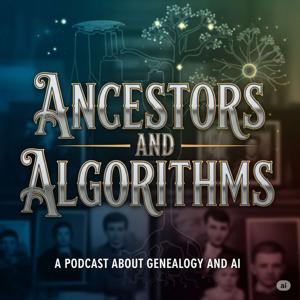

Three records. Three completely different birthplace answers. A German Lutheran church register from Schuylkill County, Pennsylvania says New York. The 1880 US Federal Census says Germany. A Pennsylvania death certificate says Pennsylvania. All three claim to document the same German immigrant ancestor. Not one of them agrees.
In this episode of Ancestors and Algorithms, Brian walks through a step-by-step AI-powered workflow for resolving conflicting genealogical evidence, using a German immigrant ancestor from the Rhine Province of Prussia who arrived through New York in the 1860s and spent the rest of his life in Pennsylvania's coal region. This is Episode 35 and Part 2 of the GPS Mini-Series, with a full-episode focus on GPS Element 4: the resolution of conflicting evidence.
Three AI tools are demonstrated with exact copy-paste ready prompts you can apply to your own conflicting records today. Perplexity with Comet Browser researches historical context for German immigrant Lutheran church records and documented immigrant identity patterns. Claude performs systematic document comparison and evaluates which informant knew what, and when. ChatGPT brainstorms every ranked explanation for why an ancestor might tell his own pastor a different birthplace than he gave the census enumerator five years later.
What you will learn in this episode:
If you research German ancestors, Pennsylvania family history, 19th-century immigration records, or any ancestor whose census records, church records, and death certificate simply do not agree, this episode gives you the exact prompts and a repeatable framework you can use today.
Tools demonstrated: Claude (claude.ai), Perplexity with Comet Browser (perplexity.ai), ChatGPT (chat.openai.com). All free tiers.
Australian and UK listeners: this conflict resolution framework applies directly to convict transportation records, colonial census data, Scottish parish registers, and General Register Office civil registration. Same approach, different archives.
Advanced resources including 12 expert-level prompts and a GPS Research Checklist are available for Patreon members at ancestorsandai.com.
Connect with Ancestors and Algorithms:
📧 Email: [email protected]
🌐 Website: https://ancestorsandai.com/
📘 Facebook Group: Ancestors and Algorithms: AI for Genealogy - www.facebook.com/groups/ancestorsandalgorithms/
Golden Rule Reminder: AI is your research assistant, not your researcher.
Join our Facebook group to share your AI genealogy breakthroughs, ask questions, and connect with fellow family historians who are embracing the future of genealogy research!
New episodes every Tuesday. Subscribe so you never miss the latest AI tools and techniques for family history research.
 View all episodes
 By Brian
5
1111 ratings
Three records. Three completely different birthplace answers. A German Lutheran church register from Schuylkill County, Pennsylvania says New York. The 1880 US Federal Census says Germany. A Pennsylvania death certificate says Pennsylvania. All three claim to document the same German immigrant ancestor. Not one of them agrees.
In this episode of Ancestors and Algorithms, Brian walks through a step-by-step AI-powered workflow for resolving conflicting genealogical evidence, using a German immigrant ancestor from the Rhine Province of Prussia who arrived through New York in the 1860s and spent the rest of his life in Pennsylvania's coal region. This is Episode 35 and Part 2 of the GPS Mini-Series, with a full-episode focus on GPS Element 4: the resolution of conflicting evidence.
Three AI tools are demonstrated with exact copy-paste ready prompts you can apply to your own conflicting records today. Perplexity with Comet Browser researches historical context for German immigrant Lutheran church records and documented immigrant identity patterns. Claude performs systematic document comparison and evaluates which informant knew what, and when. ChatGPT brainstorms every ranked explanation for why an ancestor might tell his own pastor a different birthplace than he gave the census enumerator five years later.
What you will learn in this episode:
If you research German ancestors, Pennsylvania family history, 19th-century immigration records, or any ancestor whose census records, church records, and death certificate simply do not agree, this episode gives you the exact prompts and a repeatable framework you can use today.
Tools demonstrated: Claude (claude.ai), Perplexity with Comet Browser (perplexity.ai), ChatGPT (chat.openai.com). All free tiers.
Australian and UK listeners: this conflict resolution framework applies directly to convict transportation records, colonial census data, Scottish parish registers, and General Register Office civil registration. Same approach, different archives.
Advanced resources including 12 expert-level prompts and a GPS Research Checklist are available for Patreon members at ancestorsandai.com.
Connect with Ancestors and Algorithms:
📧 Email: [email protected]
🌐 Website: https://ancestorsandai.com/
📘 Facebook Group: Ancestors and Algorithms: AI for Genealogy - www.facebook.com/groups/ancestorsandalgorithms/
Golden Rule Reminder: AI is your research assistant, not your researcher.
Join our Facebook group to share your AI genealogy breakthroughs, ask questions, and connect with fellow family historians who are embracing the future of genealogy research!
New episodes every Tuesday. Subscribe so you never miss the latest AI tools and techniques for family history research.

43,542 Listeners
326 Listeners
247 Listeners

54 Listeners

265 Listeners

256 Listeners
106 Listeners
10,859 Listeners

15,967 Listeners
2,026 Listeners
187 Listeners
37 Listeners
956 Listeners

633 Listeners

8 Listeners