
Sign up to save your podcasts
Or


Send us a text
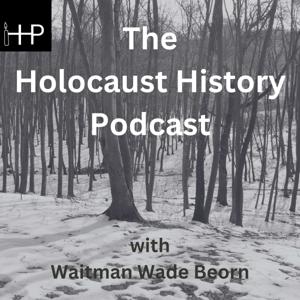
The mass shooting of Jews at Babi Yar in Kiev in September 1941 was the largest open-air shooting of Jews during the Holocaust. In some ways, it came to stand for the Einsatzgruppen killings taking place across the occupied Soviet Union. But as it was not a camp, it left no real physical traces behind. And this was in many ways to the liking of the Soviet government.
In this episode, I talked with Shay Pilnik about the place of Babi Yar in Soviet postwar Holocaust memory. How did the state allow/repress commemoration of the massacre? And, in particular, how did Soviet writers, both Jewish and non-Jewish treat the Babi Yar massacre? It's a really enlightening conversation about the Holocaust, memory, and the ways in which the authoritarian state controls commemoration.
Shay Pilnik is Director of the Emil A. and Jenny Fish Center for Holocaust and Genocide Studies at Yeshiva University.
Follow on Twitter @holocaustpod.
Email the podcast at [email protected]
The Holocaust History Podcast homepage is here
You can find a complete reading list with books by our guests and also their suggestions here.
 View all episodes
 By Waitman Wade Beorn

4.7
6969 ratings
Send us a text
The mass shooting of Jews at Babi Yar in Kiev in September 1941 was the largest open-air shooting of Jews during the Holocaust. In some ways, it came to stand for the Einsatzgruppen killings taking place across the occupied Soviet Union. But as it was not a camp, it left no real physical traces behind. And this was in many ways to the liking of the Soviet government.
In this episode, I talked with Shay Pilnik about the place of Babi Yar in Soviet postwar Holocaust memory. How did the state allow/repress commemoration of the massacre? And, in particular, how did Soviet writers, both Jewish and non-Jewish treat the Babi Yar massacre? It's a really enlightening conversation about the Holocaust, memory, and the ways in which the authoritarian state controls commemoration.
Shay Pilnik is Director of the Emil A. and Jenny Fish Center for Holocaust and Genocide Studies at Yeshiva University.
Follow on Twitter @holocaustpod.
Email the podcast at [email protected]
The Holocaust History Podcast homepage is here
You can find a complete reading list with books by our guests and also their suggestions here.
3,982 Listeners
1,239 Listeners
4,780 Listeners
4,054 Listeners
461 Listeners
181 Listeners
1,425 Listeners
162 Listeners
5,239 Listeners
1,892 Listeners
182 Listeners
336 Listeners
1,385 Listeners
93 Listeners
98 Listeners