
Sign up to save your podcasts
Or



Whatever is the matter should be a matter for prayer.
In every thing, we are instructed to take it to the Lord in prayer (Philippians 4:6). This means anything, and everything that would cause us stress, frustration, anxiety, or worry.
Which is, let’s face it, most things!
Like my car problem. We’ve had this ongoing issue with one of our vehicles for over a year. It’s under warranty, but the cause is officially listed as “unknown” and there is “no known resolution.”
The dealer is little help, the manufacturer isn’t either and nobody wants to be responsible or find a solution. They just want to pay us some money and we can’t file a claim in the future.
So we’re stuck. What can we do? We can file a claim with the company and open a case file. One other thing we can do is pray and trust the Lord. We seek Him for wisdom and for grace, knowing that if it’s His will, this can be resolved. And if it’s His will, we can get through it.
Big things or little things, and all things in between—should be for us a matter for prayer. Not only for God’s help and an answer, but for the promise that the peace of God, which surpasses all understanding, will guard your hearts and minds through Christ Jesus (Philippians 4:7).
It is not necessarily the answer to a prayer that brings the peace, but the praying itself brings us peace. It’s not praying is what leads to anxiety. Make your requests known to God.
We may bring to Him our practical concerns in those every day life situations, large and small, and ask for His help. We need God’s help! We have an issue at work, problems with health, concern for a troubled family member, doubts about a decision? We need God’s help with all that, and so we go to Him in prayer.
All that matters may be brought before God, but we must always bring before God those things that matter most.
Alistair Begg points out that Jesus tells us what to do in Matthew 6—we are to seek first the kingdom of God and his righteousness… (v. 33) ‘That’s prioritizing spiritual things … and all these thing will be added to you. Jesus taught the disciples to pray Your kingdom come, Your will be done—before asking ask for their daily bread.
So we bring all our matters to God, but start first with the spiritual (the gospel) and then the practical or physical. Notice the times Paul writes that I bow my knees before the Father… and in humility, we also acknowledge His Lordship and sovereignty over all things.
Let us not neglect to bring the matter to God in prayer.
I like what English Puritan theologian and pastor John Owen says: When prayer is a delight to believers, refreshing their spirits, calming their minds and comforting their consciences, then is true prayer.
I want to pray like that, regardless of circumstances going my way or not going as I’d wish. And honestly, how many things daily do not go my way? No, I must learn to be patient, calm, trusting, faithful, humble, and reliant on a great, good, and gracious God who is doing all these things for my good.
My good, that may not mean right now in my circumstance. But good
in my character, to becoming mature in Christ, conformed to His likeness and nature. Which brings Him glory.
Prayer often feels like an uphill battle in our busy lives. Yet sometimes, the most important spiritual practices are those we pursue even when motivation fails us.
"Pray fervently when you don't feel it. If you do not pray except when you feel like praying, you will not pray much, nor pray when you most need it. My brethren, when you do not feel like praying, you ought to pray all the more, and go to the Lord to help you to pray." — C.H. Spurgeon
"Take heed, watch and pray; for you do not know when the time is." — Mark 13:33
Prayer requires something from us—effort, focus, energy, and time. Epaphras was described as "always laboring in prayers" for his fellow believers. Perhaps this explains why prayer is often abandoned in our convenience-driven culture.
True prayer demands more than casual attention.
A former colleague of mine would often break through our workplace reluctance with a simple phrase: "Well, there's nothing to do but do." His words would cut through our hesitation, and we'd grab our tools and return to the task—not because enthusiasm suddenly materialized, but because the work demanded completion.
Anyone who has finally tackled a dreaded chore knows the satisfaction that follows. When you collapse into a porch chair after finishing the lawn, sweat cooling on your brow and the scent of fresh-cut grass filling your nostrils, doesn't the accomplishment feel magnified precisely because it was difficult?
It seems that way with me.
Prayer works similarly.
Beginning is often the greatest hurdle. But as we press in, something transforms. Whispered words become conversation. The weight on our shoulders grows lighter. Divine peace—not like the temporary relief of finished chores but a deep, anchoring assurance—settles over you. You rise from your knees knowing God's promises are "Yes and Amen," certain as the sunrise.
The best time to pray is right now.
Not when circumstances force your hand or when feelings finally align. This very moment—with all its distractions, demands, and dullness—is your perfect opportunity.
What are we waiting for?
One of the significant events of Jesus' last week was His time of prayer in the Garden. After the triumphal entry, the Last Supper, and washing His disciples' feet—but before His betrayal and arrest—the Son of God was alone with His Father, praying. It was late, and those with Him stayed behind and fell asleep while He prayed.
I do much of my own praying well before dawn, and always have a coffee with me. It helps me wake up, but it occurs to me that Jesus prayed without coffee!
Three times Jesus prayed that night. But he found his disciples sleeping. I guess they didn’t have coffee either.
"What? Could you not watch with Me one hour? Watch and pray, lest you enter into temptation. The spirit indeed is willing, but the flesh is weak." (Matthew 26:40-41)
"Simon, are you asleep? Were you not able to keep watch for one hour?" (Mark 14:37-38)
"Why are you sleeping? Get up and pray so that you will not enter into temptation." (Luke 22:40)
The point isn’t about caffeine, but about our being spiritually alert and in prayer.
Our inability to stay spiritually alert highlights our frailty and struggle against spiritual sluggishness. We must remain vigilant against spiritual dangers and humbly, rely on the Lord’s divine strength.
How many of us have drifted from Him? Or lost our first love? Have we compromised our lives, merely going through motions, hiding our faith from colleagues or friends?
I am no different than those disciples in the Garden on the night Jesus was betrayed. When we find ourselves weary and in temptation, we also need to watch and pray.
Jesus sweat drops of blood, yet I can struggle to stay alert even with coffee. O Lord, so gracious to hear my cry, even though I am weak and prone to wander. I come now—let me watch with you.
And you, be watchful in your spiritual life because of the ongoing presence of spiritual conflicts. We are inclined toward physical weakness, so let us lean on God's strength through prayer. This is a valuable tool for spiritual resilience and connection with the Lord. Peter's sleeping is a reminder of our need to guard and protect our time and attention to prayer.
So watch with Jesus, and pray that you do not fall into the same temptation. And be vigilant for His return!
The Vineyard and the Vision
If you plant a seed, you don’t just hope for a sprout — you hope for fruit. A harvest. Something full-grown, resilient, rooted. Whether it’s tomatoes in the backyard or grapes in a vineyard, the goal is never just green leaves. It's the fruit that feeds.
Spiritual growth is no different. When we pray for one another, we're not only asking for help in the moment—we're watering a life. We're asking God to cultivate something deep and lasting in someone’s soul. We’re praying people into Christlikeness.
But here's the truth: maturity doesn't happen by accident. It doesn’t come with age or experience alone. It is something formed, shaped, and yes—prayed into being.
Paul knew this. Again and again in his letters, he lifted up churches in prayer—not for ease, but for depth. Not for comfort, but for Christlikeness. And in that, he gives us a model: to pray not just reactively, but proactively. Purposefully. With a vision of growth in mind.
Let’s explore why praying for spiritual maturity matters—and how we can do it well.
Why Spiritual Maturity Is Worth Praying For
In Colossians 1:28–29, Paul says, “We proclaim Him, admonishing and teaching everyone with all wisdom, so that we may present everyone fully mature in Christ.” This was his goal, his energy, his prayer: not just that people would believe in Jesus—but that they’d become like Him.
What the Bible (and Paul) Teaches About Praying for Maturity
If we want to pray deeply and well, we don’t need to look far—we only need to open the Scriptures.
These aren’t checklist prayers. They’re formation prayers. They reveal a deeper goal: not behavior modification, but heart transformation.
What to Pray For: Markers of Spiritual Maturity
So if we're going to pray people into maturity, what exactly should we be asking for?Scripture gives us more than vague aspirations. It gives us a practical portrait of spiritual maturity—something we can recognize, pursue, and pray for.
When we pray for these things, we’re not asking for small changes—we’re asking for soul-deep transformation, in our inner-man. And God delights to answer!
How to Build a Habit of Praying This Way
It takes repetition, intention, and trust in the process. You won’t always feel momentum, but over time—your prayers build something lasting in your life or the life of another person.
Start with a name. A scripture. A prayer.
And build something that lasts.
A Framework for Maturity-Focused Prayer
By now, you’ve seen the why and what of praying for spiritual maturity—but if you’re like most of us, you may still be asking, How do I do this consistently without getting overwhelmed or scattered?
That’s where a simple framework can help.
Inspired by the themes in Paul’s prayers, here’s a pattern I like that you can return to again and again—a guide that keeps your heart focused and your intercession grounded in Scripture. I call it the GROWTH Model.
Conclusion: Praying People into Christlikeness
If you’ve ever watched a garden grow, you know it’s not about flashy moments. It’s about quiet, steady care. Seeds planted in faith. Watered with trust. Kept under watchful eyes—day after day.
That’s what prayer for spiritual maturity is.
It’s choosing to believe that God is forming something in His children that we can’t yet see. It’s lifting up friends, family, churches, and even strangers—not just for help, but for holiness. Not just for strength, but for fruit. Not just for comfort, but for Christlikeness.
So start small. Start somewhere. Start with someone.
Use the GROWTH framework. Open up Colossians or Philippians or Ephesians and put a name into the text. Set a time, a place, a list. And pray.
It’s been four years this week since this publication began, thank you being in the prayer group!
3 things I have learned
* Neglecting prayer is worse than neglecting food or sleep
* Studying praying people broadens and deepens my understanding
* Not everyone is interested in prayer or learning to pray
May we learn to pray without ceasing! Fortunately the Lord is both a patient and excellent teacher.
To that end, we pray for you and ask you to pray for us.
Four prayer requests:
* That you pray every day
* That you invite someone else to pray
* That you pray for us
* That you send us your prayer requests Thank you again for this past year - and much grace and many blessings of peace and joy in the coming newsletter year.
But may the God of all grace, who called us to His eternal glory by Christ Jesus, after you have suffered a while, perfect, establish, strengthen, and settle you. To Him the glory and the dominion forever and ever. Amen.
1 Peter 5:10-11
Delays in answering prayers can occur due to God's desire to show His power, to increase the petitioner's fervor, or to reveal something that needs to be addressed in the petitioner. We are to wait patiently and continue praying earnestly, with hopeful expectation that God's response will come in due time.
Therefore will the Lord wait that He may be gracious unto you. — Isaiah 30:18
We don’t like to wait long, do we? I know I’ve had to learn the hard way to wait! We wait for stoplights, cashiers, buffering, birthdays, and so many other things.
Including answered prayer.
God often delays in answering prayer.
What is the reason for that?
Here are three possible reasons:
Spurgeon says,
* You might be waiting for an answer because God wants you to really want it.
* Sometimes, he delays answering prayers to reveal something in us that needs fixing.
* Or, he might want to show us his power and sovereignty.
We find delays in Scripture.
We would not delay, but our Savior did. Why?
It was for his glory that Jesus delayed!
What to do while waiting.
The farmer and the gardener know there is time between planting and harvesting. This delay is for growth, and watering and sunshine are needed for the growing. This is prayer time.
Let not despair make you silent, but continue instant in earnest supplication.
C.H. Spurgeon
This delay builds our trust in Him.
This kind of waiting means to look with hopeful expectation, with patience and endurance - while we pray through the delay.
So, when you're praying and waiting, remember that God has a purpose for the delay. Keep praying, don't lose heart, be willing to adjust your asking if you find your asking is delayed for one of the reasons above. All your prayers are filed in heaven and they are not forgotten, and God's grace and mercy will come to you in due time to your delight and satisfaction (Spurgeon).
Why we pray for the Children of God
First, because it’s who Jesus prayed for: those who believe in Him.
Also, because it’s who Paul and the Apostles prayed for: those who gather in fellowships, called churches.
Finally, because the Lord gave us these prayers to ask Him—it is His revealed will for us, and He plans on answering them. That the church might be filled with the fullness of God, Ephesians 3.
Five Scriptures To Pray This April
Acts 4:29 — grant to Your servants that with all boldness [we] may speak Your word…v 31, and [we] may all be filled with the Holy Spirit, and [we] speak the word of God with boldness.
Romans 15:5-7 — grant [us] to be like-minded toward one another…that [we] may with one mind and one mouth glorify God
Romans 15:13 — fill [us] with all joy and peace in believing, that [we] may abound in hope
Ephesians 1:17-19 — give to [us] the spirit of wisdom and revelation in the knowledge of Him, the eyes of our understanding being enlightened; that [we] may know what is the hope of His calling, what are the riches of the glory of His inheritance in the saints…and what is the exceeding greatness of His power toward us who believe…
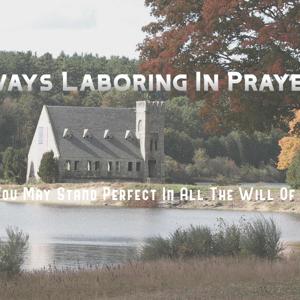
Colossians 4:12 — [we are] always laboring fervently for [the church] in prayers, that [we] may stand perfect and complete in all the will of God.
Your fellow brothers and sisters in Christ need your prayers!
Prayers for
* boldness,
* unity,
* joy,
* peace,
* hope
* wisdom
* revelation
* knowledge
* power
* maturity
The people of God need these promises (and others from the Bible) answered, more than they need prayers for health, job, comfort, safety, etc. Not that those are unimportant, but they are earthly needs. These Scriptures speak of spiritual needs for the here and now, and are eternally more important.
Will you join us in praying these verses, and ask one person to join you?
Also, for Subscribers: just this Monday I prayed for every one of you by name or user name. What I prayed is from and my prayer is recorded for you all in the PrayerCast episode.
Thank you for your faithful support!
The player lay almost still after the hit, clearly in pain. Coaches and fans stood, gasping and wondering as the medical team rushed over. Would the player stand up on his own? Could he continue playing, or would he need to be carried off for medical care?
Meanwhile, eight players from both teams gathered in the middle of the field. They knelt in a prayer circle, heads bowed, asking God to heal the injured player. Fans in the stands joined in, removing their hats and praying too.
This is just one example of how Christian faith appears in sports at all levels—college, high school, and professional. For many decades, faith has been present in these settings. And the Lord is using this for His glory.
It shows me how believers can live out our faith openly at school or work. In our everyday settings, we can be visible and effective in witnessing, ministering and praying for others.
Prayer is a pretty common practice in sports today, with many athletes and coaches from various sports leagues openly expressing and living their faith during games and competitions.
All these gifted, exceptional athletes play and compete at the highest levels of their game, while living their faith in real-time, highly visible ways. It’s on television all the time, being interviewed for radio, podcasts, newspapers, and public appearances.
Their faith and their praying is not only on the field, but in the locker room and the sideline.
From Simplifying Prayer for Athletes and Coaches: The article includes Three Things You Can Do Today To Start Praying For Your Team
From How To Pray the Scriptures Here is a suggested prayer for athletes. They also have one for praying for themselves and one for coaches to pray for the team.
Why this is important
God is using this visibility to bring people together and show his glory.
Beyond the Game
The stories of athletes praying on fields, in locker rooms, and during interviews reveal something profound: faith isn't confined to churches or private moments. It's a living, breathing reality that can transform every space—even the most competitive arenas of professional and amateur sports.
My prayer today is that we all become as dedicated to living faith, as committed to excellence, and as bold and outspoken in faith and praying as any of these.
Praying alone, in a secret place, is vital. It’s the way Jesus prayed.
Praying together, with believers, is also vital. It’s the way the early church prayed.
We should do both today.
From our article Secret Praying—Getting alone with the Lord in silence and solitude:
Alone is often how Jesus prayed, and this was the first lesson He taught — that when praying, get alone. But when you pray, go into your room and shut the door and pray to your Father who is in secret. And your Father who sees in secret will reward you. Matthew 6:6.
So we are to pray privately, but we also pray with others, in one accord (Acts 1:14), and at the house of Mary, many were gathered together and were praying (Acts 12:12).
In our article When Two Or Three Gather—Praying in agreement and Dynamics of small group prayer meetings, we learned that Jesus is speaking of his church — those who gather in his name, even just two or three, and praying together. Why are two or three important? Jesus teaches in Matthew 18:16 to take one or two others along with you, that every word may be confirmed by the evidence of two or three witnesses.
In the church we are to assemble to pray
As you can see, it’s not one or the other—alone vs gathered, it both. Each is necessary and vital. One primarily for personal prayer, the other for corporate intercession.
It’s like left foot, right foot. The church of God’s people trying to walk in step with the Spirit needs two feet.
They go together, like ham and eggs, pork and beans, or ketchup and mustard—which are all metaphors for different foods that famously go together. We can’t image one without the other.
Do you pray personally? That’s good!
Does your fellowship also have a specific time for corporate prayer? That’s also good!
It’s not good if you don’t. Not having personal prayer, or having a gathering for prayer is like having a flat tire on a bicycle. So here are some suggestions for prayer groups to help give you some ideas to get started.
But remember, while there are many good reasons for group prayer, it shouldn’t take the place of private praying.
How easy it is to fume about someone who’s actively against us!
I don’t know about you, but isn’t it all too easy to get riled up over criticism, or disagreement, or even persecution?
Someone has wronged us, by theft, or lies or gossip, and we toss and turn over and over what we want to do to get them back.
Sounds familiar, yes? It does to me, I was like this a lot in my younger days. Even if I never did anything to actually get back a someone, I sure thought about it.
Does it sound like Jesus?
But I say to you, love your enemies, bless those who curse you, do good to those who hate you, and pray for those who spitefully use you and persecute you, Matthew 5:44
In the Sermon on the Mount, Jesus teaches a number of things that go far beyond the keeping of the Law in a action sense and that it goes deeper - to the intent of the heart of the believer.
We are to do good to those who are actively opposed to us
Praying for those opposed to us?
Perhaps we pray for their salvation?
Remember, the opposite of retaliation is prayer. The opposite of hate is love.
Praying is like planting a garden
Praying for our enemies is like planting a garden in rocky soil.
Conclusion
The journey from enemy to friend begins with a single prayer. When we follow Christ's example and instruction by praying for those who oppose us, we participate in His redemptive work in this broken world. Though we may never see the fruits of these prayers in this lifetime, the act itself aligns our hearts with God's and breaks the through hard hearts to humility, maybe leading to salvation. Our willingness to pray for our enemies stands as a radical testimony to the transformative power of Christ's love.
What about you?
Is there someone in your life right now who has hurt or opposed you that you've been reluctant to pray for? What might happen if you committed to praying blessing over them daily for just one week?
From the publisher's feed