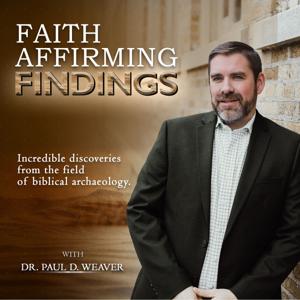
Faith Affirming Findings

Faith Affirming Findings

Download on the App Store

Faith Affirming Findings episodes

  • Caesarea Maritima: Herod's Harbor Revealed!
    In this episode, Dr. Weaver takes us through the historical and biblical significance of Caesarea Maritima, highlighting its role during the time of King Herod. The Apostle Paul's journey and imprisonment also occurred here, marking it as a pivotal location for early Christianity. Discoveries at this site continue to affirm the reliability of scripture.

    -Caesarea Maritima was a thriving port city in the first century AD.
    -Herod the Great transformed a crumbling village into an opulent city.
    -The city served as a backdrop for pivotal moments in the Book of Acts. 
    -Philip the Evangelist preached the Gospel in Caesarea.
    -Paul was tried in Caesarea before several Roman officials.
    -The archaeological remains affirm the historicity of biblical accounts.
    -Herod's legacy reflects his obsession with power.
    -Luke's writings provide a historically accurate account of events.
    -The discoveries discussed are part of a forthcoming book by the same name "Faith Affirming Findings."

    00:00 - Introduction
    00:58 - Herod's Construction of Caesarea Maritima
    2:06 - The Discoveries at Caesarea Maritima
    2:39 - Biblical Events that Occurred at Caesarea Maritima
    3:31 - Paul's Trials at Caesarea
    4:08 - The Significance of the Discoveries at Caesarea Maritima
    5:39 - The Historicity and Reliability of Luke's Account
    6:18 - Conclusion
    8 min
  • Discoveries from the Jerusalem Temple that Prove the Bible True!
    In this episode of Faith Affirming Findings, Dr. Paul Weaver explores the historical and archaeological significance of Mount Moriah, detailing its biblical history from Abraham to the destruction of Herod's temple. He discusses key archaeological discoveries that affirm the reliability of Scripture, including the Temple Warning Inscription, the Place of Trumpeting Stone, and findings from the Temple Mount sifting project. These discoveries provide evidence of the temples built on Mount Moriah and their prophetic destruction, reinforcing the faith of listeners in the historicity of the Bible.

    -Mount Moriah is central to biblical history.
    -Abraham's faith was tested on Mount Moriah. 
    -The temple warning inscription was a significant discovery.
    -The Place of Trumpeting Inscription marks priestly duties. 
    -The Temple Mount sifting project revealed important artifacts.
    -Herod's temple was a monumental construction. 
    -Prophecies about the destruction of the temples were fulfilled.
    -Archaeological findings support the biblical narrative.

    00:00 - Introduction
    00:56 - Mount Moriah and the Offering of Isaac
    01:33 - The First Temple (Solomon's Temple)
    02:26 - The Second Temple (Zerubbabel's Temple)
    02:44 - The Third Temple (Herod's Temple)
    03:11 - The Destruction of Herod's Temple 
    03:38 - Discoveries Regarding the Temple
    05:37 - The Significance
    06:18 - Conclusion
    8 min
  • Capernaum Synagogue - Where Jesus Performed Miracles!
    In this episode of Faith Affirming Findings, Dr. Paul Weaver explores the archaeological discoveries at Capernaum, focusing on the synagogue where Jesus preached and performed miracles. He discusses the historical significance of these findings, including the identification of a first-century synagogue and its proximity to Peter's house, affirming the Gospel accounts. The episode emphasizes the importance of biblical archaeology in strengthening faith and understanding the historical context of scripture. Explore the Ancient synagogue of Capernaum and learn about its historical significance. This virtual tour will guide you through the biblical sites where Jesus Christ performed miracles. Discover the rich history and spiritual importance of Capernaum.

    -The synagogue of Capernaum is a significant archaeological site.
    -Excavations began in the 19th century and continued into the 20th century. 
    -The limestone synagogue was built after Jesus' time, but a first-century basalt foundation was discovered beneath it.
    -Four lines of evidence support the identification of the basalt structure as a first-century synagogue.
    -Historical accounts from early pilgrims provide support for the site's significance.
    -The Gospels record Jesus teaching and healing in the Capernaum synagogue.
    -Peter's house is located just 90 feet from the synagogue, confirming biblical accounts.
    -The discoveries affirm the historicity of scripture and the reliability of the Gospels.
    -Dr. Weaver's upcoming book will detail these findings and more.

    00:00 - Introduction
    00:55 - The Discovery of the Synagogue of Capernaum
    02:30 - Compelling Evidence for this 1st-Century Synagogue
    3:58 - Biblical Events that Occurred at the Capernaum Synagogue
    5:21 - The Historicity and Reliability of the Biblical Narratives
    6:10 - Conclusion
    8 min
  • The Herodium - The Final Burial Place of Herod the Great
    In this episode of Faith Affirming Findings, Dr. Paul Weaver explores the historical significance of the Herodium, a monumental site built by King Herod. The discussion delves into Herod's obsession with legacy, his architectural achievements, and his brutal reign, including the infamous slaughter of innocents as described in the Bible. The findings at the Herodium not only affirm the historical existence of Herod but also provide insights into the biblical narrative surrounding his tyrannical rule.

    -Herod built the Herodium as a testament to his legacy. 
    -The Herodium was identified in 1838 and excavated from 1962.
    -Ehud Netzer dedicated 38 years to uncovering the Herodium. 
    -Herod's tomb was discovered in 2007, confirming his burial site.
    -Herod's reign was marked by paranoia and brutality.
    -He executed many, including family members, to secure his throne.
    -Herod's actions align with biblical accounts of tyranny. -The Herodium's architecture reflects Herod's ambitions.
    -The site serves as a significant archaeological find for biblical history. -The podcast aims to affirm faith through historical discoveries.

    00:00 - Introduction
    01:06 - The Excavations of the Herodium 
    01:48 - Description of the Herodium
    02:40 - The Discovery of Herod's Tomb 
    02:58 - Herod the Butcher 
    04:23 - The Biblical Significance of the Discovery
    05:00 - Conclusion
    7 min
  • The Pool of Bethesda
    In this episode of Faith Affirming Findings, Dr. Paul Weaver explores the archaeological discovery of the Pool of Bethesda, highlighting its historical significance and alignment with biblical accounts. The discussion delves into the site's excavation, its cultural context, and the implications for understanding the miracles of Jesus. The findings affirm the reliability of Scripture and provide insights into the historical and spiritual truths of the Bible. Dr. Weaver connects the Bible story to a powerful archaeological discovery. This discovery aligns the Gospel account with historical evidence, highlighting the significance of this location in Jerusalem. This discovery is truly faith affirming.

    -The Pool of Bethesda is a significant archaeological site.
    -It consists of two pools separated by a wall. 
    -Excavation revealed five porticos surrounding the pools.
    -The Northern Pool served as a water reservoir.
    -The Southern Pool was used for ritual baths (mikvah).
    -Jewish law required ritual baths to be filled with living water. 
    -A channel connected the two pools, causing water to stir.
    -The biblical account of healing aligns with archaeological findings.
    -The level of detail in John's gospel supports its first-century authorship.
    -The discovery affirms the historical reliability of the Bible.

    00:00 - Introduction
    00:57 - The Discovery
    02:56 - The Description of the Pools
    05:00 - The Significance of the Pool of Bethesda
     07:21 - Conclusion
    9 min
  • The Politarch Inscription
    This video highlights how a single Greek word, uncovered through **archaeological discoveries**, has bolstered the **historical accuracy** of the Book of **Acts**. The finding affirms the reliability of **scripture**, turning skeptics into believers and demonstrating the power of **ancient** context.
    7 min
  • The Theater of Ephesus
    Explore how the **historical setting** of the Great Theater of **Ephesus** connects to a key moment in the Book of **Acts**. Discover how **archaeological discoveries** at this ancient site support the accuracy of **bible history**. This real-world location provides a tangible link to the past. Dr. Weaver discusses the theater's size, its role in the events of Acts 19, and how archaeological findings validate the historical accuracy of the biblical account.

    -Ephesus was never fully forgotten, with ruins visible for centuries. 
    -John Turtle Wood began excavations in the 1860s, uncovering the theater.
    -The theater could hold up to 25,000 spectators, making it one of the largest. 
    -Paul's ministry in Ephesus led to significant changes in the community. 
    -Demetrius, a silversmith, opposed Paul's teachings due to economic concerns.
    -Archaeological findings confirm the existence of silversmiths in Ephesus.
    -Luke's account in Acts is detailed and historically accurate. 
    -The theater remains a witness to the events of the early church.
    -The upcoming book 'Faith-Affirming Findings' discusses these discoveries. 

    00:00 Introduction
    00:54 - The Discovery of the Theater
    01:27 - The Description of the Great Theater of Ephesus
    02:04 - Paul's Mission in Ephesus: The Impact of the Gospel
    03:21 - Archaeological Evidence: Confirming Biblical Accounts
    06:10 - The Gospel Cannot Be Silenced
    06:33 - Conclusion
    8 min
  • The Temple of Artemis
    his conversation explores the historical significance of Ephesus, particularly in relation to the Apostle Paul's ministry and the Temple of Artemis. It highlights archaeological discoveries that affirm the biblical narrative and the enduring truth of scripture. It is in Ephesus that the Book of Acts records that the Apostle Paul faced a furious mob. The details discovered at Ephesus affirm the biblical record and strengthen faith.

    -Ephesus was a major city with a rich history.
    -The Temple of Artemis was one of the seven wonders of the ancient world.
    -John T. Wood's discovery of the Temple of Artemis was pivotal. 
    -Ephesus was home to a large population, making it a commercial hub.
    -The temple had 127 columns, each 60 feet tall. 
    -Paul's ministry in Ephesus threatened the idol industry.
    -Demetrius, a silversmith, led a riot against Paul. 
    -The archaeological record supports the biblical account. -Only a single column remains of the Temple of Artemis today.
    -The Bible's historicity is affirmed by archaeological findings at Ephesus. 
    00:00 - Introduction
    00:53 - The Story of the Discovery of the Temple of Artemis
    03:08 - The Importance of the Temple of Artemis
    3:31 - A Description of the Ancient Temple
    4:03 - Demetrius and the Mob at Ephesus
    :26 - The Significance
    :12 - Conclusion
    7 min
  • The Arch of Titus Records the Fulfillment of Bible Prophecy
    In this episode, Dr. Paul Weaver discusses the Arch of Titus, the Triumphal Arch, a monumental structure in Rome constructed by Domitian during the Roman Empire, which serves as a historical testament to Bible prophecy. Dr. Weaver discusses its significance in relation to the destruction of the Jewish temple in AD 70, as well as the prophetic words of Jesus and the historical accounts of Flavius Josephus. The arch not only commemorates a Roman triumph but also stands as a visual confirmation of the events foretold in Scripture, affirming the reliability of biblical texts and biblical prophecy. Dr. Weaver also shares insights about his upcoming book and encourages listeners to engage with the content.

    -The Arch of Titus commemorates the military success of Titus. -It serves as a political and religious statement from Domitian.
    -The arch contains three significant reliefs depicting triumph, spoils, and deification.
    -Flavius Josephus provides historical confirmation of the events depicted in the arch.
    -Jesus predicted the destruction of the temple, which came to fruition in AD 70.
    -The menorah and other temple artifacts were looted and depicted in the arch.
    -The arch stands as a testament to the reliability of biblical prophecy.
    -Dr. Weaver's upcoming book will explore these themes further.
    -The podcast aims to affirm faith and the reliability of scripture. Listeners are encouraged to support the podcast and engage with its content.

    00:00 - Introduction
    0:58 - The Construction of the Arch 
    1:48 - Relief 1: Triumphal Procession through Rome
    2:27 - Relief 2: The Vessels of the Jewish Temple Plundered
    3:09 - Relief 3: The Deification of Titus
    3:21 - The Inscription
    3:48 - Josephus' Description
    4:10 - Jesus' Prophecy Fulfilled
    5:00 - The Prophecy of Hebrews Fulfilled
    5:33 - The Significance of the Arch of Titus
    6:20 - Conclusion

    8 min
  • The Jesus Boat
    In this Faith Affirming Findings episode, Dr. Paul Weaver discusses an amazing **discovery** in the **sea of galilee**. He shares how a drought in **Israel Sea of Galilee** led to the unearthing of the **Galilee Boat**, a first-century fishing boat nicknamed the Jesus Boat, connecting it to **bible stories** and affirming that a first-century fishing boat was large enough to hold Jesus and his twelve disciples. The episode explores the circumstances of the boat's discovery, its preservation, and its significance in understanding biblical narratives.

    -The Jesus Boat was discovered during a severe drought in the Sea of Galilee.
    -The Lufan brothers found ancient coins before discovering the boat. 
    -The boat is dated to about 40 BC through carbon-14 testing.
    -It measures 26.5 feet long and can hold up to 15 passengers. 
    -The boat's preservation involved a complex process over a decade.
    -This discovery enhances our understanding of the biblical narratives involving boats.
    -This boat serves as a physical link to the world of Jesus. -It affirms the historicity of the Gospels and biblical narratives.
    -The Jesus Boat is displayed at the Yigal Elan Museum in Israel.
    -Dr. Weaver's upcoming book, Faith Affirming Findings, discusses this and 49 other archaeological findings.

    00:00 - Introduction
    01:00 - The Discovery of the Jesus Boat
    02:54 - The Excavation, Transportation, and Preservation of the Jesus Boat
    04:03 - Description of the Boat
    04:35 - Boats in the Biblical Record
    05:01 - The Significance of this Discovery
    5:50 - Conclusion
    06:01 The Significance of the Jesus Boat in Biblical Context
    7 min

About Faith Affirming Findings

From the publisher's feed

Faith Affirming Findings podcast is devoted to sharing discoveries of biblical archaeology - artifacts and sites that relate to the Bible. These discoveries will affirm your faith in the historical…

More shows like Faith Affirming Findings

Bible and Theology Matters: Insightful Conversations with Bible Scholars by Dr. Paul D. Weaver - DTS Professor and Biblical Scholar

Bible and Theology Matters: Insightful Conversations with Bible Scholars

61 Listeners