
Sign up to save your podcasts
Or

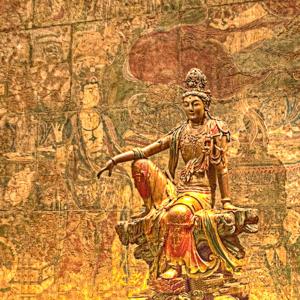


We begin the afternoon session with Tonglen meditation. After the session, Alan explains the second component of Tonglen, which is loving-kindness. Alan explains how loving-kindness is often compared with love and how they are different in nature. While ordinary love is an emotion and often comes with associated attachment (to a person, animal or thing), loving-kindness is an aspiration and a heart-felt yearning for sentient beings (both those we feel affection towards and those we despise) that they find genuine happiness (its fruition) and causes of genuine happiness. Also, attachment looks only at the surface of the person and changes with changing circumstances and the person's behavior. Loving-kindness, on the other hand, looks at a very deep substance of a person and is independent of circumstances and changes in the other person's behavior or character. Later, Alan refers to the Pali canon to explain both the near and far enemies of loving-kindness. The near enemy is self-centered attachment and the far enemy is ill-will (malice). So, how one can know if his/her practice is successful? If loving-kindness is practiced correctly, malice subsides. Overall, Tonglen practice is really successful when one develops willingness to take on others' suffering on oneself without regard for one's own well-being (similar to a mother willing to take on her child's suffering on herself). In the face of so much suffering present in the world nowadays and our limited ability to do something about it, Tonglen practice is often our best way to contribute to the world, and we don't need to reserve the practice only to the time on the cushion but should extend it to our everyday activities and interactions with others.
Final note: the microphone gives out at the end, at which point Alan ends the session.
Meditation starts at: 00:40
Today is the last day of the cycle of the Shamatha without a sign. Before the morning meditation, Alan reads instructions from Penchen Rinpoche, where he explains that whenever thoughts arise, when their nature is observed, they naturally disappear and a clear vacuity arises. So the technique to disperse the thoughts is to simply observe their nature (meaning: mental phenomena occurring in the space of the mind) when they arise. The goal is to view the mind as mind and to not mistake the appearances of mental phenomena for anything else; view thoughts as thoughts, mental events as mental events. By doing so, we disempower them and stop being victims of our thoughts (and other mental events). We need to become scientists of our minds: observe them, examine them, understand them. By doing so, we can realize both the empty nature of the mind and its luminosity. Both is stability and movement. Both the awareness and the space of the mind.
Meditation stars at: 24:10
Dr. Wallace continues with the text from Panchen Lozang Chokyi Gyaltsen. He explains that the movement of awareness is caused by grasping. The object of mindfulness in this practice (awareness of awareness) is the cognisance and luminosity of awareness.
Meditation starts at: 20:04
The session continues with the practice of Tong Len. Before the meditation, Dr. Wallace talks about related issues, such as the meaning of intent to other people with compassion and loving-kindness; does it affect the people we attend to?
Meditation starts at: 27:26 min
Dr. Wallace continues with the text from Panchen Lozang Chokyi Gyaltsen. He explains that the movement of awareness is caused by grasping. The object of mindfulness in this practice (awareness of awareness) is the cognisance and luminosity of awareness.
Meditation starts at: 20:04
The classic, developmental approach is to alternate between ultimate and conventional bodhicitta. It is so important to balance the cultivation of ultimate truth with development of the heart. Another approach is to develop Shamatha, Vippassana, Trekcho (break through) and Togal (crossover). Where is the balance? If you realise rigpa- ultimate bodhicitta, then relative bodhicitta arises spontaneously.
Alan then talks on the classical approach to the realisation of emptiness and contrasts this with realising rigpa first before realising emptiness: like being in a dream and developing shamatha, vippassana and then post meditation seeing all appearances as dream like. Then you get pointing out instructions and realise that you are not even conventionally located there. Now viewing that dream from the perspective of one who is awake. But it can happen that there is a breakthrough right there, without a step by step sequence, in an instant. Like becoming lucid in a dream, realise rigpa and by the power of that, seeing all phenomena as empty.
Alan then runs through the cultivation of bodhicitta: Cultivate the four immeasurables and on the basis of that, cultivate great compassion. Great compassion goes beyond "may all be free of suffering and its causes" and includes an aspiration, an intent, a commitment that I shall see to it. But who is the referent, who took on this resolve? It only makes sense that it is on the basis of rigpa that this resolve is made. Then by being aware of the depth of suffering in the world and knowing that suffering is not inevitable, not necessary, wanting to bring each sentient being to liberation and awakening. How can this actually occur? Only if I completely unveil my Buddha nature, so all the wisdom compassion and power is manifested, and from that platform you can liberate and awaken all sentient beings. So that is bodhicitta. And this, only after having developed loving kindness and compassion - the essence of tong len practice.
Alan also answers questions on how Dujom Lingpa receives visions and also on finding authentic sangha when returning back home from retreat.
Meditation starts at: 1:15
Alan introduces a complementary approach to this practice, which is an ingenious integration between settling the mind in its natural state and shamatha without a sign. The root text is Panchen Losang Chokyi Gyaltsen's union of the Gelugpa and Kagyu traditions of mahamudra. This is a wonderful approach specific to tradition, but if it does not fit you then that is no problem.
Of the two approaches, 1) seeking to meditate on the basis of the view and 2) seeking the view on the basis of meditation, this accords with the latter. The technique starts on a comfortable cushion, adopting the seven point vairochana posture and with the nine fold breathing clearing out stale vital energies. Then clearly distinguish between the radiant purity of awareness and its defilements and with a pristinely virtuous mind take refuge, generate bodhicitta and meditate on the profound path of guru yoga. After making supplication rest in unwavering meditative equipoise.
Meditation starts at: 28:45
Alan goes straight into the meditation practice.
Alan states that 'settling the mind in its natural state' and 'Shamatha without a sign' are notorious for catalysing karma. Alan defines 'nyam' and obstacles. Alan states Dudjom Lingpa's two approaches to nyam arising - to reify or to not grasp, and to use whatever understanding you have of emptiness.
Alan then gives commentary to the line in Atisha's text 'Between sessions act as illusory being'.
Alan talks on the impure and the pure illusory bodies. He then goes on to discuss Vajrayana practices of stage of generation and completion - the developmental approach, and the Dzogchen approach. One says you have Buddha nature, the other you are Buddha nature.
Alan describes what to rely on in your practice (what to take refuge in).
In between sessions act as if you are in a lucid dream. Dzogchen approach 'all things appear, but are non-existent'. This is a dream. A radical shift in perspective.
Meditation starts at: 00:31
Alan goes straight into the practice. He reads Padmasambhava's instructions direct from text with a little commentary.
Alan gives Padmasambhava's concluding paragraph, 'summing it up'. He explains that next the text goes directly into Vipassana, dream yoga and Dzogchen (not discussed in this session). He reiterates the importance of Shamatha as a foundation to give stability to 'breakthrough' experiences one may have when receiving teachings from great masters.
Question re: the use of the eye mask for this practice.
Alan discusses how he submitted notes on 'the illusions of knowledge in the mind sciences' to a particular editor (not named), showing there is no compelling evidence at all of the materialistic equations of mind with brain, or compelling reason. An unfavourable response to it being published was received.
Meditation starts at: 00:34
“The essential nature of the path is resting in the substrate” the ultimate substrate: the union of ultimate nature of reality (dharmata) and ultimate nature of the mind (citta).
Meditation starts at: 0:00
From the publisher's feed

326 Listeners