
Sign up to save your podcasts
Or

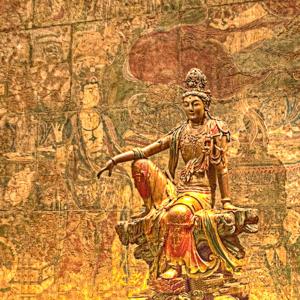


From Padmasambava – Natural Liberation
Meditation starts at: 9:05
Alan introduces us to this practice also known as Awareness of Awareness, practiced by all four schools of Tibetan Buddhism by reading us Padmasambava's Instructions. Here it is said the view arises from meditation rather than theory.
Additionally Alan answers four student questions:
Meditation starts at : 6:40
Alan continues "taking off another layer" and assisting us to overcome our addiction to doing and trying in this meditation. He gives an analogy of a car in neutral gear. Not going forward or backward but knowing it is running.
After the meditation talks about the difference between the Dzogchen meditation and Shamatha Without a Sign.
Moving to the text we examine the seven qualities of our own Rigpa, before moving on to Padmasambhava's parable. This gives us an opportunity to consider a convergence between Buddhism and other contemplative traditions and modern science.
Meditation starts at: 24:23
Before the final (silent) meditation session on settling the mind in its natural state, Alan compares this mode of Shamatha with Vipassana (four applications of mindfulness). While settling the mind in its natural state has some resemblance of the Vipassana’s close application to the mind and both give rise to insight, what differentiates Vipassana from Shamtha is the degree of inquiry. In Shamatha, the main mode of meditation is simply placing attention on the chosen object (non-judgmentally). In Vipassana, on the other hand, it is close examination of the object. Hence, settling the mind in its natural state is a perfect preamble to Vipassana and a natural Segway toward it.
After the meditation, Alan gives his second commentary to the Atisha’s aphorism: “Examine the unborn nature of awareness.” Alan starts with a quote from Padmasabhava, who said that there is something called mind and different schools of thought point into the common reality, while calling it by different names and starting from a different conceptual framework and modes of investigation. Also, while all the schools have a different degree of insight into this reality, there is a degree of convergence as to the nature of reality they talk about. After that, Alan moves onto explaining the difference between the space of the mind, substrate consciousness, and pristine awareness (Rigpa, primordial consciousness, the ground of being). He also presents an overview of the modern science’s perspective on primordial consciousness, which is equated to the vacuum the universe is made of and shares similarities between Dzogchen teachings and the findings of quantum mechanics.
Meditation starts at: 10:11
The guided meditation is settling the mind in its natural state. Before this meditation starts, Dr. Wallace points out the two types of vividness (qualitative and temporal) and the continuity of stability.
Meditation starts at: 5:56
Before the final (silent) meditation session on settling the mind in its natural state, Alan compares this mode of Shamatha with Vipassana (four applications of mindfulness). While settling the mind in its natural state has some resemblance of the Vipassana’s close application to the mind and both give rise to insight, what differentiates Vipassana from Shamtha is the degree of inquiry. In Shamatha, the main mode of meditation is simply placing attention on the chosen object (non-judgmentally). In Vipassana, on the other hand, it is close examination of the object. Hence, settling the mind in its natural state is a perfect preamble to Vipassana and a natural Segway toward it.
After the meditation, Alan gives his second commentary to the Atisha’s aphorism: “Examine the unborn nature of awareness.” Alan starts with a quote from Padmasabhava, who said that there is something called mind and different schools of thought point into the common reality, while calling it by different names and starting from a different conceptual framework and modes of investigation. Also, while all the schools have a different degree of insight into this reality, there is a degree of convergence as to the nature of reality they talk about. After that, Alan moves onto explaining the difference between the space of the mind, substrate consciousness, and pristine awareness (Rigpa, primordial consciousness, the ground of being). He also presents an overview of the modern science’s perspective on primordial consciousness, which is equated to the vacuum the universe is made of and shares similarities between Dzogchen teachings and the findings of quantum mechanics.
Meditation starts at: 10:11
Today is the last day in the cycle of settling the mind in its natural state. Before the practice, Alan introduces one complimentary practice called gentle vase breathing to be used along the settling the mind in its natural state practice. The purpose of it is to support the settling the mind in its natural state by allowing prana accumulated in the naval chakra to flow more easily and to further strengthen samadhi. Gentle vase breathing is meant for the upright sitting position and its function is to loosen up the belly while bringing in more spaciousness to the area. It also promotes deeper relaxation. To do so, we hold a pot-like shape of the belly during both the in- and out-breath. The practice is optional, meant to augment the settling the mind in its natural state, for those who find it beneficial. After the practice, Alan addresses two questions: one on the role of prayer and another on the possibility to develop samadhi while living a fully engaged life.
Meditation starts at: 8:57
Dr. Wallace makes a presentation on the four sequential modes of mindfulness as one evolves on the path of Shamata: (a) Single pointed mindfulness, (b) Manifest mindfulness, (c) Absence of mindfulness and (d) Self illuminating mindfulness.
Meditation starts at: 20:22
The guided meditation is settling the mind in its natural state. Before this meditation starts, Dr. Wallace points out the two types of vividness (qualitative and temporal) and the continuity of stability.
Meditation starts at: 5:56
Dr. Wallace makes a presentation on the four sequential modes of mindfulness as one evolves on the path of Shamata: (a) Single pointed mindfulness, (b) Manifest mindfulness, (c) Absence of mindfulness and (d) Self illuminating mindfulness.
Meditation starts at: 20:22
From the publisher's feed

326 Listeners