
Sign up to save your podcasts
Or

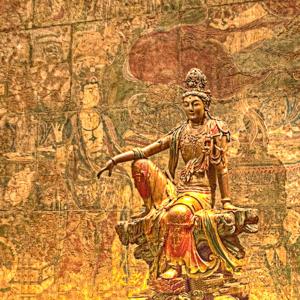


In this next practice "Setting the mind in it's Natural State" we withdraw our attention from the space of the body and observe the state of the mind and the mental events occuring within. Here we become aware of our emotions, thoughts and stories without cognitively fusing with them. We are distinguishing between our awareness of the mind and what happens within the space of the mind.
Meditation starts at: 05:04
This afternoon we complete the cycle of mindfulness of breathing. Before we go into the final practice, Alan addresses one of the participant's question about experiencing tingling/vibrating sensations in the forehead when practicing mindfulness of breathing at the aperture of the nostrils. Alan explains that this might happen for some meditators even when they are practicing correctly since prana, which follows attention, might build up in the area we are focusing on. He suggests, in such cases, to change the practice to an alternate one, which is mindfulness of breathing with the focus on the whole body. To do so, a practitioner needs to focus on all the tactile sensations arising in the field of the body that are directly correlated with each in and out breath.
After the practice, Alan moves on to discussing the fourth thought that turns the mind, which is the law of karma or, in other words, actions and their consequences or cause and effect. The Buddha's notion of karma deals with deliberate action (volition) and can be fully understood only in the context of the continuity of consciousness. If we accept this fact as a working hypothesis for our life, then the question whether our behavior in this lifetime has any ramifications for our future lifetimes emerges and the need to discern wholesome actions from unwholesome ones becomes imperative.
But how can we know which actions are virtuous and which are not and how they will ripen in our future lives? Since at this stage we are unable to see the entire web of all karmic connections as the Buddha did on the second day of his enlightenment, the best way to approach this dilemma is by bringing it to the realm of this lifetime. To do so, we ask ourselves a question whether our actions (of body, speech, and mind) bring about the well-being and genuine happiness of oneself and others. If the consequence of our action contributed to our own well-being and that of others, we can say that the action was virtuous, and vice versa. We need to see ourselves as part of a whole web of connections (an eco-system) and judge the nature of the action by how it affects the entire system as karma is both individual and collective.
Alan also emphasizes that karma works equally for both virtuous and non-virtuous actions and is not static; it grows over time. Last but not least, Alan stresses that all non-virtue comes from delusion, which is the result of misapprehending reality. As karma is simply as things are (a universal law rather than a moralistic requisite), meditation on this subject is meant to shift one's perspective on viewing reality and encourage the investigation of this truth for oneself in order to gain confidence in it.
Meditation starts at: 19:21
Before the morning meditation, Alan raises a question: what makes a practice Dharma? Is, for example, mindfulness of breathing Dharma in and of itself or is there something else necessary to make it Dharma? Mindfulness of breathing can be simply a relaxation technique.
What makes it Dharma is motivation based in Bodhicitta. In fact, if we hold Bodhicitta as our motivation, everything we do throughout the day can be used to cultivate virtue and ethical way of life, not only our meditations. Our motivation (aspiration) connects all our activities from one day to another creating a karmic momentum. Practicing Bodhicitta is like investing in a fund and creating leftover karma for future lifetimes. The virtue of our lives goes where our aspiration goes. In the meditation practice, we continue mindfulness of breathing at the aperture of the nostrils.
Meditation starts at: 12:30
The third phase of mindfulness of breathing is discussed before entering into the guided meditation. This third phase is a classical Theravada method in which the focus is directed to the tactile sensations of the breath at the apertures of the nostrils.
We immediately start with a meditation session. After the guided meditation, a question comes up about the role of pain in meditation, based on a comment from an abbot who claimed that pain is a goal to reach Nirvana, and a comfortable position during meditation is not suitable for reaching Nirvana.
Meditation starts at: 0:35
This afternoon we complete the cycle of mindfulness of breathing. Before we go into the final practice, Alan addresses one of the participant's question about experiencing tingling/vibrating sensations in the forehead when practicing mindfulness of breathing at the aperture of the nostrils. Alan explains that this might happen for some meditators even when they are practicing correctly since prana, which follows attention, might build up in the area we are focusing on. He suggests, in such cases, to change the practice to an alternate one, which is mindfulness of breathing with the focus on the whole body. To do so, a practitioner needs to focus on all the tactile sensations arising in the field of the body that are directly correlated with each in and out breath.
After the practice, Alan moves on to discussing the fourth thought that turns the mind, which is the law of karma or, in other words, actions and their consequences or cause and effect. The Buddha's notion of karma deals with deliberate action (volition) and can be fully understood only in the context of the continuity of consciousness. If we accept this fact as a working hypothesis for our life, then the question whether our behavior in this lifetime has any ramifications for our future lifetimes emerges and the need to discern wholesome actions from unwholesome ones becomes imperative.
But how can we know which actions are virtuous and which are not and how they will ripen in our future lives? Since at this stage we are unable to see the entire web of all karmic connections as the Buddha did on the second day of his enlightenment, the best way to approach this dilemma is by bringing it to the realm of this lifetime. To do so, we ask ourselves a question whether our actions (of body, speech, and mind) bring about the well-being and genuine happiness of oneself and others. If the consequence of our action contributed to our own well-being and that of others, we can say that the action was virtuous, and vice versa. We need to see ourselves as part of a whole web of connections (an eco-system) and judge the nature of the action by how it affects the entire system as karma is both individual and collective.
Alan also emphasizes that karma works equally for both virtuous and non-virtuous actions and is not static; it grows over time. Last but not least, Alan stresses that all non-virtue comes from delusion, which is the result of misapprehending reality. As karma is simply as things are (a universal law rather than a moralistic requisite), meditation on this subject is meant to shift one's perspective on viewing reality and encourage the investigation of this truth for oneself in order to gain confidence in it.
Meditation starts at: 19:21
Before the morning meditation, Alan raises a question: what makes a practice Dharma? Is, for example, mindfulness of breathing Dharma in and of itself or is there something else necessary to make it Dharma? Mindfulness of breathing can be simply a relaxation technique.
What makes it Dharma is motivation based in Bodhicitta. In fact, if we hold Bodhicitta as our motivation, everything we do throughout the day can be used to cultivate virtue and ethical way of life, not only our meditations. Our motivation (aspiration) connects all our activities from one day to another creating a karmic momentum. Practicing Bodhicitta is like investing in a fund and creating leftover karma for future lifetimes. The virtue of our lives goes where our aspiration goes. In the meditation practice, we continue mindfulness of breathing at the aperture of the nostrils.
Meditation starts at: 12:30
We return to mindfulness of breathing, with a gradual and persistent cultivation of stability, which is really getting the mind to calm down. Maintian a continuity of attention, a flow of mindfulness but without the habitual contraction which is almost always associated with ego, stress, a goal. Yogis that come out of hours of samadhi come out feeling fresh and revived. How? By the concentration coming out of a sense of release.
Post meditation: The second of the four preliminaries, reflecting on impermanence and death. This is a way for us to develop conative intelligence, that is, having wise or intelligent desires. There are so many dumb desires, the meditation on impermanence and our own mortality is like taking smart pills.
Meditation starts at: 7.15
The third phase of mindfulness of breathing is discussed before entering into the guided meditation. This third phase is a classical Theravada method in which the focus is directed to the tactile sensations of the breath at the apertures of the nostrils.
We immediately start with a meditation session. After the guided meditation, a question comes up about the role of pain in meditation, based on a comment from an abbot who claimed that pain is a goal to reach Nirvana, and a comfortable position during meditation is not suitable for reaching Nirvana.
Meditation starts at: 0:35
From the publisher's feed

326 Listeners