
Sign up to save your podcasts
Or

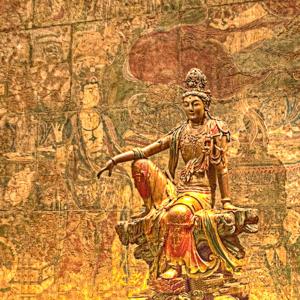


Meditate for half the session on shamatha without a sign – probing right into where you think the observer is – this can lead to ultimate Bodhicitta. Spend the second half of the session on Tonglen, relative Bodhicitta.
Description of the five powers: resolution, familiarization, positive seeds, revulsion and prayer. Under power of prayer, given the law of karma, what can the Buddha’s do?
Silent meditation (not recorded) was "front loaded" at the start of the session.
What makes us so vulnerable to suffering? We identify so closely with the body and mind. This meditation starts to put some distance as you roll back from the environment, roll back from your body and attend to the mind without fusing with it.
Meditation – Focus on the space of the mind and observe when it is still and when there is motion. When there is motion there is grasping.
Alan describes stage eight of the shamatha path – Single-pointed Attention.
Silent meditation (not recorded) was "front loaded" at the start of the session.
We revisit an important facet of settling the mind in its natural state: to observe not so much the objective appearances to the mind, but the subjective impulses to the mind. This is not as easy as we only become aware after it occurred. But we can observe them and not identifying with them. There are three points: 1) The importance of this practice cannot be over emphasised, we can’t just wish for no mental afflictions and apart from arharts, everyone has them. Now we have the great fortune to see mental afflictions as mental afflictions which is so beneficial. As we do not identify with them, the little violence in our minds does not spew out onto those around you. 2) This is a path of self knowledge, it’s the wrong path if you want to have one pleasant hedonic day after another, release the hedonic evaluation of a good session or a bad session, the proof of the practitioner is how one responds to the various disturbances that occur. Go through the experience, not take a detour around it. Don’t identify with it and keep going anyway. We are not going into some fantasy realm, we are seeing what is happening here and now and getting real, removing the conceptual overlay. 3) Enter the practice by relaxing, being kind gentle and patient, seeking to cultivate genuine happiness. Then as you come off the cushion this sense of loving kindness is brought to the world.
After the meditation Alan talks about achieving Shamatha and what one experiences at the time.
Meditation starts at: A silent meditation session, not recorded. Starts at 25:20
Silent meditation on relative and ultimate Bodhicitta (not recorded) at 6:08.
Fourth point of the text 'To synthesise the essence of this practical guidance, apply yourself to the five powers', the last of which is the power of prayer.
Alan discusses the last 150 years of the 'dark age' of scientific materialism. This is the view of the 21st century that is important to understand to relate to the world in which we live.
Much of science hinges on the causality being closed, and the conservation of energy principle. Modern physics has demonstrated that it is not closed and is regularly violated. It is therefore possible for non-physical influence. This principle hasn't carried over to other sciences.
Alan discusses the expansion of the universe (energy) and the orderly nature of the universe (matter). 96% of mass and energy is unaccounted for in science - dark matter/ energy.
Alan discusses the placebo effect which is basically - if you believe it, it will happen. Part information and part causal efficacy.
Alan discusses how scientist don't believe in anything until there is sufficient evidence - the current view. Alan demonstrates how scientific greats of the past did not hold this view.
Focus simply on the observation of the so call objective appearances that appear in the space of the mind.
When we have difficulty doing this practice, the way to counter is to learn to relax more. OUr prana systems are so wired.
We can also request the blessings of the guru as explained earlier. Alan discusses the so called placebo effect with respect to trust.
After the silent meditation Alan goes on to explain the 9th stage prior to achieving shamatha - attentional balance.
Silent meditation at 14:17 (not recorded) was "front loaded" at the start of the session.
Meditate for half the session on shamatha without a sign – probing right into where you think the observer is – this can lead to ultimate Bodhicitta. Spend the second half of the session on Tonglen, relative Bodhicitta.
Description of the five powers: resolution, familiarization, positive seeds, revulsion and prayer. Under power of prayer, given the law of karma, what can the Buddha’s do?
Silent meditation (not recorded) was "front loaded" at the start of the session.
What makes us so vulnerable to suffering? We identify so closely with the body and mind. This meditation starts to put some distance as you roll back from the environment, roll back from your body and attend to the mind without fusing with it.
Meditation – Focus on the space of the mind and observe when it is still and when there is motion. When there is motion there is grasping.
Alan describes stage eight of the shamatha path – Single-pointed Attention.
Silent meditation (not recorded) was "front loaded" at the start of the session.
We return to this practice also known as Appearances and Awareness as the Path. Alan reminds us to examine the essential nature of the thought arising rather than the content or referent and discusses stillness and motion as the type of mindfulness we are working with here.
Next we look into stage seven of the Shamatha Path: Fully Pacified Attention. Alan relates this to the five paths and ten stages.
Meditation starts at:11:35 (silent meditation not recorded)
Here Alan continues the Lojong text and addresses how we can eliminate the tug of war between dharma and our everyday life by transforming everything into dharma. We look at different ways of viewing adversity - external and internal - in terms of our hedonic and eudonameic happiness.
Alan then looks at the difference between hope and aspiration before moving on to talk about transformation at a psychological level and an ultimate level.
Meditation starts at: Silent meditation not recorded at the start of the session.
We begin the evening session with a silent Tong Len meditation by focusing on a person, group of people, or other sentient beings - those who come to mind. The session is briefly introduced by Alan right before. After the meditation, we go back to the explanation of the sixth stage of Shamatha path and the wide range of experiences that might occur as a result of dredging up the psyche and the importance of seeing them simply as appearances to the mind: see them for what they are. After that, we move onto the last of the four practices to purify karma of the Seven Point Mind Training, which is: make offerings to Dharma Protectors. Alan explains that if one is not sure who his/her Dharma protector is, the best method is to see Buddha Shakyamuni as the Dharma protector and make offerings to him, as suggested by His Holiness The Dalai Lama. We end the session by Alan answering three questions from the retreatants.
Meditation starts at: 5:20 (silent meditation; not recorded)
From the publisher's feed

326 Listeners