
Sign up to save your podcasts
Or



Alexandria “AOC” Ocasio-Cortez
US Representative for New York’s 14th congressional district
Artwork:
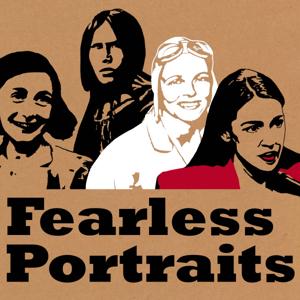
AOC’s portrait in the Fearless Portrait project consists of an ink drawing of her giving her floor speech calling out the misogyny in Congress. She’s wearing a bright red blazer with matching red lipstick— something she describes as her “war paint.” I’ve drawn her over a map of New York City’s Bronx and Queens boroughs, where her district is located.
The Story:
On July 20, 2020, a male legislator crassly accosted Representative Alexandria Ocasio-Cortez, calling her “disgusting” and worse insults. She said he was being “rude” and walked away. In response to news reports of the verbal abuse, the instigator addressed the matter on the floor of the House of Representatives. Giving a weak, non-apology, he glossed over his gross disrespect and sought cover behind the excuse of about being married with two daughters.
The following day, AOC gave a powerful rejoinder, calling out the deflection for what it was: another instance of men mistreating women while hiding behind the women in their lives to avoid taking responsibility for their actions.
“I will not stay up late at night waiting for an apology from a man who has no remorse over calling women and using abusive language towards women,” she said in her floor speech. “But what I do have issue with is using women—wives and daughters—as shields and excuses for poor behavior.”
“I am someone’s daughter too,” she reminded him, Congress, and the rest of the nation. “My father, thankfully, is not alive to see how Mr. Yoho treated his daughter. My mother got to see Mr. Yoho's disrespect on the floor of this House towards me on television. And I am here because I have to show my parents that I am their daughter and that they did not raise me to accept abuse from men.”
Background on AOC:
Born: October 13, 1989, New York City.
Entering Congress at 29, she is the youngest female representative ever. Born into a work-class family in the Bronx, Ocasio-Cortez did not have a typical background for a congresswoman. Her father was an architect and her mother cleaned houses and drove a school bus to make ends meet. “We were poor, so I was used to eating rice and beans every day,” she says, describing her childhood. After college, she supplemented nonprofit and political cause work with jobs as a bartender and waitress.
In 2018, she decided to run for Congress and waged an unlikely campaign to defeat a 10-term incumbent in the primary election. This win was one of the largest political upsets of the time and was made all the more impressive given that Ocasio-Cortez operated her campaign from a paper grocery bag behind the bar she worked. Between shifts at the restaurant, she’d reach into the bag for campaign material and a change of clothes and set out to canvas.
She has advocated strongly in Congress for the environment, more affordable healthcare and higher education, and immigrant-friendly policies, among other things.
Music:
This episode contains music by Geovane Bruno and RYYZN.
Sources:
- Dolores Huerta
American labor leader and civil rights activist
I want my daughters to pursue lives where anything is possible and they can be whatever they want to be. But if they never see someone like them do it first, how will they know it’s an option for them?
After all, if they can see it, they can be it.
I realized one day that I could only think of one female scientist—the chemist and physicist Marie Curie. Likewise, for other fields, I knew of one or two famous women and that was it. Or sometimes I had never heard of women in the field at all.
I grew up reading history and later got a degree in it. I did notice the texts I read centered on the life and exploits of white men, but I didn't think much of it at the time. History was that. His story. And I didn't really question it. But why should it be that way?
For example, in the United States’ origin story, there are the Founding Fathers (no mothers) and the stories of the nation forged in revolution include great armies of great men facing off against each other—Generals George Washington and Nathaniel Greene against Lords Howe and Cornwallis. There was the Swamp Fox Francis Marion, Nathan “Give me liberty or give me death” Hale, Light Horse Harry Lee, the Marquis de Lafayette, John Paul “I have not yet begun to fight” Jone, and so many more.
In the popular narrative of the American Revolution, there were apparently only two women involved in the whole of the war—Abigail Adams and Betsy Ross. Ross sewed a flag and Adams was noted for how much she did in a time when women often didn't. Even the side-switching Benedict Arnold gets more recognition than the many women who contributed in ways large and small.
The women whose stories I'm telling in this podcast are not perfect. These women worked to change the world in some way and that’s what this podcast celebrates.
I had three criteria for inclusion in this project:
So many great women couldn't meet even these simple criteria because no one had deemed their stories worth recording. Their photos were not taken, while their male contemporaries were. Their words were not recorded, while men's were. Their stories were not passed down, eclipsed and sometimes actively replaced by men’s stories. These problems were most acute among women of color, as they faced the double prejudice of misogyny and racism, so only a sliver of their full story could squeeze into the historical record.
It frustrated me when I couldn't tell someone's story in their own words. That not even one sentence of their voice was recorded and I had to resort to the words of men around them to describe who they were and what they felt.
This collection of stories is my small effort in recognizing the accomplishments of women throughout history and the present day. Researching these women has been an education for me and the result is a demonstration to my daughters and girls everywhere of what is possible for them to achieve.
Music:
This episode contains music by Geovane Bruno.
Coming soon, the Fearless Portrait Podcast, a collection of stories about women who worked to change the world.
From the publisher's feed