
Sign up to save your podcasts
Or



In our ninth episode, we talk with Edwin Cleophas: a theologian, psychometrist, and antiracist activist from South Africa. Cleophas has a compelling story: once a gang member in South Africa, he is now an international advocate for social justice with four degrees in higher education. Cleophas speaks with passion and precision about the stakes of antiracism, reparations, his role as a disruptor, and the indescribable value of affinity spaces. He shares about his heartbreak over how South Africa's Truth and Reconciliation process did not address the immediate and long-term consequences of the horrific practices of apartheid, and speaks to what truly transformative accountability after harm could look like. Listen in to learn more about how global antiracist efforts are linked and how self-compassion makes those efforts possible.
Edwin Cleophas is the Managing Director of The Social Justice Agency, where he passionately works to mitigate racial disparities and foster equity in South Africa. In this role, he collaborates with various organizations, including prestigious universities and civil society groups, showcasing his adept skills in partnership building. Edwin had a pivotal impact in his previous role as secretary general for Social Cohesion and Nation Building at the South Africa Department of Sport, Arts and Culture. Grounded in his strong foundation in youth development, Edwin also founded Project No Limits, an after-school program in Kleinvlei, Eersterivier. With a solid educational background in Theology, Psychology, and Development Studies, and currently pursuing a Ph.D. in Sustainable Development at Stellenbosch University, Edwin’s unwavering dedication to social justice and youth development truly sets him apart as a leader and change-maker in his community and beyond.
You can find transcripts (posted midday) and more episodes of "Fierce Compassion" at antiracistconversations.com/fierce-compassion-podcast. For more information about our Antiracist Conversations book series, visit antiracistconversations.com
Stay up to date with Sarah and Roxy's personal work at Sarahpeyton.com and Roxannemanning.com
Like this podcast? Rate "Fierce Compassion" on this podcast app, leave a review, and share it with your friends!
This episode was produced by hannah rubin.
In our eighth episode, we talk with Carolyn Michelle Smith, an actor, creator, and mentor with Trinidadian roots who brings the importance of story to her acting and expression. During our conversation, we get to hear about what it's like to be a Black actor and creator, how to participate in the new post-network Hollywood, and the importance of the writer's strike. We also explore the importance of authentic self-expression and finding our own stories for creativity.
Carolyn Michelle Smith is one of the readers for Roxy's audio book--and Roxy and Carolyn spend time in this episode getting to delight in how they met, and the powerful bond of their shared identity. Join us to celebrate lateral networking and the importance of community and mutual contribution. You can purchase and listen to the audiobook using Libro.fm, which supports independent bookstores, or on Audible.
Carolyn Michelle Smith, a Juilliard-trained actress, has graced stages and screens, most recently with roles in "House of Cards," "Luke Cage," and "The Chi." Beyond her on-screen prowess, she's a dedicated mentor, significantly contributing to Lena Waithe’s Hillman Grad Mentorship Lab and leading AspireHigher Coaching Services. As the entertainment landscape shifts, Carolyn Michelle Smith champions the intersection of artistry, empowerment, and antiracism, drawing from her rich Trinidadian heritage and her commitment to elevating diverse voices.
You can find transcripts (posted midday) and more episodes of "Fierce Compassion" at antiracistconversations.com/fierce-compassion-podcast. For more information about our Antiracist Conversations book series, visit antiracistconversations.com
Stay up to date with Roxy and Sarah's personal work at Roxannemanning.com and Sarahpeyton.com
Like this podcast? Rate "Fierce Compassion" on this podcast app. leave a review, and share it with your friends!
In our seventh episode, we talk with Marx Cassity, a Two-Spirit Indigiqueer artist of Osage/Kaw heritage whose music is a fusion of electronic rock and Native nuances. Their newest work, 2Sacred, is their fourth musical album and releases next month on November 5th. During our conversation, Cassity discusses the inspiration and motivation for 2Sacred: decolonizing harmful narratives of Two-Spirit and queer peoples, and helping us remember that all human cultures have long histories of gender diversity. We talk about Cassity's work as a therapist for queer youth, and the role that Nonviolent Communication played in supporting their profound shift in consciousness away from self-hatred and towards self-compassion. Not to be missed, Cassity sings us their most recently released single, How Long, a beautiful and haunting song about queer resilience and radical belonging.
Marx Cassity, a Two-Spirit, Indigiqueer artist (Osage/Kaw), moves between worlds as a trauma-informed licensed marriage and family therapist, a composer of lyrical folk-rock transformations, and a passionate advocate for LGBTQ+ Native American youth. Guided by spirit, ancestors, and on a mission to help people embrace their identity, Cassity is constantly exploring and evolving as an artist and a person. Influenced by family heritage and iconic artists like Bowie and Queen, Marx’s forthcoming album, 2Sacred, is both a testament to resilience and a call for self-acceptance.
You can find transcripts (posted midday) and more episodes of "Fierce Compassion" at antiracistconversations.com/fierce-compassion-podcast. For more information about our Antiracist Conversations book series, visit antiracistconversations.com
Stay up to date with Sarah and Roxy's personal work at Sarahpeyton.com and Roxannemanning.com
Like this podcast? Rate "Fierce Compassion" on this podcast app, leave a review, and share it with your friends!
This episode was produced by hannah rubin.
In our sixth episode, we talk with Philip Miller, an activist composer from South Africa, whose whole career has integrated social justice with collaborative music projects. His newest work, NKOLI: The Vogue-Opera, profiles the life and work of Simon Nkoli, a gay anti-apartheid activist who was instrumental in securing civil rights for the LGBTQ community in South Africa and other African countries. Miller shares about the influence his family and identity had on his development as an activist, and the importance of making connections across the many forms of racial superiority and oppression that operate in our society. As a white, Jewish, gay man, Miller describes how he collaborates with Black South African to amplify their voices and raise awareness about their experiences. Miller makes beautiful connections between musical resonance and emotional resonance, and describes how music can help us integrate the unworded enormity of systemic oppression.
Philip Miller (b.1964) is a South African composer and sound artist. His work is influenced by a range of musical genres, from contemporary electronic music and minimalism to South African choral and instrumental music. His works and collaborations cross various media, from live stage performance and film to video and sound installations, and contemporary dance. Much of his work explores aural histories and testimonies found in both public and his own personal archives. He has composed over 80 scores for both the big and small screen which have earned prestigious awards and accolades, including an Emmy nomination for HBO’s "The Girl" and several other awards and nominations for best scores - like “The Book of Negroes" for CBC television, "The Bang Bang Club", the Emmy award-winning "Shot-Down", "Black Butterfly" and BBC’s "Seven –Up".
You can find transcripts (posted midday) and more episodes of "Fierce Compassion" at antiracistconversations.com/fierce-compassion-podcast. For more information about our Antiracist Conversations book series, visit antiracistconversations.com
Stay up to date with Sarah and Roxy's personal work at Sarahpeyton.com and Roxannamanning.com
Like this podcast? Rate "Fierce Compassion" on this podcast app, leave a review, and share it with your friends!
This episode was produced by hannah rubin.
In our fifth episode, we talk with Zillah Eisenstein, an American political theorist and gender studies professor, about her life, her work, her activism, and her writing. Eisenstein's parents were members of the American communist party, and she shares about her experiences growing up as a child of the communist party during the Civil Rights movement, and how that has shaped her politics throughout her life. Eisenstein discusses the importance of being willing to risk in building collaborative activism and comradeship, and touches upon her ambivalence about the discourse around "white fragility" within white organizing spaces. Join us for this fascinating episode, as we explore how intersectionality (or "marbling", as Zillah prefers to refer to it) touches on every aspect of modern life, and how to practice hope as a strategy for effective resistance and change.
Zillah Eisenstein is one of North America's most prolific anti-racist feminist writers and activists of her time. She is well recognized for her earlier activism and writing about the rape camps in Bosnia, breast cancer activism in Cuba, the impact of globalization on women workers across the globe, the racialized gender politics of affirmative action in the US, neo-liberal assaults against feminisms of all sorts and feminist struggles in the former Soviet Union, India, Turkey and Iran. Her books include Against Empire (2004), Sexual Decoys (2007), Capitalist Patriarchy and the Case for Socialist Feminism, ed. (1978), The Radical Future of Liberal Feminism (1981), The Color of Gender (1994) and Hatreds, Racialized and Sexualized Conflicts in the 21st Century,(1996). Zillah Eisenstein teaches political theory and anti-racist feminisms in the Politics Department of Ithaca College, Ithaca, New York.
You can find transcripts (posted midday) and more episodes of "Fierce Compassion" at antiracistconversations.com/fierce-compassion-podcast. For more information about our Antiracist Conversations book series, visit antiracistconversations.com
Stay up to date with Sarah and Roxy's personal work at Sarahpeyton.com and Roxannemanning.com
Like this podcast? Rate "Fierce Compassion" on this podcast app, leave a review, and share it with your friends!
In our fourth episode, Roxy and Sarah are joined by author and DEI educator Shakil Choudhury. Together, they discuss the neuroscience of how systemic oppression impacts our brain, as well as concrete strategies to help us reduce bias in our communities. Shakil shares some of the powerful experiences that he has had on his antiracist education journey. His stories provide a window into the challenges and nuance of how we frame antiracist activism, and how we invite people to join us.
Shakil Choudhury is an award-winning educator, consultant and author with over 25 years of experience in the field of racial justice, diversity and inclusion. He coaches executive teams and has worked with thousands of leaders across sectors in Canada and the United States to help improve their equity outcomes. Shakil also facilitates dialogue processes to resolve inter-group conflict, having led projects internationally as well as with organizations locally. He is the author of Deep Diversity: A Compassionate, Scientific Approach to Achieving Racial Justice.
You can find transcripts (posted midday) and more episodes of "Fierce Compassion" at antiracistconversations.com/fierce-compassion-podcast. For more information about our Antiracist Conversations book series, visit antiracistconversations.com
Stay up to date with Sarah and Roxy's personal work at Sarahpeyton.com and Roxannemanning.com
Like this podcast? Rate "Fierce Compassion" on this podcast app, leave a review, and share it with your friends!
In this episode, Roxy and Sarah are joined by filmmaker, dreamer, and transformative educator, Dr. Shakti Butler. Shakti gets deep into the unifying power of love, spirituality, and dreams as inspirations and energizers for our creativity and our antiracism work. Together, we travel with Shakti into her early years growing up in Harlem, and learn how she was impacted by both family history and civil rights leaders advocating passionately for liberation. Shakti shares her creative process and makes profound connections between compassion, connection, community, and transformation.
Shakti Butler, PhD, is a visionary, dreamer, filmmaker, transformative learning educator, wife, mother, grandmother, and friend to many. She is the President and Founder of World Trust Educational Service, Inc., a non-profit transformative educational organization. Rooted in love and justice, World Trust produces films, curricula, workshops, and programs that are catalysts for institutional, structural, and cultural change. Shakti is an inspirational speaker, facilitator, trainer, and lecturer who is sought after by schools, universities, public and private organizations, and faith-based institutions. Dr. Butler has produced five documentaries and served as the diversity consultant and advisor on the Oscar-winning Disney animated film, Zootopia, which focuses on challenging bias and systemic inequity.
You can find transcripts (posted midday) and more episodes of "Fierce Compassion at antiracistconversations.com/fierce-compassion-podcast. For more information about our Antiracist Conversations book series, visit antiracistconversations.com
Stay up to date with Sarah and Roxy's personal work at Sarahpeyton.com and Roxannemanning.com
Like this podcast? Rate "Fierce Compassion" on this podcast app, leave a review, and share it with your friends!
This episode was produced by hannah rubin.
In this episode, Roxy and Sarah are joined by award-winning beatboxer and nonviolence high school educator, Mike Tinoco. Together, they discuss how Kingian Nonviolence provides a paradigm shifting roadmap for teachers in the classroom. Mike offers lesson plans, tips, and personal stories about embodying this holistic approach to compassion and delights us with a live performance of his award-winning beatboxing.
Mike Tinoco is a high school educator and nonviolence teacher from San José. His work draws primarily from Kingian Nonviolence, Nonviolent Communication, and Aikido with the aim of strengthening interconnectedness, healing together, and fighting for collective liberation. He is committed to working alongside his students, educators, and everyday people in creating a world that demands justice, centers love, and holds room for everyone to be part of the Beloved Community. Mike is the author of Heart at the Center, a book that invites teachers to practice a pedagogy of nonviolence, which will be published in 2024.
Mentioned:
Outlaw Culture by bell hooks
"Address Delivered at the General Assembly of the National Council of Churches" by Martin Luther King
You can find transcripts (posted midday) and more episodes of "Fierce Compassion" at antiracistconversations.com/fierce-compassion-podcast. For more information about our Antiracist Conversations book series, visit antiracistconversations.com
Like this podcast? Rate "Fierce Compassion" on this podcast app and share it with your friends!
This episode was produced by hannah rubin. Original beatboxing by Mike Tinoco.
In our first episode, hosts Roxy Manning and Sarah Peyton discuss the power of compassion in building an antiracist society. They share common struggles with self-compassion - including their own! Roxy and Sarah also touch on the role of unconscious contracts and unconscious bias as blocks to living our antiracist ideals, and explore the concept of Beloved Community.
Roxy Manning, PhD, is a clinical psychologist and certified Center for Nonviolent Communication (CNVC) trainer. She brings decades of service experience to her work interrupting explicitly and implicitly oppressive attitudes and cultural norms.
Sarah Peyton, Certified Trainer of Nonviolent Communication and neuroscience educator, integrates brain science and the use of resonant language to awaken and sustain self-compassion, particularly in the face of such difficult issues like self-condemnation, self-disgust and self-sabotage.
You can find transcripts (posted midday) and more episodes of "Fierce Compassion" at antiracistconversations.com/fierce-compassion-podcast. For more information about our Antiracist Conversations book series, visit antiracistconversations.com
Like this podcast? Rate "Fierce Compassion" on this podcast app and share it with your friends!
This episode was produced by hannah rubin.
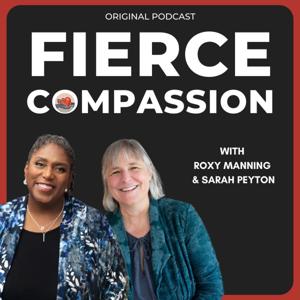
Roxy Manning and Sarah Peyton welcome you to the first season of their podcast, Fierce Compassion.
From the publisher's feed

12,681 Listeners