
Sign up to save your podcasts
Or



Exceeding Expectations in Occupational Health: An Interview with Barbara Khozam
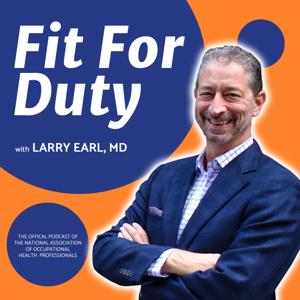
In this episode of the 'Fit for Duty' podcast, host, Dr. Larry Earl, interviews customer service expert, Barbara Khozam, on strategies to improve customer service in occupational medicine. Discussions focus on challenges of balance between patient needs and employer expectations, ways to create positive patient experiences, best practices for employer communication, the importance of ongoing training for staff, and the utilization of technology for efficient workflows.
Khozam also shares insights from her global professional experiences, demonstrating how empathy and regular recognition of employees contribute to maintaining high service standards even in a busy medical environment. The conversation concludes with some advice on dealing with mistakes and the importance of treating everyone kindly.
Key Conversation Points:
00:06 Introduction to Fit for Duty Podcast
01:06 Exceeding Expectations in Occupational Medicine
01:35 Introducing Barbara Khozam: The Customer Service Magician
02:21 Communication Strategies for Occupational Medicine
02:39 Building Trust and Loyalty with Employer Clients
03:38 Effective Communication in Sensitive Work-Related Topics
05:52 Leveraging Technology for Better Customer Service
07:36 Building Stronger Relationships with Employers
11:07 The Role of Recognition in Customer Service
24:00 Balancing the Needs of Patients and Employers
26:39 Lessons from Volleyball: Teamwork and Customer Service
30:45 Conclusion: The Key to Exceeding Expectations in Occupational Medicine
Thanks for tuning in to the Fit for Duty Podcast. Please help us by liking, rating, and subscribing to the channel. It really helps others find this show and benefit from its content. See you on the next one!
Check out the video version of the podcast at - https://www.youtube.com/@naohp-occhealth
Customer Service Course: Here
Join NAOHP membership - Click here
Occupational Medicine for Providers - Click here
Navigating the Complexities of Delayed Recovery in Occupational Health: A Conversation with Dr. Diana Kraemer
In this episode of the Fit for Duty podcast, the host Dr. Larry Earl, President of the National Association of Occupational Health Professionals, discusses the concept of delayed recovery in occupational health with guest Dr. Diana Kraemer of iaime.org.
Dr. Diana Kraemer, an occupational medicine expert, neurosurgeon, and the President of the International Academy of Independent Medical Evaluators, shares her insights on the intricate layers of delayed recovery, addressing risk factors in workers' comp cases, utilizing the biopsychosocial approach over the limited biomedical model, and talking about medically unexplained physical symptoms.
She also highlights methods to optimize recovery processes, reduce unnecessary disability risk, and the systemic barriers in healthcare and workers' comp systems. Consideration is given to the importance of education, appropriate care referral, and the significant role of industry engagement for effective approaches.
Key Conversation Points:
00:06 Introduction to Fit for Duty Podcast
00:59 Understanding Delayed Recovery in Occupational Health
01:42 Guest Introduction: Dr. Diana Kraemer
02:58 Decoding Delayed Recovery: A Conversation with Dr. Diana Kraemer
03:20 Understanding DFRUD: Delayed and Failed Recovery, and Unnecessary Disability
04:57 The Impact of Delayed Recovery on Patient's Treatment
09:59 The Difference Between Impairment and Disability
13:31 The Biopsychosocial Model of Recovery
18:50 Strategies and Interventions for Biopsychosocial Aspects of Recovery
22:26 Special Offer from the International Academy of Independent Medical Evaluators
22:49 Integrating Biopsychosocial Model Aspects into Clinical Practice
25:39 The Importance of Movement in Injury Recovery
26:43 Addressing Migraines and Headaches in the Workplace
27:25 The Role of Sleep, Diet, and Nutraceuticals in Health
29:33 Understanding Medically Unexplained Physical Symptoms
33:46 The Impact of Imaging Studies on Patient Perception
37:00 Addressing Systemic Barriers in Healthcare
41:32 Raising Awareness and Encouraging Cultural Shifts in Medical Settings
45:43 Closing Remarks and Future Discussions
Thanks for tuning in to the Fit for Duty Podcast. Please help us by liking, rating, and subscribing to the channel. It really helps others find this show and benefit from its content. See you on the next one!
Check out the video version of the podcast at - https://www.youtube.com/@naohp-occhealth
PROMOTION: “Never-A-Member” first year Dues for IAIME at half price, $247.50 instead of $495. New Members receive our Core Competencies Study Guide, our Report Writing Handbook, and our 3-hour video course, “Introduction to IMEs.
https://iaime.org/become-a-member-2/
Hill Criteria Article: Fedak KM, Bernal A, Capshaw ZA, Gross S. Applying the Bradford Hill criteria in the 21st century: how data integration has changed causal inference in molecular epidemiology. Emerg Themes Epidemiol. 2015 Sep 30;12:14. doi: 10.1186/s12982-015-0037-4. PMID: 26425136; PMCID: PMC4589117. https://www.ncbi.nlm.nih.gov/pmc/articles/PMC4589117/
Join NAOHP membership: Click here
Occupational Medicine for Providers: Click here
From the publisher's feed