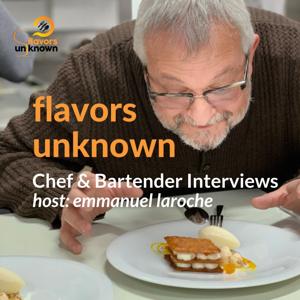
flavors unknown podcast

flavors unknown podcast

By Emmanuel Laroche - Show HostArtsFood
Download on the App Store

flavors unknown podcast episodes

  • Mark Welker – Set Goals and Make Them Happen
    Mark Welker is the executive pastry chef at “Make it Nice” group which includes Eleven Madison Park and NoMad (New York, L.A., Las Vegas, and London). He was raised in Indiana, went to culinary school in Kentucky, and attended the former French Culinary Institute in NYC. Then you went to France “because you wanted to understand where pastry making was born”. Talking about his position today, Executive Pastry Chef Mark Welker says "It's a very collaborative team. When we talk about things we want to accomplish, everyone's voice counts and everyone's voice matters. I want people to be the best versions of themselves and I have to help them to get there, help them make good decisions".
    What we covered in this episode
    Chef Mark Welker went to France a few years after culinary school because he "wanted to understand where pastry making was born”. It was one of his first goals in life.
    Since he started professionally, he always has been focused on his career. 
    Setting goals and delivering on those goals are important for Chef Mark Welker. This applies to travel abroad as well.
    He recommends traveling for people who want to enhance their career and just become a better person. 
    Chef Mark Welker today's goals are less personal and more aligned with the company culture.
    Coming back from France Chef Mark Welker staged at WD-50.
    After helping friends in St Louis, Chef Mark Welker staged at Eleven Madison Park and he has been now more than 10 years in the group (recorded in 2020).
    Chef Mark Welker talks about becoming a Four Stars NY Times restaurant, being on the top 50 San Pellegrino list,  and becoming a three Michelin Star restaurant.
    What does it mean to be the first restaurant in the world?
    About Nomad, we discussed how to create menus that are specific to each location but still keep the brand identity.
    It takes a long time before you understand your style or the style of the restaurant that you're you're creating desserts for.
    Listen to the full conversation on this page or on any phone podcast apps like Apple Podcasts or Spotify.
    Link to the podcast episode on Apple Podcast http://bit.ly/PastryChef_Mark_Welker
    Links to other episodes in New York City
    Chef David Burke - Restaurateur
    Executive Chef Gabriel Kreuther
    The Brandy Library with owner Flavien Desoblin
    Pastry Chef Sam Mason - Odd Fellows
    Chef Trigg Brown - Win Son
    Submitted questions from podcast listeners
    Which country is best for chefs?
    I think there are so many locations, especially with the 50 best restaurants list out there, they highlight so many different restaurants from all over the world and so many of these restaurants have different philosophies. So if you want to focus on fermentation and foraging and things like that, there are restaurants out there that specialize in that, like, you know, a lot of the Nordic restaurants. I think some of the restaurants in Brazil and South America really do well with fermentation. If you're interested in Mexican cuisine and Mexican spices, then you should probably travel south of the border. I think that there are restaurants all over the world at this point time, and it doesn’t need to be a Michelin star restaurant. If you're passionate about Thai food and you want to learn about Thai ingredients, then just go travel through Thailand. Go eat on the streets. Go to the markets, go to the wet markets, have an Airbnb, get the ingredients and cook. As long as you're setting yourself goals. timelines, and pushing to meet those goals with a mindset of coming back and actually using what you've learned to better yourself and to further your career.
    Which savory ingredients could be added to sweets?
    In the realm of things being fermented, different koji inoculating with different things, using different homemade vinegars is a big one that really can help desserts a lot, like using kombucha techniques to make a tea. Kind of like make a fermented tea and then use that to season things.I kind of think that's like the best. I'm not into using bacon, you know, or different meat products. I'm not really into even vegetables outside of squash or carrot. Like, I really don't want to. I'm not I'm just not a big fan of that kind of stuff. We use a lot of vinegar for brightness. And again, it kind of lower the sweetness of the dessert.
    What is Mark Welker's apple pie recipe?
    I would look at the apples first that I chose to make the pie and when I make an apple pie, I think of the different textures inside of apple pie. And I don't like it to all be one texture. So I think that I would choose maybe three different varieties of apples. That's where I would start, I would pick my favorite apples. And you'd want an apple that's going to be very firm and hold up the cooking while one that's going to have different make sweetness or acidity notes as well. You want one that kind of falls apart, they can kind of like bind it all together. But again, not having like too much moisture. And I think then there are different ways to deal with that if an apple has too much moisture. What I would do is give it a little sugar in my Calvados treatment or pick the core of your choice, rum or it could be bourbon, it could be anything you really want it to be. But I would add a little bit to the apples and I would let them soak and macerate overnight and then I would drain them, and then really kind of like get all that liquid out of it and then maybe even make a caramel with all that juice and sugar that's leftover and then kind of just lay it on the inside.
    #gallery-3 {
    margin: auto;
    }
    #gallery-3 .gallery-item {
    float: left;
    margin-top: 10px;
    text-align: center;
    width: 25%;
    }
    #gallery-3 img {
    border: 2px solid #cfcfcf;
    }
    #gallery-3 .gallery-caption {
    margin-left: 0;
    }
    /* see gallery_shortcode() in wp-includes/media.php */
    Chef Mark Welker and @flavorsunknown
    Peaches with creme fraiche – Picture Evan Sung
    Chocolate Pretzels – Picture Evan Sung
    A dessert of honey oatmeal crumble with honey brittle, dehydrated milk foam, and ice milk drizzled with honey prepared by NoMad Executive Pastry Chef Mark Welker
    Click to tweet
    People should travel. It's good to get out of the country and see how small the world is, and how small life is. It makes you think differently.
    Click To Tweet
    Young people today want to learn things much faster. They want to move to the stations a lot quicker. And it’s more about resumé building to them.
    Click To Tweet
    Long term goals change as you change and grow but short term goals should be very realistic. People should have a lot of them. And they should be checking them off.
    Click To Tweet
    I want to hire people who want my job. We want people that are ambitious.
    Click To Tweet
    Every single day we show up to work. We need to think of it like a championship game. And as a leader, you have to show up every day like you're ready for the championship game. It starts at the top.
    Click To Tweet
    We want things to look effortless on the plate. But once you eat it, you realize that the flavors, the textures, and the technique are much deeper than what you think.
    Click To Tweet
    You should use sugar to season something not to like just make it sweet, not just for like an end result.
    Click To Tweet
    Social media
    Chef Mark Welker
    Instagram
    Links mentioned in this episode
    Eleven Madison Park
    Nomad
    Make It Nice

    59 min
  • Chris Shepherd – Sharing Food & Life Experiences
    I am really pleased to have Chef Chris Shepherd of Houston, TX on the show. Chef Chris Shepherd is a James Beard Award winner and was recently named by the Robbery Report magazine as the best chef in the world. He has helped change the landscape of the Houston culinary scene since opening Underbelly in 2012. What we covered in this episode Chef Chris Shepherd is the most recognizable Chef in Houston, TX.In 2019 he was named the Chef of the Year (in the world) by Robb Report, the luxury-lifestyle magazine based in Los Angeles.Houston is known to be the most diverse city in the US. Chef Chris Shepherd describes the food scene in Houston.Food takes you to local ethnic places and you get to learn from people and they learn from you. And just sharing life experiences. And that's it's a beautiful, beautiful thing. His cookbook "Cook like a Local" is broken into six chapters dedicated to integral ingredients of the unique Houston melting pot: fish sauce, chiles, soy, rice, spices and corn.When Chef Chris Shepherd talks about "local food" he is not talking about locality of ingredient, he is talking about locality of culture. Chef Chris Shepherd says that his cookbook is a love letter to Houston, and to the US. And it's a love letter to accepting and to start to learn and understand where we're going as people.His has an unconventional approach to the restaurant business. He opened Underbelly in 2012 and closed it in 2018 even if the business was good. With One Fifth Chef Chris Shepherd decided that with the five year lease he will have five restaurants in five years with five different concepts: year one Steakhouse, year two Romance languages (French, Spanish, and Italian), year three Mediterranean (Greek inspired), year fourvGulf Coast cuisine.To learn more about our my conversation with Chef Shepherd, click on the link to the podcast episode on Apple Podcasts http://bit.ly/Chef_Chris_Shepherd
    p.p1 {margin: 0.0px 0.0px 0.0px 0.0px; font: 12.0px Helvetica}
    Links to other episodes in Houston Chef Drake Leonards - EuniceBaker Matthieu Cabon - Magnol French Baking
    Submitted questions from podcast listeners How to use fish sauce?What I learned is that there should be two ingredients in fish sauces. There should be anchovies and there should be salt. And that's it. For a home consumer to use fish sauce make sure you are buying quality. And that's pretty easy to do at this point. Then it's like how do you balance something so super funky that you need something sweet, that you need something spicy, that you need something to tone it back. You need some acidic. And it's just learning about balance.  I think fish sauce is the perfect day to inspire you to learn balance in a dish because most cooks cook with salt, pepper and maybe a little bit of lemon juice or lime juice or something on a dish. But it's more about understanding the balance of sweetness, sour, the spice, the funk. Fish sauce is a perfect ingredient for young cooks, especially to understand their palate and to understand balance and flavors.Where to use fish sauce?If you are going to brines a chicken. I think for use it in a little bit of fish sauce into it gives it that "you'll never know it is there" spice or flavor profile. It is perfect in Bolognaise sauce. You had a little bit in your Bolognaise and it just gives it that umami richness. If you aren't looking to do predominantly a Vietnamese or Thai influenced flavor, that you're adding just a little bit of sodium and more of that richness of fermentation and that richness of umami, that flavor contrast that you can't find, that you can't buy, that it's there and you have to use these ingredients then I think for fish sauce is the absolutely perfect way to put those things in there. A little bit in a vinaigrette, a little bit in a braising.Chef Chris Shepherd chicken wings recipe?Caramelized fish sauce, chicken wings. Greatest thing ever. Roast the chicken wings in the oven or grill them.Then have a little sauté pan, toast a little bit of garlic, shaved garlic, add some honey or white sugar, caramelized that fish sauce, add lime juice. Toss the wings and you're good. A few chilies in there like Sereno or Jalapeño.
    Click to tweet
    The best way to start to have a conversation is through food on the table. Then you can establish friendship conversations and learning from each other and not just talking about food all the time, but talking about life.
    Click To Tweet
    Learning from people is one of the greatest things that we could possibly do. Just share stories and have conversations. It's the easiest thing to do.
    Click To Tweet
    You need to quit cooking for yourself and start cooking for the culture. You could cook free at that point.
    Click To Tweet
    People love challenges. Status quo is one of the worst things for people that is trying to just sit there and do the same things over and over and over again.
    Click To Tweet
    I tell people all the time that the only thing that holds you back is yourself. And that's the honest truth. Because you have to try and push to try to learn and you'll find inspirations anywhere and everywhere.
    Click To Tweet
    Creativity is probably the most important thing, it's about seeing things and using things and touching things. Technique is cool. But at the end of the day, it's got to taste good.
    Click To Tweet
    Social media Chef Chris Shepherd
    Instagram
    Facebook
    Twitter
    Links mentioned in this episode UB PreservGeorgia JamesHay Merchant
    51 min
  • Beau du Bois – Listen to your Neighborhood!
    Have you ever wonder how to revamp a cocktail program or how to go about reinventing a classic cocktail?  Well, in today's episode, this is exactly what you will find out with my guest, the award-winning bar director, Beau Du Bois. You recently moved to the south of California as the new bar and spear with the creative director at Puesto in San Diego. He built is 16 years career in L.A. at the Corner Door and in Napa Valley at the three Michelin star restaurant, Meadowood.
    What we covered in this episode
    Looking back at Beau du Bois' career, I asked him if he would build his cocktails more from the top-down or bottom up? Meaning, would he come up with an overarching flavor / theme and build the details with specific ingredients or bring individual flavors one at a time?
    What drew him to mixology?
    What was the motivation for creating themed cocktail menus when Beau du Bois was at Corner Door in L.A.?
    How is it different to create a drink menu at a 3 Michelin Star restaurant?
    Beau du Bois recently joined Puesto in San Diego. Which “road” brought him to work this Mexican restaurant?
    How would Beau du Bois describe San Diego cocktail scene in comparison to Los Angeles and Napa?
    Listen to the full podcast episode to learn more about designing a cocktail program, discovering his creative process, and the cocktail trends for 2020.
    Link to the podcast episode on Apple Podcast http://bit.ly/Beau_du_Bois
    Submitted questions from podcast listeners
    How to make an old fashioned at home?So for a twist on an Old Fashioned, I would say head to the decent liquor store in your town or down the street from your house and grab some apple brandy and grab a bottle of cognac. And let's just do one ounce of each. Let's get a little bit of apple cider and we're gonna use the cider instead of water to make this simple syrup. So just equal parts there. Then just a little bit of cherry and orange bitters in there. And you've got a Thanksgiving Day in a glass right there.How to Design a Successful Drink Menu?Take your time and you want to come at it the right way.First, you look at some of their the sales reports. Then, you look at Instagram and you start correlating the things that are already working, the flavors that are already working, the types and formats that are already working. This isn't about ripping the rug out from underneath the program. It's about just taking quarter turns on the things that are already doing so well and just elevating them ever so slightly so that you don't leave those guests in the dark just because they don't like Aloe Vera or Tamarin. It's about this quarter turning that recipe and turning the volume up a little. So the customers will be like, “I like the old one, but this one is getting better”. And this is the trust. The trust that you earn from guests so that maybe they will come back in a month or two months and try that crazy cocktail at the bottom of the menu.The other side of that is looking at things that really don't work, or haven't worked historically. And in offering something new that, again, listening to the neighborhood, you feel is going to be a success or is going to start to tell a story.How to reinvent a classic cocktail?In terms of reinventing the classic cocktail, let's just go for the low hanging fruit. Let's talk about old fashioned.An old fashioned is just a combination of a base spirit, bitters, and sugar.Obviously it was historically usually made with whiskey. And at a time, when bars were just beginning to have creative menus, people would come back and say, can I have the whiskey cocktail, the old fashioned way? That's when the name was born.When you look at those building blocks of that cocktail, whiskey, sugar, bitters, and any base spirit, there's a lot of room to play there.Let's take the bourbon out. Let's put in cognac. Or let's take the bourbon out or the rye out, and let's put in tequila or let's do a split of cognac and rye.Now for the sugar. It is just a just a vehicle for some richness, some softness of the cocktail. But that sugar is made with water, which is flavorless. It doesn't need to be flavorless. Why don’t we just use tea or put, some fruit in that water, or infuse the sugar with some fruits and peels of various citrus.So now you've already greatly changed that cocktail to something that's a little close to a fingerprint of flavor that you were going for. But it still scratches the itch of someone who's looking for that old fashioned.Of course, you can play with the bitters. I mean, we live in a time where I'd be shocked if you could find the flavor that isn't in a bitter right now. I'm sure somebody got a peanut butter bitters out there.
    Jesse Vidawhen he was at BlackTail
    If you are interested in mixology check out these two additional episodes by clicking on the respective pictures:   Jesse Vida (Episode #1)  when he was at BlackTail, NYC and Angel Teta (Episode #4) Whiskey Guardian at Angel's Envy.
    Angel Teta Whiskey Guardian @ Angel's Envy
    #gallery-3 {
    margin: auto;
    }
    #gallery-3 .gallery-item {
    float: left;
    margin-top: 10px;
    text-align: center;
    width: 25%;
    }
    #gallery-3 img {
    border: 2px solid #cfcfcf;
    }
    #gallery-3 .gallery-caption {
    margin-left: 0;
    }
    /* see gallery_shortcode() in wp-includes/media.php */
    Beau du Bois – Cliftons_Media
    Cocktail Beau du Bois – Cliftons_Media-15 copy
    Beau du Bois @Puesto
    Beau du Bois @Puesto
    Click to tweet
    It starts with the base spirit. Then it becomes more about the overarching flavor that I'm going for. And then it moves into the visual presentation that will elevates the guest experience.
    Click To Tweet
    When it comes to building cocktails and creating cocktails, make sure that you're listening to your neighborhood and to your guests. Your neighborhood helps you keep the bills paid. Make sure that you're not leaving the neighborhood behind!
    Click To Tweet
    Themed cocktail menus give the opportunity and the challenge of creativity. But you always have to stay one foot in the "is this viable for this business or for this neighborhood"? First, you earn the trust of your community and your demographic. And then once you have that, it's time to innovate.
    Click To Tweet
    In cocktail-food pairing, overly complimentary is where you're using the same ingredients or similar flavors in the cocktail, in the dish. For me, that's just too much. It's more important to offer a little bit of contrast so that we're helping to reset the palate.
    Click To Tweet
    We live in the world of Instagram, we live in a world of pictures, and people taste with their eyes. And if you can't evolve as a chef or a bartender and understand how to use that to your advantage, then you're sleeping at the wheel.
    Click To Tweet
    Social media
    Beau du Bois
    Instagram
    Facebook
    Twitter
    Links mentioned in this episode
    PuestoCorner Door in LAMeadowood in Nappa Valley
    45 min
  • Ted Lee – Home Cook and Writer
    Ted Lee from the Lee Brothers: "we grew up in Charleston, South Carolina. It's a very particular region of the south. So we didn't know a lot about eastern Kentucky or the panhandle of Florida. And so then this other phase of our lives, with magazines paying us to go to different regions of the south that we didn't know. To write about them was so exciting. We learned so much because remember, we don't have a southern grandmother. We grew up in Charleston, but neither of our parents grew up there. So we had to learn everything about southern food from somebody else's mother or grandmother."
    What we covered in this episode
    Ted Lee from The Lee Brothers is a home cook and a writer.Him and his brother moved to Charleston, SC when he was 8 and his brother Matt 10.They developed their orientation towards food during their childhood. It all started with Boiled Peanuts in Charleston, SC and the Lee Bros. Boiled Peanut Catalog.They published their first cook book "Southern Cookbook" in 2006.Ted Lee talks about how to write a successful cookbook?The most existing cookbooks today are personal cookbook.The most critical element for writing a recipe cookbook is to invest in independent recipe testing."You can make money. Usually the book sort of breaks even, but it serves every other aspect of your business."The Lee Bros. developed a cookbook writing workshop in Charleston, SC called "Cookbook Boot Camp".Ted described the 6 seminars of the curriculum: "Finding a Voice", "Defining you Kitchen Vision", "Keeping your Material Fresh", "Creating a Test-Kitchen Practice", "How you are going to Tell your Story", and "Marketing & Publicity".We discuss about Charleston being one of the main food travel destination in the US and the food from the Low Country.Ted Lee introduces their new book called "Hotbox" about catering and tells many stories linked to their experience in the catering industry.Listen to the full podcast to learn more cookbook writing, the low country, and the behind the scenes of the catering business. Link to the podcast episode on Apple Podcast http://bit.ly/Ted_Lee
    Submitted questions from podcast listeners
    How do you make pimento cheese?The cheese in a pimento cheese is usually typically an orange-colored sharp cheddar cheese. I use a white cheddar, really aged with some age on it with seems almost crystalline structure which makes it  so delicious. I also used Poblano. The Poblano peppers are roasted and then pickled. And it is just a completely different but familiar flavor. It is like green chili pimento cheese. I use cream cheese and mayonnaise in it, which is sort of controversial. Some people only think it's only mayonnaise, but I like the combination. There are so many different spins you can do on pimento cheese, but that one with the extra sharp cheddar and roasted pickled planters is extraordinary.What is the difference between Low Country, Gullah, and Soul Food?There's a lot in common between the cuisines. You mentioned Gullah Geechee cooking, low country cooking and soul food. I would say they all have their origins in the migration of enslaved Africans to North America. That's the origin of those things. And you can see this in a dish that's sort of a classic low country dish like red rice. You can see the sort of connections to the West African joloff rice. It's a huge influence. I would say that what's important is to get away from defining them or defining them as sort of oppositional. But finding the proximity, and especially finding a chef who can guide you through that, through their personal experience, either through a book or by meeting them.What is the difference between a chef and a caterer?It's so different. Very rarely are you cooking things to order. So if you are doing a gala with six hundred people who get served filet tenderloin or lamb chops, those proteins should be seared in a deep fryer the day before. Just to get the color on them and then killed down in the walk in. And then it would be moved to the venue in a transport cabinet which, once on site, is turned into a hot box, all the food pulled from it and transformed using sterno and sheet pans into a warming oven. And so it's a completely different practice than what restaurant chefs are used to. It’s always most plated dinners at simultaneous service. So you're really building a kitchen that's meant to serve out the first course. The second course and the third course, all the same plate within 15 minutes, instead of having the bell curve that a restaurant has over the course of the evening where the orders come in.
    Click to tweet
    The great thing about cookbooks is there can be all kinds of them and as long as they are of quality, and the recipes tested, they will find an audience.
    Click To Tweet
    You can make money. Usually the book sort of breaks even, but it serves every other aspect of your business.
    Click To Tweet
    The most exciting books that are being done today are the most personal book. The ones that really are from an accomplished cook who's telling about how who they became resulted in the food they serve and why people love it.
    Click To Tweet
    The Chefs today are more in tune with telling stories about themselves and their ancestors, where they've come from, where they're going, and really situating their own kitchen practice between the past and the present and the future.
    Click To Tweet
    There is no visibility because they're working in special events catering. It's all designed to focus attention on whoever is being celebrated. The people behind the scenes are not the story.
    Click To Tweet
    Social media
    The Lee Brothers
    Instagram
    Facebook
    Twitter
    Links mentioned in this episode
    The Lee Bros.The Lee Brothers Boiled Peanuts CatalogThe Cookbook Boot Camp
    1 hr 8 min
  • Brother Luck – Embracing your Fears!
    "The first time I did a Top Chef Colorado, says Chef Brother Luck from Four by Luck in Colorado Springs, that was more about anger. I was angry at myself for losing the show. And I understood why. I was disappointed in myself. Coming back for the second season and doing Top Chef, Kentucky was a decision that I probably shouldn't have made. I was so quick to want to validate myself from losing the previous season and feeling like it was unfinished that. I went back and I wasn't in a good mental place. And in the end, I think that's where a lot of young chefs don't understand, is you have to take care of your mental health."
    What we covered in this episode
    From depression to raising awareness for mental heath issues
    Chef Brother Luck shares his "big lesson" after being on multiple cooking TV shows like Beat Bobby Flay, Chopped, and Last Chance Kitchen.
    Cooking on television isn't real. It's entertainment. 
    Chef Brother Luck takes us to the time when he was told "pack you knives and go!" when he lost Last Chance Kitchen.
    The elimination from Bravo's Top Chef was the beginning of some important life changes for Chef Brother Luck.
     Chef Brother Luck had a very traumatic childhood. "I never realized how much that was going to affect me as a man. I built up a lot of anger from all that pain. And you can only hold that in for so long."
    "And all it takes is one fracture of a scenario to break it and it's coming out. You don't know how to handle that. And I think that was where I was at at that point in my life when when I got kicked off Top Chef, Kentucky. Losing the show was the trigger."
    "That was a really hard time. And I was one of the fortunate ones to say, you know, I need help. And I want to go talk to my therapist. I need to be around people that actually care about me because I felt used at that time. And I think when you're in a situation where you feel used or taken advantage of, you're gonna shut down. And that's exactly what I was doing."
    His therapist diagnosed him with post-traumatic stress disorder (PTSD) about two years ago, which stemmed from experiences like the passing of his father and violence in his childhood.
    Chef Brother Luck came to realize that sharing his story helps other chefs and cooks struggling with the same challenges.
    "When someone's dealing with depression or insecurities or not feeling like they belong or they're looking for validation, the answer isn't to ask them “are you OK?” I think the answer is to share your own story so they don't feel alone."
    "I think we don't have a labor shortage right now. We have bad leaders. So we have to change our our culture. So I think that's where it starts."
    Read Chef Brother Luck's essay about mental health and depression (link to article in the "link mentioned in this episode" section below)
    From cooking for necessity to owning Four by Luck restaurant in Colorado Springs
    "I never wanted to be a chef until they told me I was good at cooking. And that compliment is what I became hungry for. I wanted that attention. I spent my whole career chasing that approval of that male role model."
    Chef Brother Luck mentions the benefits of Griffith Center for Children, C-CAP, and Pro-Start programs.
    The cuisine at Four by Luck is continuously influenced by four main providers who supply the ingredients  "The Hunter, The Gatherer, The Fisherman, The Farmer"
    Influenced by a recent trip he made to Japan, Chef Brother Luck transcribed the love that Japan has for nature, menus celebrating the four seasons into his local region in Southern Colorado.
    "It's not about which ingredient is the best each season. It's about the transformation of the ingredient from the season."
    For Chef Brother Luck at Four by Luck, cooking is about survival.  The story of each ingredient as it transforms through the season is what it's about.
    Favorite ingredients: Huitlacoche, pronounced weet-la-COH-cheh, is a fungus that grows on ears of corn, and, green chilies.
    For Chef Brother Luck creativity happens because of techniques.
    He describes his creative process behind the signature dish Tempura Poppers.
    Chef Brother Luck describes the food scene in South Colorado.
    5 rapid-fire questions!
    Click to tweet
    I've had a very traumatic childhood. I never realized how much that was going to affect me as a man. I built up a lot of anger from all that pain. And you can only hold that in for so long.
    Click To Tweet
    I have an addictive personality. That's who I am. And whether it was being an addict to alcohol or drugs or for me, it's work. So it's easy to drown myself in the world work.
    Click To Tweet
    When someone's dealing with depression or insecurities or not feeling like they belong or they're looking for validation, the answer isn't to ask them “are you OK?” I think the answer is to share your own story so they don't feel alone.
    Click To Tweet
    When you watch social media, you're watching everyone's greatest hits. No one's posting the bad stuff that happened to them today. They're talking about the great stuff and we measure ourselves against that. So I think it starts from me with social media being real.
    Click To Tweet
    I think we don't have a labor shortage right now. We have bad leaders. So we have to change our culture. So I think that's where it starts.
    Click To Tweet
    For me, cooking started at a very young age out of necessity. But then it became the supplement of the male role model from the street hustler or the gangbanger to now the chef and the toques.
    Click To Tweet
    I never wanted to be a chef until they told me I was good at cooking. And that compliment is what I became hungry for. I wanted that attention. I spent my whole career chasing that approval of that male role model.
    Click To Tweet
    For me, it's not about which ingredient is the best each season. For me, it's about the transformation of the ingredient from the season.
    Click To Tweet
    Social media
    Chef Brother Luck
    Instagram
    Twitter
    Facebook
    Social media
    Restaurant Four by Luck
    Instagram
    Facebook
    Links mentioned in this episode
    Four by Luck
    Chef Brother Luck's Essay about Mental Health and Depression
    Griffith Center for Children
    C-CAP
    Pro-Start program
    48 min
  • Hari Cameron – Creativity within Boundaries
    "When we do the tasting menus at a(MUSE.) we asked each guest three questions. What do you love in season? Do you have any allergies or intolerances? Is there anything you'd rather stay away from? So in the restaurant, we can be doing five tasting menus and they can all be different. In my creative approach, Everything has to be technique. I'm not in a place where I can just put a radish on a plate and serve it. I have to manipulate it. The vegetables is a perfect, beautiful thing. And how can I not mess that up? How can I deliver it in its peak of flavor? And how can I presented in a way where the guests will enjoy it and really get a sense of what it is?"
    What we covered in this episode
    a(MUSE.) is Chef Hari Cameron flagship restaurant in Rehoboth Beach, DE and GrandPa Mac is a fast casual concept focusing on mac & cheese that he opened with his brother Orion Cameron.
    a(MUSE.) = amuse-bouche + inspiration + fun
    At GrandPa Mac they make everything from scratch and fresh pasta everyday. It has integrity and soul.
    A(Muse) celebrate progressive Mid-Atlantic cuisine and real "farm to table" concept.
    "I always want my food to be, no matter how progressive it is, always grounded in the mid Atlantic, but seasonal and regional."
    "We often speak of food from the South and New England. We think of Louisiana cuisine. But the Mid-Atlantic is sometimes overlooked as a cuisine. But I think we have a lot of history and rich heritage."
    Chef Hari Cameron describe the food staples from Delaware: crab, seafood,  light beer, corn, and chicken.
    "As a modern chef, I'm taking a lot of the fat in the roux out of things. Fat is a tool for flavor. So if you're using it, well, it's fine. But no, back in the old days, a lot of these old recipes have a lot of flour and butter and things that aren't necessary, things that kind of get in the way of flavor."
    Chef Hari Cameron explains how he had to balance his progressive mindset and interest for new techniques and new ingredients with the reality of the commercial aspect of the business. 
     "When we do the tasting menus at a(MUSE.) we asked each guest three questions. What do you love in season? Do you have any allergies or intolerances? Is there anything you'd rather stay away from? So in the restaurant, we can be doing five tasting menus and they can all be different."
    Chef Hari Cameron talks about his creative process using squash, and Channeled Whelk as an example.
    "There needs to be technique. You have to be creative. But creativity has to happen within boundaries because if you're creative for creative sake, you're only going to hit a very small portion of people."
     What compelled him to become a Chef. He did not find cooking, Cooking re-found him.
    5 rapid-fire questions! 
    Chef Hari Cameron gourmet mac & cheese recipe
    So you can get fresh pasta from so many different makers right now. Even if you don't have a home extruder, it's pretty easy to get fresh pasta. So I think you start with the pasta. If you're using dry pasta, that's fine. There's a place for that as well. Next thing I think is your cheese selection. I think that you need some depth in your cheese. So using a couple of different cheeses, depending on if it's white or yellow. I think Gruyere as some really nice nuttiness. I think Fontina adds some depth there also. Really understanding your cheeses, white cheddar of course and different ages. It's kind of a classic. And then I don't think flour is needed. I think that if you are a home cook and you use sour salt, it's called sodium citrate, you can make any cheese into the perfect melting consistency. Like Velveeta. The perfect mac and cheese cheese. So you use 9 to 12 percent of that of total weight of cheese.
    I think you need some acid in there. Some people use mustard as their acid, some people use an alcoholic cider. Kind of like doing a fondue play. Or I think that using a beer would be interesting. So when you can add a little acidity to help cut the fat, the mustard is nice because it adds that kind of spice as well. Tabasco is nice. Tabasco is a vinegar based hot sauce. It has that kind of brightness that you're looking for. Nutmeg would make it more, you know, the Italian Bechamel.
    Pasta is like a nicely dressed salad. You don't want too much dressing. You want it to evenly coated, understanding the consistency of your sauce and you don't need to bake it or you could bake it. One of the best mac and cheese you can make is Cacio e Pepe. I think that if you have some parmesan, if you have olive oil or butter, pasta, water and black pepper and a good pasta, if your emulsification technique is good, you can make it beautiful. It's not mac and cheese, but it's so simple.
    #gallery-3 {
    margin: auto;
    }
    #gallery-3 .gallery-item {
    float: left;
    margin-top: 10px;
    text-align: center;
    width: 25%;
    }
    #gallery-3 img {
    border: 2px solid #cfcfcf;
    }
    #gallery-3 .gallery-caption {
    margin-left: 0;
    }
    /* see gallery_shortcode() in wp-includes/media.php */
    “Liver & Onions” Foie Gras Mousse – Baby Sweet Onions – Crab Fat Ash Oil – Charred Onion Skin Broth Poured Table side
    Poached Shrimp – Cocktail Powder – Celery Root Sorbet
    Smoked fish pâté – Green Tomato – Cornbread – Fennel – Cultured Cream – Fermented Chili
    45 day dry aged strip steak – heirloom tomato – fried chili anchovy shallot oil
    Chicken Of The Woods Mushroom’s – Lo Country Long Grain Rice – Black Truffle – Herbs and flowers
    Charentais Melon – House Made Saucisson Sec Relish – Lemon Verbana
    Chef Hari Cameron from a(MUSE.)
    Chef Hari Cameron from a(MUSE.) & @flavorsunknown
    Click to tweet
    I always want my food to be, no matter how progressive it is, always grounded in the Mid-Atlantic, but seasonal and regional.
    Click To Tweet
    We often speak of food from the South and New England. We think of Louisiana cuisine. But the Mid-Atlantic is sometimes overlooked as a cuisine. But I think we have a lot of history and rich heritage.
    Click To Tweet
    As a modern chef, I'm taking a lot of the fat in the roux out of things. Fat is a tool for flavor. So if you're using it well, it's fine. Back in the old days, a lot of these old recipes have a lot of flour and butter that aren't necessary, things that kind of get in the way of flavor.
    Click To Tweet
    When I first opened up, I was more militaristic about the only using ingredients in our food shed. Now it's more about sourcing the best things that I can and making the guest happy.
    Click To Tweet
    I've only ever been in competition with myself. I feel like if I'm paying attention to other people, I'm taking the eye off of my craft and what I'm doing.
    Click To Tweet
    Social media
    Chef Hari Cameron
    Instagram
    Twitter
    Social media
    a(MUSE.) & GrandPa Mac
    Instagram
    Facebook
    Instagram
    Links mentioned in this episode
    a(MUSE.) restaurant
    GrandPa Mac
    53 min
  • Gabriel Kreuther – Making Customers Happy!
    Chef Gabriel Kreuther with cuisine rooted in  his  Alsatian heritage, says that "the beauty [of getting 2 Michelin Stars] is the sense of teamwork, the sense of accomplishment and also the sense of making customers happy. We are in business because we love what we do, we cook, but at the end of the day, we love to cook a little bit for ourselves, and by doing so we engage with customers and make them happy. And hopefully they have a great moment with us."
    What we covered in this episode
    From Alsatian cuisine in France to 2 Michelin star restaurant in NYCGarbriel Kreuther restaurant received in 2019 and in 2020  Two Michelin Stars. We discuss with Chef Gabriel Kreuther how he and his team felt about it. "A feeling of accomplishment for the past"What is the difference between a two stars and a three stars? Looking back to his career, Chef Gabriel Kreuther reviews the key milestones that led him to get 2 Michelin stars.He always wanted to be a Chef. Chef Gabriel Kreuther started to work while on vacation in the hotel from his uncle in the region of Alsace in France.He became the "Meilleur Apprenti de France". And it was for him a new start and a new thinking approach.In 1988 and 1989 he took a Chef position in Washington DC. It was a turning point to him.His motivation was (and still is today) to want to understand everything, understanding the "why". Before the time of internet and easy access to information, he spent a lot of time doing research.  He always needed to feel that he was learning something.He always wanted to work in [kitchen] environments that were decent, where the human person was respected.Chef Gabriel Kreuther talks about his mentors Chef Jean-Georges Vongerichten and Chef Danny Meyer.Gabriel Kreuther's creative processThe food served at the 2 Michelin star Gabriel Kreuther's restaurant is a blend of the Alsatian heritage and the modern aspects of other cultures.The Chef explains the story behind his willingness to  have a relaxed atmosphere in his 2 Michelin star restaurant. Alsatian cooking is basically the rusticity and the wholeness of the German cooking mixed up with refinement and the finesse of the French cooking, Almost like a kind of fusion before anybody talked about fusion cooking.Creativity around the tradition Alsatian dish: "La Tarte Flambée". The dish is based around three basic elements: "fromage blanc", onion, and smoked bacon on bread dough. Chef Gabriel Kreuther innovated with hens of the woods mushrooms, duck confit, or smoked salmon. For Chef Gabriel Kreuther, the creative process has many starting points: product centric, influenced by the season, travels, or it can be a challenge."You cannot have only technique and no flavor. It's meaningless." His management style is about coaching, mentoring and inspiring. "You really have to love what you do in order to to bring the quality on the plate and in order to do what we do, if you don't have that genuine passion, that work is too hard for you."The Chef mentions that he always used techniques that were either very old techniques or techniques that were forgotten.In the Fall of 2021, Chef Gabriel Kreuther will publish a book.5 rapid-fire questions!
    Links to other episodes in New York City
    Chef David Burke - RestaurateurPastry Chef Mark Welker - Eleven Madison ParkThe Brandy Library with owner Flavien DesoblinPastry Chef Sam Mason - Odd FellowsChef Trigg Brown - Win Son
    Chef Gabriel Kreuther recipe with scallops
    "It depends of the quality of the scallops. But if it's really, really beautiful ones. Yeah, I will literally tend to eat them almost as a tartare or as a ceviche. So we'll just slice them in couple slices and season them with grape-seed oil, a little bit of olive oil, salt, pepper, chives, a few red peppers in there, a little bit of orange juice and something crunchy, I would put a little bit puffed wheat or something like that in there. Mix it. And that's a nice little appetizer. I will have a little bit of green apple in it. Well, then just roast it. I will make them very simply with a couple of mushrooms. Just you can just deglaze with a little bit chicken stock or water or a little bit of white wine or lemon juice and a little bit olive oil. I will serve them literally with a nice lentil soup. But passed and not the whole lentils in it. And we'd be like a bed."
    #gallery-3 {
    margin: auto;
    }
    #gallery-3 .gallery-item {
    float: left;
    margin-top: 10px;
    text-align: center;
    width: 25%;
    }
    #gallery-3 img {
    border: 2px solid #cfcfcf;
    }
    #gallery-3 .gallery-caption {
    margin-left: 0;
    }
    /* see gallery_shortcode() in wp-includes/media.php */
    Chef Gabriel Kreuther & flavorsunknown
    Sturgeon & Sauerkraut Tart with Alsatian Heritage
    2 Michelin star Classic tarte flambée @ Alsatian cooking
    Foie Gras Dish @ Gabriel Kreuther
    Foie Gras Sesame Praline Chef Gabriel
    Duck breast with Mole sauce @ fusion style
    Squab Foie Gras Croustillant @ Gabriel Kreuther
    Gabriel Kreuther Restaurant @ Bryant Park
    Click to tweet
    I always wanted to work in [kitchen] environments that were decent, where the human person was respected.
    Click To Tweet
    We are walking many hours in this business, and we spending more time [in the kitchen] than we do with our families, and I think it can be fun and it can be good. It doesn't have to be the crazy side of it.
    Click To Tweet
    It takes a while for a chef to understand that it's not only cooking that makes the experience. It's a little bit more than that. Hospitality and how you speak, behave with the guests, and how you'll receive them.
    Click To Tweet
    I always ask myself, I don't need to have a jacket. I don't need to have a tie. The food won't taste better. So why can we not get over that?
    Click To Tweet
    Alsatian cooking is basically the rusticity and the wholeness of the German cooking mixed up with refinement and the finesse of the French cooking, Almost like a kind of fusion before anybody talked about fusion cooking.
    Click To Tweet
    As you get older in your [Chef] career and more seasoned, you understand that the most important thing is really the flavor. And then the technique. But you cannot have only technique and no flavor. It's meaningless.
    Click To Tweet
    You want to be original and you want to come with something that is not well known and surprises people.
    Click To Tweet
    Social media
    Gabriel Kreuther
    Instagram
    Twitter
    Facebook
    Linkedin
    Links mentioned in this episode
    Gabriel Kreuther restaurant
    54 min
  • Flavien Desoblin – Owner Brandy Library NYC
    The very sole purpose of the Brandy Library, says Flavien Desoblin, is to show our customers whoever wants to listen, that these spirits, whether it is Cognac or bourbon or tequila are made by real people. First of all, with an amazing tradition, usually a great deal of heritage and there is so much care into the process, into the making of the spirits and where wherever they made from that they definitely deserve attention and then should we pay that to a little bit of attention. We discover a whole world of flavors.Chef podcast - Chef Interview
    What we covered in this episode with owner of the Brandy Library
    Flavien Desoblin talks about his French upbringing in Burgundy, France.He moves to the US in 2000 and created the Brandy Library in Manhattan in 2004.The core mission of the BL is give the letter of character back to the spirits. There is such much care in the making of the spirits that they deserve a lot of attention.Where does the name Bourbon come from? Definitely there is a connection to France!We talk about the official definition of straight bourbon.Straight Bourbon: 51% corn, rye, malted barley, and sometimes wheat aged 2 years in charred new oak barrels - do not have to be from Kentucky to be called Bourbon but has to be produced in the US and it has to enter the cask at no more than 62.5 abc 125 proofAbout 94% of the bourbon is made in Kentucky. What makes Kentucky ideal for bourbon whiskey production? Is it because of the limestone-filtered water? Or is it because of the weather and the variation of temperature?Is older always better for bourbon?What of the following has the most impact on the final bourbon taste? A specific mashbill? The yeast? The aging in barrels? Or the finish in different casks?The number one is the aging in barrels with the impact of the seasons with the wood of the barrels expending and contracting.What does Bottle-in-Bond means?Flavien Desoblin has a strong opinion against adding drops of water to a high-proof bourbon and definitely not a good one about adding ice in a glass of bourbon.Flavien Desoblin talks about moving barrels around during maturation and describes as well the Solera techniqueInnovation via various specific cask-finish.Pairing bourbon with food. Flavien advise to use a highest proof like 92-96. What is Spirits Network? The link is at the bottom of this page.5 rapid-fire questions. 
    Links to other episodes in New York City
    Chef David Burke - RestaurateurPastry Chef Mark Welker - Eleven Madison ParkExecutive Chef Gabriel KreutherPastry Chef Sam Mason - Odd FellowsEpisode #72 with Chef Dan Kluger from Loring PlaceConversation with Chef Silvia Barban from Brooklyn in episode #64Episode #58 with Chef Bryce Shuman from BetonyChef Trigg Brown - Win SonConversation with food critic John Mariani in episode #70
    Links to other podcast episodes with awarded mixologists
    Episode #1 with Jesse VidaConversation with Angel Teta from Portland in episode #4Episode #62 with Bob Peters from Charlotte, NCConversation with Brand Ambassador Charlotte Voisey in episode #50Episode #36 with Beau du Bois from San Diego, CAConversation with Ryan Burk, Head Cider Maker at Angry Orchard
    Flavien Desolblin talks about Bourbon and Food pairings
    "For someone some reason I am one of the very few people who love to pair a bourbon, if not cask strength, at least a higher strength 96 proof or above with Jamon Iberico de Bellota because there is so much depth, richness, and harmony in Jamon Iberico de Bellota that I think is the perfect complement. You can go straight at chocolate and enjoy a wide variety of chocolate milk chocolate, very dark chocolate to the bitter chocolate. And in a variety of bourbon, you know, some bourbons are drier than others and some are sweeter than others. Some have more vanilla than others. You'll find spicy bourbons. Is it because of the rye or because it was aged for a lot longer? I'm not sure. Whichever that it is, no matter what there will be chocolate, that will be ideal for it, you can just go as simple as a praline chocolate candy and a Maker's Mark.Asian foods, especially when he gets a bit spicy is great with bourbon. But even without being spicy, there is the mastering of fat in the dishes that are just the right complement. And I mean, those barbecue sauces and the soy-based marinades. I mean there is so much depth in there that you find the depth in the bourbon as well while in the rye whiskey. So I like a cask strength or barrel-proof when I'm going that way.God knows bacon is just bourbons' best friend!
    #gallery-3 {
    margin: auto;
    }
    #gallery-3 .gallery-item {
    float: left;
    margin-top: 10px;
    text-align: center;
    width: 25%;
    }
    #gallery-3 img {
    border: 2px solid #cfcfcf;
    }
    #gallery-3 .gallery-caption {
    margin-left: 0;
    }
    /* see gallery_shortcode() in wp-includes/media.php */
    Atmosphere & Bourbon
    Bar and spirits @ Brandy Library
    Consumers 2 @ Brandy Library enjoying spirits
    Consumers @ Brandy Library enjoying spirits
    Copper & Oak with spirits
    Tasting spirits at the Brandy Library
    Bourbon and Rye tasting flight
    Bourbon class with Flavien Desoblin
    Click to tweet
    There is such a great deal of heritage and there is so much care into the process of making spirits, where wherever they are made, that they definitely deserve our attention.
    Click To Tweet
    If you found yourself in the liking of fancy red wine, naturally you're looking for the drier style and you don't mind the tannins and you appreciate the structure that the tannins will the red wine is the same thing for spirits.
    Click To Tweet
    Should you be in contemplation, so to speak, rather than in a rush to drink it and you'll see that the whiskey will expose itself to you.
    Click To Tweet
    Innovation, no matter what is absolutely needed to keep the whiskey business going.
    Click To Tweet
    Bourbon is a very natural product that you cannot temper with. So it's a beautiful thing that you can sort of play with the bourbon by transferring it after a wise traditional maturation in brand new charred oak barrels into different casks.
    Click To Tweet
    Social media
    Brandy Library
    Twitter
    Instagram
    Facebook
    Social media
    Spirits Network
    Instagram
    Links mentioned in this episode
    Brandy LibraryCopper & OakSpirits Network
    1 hr 21 min
  • Noosh – Celebrating Eastern Mediterranean Cuisine
    Noosh is a cohesive Eastern Mediterranean concept from Chefs Sayat and Laura Ozyilmaz that elevates the simplest foods from the region into a story that basically resonates with the California culture. The restaurant is named after my grandmother, says Chef Sayat. We care about cultural anchors, something that sort of rests in history and culture, and the logical place and Noosh is not just an Armenian and Greek words, but it also as a meaning. In Farsi that is part of an expression, that means cheers. 
    What we covered in this episode
    How is it to be couple in life and working as a coupe in the kitchen?
    Chef Sayat is Armenian from Turkey and Laura is from Mexico. How are they merging these two cultures (Eastern Mediterranean and Mexican) together? 
    Laura fell in love with the culture from Turkey way before she met Sayat.
    They staged in Michelin star restaurants during their...honeymoon!
    San Francisco was the right city for both of them to move to and create the food they love.
    Noosh is a Eastern-Mediterranean restaurant concept that include food, drinks, tea, and wine. It is named after Sayat's grandmother.
    They have created a borderless cuisine that celebrates the whole Eastern-Mediterranean region.
    More than 50% of the menu can be suitable for vegetarians.
    Eastern Mediterranean cuisine has a high $ / flavor ratio says Chef Sayat.
    Middle Eastern food is obviously a trend today but it is not reduce only to hummus!
    The pepper paste is in the ancient Ottoman Empire is like almost the equivalent of sofrito.
    Key spices from the area: sumac, alepo pepper, urfa biber, khmeli suneli, and blue fenugreek.
    We talk about their creative process. It has to be seasonal, Eastern Mediterranean, and easy to execute.
    Chef Sayat details a dish from their menu: Minty Yogurt Broth
    There are still a lot of flavors, ingredients, and unique traditional processes and techniques.
    Sayat and Laura share their approach to and their experience while staging before opening their own restaurant.
    Rapid-fire questions.
    Chefs Sayat and Laura Ozyilmaz Eastern Mediterranean Inspiration
    I think for the people that want to try Eastern Mediterranean food or want to start cooking, the right angle is to go and explore spices, to begin with. The spices play a huge role with this cuisine. When you understand the spices and how they interact with each other you can create something amazing. I think they'll be the right angle. The other thing, if you want to create like a special dish, of course, exploring the pantry of the eastern Mediterranean or the Ottoman Empire using them in a way that fits in with your city or your area where you live in. 
    You will always buy stuff, vegetables. So this is something that you can miss. As well using the grilling  techniques, grilling kebab and grilling fish with burnt oregano.
    Note from the host: have a look at Chef Laura Ozyilmaz book recommendations in the link section below.
    #gallery-3 {
    margin: auto;
    }
    #gallery-3 .gallery-item {
    float: left;
    margin-top: 10px;
    text-align: center;
    width: 25%;
    }
    #gallery-3 img {
    border: 2px solid #cfcfcf;
    }
    #gallery-3 .gallery-caption {
    margin-left: 0;
    }
    /* see gallery_shortcode() in wp-includes/media.php */
    Laura and Sayat Ozyilmaz
    MINT YOGURT BROTH
    Chef Sayat talking
    Skewers at Noosh
    Spread at Noosh
    Pita bread and spreads
    Spice blends Noosh
    Pita Sandwich at Noosh
    Click to tweet
    Our crisis management tool box is ever expanding. De-escalation in any situation is our best tool, and therefore we know better not to escalate situations.
    Click To Tweet
    One of the mottos has always been “we want to serve food, that we want to eat ourselves.”
    Click To Tweet
    With that idea of borderless cuisine and the value we bring by expanding it to not just food has been the biggest way we’ve elevated casual Middle Eastern foods to a higher level.
    Click To Tweet
    When creating a pantry of key flavors you build the fundamental building blocks of your cuisine by identifying those key ingredients that are so important to you, not only by finding the common denominators, but also by identifying what differentiates you.
    Click To Tweet
    Social media
    Chefs Laura and Sayat Ozyilmaz
    Instagram
    Social media
    Restaurant Noosh
    Instagram
    Facebook
    Links mentioned in this episode
    Restaurant Noosh
    Istanbul and Beyond: Exploring the Diverse Cuisines of Turkey
    Essential Turkish Cuisine
    Black Sea: Dispatches and Recipes, Through Darkness and Light
    51 min
  • 3 Chefs from Austin Question Everything
    This is the second part of the recording in Austin, TX with three local Chefs. We are here at the Fairmont in Austin and I have with me around the table three chefs from Austin. Chef Kevin Fink from Emmer & Rye, Chef Fiore Tedesco from L'Oca D'Oro and Chef André Natera from The Fairmont Hotel. We are continuing the conversation on creativity and the local food scene in Austin. Just before the series of rapid-fire questions, the 3 Chefs will talk about local ingredients.
    What we covered in this episode 3 Chefs in Austin Part Two
    Question Everything
    Kevin Fink - "The ability to question is to me what we need to follow and the ability to seek enough knowledge to have context to this questioning. And I think that what Ferran did. I know that what Rene did. The irony of this all is, as creative as it is, it just makes sense. Question the molecular structure or why things happen or what it takes for our world to do it. They just gave us glasses to understand different elements of our world."
    "Don't look for others and try and mimic what they're doing. Question why you're doing everything that you're doing and make sure that everything in that makes sense because the person that is going to be the next Ferran on Rene is not going to find somebody they're what they're gonna do instead is they're going to have a perspective different enough about what we do that others will be captivated by."
    Look For Soulful Experiences
    Fiore Tedesco - "I'm constantly in seek of soulful experiences. There is something about for me seeking out these soulful intimate experiences in all the places that I go that really turned the lights on for me and helped me answer those questions."
    "And generally when I'm going somewhere I want I want to go where I see families laughing and where I see a bunch of people gathering in what seems like like a natural way people existing in the world. I want a window into what is not authentic but fuel's right to them and feels normative when we go down to like fancy restaurants."
    Food Scene in Austin
    Andre Natera - "Right now you have almost as in between chef driven interpretation of Mexican food. And I would say probably right now locally that's what I see the most. And if I was going to open up a restaurant in Austin right now to make a lot of money what would I open. I would say Mexican cuisine is having its moment probably not in Mexico I don't think having a Mexican food moment in Mexico but here in Austin.
    Kevin Fink - "When it comes to food we in many ways have the Danish complex and what I mean by that is we don't have a style of cuisine that was ours. The Austin food scene offers a tremendous amount of creativity. It offers some limitless possibilities of things. It offers a camaraderie that we have here and because it's not so saturated and set in its ways it also offers a nimbleness to it. We have permissions here to try things that are different."
    Austin Local Ingredients
    Herbs and flowers: Hoja Santa (sassafras), Devil's Claws, Prickly Ash/Toothache Tree, Moringa, 
    Citrus: Wild lime and Persian lime
    Berries: Hackberry, Jujube dates
    Native Cactus, Monk's Pepper, Mesquite, Burr Oak
    5 Rapid-fire questions:
    Chef André Natera
    from Fairmont Austin
    If you are interested in discovering more about the Austin restaurant scene, check out these two additional episodes by clicking on the respective pictures:   Chef André Natera from the Fairmont Hotel and Chef Fiore Tedesco from L'Oca d'Oro.
    Chef Fiore Tedesco 
    from L'Oca d'Oro
    #gallery-3 {
    margin: auto;
    }
    #gallery-3 .gallery-item {
    float: left;
    margin-top: 10px;
    text-align: center;
    width: 25%;
    }
    #gallery-3 img {
    border: 2px solid #cfcfcf;
    }
    #gallery-3 .gallery-caption {
    margin-left: 0;
    }
    /* see gallery_shortcode() in wp-includes/media.php */
    Chef Andre Natera and @flavorsunknown
    3 Chefs from Austin and I
    3 Chefs from Austin and @flavorsunknown
    Chef Andre Natera
    Chef Fiore Tedesco and Chef Kevin Fink
    French Tarte from Chef Fiore Tedesco
    Food on table @ Fairmont Hotel Austin
    Chef Fiore Tedesco
    Click to tweet
    The ability to question is to me what we need to follow and the ability to seek enough knowledge to have context to this questioning. Don't look for others and try and mimic what they're doing. Question why you're doing everything that you're doing.
    Click To Tweet
    I'm constantly in seek of soulful experiences. There is something about for me seeking out these soulful intimate experiences in all the places that I go that really turned the lights on for me
    Click To Tweet
    The Austin food scene offers a tremendous amount of creativity. It offers some limitless possibilities of things. We have permissions here to try things that are different.
    Click To Tweet
    Social media
    Chef Andre Natera
    Instagram
    Twitter
    Linkedin-in
    Social media
    Chef Kevin Fink
    Instagram
    Instagram
    Social media
    Chef Fiore Tedesco
    Instagram
    Instagram
    Links mentioned in this episode
    Fairmont Hotel Austin
    Garrison restaurant at the Fairmont
    Revue restaurant at the Fairmont
    Emmer & Rye
    L'Oca D'Oro
    Hestia Austin
    Did you enjoy today's episode? If so, please show your support by writing me a 5 star review on iTunes and Stitcher Radio.
    37 min

About flavors unknown podcast

From the publisher's feed

We take you behind the scenes of trending kitchens and bars. A podcast for kitchen and bar professionals, foodies and wannabe foodies.

More shows like flavors unknown podcast

Good Food by KCRW

Good Food

1,111 Listeners

The Week in Art by The Art Newspaper

The Week in Art

206 Listeners

Salt & Spine by Brian Hogan Stewart

Salt & Spine

185 Listeners

This Is TASTE by Matt Rodbard & Aliza Abarbanel

This Is TASTE

303 Listeners