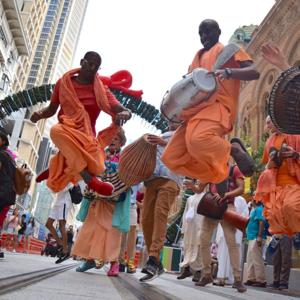
Flying Monk

Flying Monk

Download on the App Store

Flying Monk episodes

  • The Mahatma Business - BG 9.14 - Johannesburg, South Africa
    satataṁ kīrtayanto māṁ
    yatantaś ca dṛḍha-vratāḥ
    namasyantaś ca māṁ bhaktyā
    nitya-yuktā upāsate
    Translation
    Always chanting My glories, endeavoring with great determination, bowing down before Me, these great souls perpetually worship Me with devotion.
    Purport
    The mahātmā cannot be manufactured by rubber-stamping an ordinary man. His symptoms are described here: a mahātmā is always engaged in chanting the glories of the Supreme Lord Kṛṣṇa, the Personality of Godhead. He has no other business. He is always engaged in the glorification of the Lord. In other words, he is not an impersonalist. When the question of glorification is there, one has to glorify the Supreme Lord, praising His holy name, His eternal form, His transcendental qualities and His uncommon pastimes. One has to glorify all these things; therefore a mahātmā is attached to the Supreme Personality of Godhead.
    One who is attached to the impersonal feature of the Supreme Lord, the brahmajyoti, is not described as mahātmā in the Bhagavad-gītā. He is described in a different way in the next verse. The mahātmā is always engaged in different activities of devotional service, as described in the Śrīmad-Bhāgavatam, hearing and chanting about Viṣṇu, not a demigod or human being. That is devotion: śravaṇaṁ kīrtanaṁ viṣṇoḥ and smaraṇam, remembering Him. Such a mahātmā has firm determination to achieve at the ultimate end the association of the Supreme Lord in any one of the five transcendental rasas. To achieve that success, he engages all activities — mental, bodily and vocal, everything — in the service of the Supreme Lord, Śrī Kṛṣṇa. That is called full Kṛṣṇa consciousness.
    In devotional service there are certain activities which are called determined, such as fasting on certain days, like the eleventh day of the moon, Ekādaśī, and on the appearance day of the Lord. All these rules and regulations are offered by the great ācāryas for those who are actually interested in getting admission into the association of the Supreme Personality of Godhead in the transcendental world. The mahātmās, great souls, strictly observe all these rules and regulations, and therefore they are sure to achieve the desired result.
    As described in the second verse of this chapter, not only is this devotional service easy, but it can be performed in a happy mood. One does not need to undergo any severe penance and austerity. He can live this life in devotional service, guided by an expert spiritual master, and in any position, either as a householder or a sannyāsī or a brahmacārī; in any position and anywhere in the world, he can perform this devotional service to the Supreme Personality of Godhead and thus become actually mahātmā, a great soul.
    49 min
  • Takeover of Mercy - SB 3.21.41 - Cape Town, South Africa

    Translation

    The area resounded with the notes of overjoyed birds. Intoxicated bees wandered there, intoxicated peacocks proudly danced, and merry cuckoos called one another.

    Purport

    The beauty of the pleasant sounds heard in the area surrounding Lake Bindu-sarovara is described here. After drinking honey, the black bees became maddened, and they hummed in intoxication. Merry peacocks danced just like actors and actresses, and merry cuckoos called their mates very nicely.


    52 min
  • Be in Harmony with Nature - SB 3.21.42-43 - Cape Town, South Africa

    TRANSLATION

    Lake Bindu-sarovara was adorned by flowering trees such as kadamba, campaka, ashoka, karanja, bakula, äsana, kunda, mandära, kutija and young mango trees. The air was filled with the pleasing notes of kärandava ducks, plavas, swans, ospreys, waterfowl, cranes, cakraväkas and cakoras.

    PURPORT

    For most of the trees, flowers, fruits and birds mentioned here as surrounding Bindu-sarovara Lake, English synonyms cannot be found. All the trees mentioned are very pious in that they produce a nice aromatic flower, such as the campaka, kadamba and bakula. The sweet sounds of waterfowl and cranes made the surrounding area as pleasant as possible and created a very suitable spiritual atmosphere.

    43 min
  • Bathe in the God's Teardrops - SB 3.21.38-39 - Cape Town

    TRANSLATION

    The holy Lake Bindu-sarovara, flooded by the waters of the river Sarasvati, was resorted to by hosts of eminent sages. Its holy water was not only auspicious but as sweet as nectar. It was called Bindu-sarovara because drops of tears had fallen there from the eyes of the Lord, who was overwhelmed by extreme compassion for the sage who had sought His protection.

    PURPORT

    Kardama underwent austerities to gain the causeless mercy of the Lord, and when the Lord arrived there He was so compassionate that in pleasure He shed tears, which became Bindu-sarovara. Bindu-sarovara, therefore, is worshiped by great sages and learned scholars because, according to the philosophy of the Absolute Truth, the Lord and the tears from His eyes are not different. Just as drops of perspiration which fell from the toe of the Lord became the sacred Ganges, so teardrops from the transcendental eyes of the Lord became Bindu-sarovara. Both are transcendental entities and are worshiped by great sages and scholars. The water of Bindu-sarovara is described here as sivämrta jala. Siva means "curing." Anyone who drinks the water of Bindu-sarovara is cured of all material diseases; similarly, anyone who takes his bath in the Ganges also is relieved of all material diseases. These claims are accepted by great scholars and authorities and are still being acted upon even in this fallen age of Kali.

    46 min
  • Decoration of the Dead Body - Bhagavad Gita 2.51 - Varna, Bulgaria

    Translation

    By thus engaging in devotional service to the Lord, great sages or devotees free themselves from the results of work in the material world. In this way they become free from the cycle of birth and death and attain the state beyond all miseries [by going back to Godhead].

    Purport

    The liberated living entities belong to that place where there are no material miseries. The Bhāgavatam (10.14.58) says:
    samāṣritā ye pada-pallava-plavaṁ
    mahat-padaṁ puṇya-yaśo murāreḥ
    bhavāmbudhir vatsa-padaṁ paraṁ padaṁ
    padaṁ padaṁ yad vipadāṁ na teṣām
    "For one who has accepted the boat of the lotus feet of the Lord, who is the shelter of the cosmic manifestation and is famous as Mukunda, or the giver of mukti, the ocean of the material world is like the water contained in a calf's footprint. paraṁ padam, or the place where there are no material miseries, or Vaikuṇṭha, is his goal, not the place where there is danger in every step of life."
    Owing to ignorance, one does not know that this material world is a miserable place where there are dangers at every step. Out of ignorance only, less intelligent persons try to adjust to the situation by fruitive activities, thinking that the resultant actions will make them happy. They do not know that no kind of material body anywhere within the universe can give life without miseries. The miseries of life, namely birth, death, old age and diseases, are present everywhere within the material world. But one who understands his real constitutional position as the eternal servitor of the Lord, and thus knows the position of the Personality of Godhead, engages himself in the transcendental loving service of the Lord. Consequently he becomes qualified to enter into the Vaikuṇṭha planets, where there is neither material, miserable life nor the influence of time and death. To know one's constitutional position means to know also the sublime position of the Lord. One who wrongly thinks that the living entity's position and the Lord's position are on the same level is to be understood to be in darkness and therefore unable to engage himself in the devotional service of the Lord. He becomes a lord himself and thus paves the way for the repetition of birth and death. But one who, understanding that his position is to serve, transfers himself to the service of the Lord, at once becomes eligible for Vaikuṇṭhaloka. Service for the cause of the Lord is called karma-yoga or buddhi-yoga, or in plain words, devotional service to the Lord
    #liberation #material #essence #life #birth #death #oldage #disease #divorce #career #relationship #god #success #fail #family #children #house #money #sex #followers #service #devotional #soul #soulmate #love #krishnaconsciousness #krishna #bhagavadgita #knowledge #eternal #happiness #freedom #iskcon #harekrishna #chant #music #dance #harinama #nature #travel

    55 min

About Flying Monk

From the publisher's feed

Most people know me as the Flying Monk because you find pictures of me airborne while chanting Hare Krishna in the streets all over the world. This service has taken me to over 50 countries and people would like to know why I do it.