
Sign up to save your podcasts
Or



Madhavendra Puri Prabhu has a degree in both Law and Philosophy. He shares his journey in Krishna Consciousness, his service preaching at the university, teaching yoga and how HH Kadamba Kanana Swami touched his heart.
Inspirational words from South Africa' s leading book distributor
Gopa Kumar Prabhu is South Africa's leading Book Distributor. He's been so much tribulation but always keeps smiling because of his firm conviction in Srila Prabhupada's teachings.
Prabhu shares he's realisation about the philosophy, preaching and HH Kadamba Kanana Swami.
Unfortunately Caitanyadev Prabhu tragically passed away in February 2025.
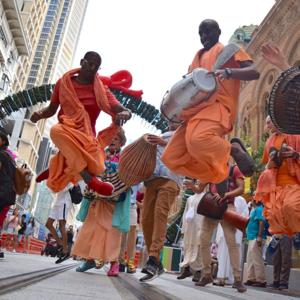
This interview was taken during our preaching at Schoolies 2024. Prabhu shares his realisations about Harinama Sankirtan and his journey in Krishna Consciousness.
May Krishna bless you. Hare Krishna
Translation
One who rejects an offering that comes of its own accord but later begs a boon from a miser thus loses his widespread reputation, and his pride is humbled by the neglectful behavior of others.
Purport
The general procedure of Vedic marriage is that a father offers his daughter to a suitable boy. That is a very respectable marriage. A boy should not go to the girl’s father and ask for the hand of his daughter in marriage. That is considered to be humbling one’s respectable position. Svāyambhuva Manu wanted to convince Kardama Muni, since he knew that the sage wanted to marry a suitable girl: “I am offering just such a suitable wife. Do not reject the offer, or else, because you are in need of a wife, you will have to ask for such a wife from someone else, who may not behave with you so well. In that case your position will be humbled.”
Another feature of this incident is that Svāyambhuva Manu was the emperor, but he went to offer his qualified daughter to a poor brāhmaṇa. Kardama Muni had no worldly possessions — he was a hermit living in the forest — but he was advanced in culture. Therefore, in offering one’s daughter to a person, the culture and quality are counted as prominent, not wealth or any other material consideration.
Translation
To deny an offering that has come of itself is not commendable even for one absolutely free from all attachment, much less one addicted to sensual pleasure.
Purport
In material life everyone is desirous of sense gratification; therefore, a person who gets an object of sense gratification without endeavor should not refuse to accept it. Kardama Muni was not meant for sense gratification, yet he aspired to marry and prayed to the Lord for a suitable wife. This was known to Svāyambhuva Manu. He indirectly convinced Kardama Muni: "You desire a suitable wife like my daughter, and she is now present before you. You should not reject the fulfillment of your prayer; you should accept my daughter."
Translation
Therefore please accept her, O chief of the brāhmaṇas, for I offer her with faith and she is in every respect fit to be your wife and take charge of your household duties.
Purport
The words gṛhamedhiṣu karmasu mean “in household duties.” Another word is also used here: sarvātmanānurūpām. The purport is that a wife should not only be equal to her husband in age, character and qualities, but must be helpful to him in his household duties. The household duty of a man is not to satisfy his sense gratification, but to remain with a wife and children and at the same time attain advancement in spiritual life. One who does not do so is not a householder but a gṛhamedhī. Two words are used in Sanskrit literature; one is gṛhastha, and the other is gṛhamedhī. The difference between gṛhamedhī and gṛhastha is that gṛhastha is also an āśrama, or spiritual order, but if one simply satisfies his senses as a householder, then he is a gṛhamedhī. For a gṛhamedhī, to accept a wife means to satisfy the senses, but for a gṛhastha a qualified wife is an assistant in every respect for advancement in spiritual activities. It is the duty of the wife to take charge of household affairs and not to compete with the husband. A wife is meant to help, but she cannot help her husband unless he is completely equal to her in age, character and quality.
Translation
Nor does the Supreme Lord assume anyone’s sinful or pious activities. Embodied beings, however, are bewildered because of the ignorance which covers their real knowledge.
Purport
The Sanskrit word vibhu means the Supreme Lord who is full of unlimited knowledge, riches, strength, fame, beauty and renunciation. He is always satisfied in Himself, undisturbed by sinful or pious activities. He does not create a particular situation for any living entity, but the living entity, bewildered by ignorance, desires to be put into certain conditions of life, and thereby his chain of action and reaction begins. A living entity is, by superior nature, full of knowledge. Nevertheless, he is prone to be influenced by ignorance due to his limited power. The Lord is omnipotent, but the living entity is not. The Lord is vibhu, or omniscient, but the living entity is aṇu, or atomic. Because he is a living soul, he has the capacity to desire by his free will. Such desire is fulfilled only by the omnipotent Lord. And so, when the living entity is bewildered in his desires, the Lord allows him to fulfill those desires, but the Lord is never responsible for the actions and reactions of the particular situation which may be desired. Being in a bewildered condition, therefore, the embodied soul identifies himself with the circumstantial material body and becomes subjected to the temporary misery and happiness of life. The Lord is the constant companion of the living entity as Paramātmā, or the Supersoul, and therefore He can understand the desires of the individual soul, as one can smell the flavor of a flower by being near it. Desire is a subtle form of conditioning for the living entity. The Lord fulfills his desire as he deserves: Man proposes and God disposes. The individual is not, therefore, omnipotent in fulfilling his desires. The Lord, however, can fulfill all desires, and the Lord, being neutral to everyone, does not interfere with the desires of the minute independent living entities. However, when one desires Kṛṣṇa, the Lord takes special care and encourages one to desire in such a way that one can attain to Him and be eternally happy. The Vedic hymns therefore declare, eṣa u hy eva sādhu karma kārayati taṁ yam ebhyo lokebhya unninīṣate. eṣa u evāsādhu karma kārayati yam adho ninīṣate: “The Lord engages the living entity in pious activities so that he may be elevated. The Lord engages him in impious activities so that he may go to hell.” (Kauṣītakī Upaniṣad 3.8)
ajño jantur anīśo ’yam
ātmanaḥ sukha-duḥkhayoḥ
īśvara-prerito gacchet
svargaṁ vāśv abhram eva ca
“The living entity is completely dependent in his distress and happiness. By the will of the Supreme he can go to heaven or hell, as a cloud is driven by the air.”
Therefore the embodied soul, by his immemorial desire to avoid Kṛṣṇa consciousness, causes his own bewilderment. Consequently, although he is constitutionally eternal, blissful and cognizant, due to the littleness of his existence he forgets his constitutional position of service to the Lord and is thus entrapped by nescience. And, under the spell of ignorance, the living entity claims that the Lord is responsible for his conditional existence. The Vedānta-sūtras (2.1.34) also confirm this. Vaiṣamya-nairghṛṇye na sāpekṣatvāt tathā hi darśayati: “The Lord neither hates nor likes anyone, though He appears to.”
Translation
If a human being is born in an aristocratic family or a higher status of life, if he performs wonderful activities, if he is youthful, if he has personal beauty, a good education and good wealth, and if he is nonetheless not proud of his opulences, it is to be understood that he is especially favored by the Supreme Personality of Godhead.
Purport
When in spite of possessing all these opulences a person is not proud, this means that he is fully aware that all his opulences are due to the mercy of the Supreme Personality of Godhead. He therefore engages all his possessions in the service of the Lord. A devotee knows very well that everything, even his body, belongs to the Supreme Lord. If one lives perfectly in such Kṛṣṇa consciousness, it is to be understood that he is especially favored by the Supreme Personality of Godhead. The conclusion is that one’s being deprived of his wealth is not to be considered the special mercy of the Lord. If one continues in his opulent position but does not become unnecessarily proud, falsely thinking that he is the proprietor of everything, this is the Lord’s special mercy.
Translation
Mahārāja Barhiṣat executed many sacrifices all over the world. He scattered kuśa grasses and kept the tops of the grasses pointed eastward.
Purport
As stated in the previous verse (kriyā-kāṇḍeṣu niṣṇātaḥ), Mahārāja Barhiṣat dived very deeply into the fruitive activities of sacrifice. This means that as soon as he finished one yajña in one place, he began performing another yajña in the immediate vicinity. At the present moment there is a similar need to perform saṅkīrtana-yajña all over the world. The Kṛṣṇa consciousness movement has started performing saṅkīrtana-yajña in different places, and it has been experienced that wherever saṅkīrtana-yajña is performed, many thousands of people gather and take part in it. Imperceptible auspiciousness achieved in this connection should be continued all over the world. The members of the Kṛṣṇa consciousness movement should perform saṅkīrtana-yajñas one after another, so much so that all the people of the world will either jokingly or seriously chant Hare Kṛṣṇa, Hare Kṛṣṇa, Kṛṣṇa Kṛṣṇa, Hare Hare/ Hare Rāma, Hare Rāma, Rāma Rāma, Hare Hare, and thus they will derive the benefit of cleansing the heart. The holy name of the Lord (harer nāma) is so powerful that whether it is chanted jokingly or seriously the effect of vibrating this transcendental sound will be equally distributed. It is not possible at the present moment to perform repeated yajñas as Mahārāja Barhiṣat performed, but it is within our means to perform saṅkīrtana-yajña, which does not cost anything. One can sit down anywhere and chant Hare Kṛṣṇa, Hare Kṛṣṇa, Kṛṣṇa Kṛṣṇa, Hare Hare/ Hare Rāma, Hare Rāma, Rāma Rāma, Hare Hare. If the surface of the globe is overflooded with the chanting of the Hare Kṛṣṇa mantra, the people of the world will be very, very happy.
From the publisher's feed