Flying Monk

Flying Monk

Download on the App Store

Flying Monk episodes

  • Precious Devotee Association - SB 5.18.10 - Swedish Sankirtan Tour
    Class given house of Madhai Jivan Prabhu.
    My dear Lord, we pray that we may never feel attraction for the prison of family life, consisting of home, wife, children, friends, bank balance, relatives and so on. If we do have some attachment, let it be for devotees, whose only dear friend is Kṛṣṇa. A person who is actually self-realized and who has controlled his mind is perfectly satisfied with the bare necessities of life. He does not try to gratify his senses. Such a person quickly advances in Kṛṣṇa consciousness, whereas others, who are too attached to material things, find advancement very difficult.
    PURPORT
    When Śrī Kṛṣṇa Caitanya Mahāprabhu was requested to explain the duty of a Vaiṣṇava, a Kṛṣṇa conscious person, He immediately said, asat-saṅga-tyāga — ei vaiṣṇava-ācāra. The first business of a Vaiṣṇava is to give up the association of persons who are not devotees of Kṛṣṇa and who are too attached to material things — wife, children, bank balance and so on. Prahlāda Mahārāja also prays to the Personality of Godhead that he may avoid the association of nondevotees attached to the materialistic way of life. If he must be attached to someone, he prays to be attached only to a devotee.
    A devotee is not interested in unnecessarily increasing the demands of the senses for gratification. Of course, as long as one is in this material world, one must have a material body, and it must be maintained for executing devotional service. The body can be maintained very easily by eating kṛṣṇa-prasāda. As Kṛṣṇa says in Bhagavad-gītā (9.26):
    patraṁ puṣpaṁ phalaṁ toyaṁ
    yo me bhaktyā prayacchati
    tad ahaṁ bhakty-upahṛtam
    aśnāmi prayatātmanaḥ
    "If one offers Me with love and devotion a leaf, a flower, fruit or water, I will accept it." Why should the menu be unnecessarily increased for the satisfaction of the tongue? Devotees should eat as simply as possible. Otherwise, attachment for material things will gradually increase, and the senses, being very strong, will soon require more and more material enjoyment. Then the real business of life — to advance in Kṛṣṇa consciousness — will stop
    36 min
  • The Flute, Love and Separation - CC Adi 4.31 - New York, USA

    dharma chāḍi’ rāge duṅhe karaye milana

    kabhu mile, kabhu nā mile, — daivera ghaṭana

    Translation

    “Pure attachment will unite us even at the expense of moral and religious duties [dharma]. Destiny will sometimes bring us together and sometimes separate us.

    Purport

    The gopīs came out to meet Kṛṣṇa in the dead of night when they heard the sound of His flute. Śrīla Rūpa Gosvāmī has accordingly composed a nice verse (see Ādi 5.224) that describes the beautiful boy called Govinda standing by the bank of the Yamunā with His flute to His lips in the shining moonlight. Those who want to enjoy life in the materialistic way of society, friendship and love should not go to the Yamunā to see the form of Govinda. The sound of Lord Kṛṣṇa’s flute is so sweet that it has made the gopīs forget all about their relationships with their kinsmen and flee to Kṛṣṇa in the dead of night.

    By leaving home in that way, the gopīs transgressed the Vedic regulations of household life. This indicates that when natural feelings of love for Kṛṣṇa become fully manifest, a devotee can neglect conventional social rules and regulations. In the material world we are situated in designative positions only, but pure devotional service begins when one is freed from all designations. When love for Kṛṣṇa is awakened, the designative positions are overcome.

    The spontaneous attraction of Śrī Kṛṣṇa for His dearest parts and parcels generates an enthusiasm that obliges Śrī Kṛṣṇa and the gopīs to meet together. To celebrate this transcendental enthusiasm, there is need of a sentiment of separation between the lover and beloved. In the condition of material tribulation, no one wants the pangs of separation. But in the transcendental form, the very same separation, being absolute in its nature, strengthens the ties of love and enhances the desire of the lover and beloved to meet. The period of separation, evaluated transcendentally, is more relishable than the actual meeting, which lacks the feelings of increasing anticipation because the lover and beloved are both present.

    54 min
  • Goal of Knowledge - SB 11.7.21 - Prague, Czech Republic
    puruṣatve ca māṁ dhīrāḥ
    sāṅkhya-yoga-viśāradāḥ
    āvistarāṁ prapaśyanti
    sarva-śakty-upabṛṁhitam
    In the human form of life, those who are self-controlled and expert in the spiritual science of Sāṅkhya can directly see Me along with all of My potencies.
    We find the following statement in the Vedas: puruṣatve cāvistarām ātmā sahita-prajñānena sampanna-tamo vijñātaṁ vadati vijñātaṁ paśyati veda śvastanaṁ veda lokālokau martyenāmṛtam īpsaty evaṁ sampanno 'thetareṣāṁ paśūnām āsanā-pipāse evābhijñānam. "In the human form of life, the soul is fully endowed with intelligence to understand spiritual knowledge. Thus, in human life the soul may speak realized knowledge, see the truth, know the future and also understand the reality both of this world and of the next. Taking advantage of the experience of mortal life, the soul in human form may endeavor for immortality, and the human body is fully equipped to achieve this end. In such an elevated state the soul is certainly well acquainted with the ordinary activities of animals, such as eating and drinking."
    The human form of life (puruṣatve) is very significant because it affords us the opportunity to perfect our existence. The Sāṅkhya system mentioned here is best illustrated by the instructions of Lord Kapila to His mother, Devahūti. Lord Kapila is the Supreme Personality of Godhead, and His mother approached Him, saying,
    nirviṇṇā nitarāṁ bhūmann
    asad-indriya-tarṣaṇāt
    yena sambhāvyamānena
    prapannāndhaṁ tamaḥ prabho
    "I am very sick of the disturbance caused by my material senses, for because of this sense disturbance, my Lord, I have fallen into the abyss of ignorance." (Bhāg. 3.25.7) Lord Kapila delivered to His mother a highly analytical summary of all material and spiritual reality. It is significant that Lord Kapila did not discriminate against His mother because she was a woman, nor did He consider her incapable of understanding the most elaborate spiritual knowledge. Thus, in a Kṛṣṇa conscious society of liberated souls, any man, woman or child may become a great devotee of Lord Kṛṣṇa without discrimination. It is also significant that in the highly intellectual Sāṅkhya system enunciated by Lord Kapila, the solid conclusion is surrender to the lotus feet of the pure devotees and love of Godhead. In Lord Kapila's instructions in the Third Canto of Śrīmad-Bhāgavatam, He emphasizes the need to take shelter of the pure devotees of the Lord. In the present verse Lord Kṛṣṇa says, sāṅkhya-yoga-viśāradāḥ: those who are expert in taking shelter of the pure devotees and who can thus understand the actual situation of this world are able to see Kṛṣṇa in His personal form, along with His internal and external potencies.
    A spiritual master becomes bona fide by his full surrender to his spiritual master; but as explained in this chapter, one may also act as his own guru. This means that an intelligent and perceptive person can understand the nature of this world and his own limitations. Such a person then becomes very much inclined to associate with the pure devotees of the Lord and to receive the mercy of those who are advanced in Kṛṣṇa consciousness. According to Śrīla Viśvanātha Cakravartī Ṭhākura, sāṅkhya-yoga, as described here, refers to the rigorous intellectual progress of the jñāna-yoga system, along with the devotion of bhakti-yoga, which emphasizes the mercy of the lotus feet of the pure devotees.
    Actually, jñāna-yoga is a factor in the bhakti-yoga system, since Kṛṣṇa is jñāna-gamya, or the goal of all knowledge. The Lord also says in Bhagavad-gītā (10.10) that He personally enlightens a sincere devotee with all knowledge. In this chapter, Lord Kṛṣṇa is training Uddhava to see the Lord's personal form in the course of his daily experiences in the material world. The Lord has already indicated to Uddhava that he will travel throughout the world in samādhi, or trance, and now Lord Kṛṣṇa is preparing Uddhava to travel as a true sannyāsī seeing the Personality of Godhead everywhere.
    45 min
  • A Lusty Lost Soul - SB 4.22.31 - Durban, South Africa

    bhraśyaty anusmṛtiś cittaṁ

    jñāna-bhraṁśaḥ smṛti-kṣaye

    tad-rodhaṁ kavayaḥ prāhur

    ātmāpahnavam ātmanaḥ


    TRANSLATION

    When one deviates from his original consciousness, he loses the capacity to remember his previous position or recognize his present one. When remembrance is lost, all knowledge acquired is based on a false foundation. When this occurs, learned scholars consider that the soul is lost.


    PURPORT

    The living entity, or the soul, is ever existing and eternal. It cannot be lost, but learned scholars say that it is lost when actual knowledge is not working. That is the difference between animals and human beings. According to less intelligent philosophers, animals have no soul. But factually animals have souls. Due to the animals' gross ignorance, however, it appears that they have lost their souls. Without the soul, a body cannot move. That is the difference between a living body and a dead body. When the soul is out of the body, the body is called dead. The soul is said to be lost when there is no proper knowledge exhibited. Our original consciousness is Kṛṣṇa consciousness because we are part and parcel of Kṛṣṇa. When this consciousness is misguided and one is put into the material atmosphere, which pollutes the original consciousness, one thinks that he is a product of the material elements. Thus one loses his real remembrance of his position as part and parcel of the Supreme Personality of Godhead, just as a man who sleeps forgets himself. In this way, when the activities of proper consciousness are checked, all the activities of the lost soul are performed on a false basis. At the present moment, human civilization is acting on a false platform of bodily identification; therefore it can be said that the people of the present age have lost their souls, and in this respect they are no better than animals.

    55 min

About Flying Monk

From the publisher's feed

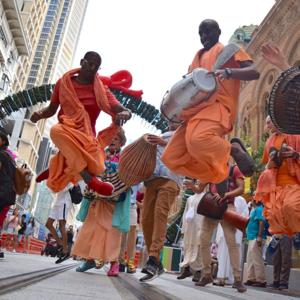
Most people know me as the Flying Monk because you find pictures of me airborne while chanting Hare Krishna in the streets all over the world. This service has taken me to over 50 countries and people would like to know why I do it.