
Sign up to save your podcasts
Or



TRANSLATION
The Supreme Personality of Godhead, Lord Vishñu, continued: My dear King Prthu, when one situated in his occupational duty engages in My loving service without motive for material gain, he gradually becomes very satisfied within.
PURPORT
This verse is also confirmed by the Vishñu Puräna. Occupational duties are known as varnäsrama-dharma and apply to the four divisions of material and spiritual life—namely brähmana, ksatriya, vaisya and südra, and brahmacarya, grhastha, vänaprastha and sannyäsa. If one works according to the varëäçrama-dharma system and does not desire fruitive results, he gets satisfaction gradually. Discharging one's occupational duty as a means of rendering devotional service unto the Supreme Personality of Godhead is the ultimate goal of life. Bhagavad-gitä confirms this as the process of karma-yoga. In other words, we should act only for the satisfaction and service of the Lord. Otherwise we will be entangled by the resultant actions.
Everyone is situated in his occupational duty, but the purpose of material occupations should not be material gain. Rather, everyone should offer the results of his occupational activities. A brähmana especially should execute his occupational duties not for material gain but to please the Supreme Personality of Godhead. The ksatriya, vaisya and südra should work in a similar way. In this material world everyone is engaged in various professional and occupational duties, but the purpose of such activities should be to please the Supreme Personality of Godhead. Devotional service is very simple, and anyone can adopt it. Let one remain what he is; he need only install the Deity of the Supreme Lord in his house. The Deity may be Rädhä-Krsna or Laksmi-Näräyana (there are many other forms of the Lord). In this way a brähmana, ksatriya, vaisya or südra can worship the Deity with the results of his honest labor. Regardless of one's occupational duty, one should adopt the devotional means of hearing, chanting, remembering, worshiping, offering everything to the Lord and engaging in His service. In this way one can very easily engage himself in the service of the Lord. When the Lord is pleased with one's service, one's mission in life is fulfilled.
TRANSLATION
A person with average intelligence does not think the head and other parts of the body to be separate. Similarly, My devotee does not differentiate Vishnu, the all-pervading Personality of Godhead, from any thing or any living entity.
PURPORT
Whenever there is disease in any part of the body, the whole body takes care of the ailing part. Similarly, a devotee's oneness is manifested in His compassion for all conditioned souls. Bhagavad-gitä (5.18) says, pandita sama-darshina: those who are learned see everyone's conditional life equally. Devotees are compassionate to every conditioned soul, and therefore they are known as apärakya-buddhi. Because devotees are learned and know that every living entity is part and parcel of the Supreme Lord, they preach Krishna consciousness to everyone so that everyone may be happy. If a particular part of the body is diseased, the whole attention of the body goes to that part. Similarly, devotees care for any person who is forgetful of Krishna and therefore in material consciousness. The equal vision of the devotee is that he works to get all living entities back home, back to Godhead.
TRANSLATION
The Lord continued: My dear Daksha Dvija, I am the original Personality of Godhead, but in order to create, maintain and annihilate this cosmic manifestation, I act through My material energy, and according to the different grades of activity, My representations are differently named.
PURPORT
As explained in Bhagavad-gitä (7.5), jiva-bhütä mahä-bäho: the whole world is energy released from the supreme source, the Personality of Godhead, who, it is further stated in Bhagavad-gitä, acts in superior energies and inferior energies. The superior energy is the living entity, who is part and parcel of the Supreme Lord. As parts and parcels, the living entities are not different from the Supreme Lord; the energy emanated from Him is not different from Him. But in the actual activity of this material world, the living entity is under the different qualities of material energy and in different forms. There are 8,400,000 life forms. The same living entity acts under the influence of the different qualities of material nature. The entities have different bodies, but originally, in the beginning of creation, Lord Vishnu is alone. For the purpose of creation, Brahmä is manifested, and for annihilation there is Lord Siva. As far as the spiritual entrance into the material world is concerned, all beings are part and parcel of the Supreme Lord, but under the covering of different material qualities they have different names. Lord Brahmä and Lord Siva are qualitative incarnations of Vishnu, as guna-avatäras, and Vishnu with them accepts control of the quality of goodness; therefore He is also a qualitative incarnation like Lord Siva and Lord Brahmä. Actually the different names exist for different directions, otherwise the origin is one only.
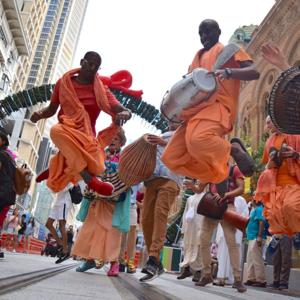
Lord's mercy is everywhere - especially for the kids of Schoolies when Harinama Sankirtan takes place.
TRANSLATION
Fire is appreciated by its light and by its ability to cook, to digest, to destroy cold, to evaporate, and to give rise to hunger, thirst, eating and drinking.
PURPORT
The first symptoms of fire are distribution of light and heat, and the existence of fire is also perceived in the stomach. Without fire we cannot digest what we eat. Without digestion there is no hunger and thirst or power to eat and drink. When there is insufficient hunger and thirst, it is understood that there is a shortage of fire within the stomach, and the Āyurvedic treatment is performed in connection with the fire element, agni-māndyam. Since fire is increased by the secretion of bile, the treatment is to increase bile secretion. The Āyurvedic treatment thus corroborates the statements in Śrīmad-Bhāgavatam. The characteristic of fire in subduing the influence of cold is known to everyone. Severe cold can always be counteracted by fire.
I appeared on National Television in Mauritius to speak on the glories of Srila Bhaktisiddhanta Sarasvati Thakur.
https://www.youtube.com/watch?v=oN5x4dspIFs&list=FLGMo9mQRd-W0Bdp7QbxAE7g
Devotees have so many qualities, not just a cult copy cats.
TRANSLATION
Because of having undergone long austerities in the water, the Pracetäs were very angry at the trees. Desiring to burn them to ashes, they generated wind and fire from their mouths.
PURPORT
Here the word tapo-dépita-manyavaù indicates that persons who have undergone severe austerity (tapasya) are endowed with great mystic power, as evinced by the Pracetäs, who created fire and wind from their mouths. Although devotees undergo severe tapasya, however, they are vimanyavaù, sädhavaù, which means that they are never angry. They are always decorated with good qualities. Bhägavatam (3.25.21) states:
titikñavaù käruëikäù
suhådaù sarva-dehinäm
ajäta-çatravaù çäntäù
sädhavaù sädhu-bhüñaëäù
A sädhu, a devotee, is never angry. Actually the real feature of devotees who undergo tapasya, austerity, is forgiveness. Although a Vaiñëava has sufficient power in tapasya, he does not become angry when put into difficulty. If one undergoes tapasya but does not become a Vaiñëava, however, one does not develop good qualities. For example, Hiraëyakaçipu and Rävaëa also performed great austerities, but they did so to demonstrate their demoniac tendencies. Vaiñëavas must meet many opponents while preaching the glories of the Lord, but Çré Caitanya Mahäprabhu recommends that they not become angry while preaching. Lord Caitanya Mahäprabhu has given this formula: tåëäd api sunécena taror api sahiñëunä/ amäninä mänadena kértanéyaù sadä hariù [Cc. Ädi 17.31]. "One should chant the holy name of the Lord in a humble state of mind, thinking oneself lower than the straw in the street; one should be more tolerant than a tree, devoid of all sense of false prestige and should be ready to offer all respect to others. In such a state of mind one can chant the holy name of the Lord constantly." Those engaged in preaching the glories of the Lord should be humbler than grass and more tolerant than a tree; then they can preach the glories of the Lord without difficulty.
Real Education is for developing perfect character not to become a royal edition of the animals.
TRANSLATION
The King will respect all women as if they were his own mother, and he will treat his own wife as the other half of his body. He will be just like an affectionate father to his citizens, and he will treat himself as the most obedient servant of the devotees, who always preach the glories of the Lord.
PURPORT
A learned man treats all women except his wife as his mother, looks on others' property as garbage in the street, and treats others as he would treat his own self. These are the symptoms of a learned person as described by Cäëakya Paëòita. This should be the standard for education. Education does not mean having academic degrees only. One should execute what he has learned in his personal life. These learned characteristics were verily manifest in the life of King Påthu. Although he was the king, he treated himself as a servant of the Lord's devotees. According to Vedic etiquette, if a devotee came to a king's palace, the king would immediately offer his own seat to him. The word brahma-vädinäm is very significant. Brahma-vädé refers to the devotees of the Lord. Brahman, Paramätmä and Bhagavän are different terms for the Supreme Brahman, and the Supreme Brahman is Lord Kåñëa. This is accepted in Bhagavad-gétä (10.12) by Arjuna (paraà brahma paraà dhäma). Thus the word brahma-vädinäm refers to the devotees of the Lord. The state should always serve the devotees of the Lord, and the ideal state should conduct itself according to the instructions of the devotee. Because King Påthu followed this principle, he is highly praised.
From the publisher's feed