
Sign up to save your podcasts
Or



When Openness Moves Faster Than Truth
What happens when a couple opens their relationship before the truth has caught up?
In this episode of The Connection Audit, Kirsten & Blake audit one of the quieter risks in ENM, swinging & open relationships: the gap between what a couple says they are ready for & what they are actually able to hold emotionally.
Because openness can look exciting from the outside. It can sound progressive, liberated & confident. But if one person is saying yes while swallowing fear, uncertainty or resentment, the relationship may not be expanding — it may be outrunning honesty.
This episode looks at the difference between genuine consent & quiet accommodation. Between curiosity & pressure. Between a shared adventure & one partner trying to keep up because they are scared of losing the relationship.
Kirsten & Blake explore why couples can move too quickly into rules, apps, events or play before doing the slower work: naming fears, checking desire, agreeing pace, building repair skills & making sure both people feel safe enough to tell the truth.
They also challenge a common cultural myth: that being “open” automatically means being evolved. In reality, openness without emotional honesty can become another performance. The question is not simply, “Are we allowed to do this?” It is, “Can we talk about what this is bringing up without punishment, withdrawal or collapse?”
Through the TBS lens, this conversation is not anti-ENM. It is pro-truth, pro-consent & pro-relationship integrity. Ethical non-monogamy is not proven by how quickly people say yes. It is proven by how carefully they listen when one person says, “I’m not sure.”
This episode is for couples considering ENM, people already in the lifestyle, anyone who has felt left behind by the pace of a relationship, & anyone who wants connection with more honesty, less performance & better repair.
You’ll hear:
• Why readiness is not the same as curiosity • How one partner can appear “fine” while quietly shutting down • Why pressure can hide inside excitement • The difference between consent, compliance & emotional safety • What couples should audit before opening further • Why TBS places education, pacing & standards before access
Because better relationships do not happen by accident. They need truth, timing, care & the courage to slow down before something breaks.
Romance fraud is not about stupidity. It targets trust, attachment, hope & the human wish to be seen.
In this episode of The Connection Audit, Kirsten & Blake audit what happens when connection becomes extraction. We look at how scam behaviour can appear emotionally fluent, patient, values-led, sexually plausible & even respectful at first — before money, crypto, gift cards, identity documents, urgent favours, secrecy, off-platform pressure or sexual-image coercion enter the conversation.
This is not a fear-led episode. It is a practical, compassionate look at staged trust capture: accelerated intimacy, plausible distance, secrecy, urgency, shame, & why capable people can become caught in a pattern that feels less like a transaction & more like protecting a relationship.
We also explore why ENM, CNM, swinging & lifestyle spaces need a more nuanced safety conversation. Privacy can be legitimate. Discretion can be healthy. But secrecy used to stop reality-testing is different. Privacy protects a boundary; secrecy can protect the scam.
You’ll hear a clear audit of the culture, the behaviour, & the solution: how to pause without becoming cynical, how to spot extraction points, why “verified” does not mean “safe”, & how The Blossom Society thinks about fraud-aware connection as part of safety-by-design.
Audit actions from this episode:
Less Scrolling. More Soul.
Why are so many people feeling exhausted by mainstream dating? In this episode of The Connection Audit, Kirsten & Blake explore what is really driving people away from conventional dating culture & towards ENM, swinging, & other alternative spaces.
Is it just novelty? Or are people stepping away from systems that feel high volume, low trust, emotionally draining, & thin on real connection?
This episode audits the shift beneath the headlines. From dating app fatigue & low-effort interactions to the growing desire for clearer boundaries, better context, slower pace, & more honest forms of relating. Kirsten & Blake unpack why what gets dismissed as thrill-seeking is often something far more thoughtful: a search for safety, self-authorship, discernment, & connection that actually feels human.
They also explore what changes when women stop performing & start choosing. Why standards sharpen. Why selectivity is not the same as lack of desire. Why calm, fit, discretion, consistency, & emotional intelligence now matter more than generic pursuit or surface-level confidence.
The conversation also examines the shadow side of curiosity. What is the difference between respectful curiosity & extractive curiosity? Why should single women never be expected to become the curriculum for someone else’s awakening? & why do so many couples mistake interest for readiness when opening up?
This episode offers a clear-eyed look at what people are moving away from, what they are hoping to find instead, & what safer, more intentional spaces need to do differently.
Why does it so often feel as though women choose, while men have to be chosen?
In this episode of The Connection Audit, Kirsten & Blake unpack one of the most repeated phrases in swinging, ENM, & modern sexual culture — & ask what really sits underneath it.
Because this is not just a story about desirability, status, or attention. More often, it is a story about risk, trust, pacing, filtering, & emotional steadiness.
Kirsten & Blake audit the gap between how many men experience non-selection, how many women experience attention, & why those two realities are so often misunderstood. They explore why women are rarely screening only for looks, charm, or chemistry, but for something more fundamental: does this person feel safe, calm, discreet, respectful, socially aware, & easy to be around — or do they feel like work?
The episode looks closely at how repeated non-selection can trigger shame, comparison, ego threat, & reactivity in men — & why some men then start solving the wrong problem. Instead of building trust, they push harder. They posture. They escalate. They mistake attraction for a sales process, when what is often being assessed is trustworthiness.
Kirsten & Blake also examine the real behavioural patterns that make people harder to choose: pressure after uncertainty, entitlement after silence, rushing private access too soon, & retaliatory tone when rejection lands badly. They show why these patterns are rarely signs of strength, but often armour responses to discomfort, status anxiety, & poor emotional regulation.
This audit also turns inward to couples. Because the same dynamic can show up inside relationships opening into non-monogamy, where one partner moves fast, the other slows down, & caution gets misread as obstruction instead of protection.
Across the conversation, the hosts offer a clearer framework: women are sovereign over pace & access, men earn trust through conduct, & couples protect the unit through clarity & alignment.
This episode is for anyone who wants to understand: how women often filter for safety before chemistry, why some men become reactive when they are not chosen, how pressure quietly kills trust, & what it would take to shift the culture away from performance & towards presence.
Because confidence is not force. Attention is not invitation. Chemistry is never entitlement. & better connection does not usually come from trying harder to get picked. It comes from becoming safer to trust.
Audit actions in this episode: notice where pace feels like a threat rather than information, spot the difference between pressure & presence, & ask what makes someone easier to trust, not just easier to notice.
If you’ve ever felt confused by these dynamics in dating, swinging, or ENM, this episode will help you see the culture more clearly — & move through it with more steadiness, self-awareness, & respect.
What happens when a couple says, “Maybe we should open up,” before they’ve built the trust, pacing, clarity, or emotional steadiness to hold it?
In this episode, Kirsten & Blake audit the gap between curiosity & readiness. Because wanting to open a relationship is not the same as being ready to do it well. Opening can be connective, ethical, expansive & honest — but it can also expose weak agreements, uneven desire, hidden pressure, poor pacing, unresolved resentment, or fear dressed up as freedom.
Kirsten & Blake unpack the cultural myths that push couples to move too fast, including the idea that non-monogamy is proof of being more evolved, progressive, or emotionally advanced. They explore why opening up does not fix insecurity, boredom, or disconnection — it magnifies whatever is already there.
This audit covers the real risks behind closed doors: velocity, emotional flooding, accommodation mistaken for consent, curiosity mistaken for readiness, & the damage caused when people talk about rules before they talk about motives. It also tackles one of the hardest truths in ENM: you cannot build ethical openness on top of un-repaired betrayal.
You’ll also get practical tools couples can actually use: a traffic-light readiness check, “motives before mechanics” questions, an agreements canvas, weekly check-ins, pause scripts, repair language, stop conditions, & a clear reminder that the slower pace is the pace.
Whether you are exploring ENM, swinging, polyamory, or a more open structure, this episode will help you slow down, tell the truth, & build from consent, accountability, safety, & mutual care — not fantasy, urgency, or avoidance.
Because better connection rarely comes from moving faster. It usually comes from slowing down enough to tell the truth.
Why do dating apps feel so flat, so tiring, so lifeless — even when they are full of people?
In this episode of The Connection Audit, Kirsten & Blake examine the “dead feeling” so many people describe after swiping, matching, messaging, & still ending up feeling unseen, overwhelmed, or emotionally cold. This is not an attack on technology or the people using it. It is an audit of the systems, incentives, & behaviours shaping modern dating.
The episode explores whether dating apps feel dead because connection has been pushed through a high-volume, low-trust machine — one that rewards speed, performance, optimisation, & endless choice, while leaving users to carry the burden of safety, vetting, context, rejection, & emotional admin.
Kirsten & Blake look at the cultural forces behind the fatigue: emotional capitalism, consumer logic in romance, disappearing third places, casino-style app mechanics, choice overload, rejection mindset, “the ick”, & the way intimacy has started to sound like HR language. They unpack how people are being taught to manage one another rather than relate to one another.
They also examine the very different pressures placed on women, men, couples, & those exploring ENM. For many women, dating apps can feel like a threat matrix disguised as opportunity. For many men, they can feel like a desert of silence, scarcity, & performance pressure. For couples or people exploring ethical non-monogamy, the challenge is often context, disclosure, boundaries, pace, & clarity in systems that were never built for nuance.
Most importantly, this episode asks what a healthier alternative might look like.
What would happen if platforms absorbed more of the labour they currently dump on users? What if connection was designed around trust, accountability, pacing, better context, & earned access rather than endless noise? What if fewer, better interactions mattered more than raw activity?
This is where the audit turns toward solution. Kirsten & Blake explore the rise of slow dating, the growing rejection of swipe culture, & why safer, more intentional infrastructure may matter more than more features, more messages, or more matches.
If you have ever stared at a dating app & thought, “Why does this feel so dead?”, this episode will help you understand why. More than that, it will show what becomes possible when we stop designing for volume & start designing for living, breathing human connection.
Because better connection rarely comes from faster swiping. It comes from more context, more honesty, more accountability, & safer ways of relating.
When people say, “I’m jealous,” is that really what they mean?
In this episode of The Connection Audit, Kirsten & Blake unpack the emotional language people reach for in love, dating, & ethical non-monogamy when something hurts, stings, or feels suddenly unsafe. Because not every difficult feeling is jealousy. Sometimes it is envy. Sometimes it is exclusion. Sometimes it is shame, activation, comparison, fear of loss, or the disorientation that follows a broken expectation.
This audit explores why naming the wrong feeling often leads to the wrong solution. We ask for reassurance when we need repair. We reach for control when we need clarity. We blame ourselves for “being triggered” when the real issue may be a broken agreement, pressure, or conduct that needs to be addressed directly.
Kirsten & Blake examine the modern pressure to appear unbothered, especially in spaces shaped by the myth of the “evolved” partner. They break down the difference between jealousy as threat, envy as lack, exclusion as disconnection, shame as self-attack, & activation as nervous-system alarm, then show how those distinctions can change the conversation entirely.
The episode also offers practical tools you can use straight away: a structured pause, 2 anchor questions, proportionate requests, calmer scripts, & a clearer way to tell the difference between an emotional wobble, an agreement issue, & a genuine conduct problem.
If you have ever struggled to explain what you were really feeling in a relationship, this episode will help you get more accurate, more honest, & more skilful with the truth.
Follow The Connection Audit for more clear-eyed conversations on modern intimacy, consent, boundaries, repair, & the relationship skills most people were never taught.
What if some of the things people find most difficult in mainstream dating — mixed signals, ambiguity, performance, ghosting, pressure, & the fear of saying what they actually want — are exactly the things some people in ethical non-monogamy are learning to handle more directly?
In this episode of The Connection Audit, Kirsten & Blake explore whether some people in E&M experience more autonomy, honesty, confidence, clarity, & belonging than they do in mainstream dating culture — & what might explain that difference.
This is not a romanticised take on E&M, nor a dismissal of monogamy. It is a careful audit of relational culture. We examine the gap between public assumptions & the emerging evidence, including the way mononormativity shapes what people think a “healthy” relationship should look like.
Kirsten & Blake unpack key distinctions between cheating & consensual non-monogamy, explain terms like polyamory, solo polyamory, kitchen table polyamory, swinging, & relationship anarchy, & explore why explicit agreements matter so much when inherited scripts no longer do the heavy lifting.
They also look at the practical skills that often sit underneath healthier relating: clearer boundaries, ongoing consent, better conflict resolution, more honest conversations about jealousy, safer sex responsibility, routine check-ins, & a greater willingness to define relationships deliberately rather than perform them by default.
The episode asks an important question: are some of the reported benefits of E&M really about the structure itself, or are they partly about community, intention, selection effects, & the fact that these spaces sometimes demand more emotional literacy than mainstream dating does?
Along the way, the conversation explores: how jealousy can be treated as information rather than catastrophe, why compersion is often a learned skill rather than a personality trait, how singles in E&M may find belonging without forced pair-bonding, & what anyone — monogamous or not — can borrow from these relational tools.
This is an episode about honesty over performance, intention over assumption, & why better connection rarely comes from pretending less matters. It usually comes from more care, more skill, & more truthful conversation.
If you’ve ever felt bruised by modern dating, pressured by outdated scripts, or curious about what healthier relational culture could look like, this audit is for you.
What if feeling exhausted in your relationship does not mean the connection is failing? In this episode, Kirsten and Blake audit the cultural myth that love should stay in constant full bloom. They unpack why “when petals wilt” is often not a warning of collapse, but a maintenance signal from an overloaded nervous system. From lifestyle fatigue and unintegrated intensity to performed consent, amber-to-red burnout, and the pressure to stay the “cool partner”, this conversation explores what really happens when people ignore their limits. Most importantly, it offers practical tools for repair, including the 48-hour maintain first aid, aftercare, and seasonal pacing. A thoughtful, honest episode for anyone navigating dating, ENM, or simply trying to love with more clarity, steadiness, and self-respect.
Loneliness is not just about being alone. It is the ache of not feeling seen, safe, or truly known. In this episode, Kirsten & Blake audit the modern loneliness epidemic: why a crowded life can still feel empty, why younger people are reporting some of the highest loneliness rates, why men in their mid-30's often hit a friendship recession, & how modern culture keeps people performing connection rather than actually living it.
They explore the difference between social isolation & subjective loneliness, the “loneliness loop” that turns disconnection into hyper-vigilance, & why attention, sex, or endless messaging can feel like relief without ever becoming real repair. The conversation also looks at consent under vulnerability, the impossible pressure placed on romantic partners to be an entire village, & the hidden physical cost of chronic disconnection.
Most importantly, this episode offers a way forward. Kirsten & Blake unpack protective friction, predictable belonging, side-by-side friendship, low-pressure ways to reconnect after silence, & the small relational moves that help retrain a nervous system expecting rejection. If you have ever felt lonely in a relationship, lonely in a crowded room, or lonely while scrolling through endless conversations, this episode will land.
Stay with us to the end for practical audit actions you can use straight away, plus a grounded look at how The Blossom Society is building safer, more thoughtful spaces for genuine connection. Because loneliness is not solved by more noise, more options, or more attention. It is eased through trust, structure, honesty, & the courage to grow deeper roots.
From the publisher's feed
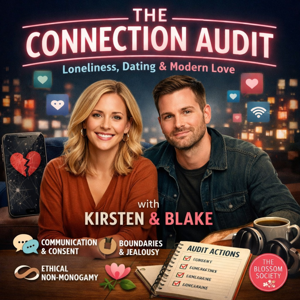
The Connection Audit is a clear-eyed podcast about modern relationships—what’s changed, what’s broken, and what actually helps people connect with respect. Hosted by Kirsten and Blake, it cuts…
What we cover
Why listen
If you’re tired of chaos, mixed messages, and performative “relationship advice”, this is for you. Each episode offers practical language, grounded frameworks, and a respectful lens—plus insight into how The Blossom Society is building a women-are-sovereign, coaching-led space where education comes before access.