
Sign up to save your podcasts
Or

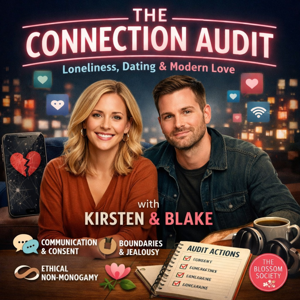


What happens when a relationship hasn’t fully broken down… but it no longer feels alive?
In this episode of The Connection Audit, Kirsten and Blake examine a pattern unfolding quietly in thousands of homes: couples who are exhausted, co-parenting more than connecting, and wondering whether opening the relationship might bring back the spark.
This is a compassionate, clear-eyed conversation about why non-monogamy is not a resuscitation tool. Because when a relationship is already running on silence, low-level conflict, emotional exhaustion, and administrative survival mode, adding more complexity rarely repairs what is missing. It amplifies it.
Together, Kirsten and Blake unpack the cultural myths that set couples up to fail — the pressure of the “everything partner”, the dopamine trap of modern dating, and the fantasy that novelty can fix internal distance. They explore what survival mode really looks like behind closed doors, from dishwasher arguments that are never about the dishwasher, to the slow disappearance of curiosity, intimacy, and warmth.
Most importantly, this episode offers a more grounded path forward. Instead of using other people as a solution to disconnection at home, the hosts explore how couples can rebuild safety, friendship, and emotional connection first. Expect practical ideas around micro-moments, honest conversations, phone-free check-ins, and what it means to build “Season 2” of a relationship rather than chasing the ghost of Season 1.
If you’ve ever wondered whether ENM can save a struggling relationship, this episode will help you ask a better question: what needs rebuilding before anything new is invited in?
Because connection without consciousness is chaos. But connection with awareness, honesty, and structure can become art.
What happens when a man who looks steady, capable, and “a great catch on paper” feels quietly trapped by the very relationship script he is supposed to want?
In this episode of The Connection Audit, Kirsten and Blake unpack the story of Peter — a 38-year-old ex-soldier whose life appears solid from the outside: career, fitness, friendships, discipline, loyalty. But beneath that composure sits a deeper conflict. Peter is not afraid of love. He is not afraid of commitment. He is afraid of confinement.
Together, we explore how twelve formative years in the army shaped his psychology, why traditional dating left him feeling paralysed, and how the pressure of the relationship escalator — date, move in, merge, marry, repeat — created dread rather than security. This is a conversation about masculinity, autonomy, loyalty, and the hidden cost of forcing people into roles that do not fit.
We also examine the turning point: a friendship built on radical clarity, explicit boundaries, and zero hidden agendas. That unexpected shift opened Peter’s eyes to a different model of connection — one where structure does not feel like a cage, and where honesty, consent, and chosen boundaries create room to breathe.
This episode challenges lazy labels like “commitment-phobic” and asks a more intelligent question: what if some people are not resisting intimacy, but resisting scripts that confuse love with surrender?
If you have ever felt the weight of unwritten rules, questioned the future you were told to want, or wondered whether there might be a more honest way to build connection, this episode is for you.
Follow The Connection Audit for grounded conversations on modern relationships, emotional clarity, ENM, boundaries, and the skills most of us were never taught.
What happens when a woman does everything she was told would make her happy — the degree, the job, the house, the marriage, the baby — and still ends up feeling invisible inside her own life?
In this episode of The Connection Audit, Kirsten and Blake explore Sally’s story: a single mother, coder, and woman who followed the accepted script to the letter, only to find herself emotionally unseen, isolated, and carrying a life that looked perfect on paper but felt deeply hollow in reality.
Together, they unpack the pressure of the relationship escalator, the quiet erasure of identity in motherhood, the damage caused when women’s emotions are dismissed as “just hormones”, and the devastation of betrayal when relational truth is avoided for too long. They also look at the exhaustion of mainstream dating culture, why so many spaces prioritise access over depth, and what it means to finally find a community built around emotional literacy, boundaries, and genuine safety.
This is a conversation about social conditioning, loss of self, divorce, healing, and the radical act of choosing clarity over compliance.
If you have ever felt trapped inside a life that looked right from the outside but felt wrong on the inside, this episode will stay with you.
Follow The Connection Audit for thoughtful conversations on modern relationships, dating burnout, emotional literacy, boundaries, consent, repair, and the quiet ways The Blossom Society is reshaping connection.
What if the biggest thing sabotaging connection isn’t your chemistry, your app, or even your communication style — but the invisible script you’ve been handed about how love is “supposed” to work?
In this episode of The Connection Audit, Kirsten and Blake unpack the golden cage: the subtle but powerful system of social expectations that promises safety, approval, and belonging — but often at the cost of authenticity, desire, and honest connection.
They audit the culture shaping modern relationships, from gender roles and monogamy defaults to shame, status management, and the pressure to perform rather than relate. They explore how these inherited scripts show up in real life: confusing desire, turning intimacy into performance, making honesty feel risky, and blurring the line between true consent and quiet compliance.
The episode also tackles the mainstream misunderstanding of ethical non-monogamy (ENM). Instead of the chaos and sensationalism often portrayed in the media, Kirsten and Blake show how healthy ENM actually demands high standards: communication, reflection, boundaries, consent fluency, and emotional responsibility.
Most importantly, this is not just diagnosis — it is practical. The episode introduces the idea of earned agency and offers a toolkit for stepping out of the cage and into more conscious connection. Expect clear, grounded takeaways on:
They also highlight how The Blossom Society is designing for this kind of healthier relating through coaching-led growth, protective friction, and a women-first model that puts safety, self-knowledge, and respect at the centre.
If you have ever felt like you were doing relationships “right” on paper but still felt unseen, resentful, exhausted, or strangely disconnected, this episode will give language to that experience — and a way forward.
Because better connection does not come from performing harder. It comes from choosing more consciously.
Modern dating keeps promising freedom, choice, and connection — but for many people it delivers noise, burnout, and confusion instead. In this episode of The Connection Audit, Kirsten and Blake take a clear-eyed look at the relationship skills people actually need if they want ethical non-monogamy to be safe, respectful, and sustainable.
They begin by auditing the culture: why today’s platforms reward speed, performance, and snap judgement over patience, character, and emotional honesty. From swipe fatigue and choice overload to the collision between modern consent values and outdated gender scripts, this episode explores why so many people feel exhausted before anything real has even begun.
Then they audit behaviour. Why do so many men fall into the status versus character trap? Why do women so often end up carrying the emotional labour of enforcing boundaries? And why do ghosting, boundary drift, safety theatre, and avoidant silence leave people second-guessing themselves instead of building trust?
Finally, Kirsten and Blake audit the solution. They unpack how The Blossom Society approaches connection differently: women are sovereign, education comes before access, and respect is treated as a learnable skill set rather than a slogan. Using TBS’s garden framework — the Vestibule, Tool Shed, Hive Mind, and Garden — they show what it looks like to build a calmer, safer, more conscious relationship ecosystem.
You’ll also hear practical tools you can use straight away, including the two yes principle, repair rituals, and the green, amber, red check-in system — simple frameworks that help couples and individuals slow down, communicate clearly, and protect trust before it breaks.
This episode is for anyone who is tired of chaos, curious about ENM, rebuilding trust, or simply trying to create healthier, more honest relationships. Because connection without consciousness is chaos — but connection with awareness can become an art form.
In this episode of The Connection Audit, Kirsten and Blake take a clear-eyed look at the one topic quietly shaping modern dating and ENM spaces: loneliness. Not “being alone” — the felt absence of meaningful connection. We unpack the loneliness loop (hypervigilance, threat-scanning, shame, withdrawal), how it changes your body and identity, and why online attention can feel like medicine while actually deepening dependency. Then we audit what loneliness does to decision physics: attachment hunger, consent drift, rapid trust escalation, secrecy, and tolerating poor treatment just to avoid the void. Finally, we lay out the ethical solution: belonging with boundaries — helping people connect better, not attach faster — using protective friction, staged access, readiness checks, practical scripts, and offline scaffolding that keeps your life grounded beyond the screen. Less scrolling, more soul.
DMs, Rejection, and the Architecture of Respect
Modern dating inboxes aren’t just “a bit messy” — they’re built on a huge, unspoken imbalance: single women and couples end up doing the unpaid emotional labour of managing strangers’ feelings. In this episode, Kirsten and Blake audit what’s really happening in early direct messages (DMs) and why “just be polite” often feels weirdly dangerous.
We unpack rejection sensitivity — the psychological reality where even a micro-rejection can trigger a pain response and a fast, hostile “hot-state” reaction. Online spaces have zero friction, so embarrassment turns into instant volatility with no social brakes.
From there, we audit behaviour (not people) and name 12 teachable DM patterns that reliably ruin early connection — without shaming, sensationalism, or judgement:
Pacing & boundaries
Communication & tone
Emotional regulation
ENM-specific logistics & safety
Then we audit the solution: The Blossom Society’s DM Feedback Loop — a behaviour-shaping system designed around women are sovereign and education before engagement. TBS_Vision_Story_Ethos_V2_ENM_v… Instead of forcing members to craft delicate rejections, the system shifts emotional labour back onto the platform:
The two-lane model: Coaching vs Safety
Protective friction that prevents retaliation
Accountability that escalates with patterns
Audit Actions (takeaways you can use today)
Modern dating isn’t exhausting because you’re broken — it’s exhausting because the environment is engineered for speed, performance, and disposability.
In this kickoff episode, Kirsten and Blake audit the “water we’re all swimming in” and name the hidden mechanisms driving dating burnout and the loneliness paradox: we’re more digitally connected than ever, yet more isolated in real life.
We unpack:
Finally, we introduce a calmer alternative: The Blossom Society — a coaching-led, standards-first community built on education before access and the design principle “Women are sovereign” (women set the pace and tone; trust is earned and visible). You’ll hear how the Garden metaphor (Vestibule → Tool Shed → Hive Mind → Garden) creates protected pacing, better vetting, and a culture where doing the work is attractive.
Audit actions (try these this week):
Dating apps feel like visual noise — and it’s not your imagination. In this episode of The Connection Audit, Kirsten and Blake unpack why the attention economy rewards peacocking (motorbikes, gym mirrors, luxury flex, aggressive poses) while women are screening for warmth, safety, and emotional regulation. We break down the ‘mistranslation’ problem: men signal competence; women read risk — creating cognitive-load burnout for women and a rejection feedback loop for men. Then we audit the fix: the Two-Second Rule (safe / neutral / on-guard), the ‘feeling intention’ exercise, and a 5-photo Trust Stack (clear face, honest full-body, ‘doing life’, warm social proof, values-in-context). We also do a caption makeover — swapping ‘no drama’ and ‘prove you’re real’ for accountable, consent-led language. Audit actions: run your lead photo through the safety test, rebuild your stack, and rewrite your bio for clarity.
Ever hit that sudden wall where the spark in your relationship (or social life) just… dies? In this episode, Kirsten and Blake audit TBS’s internal playbook “When Petals Wilt” — a hard-nosed strategy disguised as softness. We unpack unintegrated intensity: the NRE sprint → overscheduling → nervous-system crash → shame → silent churn (or silent breakup). The twist: wilting isn’t failure, it’s a maintenance signal — a check-engine light.
You’ll hear how TBS builds protective friction (a 48-hour Maintain First Aid), consent-led pacing, and copy-paste scripts that act like a prosthetic prefrontal cortex when you’re overwhelmed. Plus: why Women are Sovereign means saying no is power, not proof you don’t belong.
Audit actions: spot your Amber signs, run a 48-hour reset, and borrow a script before you spiral.
From the publisher's feed
The Connection Audit is a clear-eyed podcast about modern relationships—what’s changed, what’s broken, and what actually helps people connect with respect. Hosted by Kirsten and Blake, it cuts…
What we cover
Why listen
If you’re tired of chaos, mixed messages, and performative “relationship advice”, this is for you. Each episode offers practical language, grounded frameworks, and a respectful lens—plus insight into how The Blossom Society is building a women-are-sovereign, coaching-led space where education comes before access.