
Sign up to save your podcasts
Or

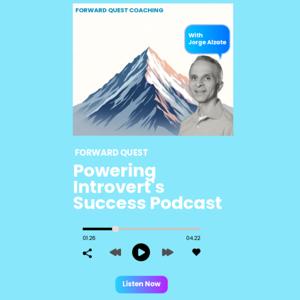


As I wrap up Season 2 of the Forward Quest Powering Introvert's Success Podcast, I wanted to provide powerful takeaways to help you reflect on and use as fuel to power your success as an introverted leader.
Over the past season, I had the privilege of speaking with scientists, executives, entrepreneurs, coaches, and business leaders who all happen to be introverts. While their careers took different paths, they shared something in common. They learned to stop fighting their introversion and instead use it to their advantage
In this episode, I revisit one key lesson from each guest.
Dr. Christina Blackburn reminds us that self-reflection is only the beginning. Growth happens when we intentionally build the skills we want to strengthen.
Bob Russo shows us that courage comes before confidence and that giving yourself permission to recharge is part of sustainable leadership.
Steph Lynn reminds us that introversion is not a weakness. It is up to us to turn it into a superpower.
Adam Packard challenges the myth that introverts cannot sell or speak in public.
Bruce Segall shares why thoughtful visibility and authentic relationship building matter far more than trying to impress people online.
Fred Chisholm brings it all together with a simple but powerful message. Know your center first. Then choose when to speak, when to listen, and when to stand your ground.
If you joined me for Season 2, thank you for being part of the journey.
If you are just discovering the podcast, this episode is a great place to start.
Because the biggest lesson from this season is simple.
You do not need to become more extroverted to become a more effective leader. You need to recognize the strengths you already have and put them to work.
This is my favorite interview so far and one of the most layered conversations I have had on this podcast.
Fred Chisholm spent 38 years in manufacturing leadership, holding roles including director of operations and plant manager. He managed plant shutdowns, led organizations through economic downturns, and developed people across complex operations. He also served as a hospital chaplain, supporting people through some of the most difficult moments of their lives.
Today, he works as a career transition coach, helping professionals clarify their strengths and build a plan to move forward with confidence.
Fred is an introvert. He is also one of the most grounded leaders I have met.
In this conversation, we cover what it means to lead quietly in high-pressure environments. Fred describes a quality he inherited from his grandfather: "I just don't rattle." We talk about how introverts can learn to speak truth into the room without taking anyone else's space, and why that skill is practiced rather than innate. Fred shares how he adapted his communication style to match what his leaders needed rather than assuming everyone wanted information delivered the same way.
We also discuss energy management, the myth that introverts dislike people, and how his martial arts training shaped his approach to presence and control as a leader.
This conversation is for anyone who leads or wants to lead from a place of calm, clarity, and intention rather than volume.
Mel Robbins says, "Let Them." I say that advice can backfire for introverts. In this solo episode, I challenge the popular "Let Them Theory" and offer a third option between staying silent and starting a conflict.
You will hear why bottling things up leads to chronic stress and uncontrolled explosions, what it looks like when you speak up with facts and zero expectations, and how I used this approach to turn a difficult boss relationship into a trusted partnership.
If you have been telling yourself to just let it go, this episode will change the way you think about that.
This is Part 2 of a two-part series on using LinkedIn with intention. In Part 1, Adam Packard shared how introverts can use LinkedIn to prospect, sell, and grow their businesses.
In Part 2, I sit down with Bruce Segall, president of Marketing Sense for Business, to talk about the other side: building visibility and deepening relationships on LinkedIn as a low-key professional.
Bruce has worked with over 250 clients and 75 professional organizations to help them improve their profiles, build their visibility, and establish meaningful connections on LinkedIn. He spent 25 years at MasterCard and Citibank before launching his consulting practice, and he specializes in helping thoughtful professionals who prefer a quieter approach to marketing and networking.
In this conversation we cover how LinkedIn's 360 Brew algorithm now evaluates the consistency between your posts, your profile, and your overall activity on the platform. Bruce explains why posting at the intersection of business and professional works better than personal content alone, and why the old tricks of clever paragraph breaks and emojis are no longer effective. We also discuss how to balance two professional identities on a single LinkedIn profile, a challenge I am navigating as I return to Food Safety and Quality Assurance leadership while maintaining my coaching and thought-leadership presence.
If you have been on LinkedIn but never posted, or if you post but feel like something is not connecting, this episode gives you a practical framework for building visibility in a way that feels authentic rather than performative.
Check out Bruce's content on his LinkedIn Featured page:
https://www.linkedin.com/in/brucesegall/details/featured/
Key topics: LinkedIn profile optimization, the 360 Brew algorithm, thought leadership themes, visibility for introverted professionals, balancing dual professional identities, and the mindset shift from bragging to sharing value.
What does it look like when an introvert thrives in sales, speaks in front of thousands, and builds a business helping others connect more meaningfully on LinkedIn? It looks a lot like Adam Packard.
In this episode of Forward Quest Powering Introvert's Success, I sit down with Adam, founder of Ninja Prospecting and a self-described outgoing introvert with over 20 years in sales.
Adam shares how he recognized and accepted his introvert personality traits as his competitive advantage: his analytical mind, his preference for depth over volume, and his need to recharge in his silo. Adam built a career on genuine connection rather than high pressure.
We talk about what it means to find your own sales style, how Adam manages energy before and after speaking to large audiences, why COVID felt like a gift, and what he would tell any introvert who worries they are too quiet to make an impact.
We also play a brand new segment: How Introverted Are You? Adam's results might surprise you.
If you have ever wondered whether your introverted nature fits in a world that rewards the loudest voice in the room, Adam's story is your answer.
Connect with Adam on LinkedIn: https://www.linkedin.com/in/adampackard/
Check out Adam's company at https://ninjaprospecting.com/
Many introverts believe they are bad at networking.
I disagree.
In this solo episode, I share a different perspective based on my own experience. Introverts may not enjoy traditional networking, but we are wired to build something more powerful. Real relationships are built on trust, consistency, and genuine connection.
I share two personal stories from my career that shaped how I think about relationship building.
In one, a relationship I built early in my career led to a pivotal recommendation that helped me return to a company when I needed it most.
In another, a simple response to a LinkedIn message led to helping someone land a role. Years later, that connection is still active, still appreciative, and still growing.
These are not networking tactics. This is the long game.
I also connect these experiences to ideas from Adam Grant’s Give and Take and the concept of being an Otherish giver. Someone who gives generously while still being intentional about growth and opportunity.
In this episode, you will learn:
• Why introverts do not need to follow traditional networking rules
• How to build relationships that create real opportunities over time
• The difference between collecting contacts and cultivating trust
• Why giving first, and sometimes paying it forward, creates long-term impact
• How introverted strengths can become your advantage in networking
If you have ever felt uncomfortable networking, this episode will help you reframe it.
You do not need to become someone else to succeed.
You need to build relationships in a way that is true to who you are.
You were told you were too much, too sensitive, too aware, too affected by your environment. What if that was never a flaw?
In this episode of Forward Quest Powering Introvert's Success, I sit down with Stephanie Linn, certified professional coach, entrepreneur, and highly sensitive person, to explore the powerful overlap between introversion and high sensitivity.
Steph shares her own arc, from a hypervigilant people-pleaser who played small, to a coach who turned her sensitivity into a superpower. Her path from professional organizer to coach is a masterclass in trusting what you are wired for.
Did you know that 70% of highly sensitive people are introverts? Stephanie unpacks what it means to have a nervous system that takes in more than most, and why that wiring is the foundation of some of the most powerful qualities you can have.
We also explore the Orchid and the Dandelion, the idea that highly sensitive people do not struggle because they are fragile; they struggle because they are in the wrong environment. Put an orchid in the right conditions, and it flourishes beyond any dandelion in the garden.
And in a surprise twist, I find out live on this episode that I might be an HSP myself. I confirmed it later with Steph's quiz. The link is in the show notes.
We also play "How Introverted Are You", our signature guest segment. Steph's result might surprise you.
If you have ever wondered whether your sensitivity is a limitation or a superpower, this conversation will change how you see yourself.
Take the HSP quiz on Steph's website: https://www.stephanielinn.com/
"You've been quiet in our meetings." Six words from a caring manager that stopped me cold, embarrassed me, and changed everything.
In this episode of Forward Quest Powering Introvert's Success, I share what happened the moment I heard that feedback and why, instead of shrinking from it, I decided to use it as a call to action.
I take you inside a pivotal global team meeting where I challenged a senior director in front of his entire team, not to rock the boat, but because staying quiet was costing me my credibility and my belief in myself.
This is not a story about becoming louder. It is a story about choosing to speak up the right way, with data, with intention, and with the courage to discern even when the room goes quiet.
If you have ever held back in a meeting because you thought you did not know enough, this one is for you.
Bob Russo spent 33 years at IBM and retired as an executive, all while privately feeling like he did not belong there.
In this deeply personal conversation, Bob shares how he succeeded as an introvert living with imposter syndrome and self-doubt. He explains why courage comes before confidence and how he learned to step forward even when every instinct told him to retreat inward,
Bob also reveals the internal force that guided him through his biggest risks, what he calls an unconditional trust in the universe. This trust allowed him to come out at age 45 after 25 years of marriage, trusting that he would not lose his family, his career, or himself.
And in one of the most relatable moments of the conversation, Bob shares the introvert survival skill no one talks about. Sometimes leadership means giving yourself permission to step into the bathroom, sit quietly, and reset before stepping back out to lead.
In this episode, you will learn:
• Why introversion is not a leadership limitation
• How imposter syndrome can become a source of humility and strength
• Why courage must come before confidence
• How introverted leaders sustain their energy
• Why trusting yourself matters more than feeling ready
This episode is a reminder that you do not need to eliminate fear, self-doubt, or introversion to succeed. You need the courage to move forward with them.
Please check out Bob's work as a Death Doula at PeaceOutEarth.Com.
To get in touch with Bob, connect with me on LinkedIn https://www.linkedin.com/in/jorgealzate/
You know you have value, but you keep hearing that you are too quiet or that people don't really know you.
In this episode of Forward Quest Powering Introvert Success, I explore what it means to unmute yourself without becoming louder or pretending to be someone you are not. I share how staying silent about who you are and what matters to you can quietly limit connection, trust, and opportunity.
Through personal stories from school, work, and leadership, I show how small, authentic moments of sharing can shift perception and deepen relationships.
Unmute yourself, and you may find connection where you least expect it.
From the publisher's feed