Free Astronomy Public Lectures

Free Astronomy Public Lectures

By Swinburne University of TechnologyEducation
Download on the App Store

Free Astronomy Public Lectures episodes

  • Heavy elements in Red Giant Stars (Free Astronomy Public Lectures)
    Presented on 20 May 2016 by Amanda Karakas.

    Most of the elements in the periodic table heavier than hydrogen and helium were forged in stars. Through the combined studies of stellar spectroscopy, nuclear physics, geochemistry, and astrophysics, humans have been able to work out the origin of many of the chemical elements that naturally occur in our Solar System. We know for example that most of the oxygen in the air was forged in ancient supernova explosions, which are the end product of very massive stars. The carbon in our bodies was synthesized instead by stars covering a wide range of stellar masses, from solar-type stars like our Sun through to massive stars. The biggest mystery today concerns the origins of the elements heavier than iron. In this talk I will take you on a journey through the origin of the elements, with a special focus on where the heaviest elements in nature are formed. in order to do this, I will discuss some basics about the life cycle of stars, which is intimately connected to the story of the origin of the elements through the nuclear reactions that occur deep in their interiors. Presented on 20 May 2016.
    45 min
  • Cosmic cartography: making maps of the Universe (Free Astronomy Public Lectures)
    Presented on 15 April 2016 by Dr Elisabete da Cunha.

    Almost one hundred years ago, astronomer Edwin Hubble revolutionised our understanding of the Universe and our place in it when he discovered that it extends beyond the Milky Way. Since then, astronomers have identified millions of galaxies beyond our own, and developed sophisticated techniques to measure their distances and motions. In this talk, I will show how astronomers map the Universe using large surveys of galaxies, and how "cosmic maps" are an essential tool in Cosmology, allowing us to understand the physical nature and history of the Universe.
    1 hr 12 min
  • Planets: From our Solar System to new Exoworlds (Free Astronomy Public Lectures)
    Presented on 18 March 2016 by Elodie Thilliez and Matthew Agnew.

    The Solar system is a remarkable place filled with wonderfully varied worlds. Travelling outwards from the sun we first encounter the hellish, rocky bodies of Mercury and Venus, continue to the cooler, water bearing world of Earth and our close neighbour Mars. Beyond the asteroid belt we hit the majestic gas giants of Jupiter and Saturn and continuing on our voyage we finally reach the cold ice giants of Uranus and Neptune. The Solar system is our home and our starting point for understanding planetary systems and their architectures. Until the late 20th century these were the only planets known to us, however, in the last two decades, there has been enormous and rapid progress in the discovery and understanding of planets beyond our Solar system, dubbed Exoplanets. As we discover more and more of these exoplanets, and the planetary systems to which they belong, our understanding of planet formation and planetary architectures has changed and raised several questions. Where did these Jupiter-sized, gas giants orbiting their stars in as little as 3 days come from? What is a 'super Earth'? Will we find another habitable world? In this lecture we will answer some of these questions as we explore our very own Solar system, look at how we observe and discover Exoplanets, and examine how these other planetary systems differ to our own.
    1 hr 5 min
  • Black hole binaries - a unique love story (Free Astronomy Public Lectures)
    Presented by Dr Pablo A. Rosado on 18th February 2016.

    One of the greatest scientific discoveries of all times was achieved last week: the first detection of gravitational waves, emitted by a black hole binary. This discovery follows decades of intense work, and opens a new window to the Universe. This talk, for scientists and for non-scientists, is about black hole binaries, and the dawn of gravitational wave astronomy. This talk is about the curious romance of Alice and Bob. Nobody has heard it before, but we can speculate about what happened: how they were born, how they grew, how they first met, and how they finally became one forever. The true story is actually written in space-time, has been traveling across the Universe for more than a billion years, and is reaching Earth now. This is the story of two distant black holes merging into one. You may be wondering how we can hear it: is there really a way to listen to the voice of space-time? I will endeavour to answer this question, and explain how we attempt to discover new sounds of the Universe that we have never been able to listen to before. The talk will involve the loudest events in the Universe, like supernovae or collisions of neutron stars and black holes. In other words, I will speak about the dawn of gravitational wave astronomy, and pose that the mysterious love story of Alice and Bob might soon be finally heard, loud and clear.

    1 hr 4 min
  • Black hole binaries - a unique love story (Free Astronomy Public Lectures)
    Presented by Dr Pablo A. Rosado on 18th February 2016.

    One of the greatest scientific discoveries of all times was achieved last week: the first detection of gravitational waves, emitted by a black hole binary. This discovery follows decades of intense work, and opens a new window to the Universe. This talk, for scientists and for non-scientists, is about black hole binaries, and the dawn of gravitational wave astronomy. This talk is about the curious romance of Alice and Bob. Nobody has heard it before, but we can speculate about what happened: how they were born, how they grew, how they first met, and how they finally became one forever. The true story is actually written in space-time, has been traveling across the Universe for more than a billion years, and is reaching Earth now. This is the story of two distant black holes merging into one. You may be wondering how we can hear it: is there really a way to listen to the voice of space-time? I will endeavour to answer this question, and explain how we attempt to discover new sounds of the Universe that we have never been able to listen to before. The talk will involve the loudest events in the Universe, like supernovae or collisions of neutron stars and black holes. In other words, I will speak about the dawn of gravitational wave astronomy, and pose that the mysterious love story of Alice and Bob might soon be finally heard, loud and clear.
    1 hr 4 min
  • Exploring the universe with the world's largest radio telescope (Free Astronomy Public Lectures)
    Presented on 4 December 2015 by Dr Lisa Harvey-Smith.

    What is Dark Matter? How did the solar system form? Was Einstein right about the nature of gravity? Are we alone in the universe? To tackle these fascinating questions and more, an international consortium of eleven nations is currently designing the 'Square Kilometre Array' (SKA) telescope. Comprising thousands of radio receivers located in Africa and Australia, the SKA will be the world's most powerful radio telescope. It will revolutionise our understanding of the universe, from the first stars and galaxies formed after the Big Bang to the formation of planet Earth. In preparation for this mega-science project, the CSIRO has built the Australian SKA Pathfinder (ASKAP) telescope which is due to start early science operations next year. In this talk, CSIRO astronomer Dr. Lisa Harvey-Smith will reveal early results from ASKAP, explain the science and technology behind the telescope and describe many scientific mysteries it will tackle.
    1 hr 24 min
  • Tune into the skies: how to do cosmology in the radio (Free Astronomy Public Lectures)
    Presented by Dr Laura Wolz on Friday 23 October 2015.

    Radio telescopes have made numerous appearances in media and films due to their huge, mechanical appearances contrasting with the natural background. The gigantic size of the dishes are essential for observing cosmic objects in high resolution following the basic rule: the longer the wavelength, the bigger the dish. The construction efforts are worthwhile because radio waves can pass our atmosphere nearly unobscured and thus allow us to view the Universe whether it is sunny or cloudy. But what are we looking at? Every galaxy emits a wide range of radio waves, including our own Milky Way, allowing us to measure the positions of the galaxies in space. Radio waves also carry information about the interior of galaxies, namely their hydrogen content. Radio telescopes can be used as cartographers to map the cosmic landscape by their hydrogen emission. This allows us to see areas unobtainable through visible light and take a glimpse how the Universe looked when it was less than half of its age. We can use both, galaxy catalogues and cosmic maps, to explore how the Universe evolved to the present state. We can learn how space floated apart after the Big Bang, how gravity pulls structures together and how dark energy is mysteriously speeding up the expansion of the cosmos
    1 hr

About Free Astronomy Public Lectures

From the publisher's feed

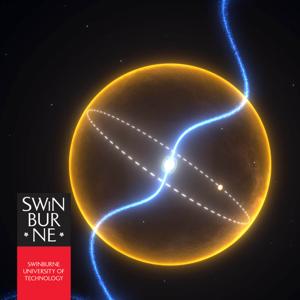
Each month, from February to November, the Centre for Astrophysics & Supercomputing presents a free public lecture at the Hawthorn campus of Swinburne University of Technology.

More shows like Free Astronomy Public Lectures

Chancellor's Lecture Series by Swinburne Commons

Chancellor's Lecture Series

0 Listeners

Talking About ... by Learning Transformations Unit

Talking About ...

0 Listeners

CSIRO Oral Histories by Swinburne Commons

CSIRO Oral Histories

0 Listeners