From Camp Lee to the Great War: The Letters of Lester Scott & Charles Riggle

From Camp Lee to the Great War: The Letters of Lester Scott & Charles Riggle

By From Camp Lee to the Great War podcast Archiving Wheeling in partnership with the Ohio County Public Library and the Wheeling Academy of Law & ScienceSociety & Culture
Download on the App Store

From Camp Lee to the Great War: The Letters of Lester Scott & Charles Riggle episodes

  • From Camp Lee to the Great War: Episode 26 [January 19, 1918]
    "There are big bets up here now that we will never go over. Some think [the war] is over now. Some think it will over in two months. Others think will last two years. Judge for yourself is the way I do..."
    In his nineteenth letter home from Camp Lee, Virginia, to his sister Minnie Riggle, US Army Wagoner (mule team driver) Lester Scott, a World War I soldier from Wheeling, West Virginia, writes that he's pretty much given up on getting to come home until maybe the spring when the farm boys get leave to help with the crops. He thinks his girlfriend Cleo's hair might be too short and he's planning to write her soon. He thinks they may never go over to France. Many think the war will be over soon. He's spending his time in classes on military courtesy, first aid, and signaling.
     
    Elsewhere on the same day, the Bolsheviks (under Vladimir Lenin), forcibly dissolved the democratically elected Russian Constituent Assembly that was meeting to draft a constitution in the wake of the October 1917 Revolution. This action ensured Bolshevik control of the new Soviet Union.
     
    Lester Scott was drafted in 1917 and trained at Camp Lee, where so many Wheeling soldiers were trained. And, like so many of his Ohio Valley comrades, he served in the 314th Field Artillery Supply Company, Battery “A,” 80th (Blue Ridge) Division in France. This is his nineteenth letter from Camp Lee, dated 100 years ago today, January 19, 1918.
    Digital scans and a transcript of Lester Scott's January 19, 1918 letter can be viewed at: http://www.archivingwheeling.org/blog/from-camp-lee-to-the-great-war-january-19-1918-podcast
    Credits:
    "From Camp Lee to the Great War: The letters of Lester Scott and Charles Riggle" is brought to you by http://archivingwheeling.org in partnership with the Ohio County Public Library (http://www.ohiocountylibrary.org) and the WALS Foundation (http://walswheeling.com).
    Jeremy Richter is the voice of Lester Scott. The letters of Lester Scott and Charles Riggle were transcribed by Jon-Erik Gilot. This podcast was edited and written by Sean Duffy, audio edited by Erin Rothenbuehler.
    Music: "Medley of Southern airs," Fred J. Bacon, banjo, 1920, courtesy Library of Congress: https://www.loc.gov/item/00694032/
    Many thanks to Marjorie Richey for sharing family letters and the stories of her uncles, Lester Scott and Charles “Dutch” Riggle, WWI soldiers from West Virginia.

    4 min
  • From Camp Lee to the Great War: Episode 25 [January 9, 1918]
    "Don't look for me until you see me coming. I will get a car to bring me out. I may be out at any time..."
    In his eighteenth letter home from Camp Lee, Virginia, to his sister Minnie Riggle, US Army Wagoner (mule team driver) Lester Scott, a World War I soldier from Wheeling, West Virginia, writes that he's sorry he asked Minnie to meet him as his planned furlough to Wheeling has once again been canceled. He's going to try to come home with Dutch [our second letter writer, Charles Riggle]. He's afraid he might be getting the mumps now, a mandatory 19-day hospital stay. He's sending a photo home and trying to get one of the mule team.
    Elsewhere on the previous day, US President Woodrow Wilson had announced his Fourteen Points programme, an idealistic blueprint for peace meant to bring an end to the war. Wilson wanted to address the causes of the war, including an end to the "secret understandings" among nations (the alliance system) and to make the postwar world "fit and safe to live in...for every peace-loving nation." Among other things, the Fourteen Points called for "open covenants of peace, openly arrived at," "absolute freedom of navigation upon the seas" (inspired by German submarine attacks), "equality of trade conditions among all the nations," a reduction of armaments, an adjustment of colonial claims, numerous territorial adjustments including an independent Polish state, and "a general association of nations" (which would become the ineffective League of Nations). Importantly, Wilson called upon the Allied Powers to be fair with Germany, a caveat that would be ignored, and the harsh terms imposed on a defeated Germany would help ensure that the Great War would not be the hoped-for "War to End All Wars." Though Wilson was awarded the Nobel Peace Prize in 1919 for his efforts, the Fourteen Points were largely ignored at the Paris Peace Conference.
    Lester Scott was drafted in 1917 and trained at Camp Lee, where so many Wheeling soldiers were trained. And, like so many of his Ohio Valley comrades, he served in the 314th Field Artillery Supply Company, Battery “A,” 80th (Blue Ridge) Division in France. This is his eighteenth letter from Camp Lee, dated 100 years ago today, January 9, 1918.
    Digital scans and a transcript of Lester Scott's January 9, 1918 letter can be viewed at: http://www.archivingwheeling.org/blog/from-camp-lee-to-the-great-war-january-9-1918-podcast
    Credits:
    "From Camp Lee to the Great War: The letters of Lester Scott and Charles Riggle" is brought to you by http://archivingwheeling.org in partnership with the Ohio County Public Library (http://www.ohiocountylibrary.org) and the WALS Foundation (http://walswheeling.com).
    Jeremy Richter is the voice of Lester Scott. The letters of Lester Scott and Charles Riggle were transcribed by Jon-Erik Gilot. This podcast was edited and written by Sean Duffy, audio edited by Erin Rothenbuehler.
    Music: "The U.S. Field Artillery March," Sousa, John Philip (arranger), New York Military Band (performer), 1921, courtesy Library of Congress: www.loc.gov/item/00694042/
    Many thanks to Marjorie Richey for sharing family letters and the stories of her uncles, Lester Scott and Charles “Dutch” Riggle, WWI soldiers from West Virginia.
    4 min
  • From Camp Lee to the Great War: Episode 24 [January 6, 1918]
    "I don't know what time I will get to Wheeling. The trains have been so late..."
    In his seventeenth letter home from Camp Lee, Virginia, to his sister Minnie Riggle, US Army Wagoner (mule team driver) Lester Scott, a World War I soldier from Wheeling, West Virginia, writes that he's just gotten out of the hospital after his bout with measles. He's feeling better and is eager to get to Wheeling for a two day visit. The weather has been "fierce" in Virginia, so he assumes it's worse in Wheeling, and he's not sure a "machine" [automobile] will be able to make it the train station to pick him up.
    Elsewhere on the same day, France and Germany recognized Finland’s independence (the latter after Bolshevik Russia, with whom the German Empire was negotiating peace, had done so) and the Italian army had some success in Albania.
    Lester Scott was drafted in 1917 and trained at Camp Lee, where so many Wheeling soldiers were trained. And, like so many of his Ohio Valley comrades, he served in the 314th Field Artillery Supply Company, Battery “A,” 80th (Blue Ridge) Division in France. This is his seventeenth letter from Camp Lee, dated 100 years ago today, January 6, 1918.
    Digital scans and a transcript of Lester Scott's September 24, 1917 letter can be viewed at: http://www.archivingwheeling.org/blog/from-camp-lee-to-the-great-war-january-6-1918-podcast
    Credits:
    "From Camp Lee to the Great War: The letters of Lester Scott and Charles Riggle" is brought to you by http://archivingwheeling.org in partnership with the Ohio County Public Library (http://www.ohiocountylibrary.org) and the WALS Foundation (http://walswheeling.com).
    Jeremy Richter is the voice of Lester Scott. The letters of Lester Scott and Charles Riggle were transcribed by Jon-Erik Gilot. This podcast was edited and written by Sean Duffy, audio edited by Erin Rothenbuehler.
    Music: "Junk Man Rag," Roberts, [Luckyeth] (composer), Victor Military Band (performer), 1913, courtesy Library of Congress: https://www.loc.gov/item/ihas.100010646/
    Many thanks to Marjorie Richey for sharing family letters and the stories of her uncles, Lester Scott and Charles “Dutch” Riggle, WWI soldiers from West Virginia.
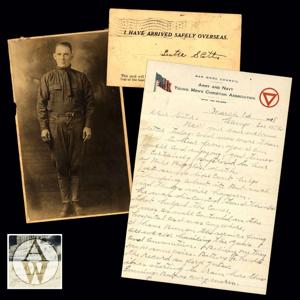
    4 min
  • From Camp Lee to the Great War: Episode 23 [January 2, 1918]
    "I say [Germany] ought to get a good whipping before it is over. If they would make peace with her now she would prepare up again. Go back in the war stronger than ever..."
    In his sixth letter home from Camp Lee, Virginia, dated January 2, 1918, PFC Charles “Dutch” Riggle, a WWI soldier from Wheeling, WV, tells his brother James “Abe” Riggle that he is recovering from a mild case of the measles. He notes that Less [our second letter writer, Wagoner Lester Scott] is now in the hospital with the same ailment. Dutch regrets missing Christmas at home, but says they had a splendid good time and a "number one good dinner" at camp. The weather has been "powerful cold" and it's "snowing like the devil" as he writes. There are 22 prisoners in the guard house who tried to "run off" for home. Dutch again mentions the U.S. Coastal Artillery (founded in 1901 to defend America's coastline and harbors). He says the army has made him tough. He has no fear of battle. He'd like to get to France soon but doesn't think he ever actually will because the Germans are "tired of war" and talking peace [probably a reference to the peace talks at Brest-Litovsk between the Germans and the Bolsheviks (Soviet Russia) that were occurring at the time]. He thinks Germany fears American power entering the war and that "she ought to get a good whipping" lest she arm up again and continue the war. In his own way, Charles seems to anticipate the rise of the Third Reich and the Second World War. He thinks the submarine was Germany's last chance to win. He closes by noting that James is taking care of Lester's horse.
    Elsewhere on the same day, the British Air Ministry was established to oversee the Royal Air Force and deal with the increasing number of German Luftstreitkräfte bombing air raids (featuring Zeppelins, Gotha bombers, and other aircraft) against Great Britain.
    Charles “Dutch” Riggle was drafted into the US Army in 1917 and trained at Camp Lee, Virginia, where so many Wheeling draftees and volunteers—including his sister-in-law Minnie Riggle’s brother, Lester Scott—were trained. Dutch Riggle was a Private First Class in the 314th Field Artillery Supply Company, in France. Riggle was a farm boy with little formal education who grew up in the hills of Pennsylvania and West Virginia. He spelled many of his words phonetically. His letters have been transcribed exactly as they were written. This is his sixth letter from Camp Lee, dated 100 years ago today, January 2, 1918.
    Digital scans and a transcript of Charles Riggle's January 2, 1918 letter can be viewed at: http://www.archivingwheeling.org/blog/from-camp-lee-to-the-great-war-january-2-1918-podcast
    Credits:
    "From Camp Lee to the Great War: The letters of Lester Scott and Charles Riggle" is brought to you by archivingwheeling.org in partnership with the Ohio County Public Library (www.ohiocountylibrary.org) and the WALS Foundation (walswheeling.com).
    Vince Marshall is the voice of Charles Riggle. The letters of Lester Scott and Charles Riggle were transcribed by Jon-Erik Gilot. This podcast was edited and written by Sean Duffy, audio edited by Erin Rothenbuehler.
    Music: "Love Will Find A Way," The Seven Black Dots (performer), 1921, courtesy Library of Congress: https://www.loc.gov/item/ihas.100010774/
    Many thanks to Marjorie Richey for sharing family letters and the stories of her uncles, Lester Scott and Charles “Dutch” Riggle, WWI soldiers from West Virginia.

    6 min
  • From Camp Lee to the Great War: Episode 22 [January 1, 1918]
    "Believe me we got some fine looking nurses here. One looks just like Cleo. I wouldn’t mind staying here for awhile."
    In his sixteenth letter home from Camp Lee, Virginia, to his sister Minnie Riggle, US Army Wagoner (mule team driver) Lester Scott, a World War I soldier from Wheeling, West Virginia, writes, on base hospital stationary, that he's in the hospital with the German measles, but is doing fine. He plans to come home as soon as he's out. He wants to make sure his girlfriend Cleo is there when he arrives. Like Dutch [Scott's brother-in-law and our second letter writer Charles Riggle] had noted in a previous letter, Lester has read that the farm boys would get to come home for the spring to get the crops planted. Lester would just as soon stay in the army. There's a soldier next to him from White Sulphur Springs, Greenbrier County, West Virginia. He's a hunter with deer hounds and promised to send Jim [Minnie's husband James Riggle] a pup. Lester thinks the nurses are good looking at the base camp hospital. One looks just like Cleo. He wouldn't mind staying for awhile.
    Elsewhere on the same day, German raids near Mericourt on the Western Front failed, the French held back a raid at Verdun, the Austrians bombed Venice Italy, and the Mare Island US Marine Corp football team defeated the Camp Lewis US Army team 19-7 in the 4th Rose Bowl, which featured squads from military bases in 1918 and 1919.
     
    Lester Scott was drafted in 1917 and trained at Camp Lee, where so many Wheeling soldiers were trained. And, like so many of his Ohio Valley comrades, he served in the 314th Field Artillery Supply Company, Battery “A,” 80th (Blue Ridge) Division in France. This is his twelfth letter from Camp Lee, dated 100 years ago today, January 1, 1918.
    Digital scans and a transcript of Lester Scott's January 1, 1918 letter can be viewed at: http://www.archivingwheeling.org/blog/from-camp-lee-to-the-great-war-january-1-1918-podcast
    Credits:
    "From Camp Lee to the Great War: The letters of Lester Scott and Charles Riggle" is brought to you by http://archivingwheeling.org in partnership with the Ohio County Public Library (http://www.ohiocountylibrary.org) and the WALS Foundation (http://walswheeling.com).
    Jeremy Richter is the voice of Lester Scott. The letters of Lester Scott and Charles Riggle were transcribed by Jon-Erik Gilot. This podcast was edited and written by Sean Duffy, audio edited by Erin Rothenbuehler.
    Music: "True to the Flag March," United States Marine Band, 1922, courtesy Library of Congress: https://www.loc.gov/item/00694039/
    Many thanks to Marjorie Richey for sharing family letters and the stories of her uncles, Lester Scott and Charles “Dutch” Riggle, WWI soldiers from West Virginia.

    5 min
  • From Camp Lee to the Great War: Episode 21 [December 25, 1917]
    Digital scans and a transcript of Lester Scott's September 24, 1917 letter can be viewed at: http://www.archivingwheeling.org/blog/from-camp-lee-to-the-great-war-december-25-1917-podcast
    Credits:
    "From Camp Lee to the Great War: The letters of Lester Scott and Charles Riggle" is brought to you by http://archivingwheeling.org in partnership with the Ohio County Public Library (http://www.ohiocountylibrary.org) and the WALS Foundation (http://walswheeling.com).
    Jeremy Richter is the voice of Lester Scott. The letters of Lester Scott and Charles Riggle were transcribed by Jon-Erik Gilot. This podcast was edited and written by Sean Duffy, audio edited by Erin Rothenbuehler.
    Music: "Castle Valse Classique," [Europe, James Reese] (composer),
    [Dabney, Ford] (composer), Metropolitan Military Band (performer), 1916, courtesy Library of Congress: https://www.loc.gov/item/ihas.100010721/
    Many thanks to Marjorie Richey for sharing family letters and the stories of her uncles, Lester Scott and Charles “Dutch” Riggle, WWI soldiers from West Virginia.
    4 min
  • From Camp Lee to the Great War: Episode 20 [December 23, 1917]
    "The Coast Artillery will never go across the pond. They may never see a battle unless the Germans come across an they hant much danger of them doing that..."
    In his sixth letter home from Camp Lee, Virginia, dated December 23, 1917, PFC Charles “Dutch” Riggle, a WWI soldier from Wheeling, WV, tells his brother James “Abe” Riggle that his name was drawn 104th for furlough, so it will be a good while before he gets to come home -- probably February. He'd like to come home with Less [our second letter writer, Wagoner Lester Scott] but thinks that won't be possible. He says he saw in the newspaper that Bill Riggle was sent to the U.S. Coast Artillery in Georgia [established in 1901 to defend the U.S. coastline and harbors in case of attack]. He thinks that's good because he doesn't think they will be sent to France. A few cooks have been sent over. He also read that all the farmers would be sent home in the spring. Charles isn't sure he wants to go. He feels army life has done him good. He's heartier than ever. He says the expect a big dinner for Christmas in camp and a lot of stuff from the Red Cross. He says they had nine inches of snow. He asks Abe to save him some apples as they are too expensive at a nickel a piece at Camp Lee.
    Elsewhere, peace talks between Soviet (Bolshevik) Russia and the Central Powers had been initiated the previous day at Brest-Litovsk, a city near the Polish border in what is now Belarus. The negotiations would continue for two months and would lead to, among other things, the ceding of the Baltic States (Estonia, Latvia, and Lithuania) to Germany as well as the release of Russian claims in Poland, Ukraine, and Finland. The Bolsheviks were involved in a civil war for control of Russia and were willing to agree to harsh peace terms to free up resources.
    Charles “Dutch” Riggle was drafted into the US Army in 1917 and trained at Camp Lee, Virginia, where so many Wheeling draftees and volunteers—including his sister-in-law Minnie Riggle’s brother, Lester Scott—were trained. Dutch Riggle was a Private First Class in the 314th Field Artillery Supply Company, in France. Riggle was a farm boy with little formal education who grew up in the hills of Pennsylvania and West Virginia. He spelled many of his words phonetically. His letters have been transcribed exactly as they were written. This is his fourth letter from Camp Lee, dated 100 years ago today, December 23, 1917.
    Digital scans and a transcript of Charles Riggle's December 23, 1917 letter can be viewed at: http://www.archivingwheeling.org/blog/from-camp-lee-to-the-great-war-december-23-1917-podcast
    Credits:
    "From Camp Lee to the Great War: The letters of Lester Scott and Charles Riggle" is brought to you by archivingwheeling.org in partnership with the Ohio County Public Library (www.ohiocountylibrary.org) and the WALS Foundation (walswheeling.com).
    Vince Marshall is the voice of Charles Riggle. The letters of Lester Scott and Charles Riggle were transcribed by Jon-Erik Gilot. This podcast was edited and written by Sean Duffy, audio edited by Erin Rothenbuehler.
    Music: Hungarian Rag | New York Military Band (performer), 1914, courtesy Library of Congress: https://www.loc.gov/item/00694028/
    Many thanks to Marjorie Richey for sharing family letters and the stories of her uncles, Lester Scott and Charles “Dutch” Riggle, WWI soldiers from West Virginia.
    6 min
  • From Camp Lee to the Great War: Episode 19 [December 20, 1917]
    "The doctor asked me what I was before I came to the army a preacher or a prize fighter... I told him I was nothing but a common farmer. I weigh 188 now so you know I would look like a preacher..."
     
    In his Fourteenth letter home from Camp Lee, Virginia, to his sister Minnie Riggle, US Army Wagoner (mule team driver) Lester Scott, a World War I soldier from Wheeling, West Virginia, writes that he will not be home for Christmas but expects to visit for five days after New Year's. Christmas furloughs are being determined by a random drawing, but after New Year's they will be granted alphabetically. When Les and the other troops were examined for tuberculosis, the doctor asked if he was a preacher or a prizefighter. He thinks he'll be driving a truck instead of driving mules. He says Dutch [our second letter writer, PFC Charles "Dutch" Riggle] was also driving mules that day. Les had luck hunting opossum, until some were stolen.
     
    Elsewhere on the same day, the Battle of Jaffa (Palestine) would begin, with the Egyptian Expeditionary Force and a few Scottish brigades of the British Empire on one side and the Yildirim Army Group of the Ottoman Empire and German Empire on the other. A daring nighttime river crossing by the Scottish brigades during a heavy downpour secured victory for the British.
     
    Lester Scott was drafted in 1917 and trained at Camp Lee, where so many Wheeling soldiers were trained. And, like so many of his Ohio Valley comrades, he served in the 314th Field Artillery Supply Company, Battery “A,” 80th (Blue Ridge) Division in France. This is his twelfth letter from Camp Lee, dated 100 years ago today, December 20, 1917.
    Digital scans and a transcript of Lester Scott's September 24, 1917 letter can be viewed at: http://www.archivingwheeling.org/blog/from-camp-lee-to-the-great-war-december-20-1917-podcast
    Credits:
    "From Camp Lee to the Great War: The letters of Lester Scott and Charles Riggle" is brought to you by http://archivingwheeling.org in partnership with the Ohio County Public Library (http://www.ohiocountylibrary.org) and the WALS Foundation (http://walswheeling.com).
    Jeremy Richter is the voice of Lester Scott. The letters of Lester Scott and Charles Riggle were transcribed by Jon-Erik Gilot. This podcast was edited and written by Sean Duffy, audio edited by Erin Rothenbuehler.
    Music: "Castle Walk," Meacham, F. W. (composer);
    Dabney, [Ford] (composer); Prince's Band, 1914, courtesy Library of Congress: https://www.loc.gov/item/ihas.100010714/
    Many thanks to Marjorie Richey for sharing family letters and the stories of her uncles, Lester Scott and Charles “Dutch” Riggle, WWI soldiers from West Virginia.
    4 min
  • From Camp Lee to the Great War: Episode 18 [December 15, 1917]
    "If one deserts in time of war the punishment is death, so I guess I will not try it..."
    In his thirteenth letter home from Camp Lee, Virginia, to his sister Minnie Riggle, US Army Wagoner (mule team driver) Lester Scott, a World War I soldier from Wheeling, West Virginia, writes that he won't be coming home for Christmas because the Secretary of War won't allow it. Secretary Newton D. Baker issued a directive December 11 instructing divisional commanders at national army and national guard camps to restrict Christmas furloughs due to the harmful effect a general leave would have on camp discipline and the heavy burden it would throw on the railroads as reasons for the department’s action. "Most of the men in camps are far away from home," Secretary Baker reported. "It would be a great expense to those able to afford a trip home, and a discrimination against the men who could not afford the trip. Moreover, it would seriously interfere with the training of the men if any large number were permitted to go home for the Christmas holidays." [1] Lester, however, seems to think President Wilson disagrees, offering slim hope of a last-second reprieve. The weather in Virginia is cold and there are six inches of snow on the ground, which is hard for the mules. Meanwhile, Lester has been promoted to Private First Class, which surely beats being a "buck private." He's done well taking orders in the army and thinks Minnie could use some army discipline herself. If he does get to come home, he won't abuse the privilege, lest he be considered a deserter.
    Elsewhere on the same day, the big news was that Bolshevik controlled Russia signed an armistice with Germany (and the Central Powers) which would lead to the Treaty of Brest-Litovsk in March 1918. This critical development effectively freed Germany to shift 44 divisions to the Western Front in preparation for a massive offensive in the spring of 1918.
    Lester Scott was drafted in 1917 and trained at Camp Lee, where so many Wheeling soldiers were trained. And, like so many of his Ohio Valley comrades, he served in the 314th Field Artillery Supply Company, Battery “A,” 80th (Blue Ridge) Division in France. This is his twelfth letter from Camp Lee, dated 100 years ago today, December 15, 1917.
    Digital scans and a transcript of Lester Scott's December 15, 1917 letter can be viewed at: http://www.archivingwheeling.org/blog/from-camp-lee-to-the-great-war-december-15-1917-podcast
    Credits:
    "From Camp Lee to the Great War: The letters of Lester Scott and Charles Riggle" is brought to you by http://archivingwheeling.org in partnership with the Ohio County Public Library (http://www.ohiocountylibrary.org) and the WALS Foundation (http://walswheeling.com).
    Jeremy Richter is the voice of Lester Scott. The letters of Lester Scott and Charles Riggle were transcribed by Jon-Erik Gilot. This podcast was edited and written by Sean Duffy, audio edited by Erin Rothenbuehler.
    Music: "Love Will Find A Way," The Seven Black Dots (performer), 1921. Courtesy Library of Congress: https://www.loc.gov/item/ihas.100010774/
    Many thanks to Marjorie Richey for sharing family letters and the stories of her uncles, Lester Scott and Charles “Dutch” Riggle, WWI soldiers from West Virginia.
    5 min
  • From Camp Lee to the Great War: Episode 17 [December 7, 1917]
    "There are about 6000 Negro troops here and you never saw a lively bunch of fellows as they are. There are some dandy singers among them..."
    In his fifth letter home from Camp Lee, Virginia, dated December 7, 1917, PFC Charles “Dutch” Riggle, a WWI soldier from Wheeling, WV, tells his brother James “Abe” Riggle that Charles and his brother-in-law "Less" (our second letter writer, Wagoner Lester Scott), have applied for Christmas furloughs. Charles talks about hunting rabbits, fox, and raccoon and asks about the corn, potato, and apple crops back home. He still thinks he won't have to go to France because the Germans are "getting the fur knocked out of them," and "bound to get licked," especially since the submarines (aka "U-boats") aren't doing much now. He says he's been "hungry" for his snuff and was happy to get some from home. Importantly, he notes the arrival of 6,000 Negro troops raising the company's number to 40,000. Charles is impressed by the spectacle of thousands of uniformed troops marching past Secretary of War [Newton D.] Baker, who was visiting the camp.
    For African Americans like those seen by Charles Riggle, the First World War was a transformative experience. Blacks were dealing with the horrors of full-blown "Jim Crow" segregation in the American South (including Wheeling, West Virginia), and the "Great Migration" was taking place, as thousands of African Americans moved to northern cities seeking opportunity. President Wilson's pledge to "make the world safe for democracy" gave many African Americans hope that the war would also increase freedom and equality for them at home. Others decried the hypocrisy of asking people who were not treated as equals in their own country to fight for democracy overseas. More than 200,000 African American soldiers were eventually sent to France. Those who did see combat were often assigned to French command and were treated with greater respect by the French. Many served with distinction, especially members of the 92nd Division and the 93rd Division's 369th Infantry Regiment from New York, nicknamed the "Harlem Hellfighters." Unfortunately, the hoped-for improvement in race relations at home, out of respect for honorable service, did not happen. The achievements of African American soldiers were largely ignored or diminished for decades. But the WWI experiences of African Americans, both military and civilian, had also proved empowering and eyeopening, and many were inspired and emboldened to fight for racial justice.
    Charles “Dutch” Riggle was drafted into the US Army in 1917 and trained at Camp Lee, Virginia, where so many Wheeling draftees and volunteers—including his sister-in-law Minnie Riggle’s brother, Lester Scott—were trained. Dutch Riggle was a Private First Class in the 314th Field Artillery Supply Company, in France. This is his fourth letter from Camp Lee, dated 100 years ago today, December 7, 1917.
    Digital scans and a transcript of Charles Riggle's December 7, 1917 letter can be viewed at: www.archivingwheeling.org/blog/from-camp-lee-to-the-great-war-december-7-1917-podcast
    Credits:
    "From Camp Lee to the Great War: The letters of Lester Scott and Charles Riggle" is brought to you by archivingwheeling.org in partnership with the Ohio County Public Library (www.ohiocountylibrary.org) and the WALS Foundation (walswheeling.com).
    Vince Marshall is the voice of Charles Riggle. The letters of Lester Scott and Charles Riggle were transcribed by Jon-Erik Gilot. This podcast was edited and written by Sean Duffy, audio edited by Erin Rothenbuehler.
    Music: "Porcupine Rag," Johnson, Chas. J. (composer), New York Military Band, 1915, courtesy Library of Congress: https://www.loc.gov/item/ihas.200035782/
    Many thanks to Marjorie Richey for sharing family letters and the stories of her uncles, Lester Scott and Charles “Dutch” Riggle, WWI soldiers from West Virginia.
    6 min

About From Camp Lee to the Great War: The Letters of Lester Scott & Charles Riggle

From the publisher's feed

World War I soldiers from Wheeling, West Virginia, Lester Scott and Charles "Dutch" Riggle were drafted in 1917 and trained at Camp Lee, Virginia. Lester Scott served as a Wagoner (mule team driver) in the 314th Field Artillery Supply Company, Battery “A,” 80th (Blue Ridge) Division in France. Dutch Riggle was a PFC with the same unit. These are their letters home.