From Camp Lee to the Great War: The Letters of Lester Scott & Charles Riggle

From Camp Lee to the Great War: The Letters of Lester Scott & Charles Riggle

By From Camp Lee to the Great War podcast Archiving Wheeling in partnership with the Ohio County Public Library and the Wheeling Academy of Law & ScienceSociety & Culture
Download on the App Store

From Camp Lee to the Great War: The Letters of Lester Scott & Charles Riggle episodes

  • From Camp Lee to the Great War: Episode 36 [March 6, 1918]
    "I would like for you to hear the firing we have here. Some are three inch and some machine guns. They make some noise, believe me. The shells weigh 16 lbs, so you can imagine what they are like..."
    In his twenty-seventh letter home from Camp Lee, Virginia, to his sister Minnie Riggle, US Army Wagoner (mule team driver) Lester Scott, a World War I soldier from Wheeling, West Virginia, writes during a thunderstorm. He's finally gotten a letter from Cleo (his girlfriend). She wanted her "sovallier" [Cleo may have been asking for the return of a lavaliere, a piece of jewelry, as part of the couple's ongoing relationship issues]. He sent it back. He's still on the firing line. They'll be going to Dutch Gap [a canal dug during the Civil War by freed African American workers pressed into service by Union troops] for target practice, and he's looking forward to camping out. The three-inch guns fire 16-pound shells and are noisy. He's spoken to Dutch (our second letter writer, PFC Charles Riggle), who is "happy as can be."
    Elsewhere on the same day, the USS Cyclops, a US Navy Proteus-class collier carrying 11,000 tons of manganese ore (used in munitions production) mysteriously disappeared in the Bermuda Triangle. No trace of the vessel, nor any of the 306 crew and passengers, was ever found. No distress signal was sent, and Germany later denied any knowledge of the ship.
    Lester Scott was drafted in 1917 and trained at Camp Lee, where so many Wheeling soldiers were trained. And, like so many of his Ohio Valley comrades, he served in the 314th Field Artillery Supply Company, Battery “A,” 80th (Blue Ridge) Division in France. This is his twenty-seventh letter from Camp Lee, dated 100 years ago today, March 6, 1918.
    Digital scans and a transcript of Lester Scott's March 6, 1918 letter can be viewed at: http://www.archivingwheeling.org/blog/from-camp-lee-to-the-great-war-march-6-1918-podcast
    Credits:
    "From Camp Lee to the Great War: The letters of Lester Scott and Charles Riggle" is brought to you by http://archivingwheeling.org in partnership with the Ohio County Public Library (http://www.ohiocountylibrary.org) and the WALS Foundation (http://walswheeling.com).
    Jeremy Richter is the voice of Lester Scott. The letters of Lester Scott and Charles Riggle were transcribed by Jon-Erik Gilot. This podcast was edited and written by Sean Duffy, audio edited by Erin Rothenbuehler.
    Music: "Porcupine Rag," Johnson, Chas. J. (composer), New York Military Band, 1915, courtesy Library of Congress: www.loc.gov/item/ihas.200035782/
    Many thanks to Marjorie Richey for sharing family letters and the stories of her uncles, Lester Scott and Charles “Dutch” Riggle, WWI soldiers from West Virginia.

    4 min
  • From Camp Lee to the Great War: Episode 35 [March 1, 1918]
    "You were wanting to know if I ever play the violin. I sure do. Some of boys come up from the infirmary with a violin and banjo and guitar. We have regular old stag dances..."
    In his twenty-sixth letter home from Camp Lee, Virginia, to his sister Minnie Riggle, US Army Wagoner (mule team driver) Lester Scott, a World War I soldier from Wheeling, West Virginia, writes that he's surprised to learn of the death of Bill Riggle. Les has been firing guns at the target range all week. He hasn't heard from Cleo (his girlfriend), but says he doesn't care if she doesn't write anymore. A soldier named Harry Crow has deserted. Les thinks he'll be caught, court-martialed, and executed or imprisoned for life. Les wishes he'd enlisted in the cavalry or the Marines. He plays stag dances with his violin. Another soldier plays the banjo and another the guitar. He'll visit home when he finds out when he'll be sent to France. Those who say it's unconstitutional to send the boys overseas are badly mistaken, Les believes. Dutch [Charles Riggle] is doing fine. Les is off to a "big entertainment" at the YWCA.
     
    Elsewhere on the same day, a Treaty of Peace and Amity was signed between the Finnish Social Republic of Workmen and the Russian Federal Soviet Republic. This was part of the Finnish quest for independence launched the previous December and the Finnish Civil War between the "Whites" (conservatives) and "Reds" (socialists, inspired by Russian Bolsheviks). The Whites would prevail.
     
    Lester Scott was drafted in 1917 and trained at Camp Lee, where so many Wheeling soldiers were trained. And, like so many of his Ohio Valley comrades, he served in the 314th Field Artillery Supply Company, Battery “A,” 80th (Blue Ridge) Division in France. This is his twenty-sixth letter from Camp Lee, dated 100 years ago today, March 1, 1918.
    Digital scans and a transcript of Lester Scott's March 1, 1918 letter can be viewed at: http://www.archivingwheeling.org/blog/from-camp-lee-to-the-great-war-march-1-1918-podcast
    Credits:
    "From Camp Lee to the Great War: The letters of Lester Scott and Charles Riggle" is brought to you by http://archivingwheeling.org in partnership with the Ohio County Public Library (http://www.ohiocountylibrary.org) and the WALS Foundation (http://walswheeling.com).
    Jeremy Richter is the voice of Lester Scott. The letters of Lester Scott and Charles Riggle were transcribed by Jon-Erik Gilot. This podcast was edited and written by Sean Duffy, audio edited by Erin Rothenbuehler.
    Music: "Castle Valse Classique," [Europe, James Reese] (composer),
    [Dabney, Ford] (composer), Metropolitan Military Band (performer), 1916, courtesy Library of Congress: www.loc.gov/item/ihas.100010721/
    5 min
  • From Camp Lee to the Great War: Episode 34 [February 24, 1918]
    "I got a gold inlay put in my front tooth. Cost me $5.00. I am going to get the rest fixed in town. The dentists [at Camp Lee] don’t suit me..."
    In his twenty-fifth letter home from Camp Lee, Virginia, to his sister Minnie Riggle, US Army Wagoner (mule team driver) Lester Scott, a World War I soldier from Wheeling, West Virginia, writes that it's "warm as summer." He took a trip in the country with four other soldiers on some mules. Two "got throwed off" but were uninjured. He paid $5.00 for a gold inlay in his front tooth. He'll get the rest fixed in town, away from the army dentists. He says he can't figure out why his teeth keep decaying. He takes good care of them. He's also going bald and getting fat eating veal and pork. He hasn't heard from his girlfriend Cleo lately. The men shaved off half of a new man's mustache, forcing him to shave the rest. The fellows in the other squads call Les and his boys "hard boiled mule skinners." They have a new Victrola, a football, and boxing gloves. Les doesn't want to leave the army now.
    Elsewhere on the same day, Russia accepted Germany's peace terms (they would sign on March 3), and the German cruiser "Wolf" returned to port after having sunk 11 ships.
    Lester Scott was drafted in 1917 and trained at Camp Lee, where so many Wheeling soldiers were trained. And, like so many of his Ohio Valley comrades, he served in the 314th Field Artillery Supply Company, Battery “A,” 80th (Blue Ridge) Division in France. This is his twenty-fifth letter from Camp Lee, dated 100 years ago today, February 24, 1918.
    Digital scans and a transcript of Lester Scott's February 23, 1918 letter can be viewed at: http://www.archivingwheeling.org/blog/from-camp-lee-to-the-great-war-february-24-1918-podcast
    Credits:
    "From Camp Lee to the Great War: The letters of Lester Scott and Charles Riggle" is brought to you by http://archivingwheeling.org in partnership with the Ohio County Public Library (http://www.ohiocountylibrary.org) and the WALS Foundation (http://walswheeling.com).
    Jeremy Richter is the voice of Lester Scott. The letters of Lester Scott and Charles Riggle were transcribed by Jon-Erik Gilot. This podcast was edited and written by Sean Duffy, audio edited by Erin Rothenbuehler.
    Music: "At the Ball," Hill, J. Leubrie (composer), Prince's Band (performer), 1914, courtesy Library of Congress: https://www.loc.gov/item/ihas.100010713/
    Many thanks to Marjorie Richey for sharing family letters and the stories of her uncles, Lester Scott and Charles “Dutch” Riggle, WWI soldiers from West Virginia.
    5 min
  • From Camp Lee to the Great War: Episode 33 [February 23, 1918]
    "I would like to be in one battle before [the war] is over any way. For all i know, I might be in several of them before it is over...."
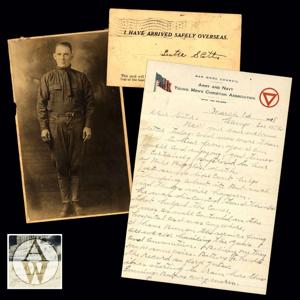
    In his ninth letter home from Camp Lee, Virginia, dated February 23, 1918, PFC Charles “Dutch” Riggle, a WWI soldier from Wheeling, WV, tells his brother James “Abe” Riggle that he's just starting to feel like he did before he left [apparently to go home for a visit]. The weather is like spring and he hasn't drilled a bit since returning. Les [our second letter writer] is out of the hospital and doing well. The two are planning to go to the show in Lakemont. Les thinks going home isn't worth the trouble for a short visit. He heard the Captain say they wouldn't go to France before October, and Dutch thinks the war will be over before then. Dutch likes the army but prefers farm work. His first sergeant was paid $62.00 a month -- good money. He can't wait to husk corn. It only took 19 hours to get back to Petersburg [the trip would take about 7 hours by car today].
     
    Elsewhere on the same day the socialist parties of the allied nations concluded one of several wartime Inter-Allied Socialist Conferences in London. The parties adopted a war aims resolution that included territorial goals; planned actions to prevent famine and refugees and punish war crimes; endorsement of a League of Nations; an International Legislature; and the abolition of secret treaties, diplomacy, and compulsory military service
     
    Charles “Dutch” Riggle was drafted into the US Army in 1917 and trained at Camp Lee, Virginia, where so many Wheeling draftees and volunteers—including his sister-in-law Minnie Riggle’s brother, Lester Scott—were trained. Dutch Riggle was a Private First Class in the 314th Field Artillery Supply Company, in France. Riggle was a farm boy with little formal education who grew up in the hills of Pennsylvania and West Virginia. He spelled many of his words phonetically. His letters have been transcribed exactly as they were written. This is his ninth letter from Camp Lee, dated 100 years ago today, February 23, 1918. 
    Digital scans and a transcript of Charles Riggle's February 23, 1918 letter can be viewed at: http://www.archivingwheeling.org/blog/from-camp-lee-to-the-great-war-february-23-1918-podcast
    Credits:
    "From Camp Lee to the Great War: The letters of Lester Scott and Charles Riggle" is brought to you by archivingwheeling.org in partnership with the Ohio County Public Library (www.ohiocountylibrary.org) and the WALS Foundation (walswheeling.com).
    Vince Marshall is the voice of Charles Riggle. The letters of Lester Scott and Charles Riggle were transcribed by Jon-Erik Gilot. This podcast was edited and written by Sean Duffy, audio edited by Erin Rothenbuehler.
    Music: "True to the Flag March," United States Marine Band, 1922, courtesy Library of Congress: www.loc.gov/item/00694039/
    Many thanks to Marjorie Richey for sharing family letters and the stories of her uncles, Lester Scott and Charles “Dutch” Riggle, WWI soldiers from West Virginia.
    5 min
  • From Camp Lee to the Great War: Episode 32 [February 11, 1918]
    "Cleo is trying to apologize now but that don't go with me. I would like for you to see the letters she wrote. They remind me of the notes the Kaiser used to [send] to the president..."
    In his twenty-third letter home from Camp Lee, Virginia, to his sister Minnie Riggle, US Army Wagoner (mule team driver) Lester Scott, a World War I soldier from Wheeling, West Virginia, writes that he's out of the hospital, feels fine, weighs the same, has lots of friends in camp, and probably won't be coming home. A five-day furlough just isn't enough time. He hears they might be moving the troops to Pennsylvania. They won't be going overseas at least until summer. Les got two letters from Cleo, who is trying to apologize. But Les isn't buying it. Minnie will see him when she's not expecting him.
     
    Elsewhere on the same day, President Woodrow Wilson addressed a Joint Session of Congress, assessing the Central Powers's reaction to his Fourteen Points, and adding what are now known as the "Four Principles," which included "adjustments as are most likely to bring a peace that will be permanent;" "that peoples and provinces are not to be bartered about from sovereignty to sovereignty as if they were mere chattels and pawns in a game;" that "every territorial settlement involved in this war must be made in the interest and for the benefit of the populations concerned;" and "that all well-defined national aspirations shall be accorded the utmost satisfaction that can be accorded them without introducing new or perpetuating old elements of discord and antagonism that would be likely in time to break the peace of Europe and consequently of the world."
     
    Lester Scott was drafted in 1917 and trained at Camp Lee, where so many Wheeling soldiers were trained. And, like so many of his Ohio Valley comrades, he served in the 314th Field Artillery Supply Company, Battery “A,” 80th (Blue Ridge) Division in France. This is his twenty-fourth letter from Camp Lee, dated 100 years ago today, February 11, 1918.
    Digital scans and a transcript of Lester Scott's February 11, 1918 letter can be viewed at: http://www.archivingwheeling.org/blog/from-camp-lee-to-the-great-war-february-11-1918-podcast
    Credits:
    "From Camp Lee to the Great War: The letters of Lester Scott and Charles Riggle" is brought to you by http://archivingwheeling.org in partnership with the Ohio County Public Library (http://www.ohiocountylibrary.org) and the WALS Foundation (http://walswheeling.com).
    Jeremy Richter is the voice of Lester Scott. The letters of Lester Scott and Charles Riggle were transcribed by Jon-Erik Gilot. This podcast was edited and written by Sean Duffy, audio edited by Erin Rothenbuehler.
    Music: "Castle's half and half," James Reese(composer), 1916, courtesy Library of Congress: www.loc.gov/item/ihas.100010715
    Many thanks to Marjorie Richey for sharing family letters and the stories of her uncles, Lester Scott and Charles “Dutch” Riggle, WWI soldiers from West Virginia.

    5 min
  • From Camp Lee to the Great War: Episode 31 [February 5, 1918]
    "I wish now I had enlisted in the Calvary. I would like it better. I like to be with horses. I am tired of seeing mules..."
    In his twenty-third letter home from Camp Lee, Virginia, to his sister Minnie Riggle, US Army Wagoner (mule team driver) Lester Scott, a World War I soldier from Wheeling, West Virginia, writes that he might not visit after all as he hates the idea of such a long trip for only two days at home. Despite being hospitalized for many days, Les claims he's never really been sick. Yet the little field hospital now houses 75 victims of the mumps. He's seen in the paper that the rest of the West Virginia boys are being sent to Camp Meade, and he'd rather be there than Camp Lee. Les wishes he'd joined the Knights of Pythias, a popular fraternal organization. He also wishes he'd joined the cavalry. He prefers the company of horses to that of mules. He reckons his horse, Bill, is as good as any he sees the officers riding. Les attempts to instruct Minnie in the importance of saluting superiors (and never striking an officer no matter how insulting they might be). He warns Minnie not to put any of his letters in the newspaper, at least until he's gone overseas. He closes by telling Minnie to "Watch for good news from me..."
    Elsewhere on the same day, the transport steamship SS Tuscania, with 2397 US troops on board, was torpedoed and sunk off the coast of Ireland by a German submarine. The Tuscania was part of a British convoy of vessels headed for France. The ship sank quickly, and 210 of the US troops were lost. On the whole, despite this attack, the convoy system employed as a defensive measure against German U-Boat attacks, was highly successful.
    Lester Scott was drafted in 1917 and trained at Camp Lee, where so many Wheeling soldiers were trained. And, like so many of his Ohio Valley comrades, he served in the 314th Field Artillery Supply Company, Battery “A,” 80th (Blue Ridge) Division in France. This is his twenty-third letter from Camp Lee, dated 100 years ago today, February 5, 1918.
    Digital scans and a transcript of Lester Scott's February 5, 1918 letter can be viewed at: http://www.archivingwheeling.org/blog/from-camp-lee-to-the-great-war-february-5-1918-podcast
    Credits:
    "From Camp Lee to the Great War: The letters of Lester Scott and Charles Riggle" is brought to you by http://archivingwheeling.org in partnership with the Ohio County Public Library (http://www.ohiocountylibrary.org) and the WALS Foundation (http://walswheeling.com).
    Jeremy Richter is the voice of Lester Scott. The letters of Lester Scott and Charles Riggle were transcribed by Jon-Erik Gilot. This podcast was edited and written by Sean Duffy, audio edited by Erin Rothenbuehler.
    Music: "Love Will Find A Way," The Seven Black Dots (performer), 1921, courtesy Library of Congress: www.loc.gov/item/ihas.100010774/
    Many thanks to Marjorie Richey for sharing family letters and the stories of her uncles, Lester Scott and Charles “Dutch” Riggle, WWI soldiers from West Virginia.

    8 min
  • From Camp Lee to the Great War: Episode 30 [February 1, 1918]
    "I have been saying all the time that this summer will end it for the working class over their and the socialists are raising the devil now. Anyone would know they are nearly starving to death..."
    In his twenty-second letter home from Camp Lee, Virginia, to his sister Minnie Riggle, US Army Wagoner (mule team driver) Lester Scott, a World War I soldier from Wheeling, West Virginia, writes that his mumps are gone and he's feeling fine. He's gotten a letter from his girlfriend, Cleo, and it seems they've had a falling out of sorts. Cleo is apparently also upset with her friend Minnie. Les wants Minnie to see Cleo's letter. He thinks the war is almost over, but fears he will have to go over seas anyway. As Charles Riggle wrote a couple of days earlier, Les talks about how the German people are starving and says the "socialists are raising the devil." He says the war will be four years old in August, making it as long as any war. He says when he is sent over, he won't have time to write. Minnie will receive a cablegram. He closes with, "Watch Cleo don't pull your hair..."
    Elsewhere on the same day, the Central Powers recognized the Ukraine Republic as an independent state and the labor strikes in Germany began to collapse.
    Lester Scott was drafted in 1917 and trained at Camp Lee, where so many Wheeling soldiers were trained. And, like so many of his Ohio Valley comrades, he served in the 314th Field Artillery Supply Company, Battery “A,” 80th (Blue Ridge) Division in France. This is his twenty-second letter from Camp Lee, dated 100 years ago today, February 1, 1918.
    Digital scans and a transcript of Lester Scott's February 1, 1918 letter can be viewed at: http://www.archivingwheeling.org/blog/from-camp-lee-to-the-great-war-february-1-1918-podcast
    Credits:
    "From Camp Lee to the Great War: The letters of Lester Scott and Charles Riggle" is brought to you by http://archivingwheeling.org in partnership with the Ohio County Public Library (http://www.ohiocountylibrary.org) and the WALS Foundation (http://walswheeling.com).
    Jeremy Richter is the voice of Lester Scott. The letters of Lester Scott and Charles Riggle were transcribed by Jon-Erik Gilot. This podcast was edited and written by Sean Duffy, audio edited by Erin Rothenbuehler.
    Music: "Hungarian Rag," New York Military Band (performer), 1914, courtesy Library of Congress: www.loc.gov/item/00694028/
    Many thanks to Marjorie Richey for sharing family letters and the stories of her uncles, Lester Scott and Charles “Dutch” Riggle, WWI soldiers from West Virginia.
    7 min
  • From Camp Lee to the Great War: Episode 29 [January 30, 1918]
    "Well Abe it look like they will haft to do something pretty soon over in Germany. The way the people is doing there, I think the war will close in 2 or 3 month..."
    In his eighth letter home from Camp Lee, Virginia, dated January 30, 1918, PFC Charles “Dutch” Riggle, a WWI soldier from Wheeling, WV, tells his brother James “Abe” Riggle that Les (PFC Lester Scott) is in the hospital with the mumps, like a lot of other boys in camp. He says they are practicing on the "big guns," which "do roar when they go off." Though it's raining "like the devil," Charles has never seen a nicer winter. He's impressed that camp is "fixed up dandy," complete with a cement road to hike on, electric lights everywhere, and hot and cold water in the bathhouse. He inquires about the corn husking back home. He thinks the German people are suffering, so the war will have to end soon. Charles is writing on his birthday. He is 24 years old.
     
    In this letter, when Charles Riggle writes about the "way the people [are] doing" in Germany, he is undoubtedly referring to the food shortages suffered by the German people in the months preceding January 2018, during which a quarter of a million people had starved to death. Also as of the end of January, more than four million workers were striking in Berlin, Dusseldorf, Kiel, Cologne, and Hamburg. The German government's reaction was swift and harsh, even as the German military dropped 14 tons of bombs on Paris. Despite its tenacity, the Germany Charles Riggle read about in the newspapers was in bleak disarray and must have appeared on the verge of inevitable collapse.
     
    Charles “Dutch” Riggle was drafted into the US Army in 1917 and trained at Camp Lee, Virginia, where so many Wheeling draftees and volunteers—including his sister-in-law Minnie Riggle’s brother, Lester Scott—were trained. Dutch Riggle was a Private First Class in the 314th Field Artillery Supply Company, in France. Riggle was a farm boy with little formal education who grew up in the hills of Pennsylvania and West Virginia. He spelled many of his words phonetically. His letters have been transcribed exactly as they were written. This is his eighth letter from Camp Lee, dated 100 years ago today, January 30, 1918.
    Digital scans and a transcript of Charles Riggle's January 30, 1918 letter can be viewed at: www.archivingwheeling.org/blog/from-camp-lee-to-the-great-war-january-30-1918-podcast
    Credits:
    "From Camp Lee to the Great War: The letters of Lester Scott and Charles Riggle" is brought to you by archivingwheeling.org in partnership with the Ohio County Public Library (www.ohiocountylibrary.org) and the WALS Foundation (walswheeling.com).
    Vince Marshall is the voice of Charles Riggle. The letters of Lester Scott and Charles Riggle were transcribed by Jon-Erik Gilot. This podcast was edited and written by Sean Duffy, audio edited by Erin Rothenbuehler.
    Music: "Castle Walk," Meacham, F. W. (composer);
    Dabney, [Ford] (composer); Prince's Band, 1914, courtesy Library of Congress: https://www.loc.gov/item/ihas.100010714/
    Many thanks to Marjorie Richey for sharing family letters and the stories of her uncles, Lester Scott and Charles “Dutch” Riggle, WWI soldiers from West Virginia.
    5 min
  • From Camp Lee to the Great War: Episode 28 [January 24, 1918]
    "I never saw as many mumps and measles...I will venture to say that there is one fourth of the boys in camp with mumps and measles..."
    In his twenty-first letter home from Camp Lee, Virginia, to his sister Minnie Riggle, US Army Wagoner (mule team driver) Lester Scott, a World War I soldier from Wheeling, West Virginia, writes that he feels fine "with the exception of a big jaw." He's in the convalescent field hospital with the dreaded but predicted mumps now, and signs the letter "from Fat Face." He notes that the mumps are doing what the measles did before: preventing his visit home. He has nothing to do for the next 18 days but listen to the Victrola. Luckily, they have plenty of records. There are six inches of snow on the ground. Les is meeting people from all over the country. Les says it's OK to sell his horse Bill.
    Elsewhere on the same day aerial battles continued over Flanders, the Brits were conducting air raids into Germany, and British Prime Minister Lloyd George met with Italian leader Vittorio Emanuele Orlando. The two men would have significant roles at the Paris Peace Conference in 1919. American evangelist Oral Roberts was born.
    Lester Scott was drafted in 1917 and trained at Camp Lee, where so many Wheeling soldiers were trained. And, like so many of his Ohio Valley comrades, he served in the 314th Field Artillery Supply Company, Battery “A,” 80th (Blue Ridge) Division in France. This is his twenty-first letter from Camp Lee, dated 100 years ago today, January 24, 1918.
    Digital scans and a transcript of Lester Scott's September 24, 1917 letter can be viewed at: http://www.archivingwheeling.org/blog/from-camp-lee-to-the-great-war-january-24-1918-podcast
    Credits:
    "From Camp Lee to the Great War: The letters of Lester Scott and Charles Riggle" is brought to you by http://archivingwheeling.org in partnership with the Ohio County Public Library (http://www.ohiocountylibrary.org) and the WALS Foundation (http://walswheeling.com).
    Jeremy Richter is the voice of Lester Scott. The letters of Lester Scott and Charles Riggle were transcribed by Jon-Erik Gilot. This podcast was edited and written by Sean Duffy, audio edited by Erin Rothenbuehler.
    Music: "Old Pal (Why don't you answer me?)," Soman, Herbert. (performer), Lieberield, Daniel. (performer), 1921, courtesy Library of Congress: https://www.loc.gov/item/00694035/
    Many thanks to Marjorie Richey for sharing family letters and the stories of her uncles, Lester Scott and Charles “Dutch” Riggle, WWI soldiers from West Virginia.
    6 min
  • From Camp Lee to the Great War: Episode 27 [January 23, 1918]
    "I have been having some pretty hard luck..."
    In his twentieth letter home from Camp Lee, Virginia, to his sister Minnie Riggle, US Army Wagoner (mule team driver) Lester Scott, a World War I soldier from Wheeling, West Virginia, writes that he is "taking the mumps" and his "jaw is swelled some." He fears a long hospital stay (18 days for mumps) will ruin yet another attempt to visit home. Even the ever-optimistic Les has to admit he's been the victim of some "hard luck," but he still sees the silver lining in that if he has mumps now, he won't have them "sometime again." He says the mule drivers will be getting their trucks soon [American manufacturers had produced more than 225,000 trucks by 1918].
    Elsewhere on the same day the Germans captured trenches on the Belgian coast, Brits and Germans fought a submarine battle near the Canary Islands, rioting occurred in Moscow even as the Congress of Soviets met in Petrograd, and future Nobel Laureate, American biochemist Gertrude B. Elion was born.
     
    Lester Scott was drafted in 1917 and trained at Camp Lee, where so many Wheeling soldiers were trained. And, like so many of his Ohio Valley comrades, he served in the 314th Field Artillery Supply Company, Battery “A,” 80th (Blue Ridge) Division in France. This is his twentieth letter from Camp Lee, dated 100 years ago today, January 23, 1918.
    Digital scans and a transcript of Lester Scott's January 23, 1918 letter can be viewed at: http://www.archivingwheeling.org/blog/from-camp-lee-to-the-great-war-january-23-1918-podcast
    Credits:
    "From Camp Lee to the Great War: The letters of Lester Scott and Charles Riggle" is brought to you by http://archivingwheeling.org in partnership with the Ohio County Public Library (http://www.ohiocountylibrary.org) and the WALS Foundation (http://walswheeling.com).
    Jeremy Richter is the voice of Lester Scott. The letters of Lester Scott and Charles Riggle were transcribed by Jon-Erik Gilot. This podcast was edited and written by Sean Duffy, audio edited by Erin Rothenbuehler.
    Music: "The Smiler," Van Eps, Fred (instrumentalist), Burckhardt, John F. (instrumentalist), Wenrich, Percy (composer) 1925, courtesy Library of Congress: https://www.loc.gov/item/ihas.200035784/
    Many thanks to Marjorie Richey for sharing family letters and the stories of her uncles, Lester Scott and Charles “Dutch” Riggle, WWI soldiers from West Virginia.
    4 min

About From Camp Lee to the Great War: The Letters of Lester Scott & Charles Riggle

From the publisher's feed

World War I soldiers from Wheeling, West Virginia, Lester Scott and Charles "Dutch" Riggle were drafted in 1917 and trained at Camp Lee, Virginia. Lester Scott served as a Wagoner (mule team driver) in the 314th Field Artillery Supply Company, Battery “A,” 80th (Blue Ridge) Division in France. Dutch Riggle was a PFC with the same unit. These are their letters home.