From Camp Lee to the Great War: The Letters of Lester Scott & Charles Riggle

From Camp Lee to the Great War: The Letters of Lester Scott & Charles Riggle

By From Camp Lee to the Great War podcast Archiving Wheeling in partnership with the Ohio County Public Library and the Wheeling Academy of Law & ScienceSociety & Culture
Download on the App Store

From Camp Lee to the Great War: The Letters of Lester Scott & Charles Riggle episodes

  • From Camp Lee to the Great War: Episode 56 [August 6, 1918]
    "When you answer write a big long letter and tell me all the news...."
    In his thirty-eight letter home (and his first from France), to his sister Minnie Riggle, US Army Wagoner (mule team driver) Lester Scott, a World War I soldier from Wheeling, West Virginia, doesn't have much of substance to say, probably in part because of security restrictions on what he can write. He's in good health. He saw Will Riggle. It's raining in France. And, like Charles Riggle [see our August 1 episode], he wishes he could attend the Jacktown Fair. Mostly he just wants all the news from home.
    Elsewhere on the same day, the Second Battle of the Marne ended, the British Government issued a Declaration to the people of Russia, promising that they will not interfere in Russian politics, and Ferdinand Foch was named Marshal of France.
    Lester Scott was drafted in 1917 and trained at Camp Lee, where so many Wheeling soldiers were trained. And, like so many of his Ohio Valley comrades, he served in the 314th Field Artillery Supply Company, Battery “A,” 80th (Blue Ridge) Division in France. This is his thirty-eighth letter home, dated 100 years ago today, August 6, 1918.
    Digital scans and a transcript of Lester Scott's August 6, 1918 letter can be viewed at: http://www.archivingwheeling.org/blog/from-camp-lee-to-the-great-war-august-6-1918-podcast
    Credits:
    "From Camp Lee to the Great War: The letters of Lester Scott and Charles Riggle" is brought to you by http://archivingwheeling.org in partnership with the Ohio County Public Library (http://www.ohiocountylibrary.org) and the WALS Foundation (http://walswheeling.com).
    Jeremy Richter is the voice of Lester Scott. The letters of Lester Scott and Charles Riggle were transcribed by Jon-Erik Gilot. This podcast was edited and written by Sean Duffy, audio edited by Erin Rothenbuehler.
    Music: "Love Will Find A Way," The Seven Black Dots (performer), 1921, courtesy Library of Congress: www.loc.gov/item/ihas.100010774/
    Many thanks to Marjorie Richey for sharing family letters and the stories of her uncles, Lester Scott and Charles “Dutch” Riggle, WWI soldiers from West Virginia.

    4 min
  • From Camp Lee to the Great War: Episode 55 [August 1, 1918]
    "I think the Germans is nearly licked now. I want to see it over in time to go to the Jacktown fair next year..."
    In his seventeenth letter home (his second from France after fifteen from Camp Lee) dated August 1, 1918, PFC Charles “Dutch” Riggle, a WWI soldier from Wheeling, WV, tells his brother James “Abe” Riggle he supposes Abe will be getting "the call" [for the draft] soon, since all the other young fellows from the ridge are already in France (even though Tom didn't pass the exam). Dutch thinks it must be lonely on the ridge. Dutch is on the firing range a lot practicing on the powerful 3-inch French guns that "don't hurt the ears like the American 3 inch does." Les is doing fine. Dutch sees him nearly every day. Walter Toland is in England (probably having a good time). Dutch has heard the soldiers might get to vote in the upcoming election but thinks it will be to much bother. The regiment is "quite a ways from the front yet." The allies are closing on Berlin and Dutch hopes the war is over in time for him to attend the Jacktown Fair.
    Elsewhere on the same day, the Allies attacked and captured Archangel defenses (part of the Allied intervention in the Russian Civil War), British troops entered Vladivostok, and the Pittsburgh Pirates and Boston Braves played a record 20 scoreless innings before the Pirates won, 2-0 in the 21st inning.
    Charles “Dutch” Riggle was drafted into the US Army in 1917 and trained at Camp Lee, Virginia, where so many Wheeling draftees and volunteers—including his sister-in-law Minnie Riggle’s brother, Lester Scott—were trained. Dutch Riggle was a Private First Class in Battery F of the 314th Field Artillery Supply Company, in France. Riggle was a farm boy with little formal education who grew up in the hills of Pennsylvania and West Virginia. He spelled many of his words phonetically. His letters have been transcribed exactly as they were written. This is his seventeenth letter home, dated 100 years ago today, August 1, 1918.
    Digital scans and a transcript of Charles Riggle's August 1, 1918 letter can be viewed at: www.archivingwheeling.org/blog/from-camp-lee-to-the-great-war-august-1-1918-podcast
    Credits:
    "From Camp Lee to the Great War: The letters of Lester Scott and Charles Riggle" is brought to you by archivingwheeling.org in partnership with the Ohio County Public Library (www.ohiocountylibrary.org) and the WALS Foundation (walswheeling.com).
    Vince Marshall is the voice of Charles Riggle. The letters of Lester Scott and Charles Riggle were transcribed by Jon-Erik Gilot. This podcast was edited and written by Sean Duffy, audio edited by Erin Rothenbuehler.
    Music: "Porcupine Rag," Johnson, Chas. J. (composer), New York Military Band, 1915, courtesy Library of Congress: www.loc.gov/item/ihas.200035782/
    Many thanks to Marjorie Richey for sharing family letters and the stories of her uncles, Lester Scott and Charles “Dutch” Riggle, WWI soldiers from West Virginia.
    5 min
  • From Camp Lee to the Great War: Episode 54 [June 22, 1918]
    "Somewhere in France...It's is a nice country alright. It's no wonder the French is fighting so hard for it."
    In his sixteenth letter home from Camp Lee, Virginia, dated June 22, 1918, PFC Charles “Dutch” Riggle, a WWI soldier from Wheeling, WV, tells his brother James “Abe” Riggle, in a letter addressed "Somewhere in France," that the weather is dandy and that he likes France just fine, but he's not sure how he will like it when he gets "into the scrap." He says the "trip across the pond" was a long one. Les got a little seasick. The Germans are getting about all they want now. He hopes to finish the war in time to make the rabbit hunt in fall.
    Elsewhere on the same day, a horrific train wreck occurred near Hammond, Indiana when an engineer fell asleep, allowing his locomotive to crash into another. The Hammond Circus Train Wreck killed 86 people, many of them circus performers, in one of the worst such disasters in American history.
    Charles “Dutch” Riggle was drafted into the US Army in 1917 and trained at Camp Lee, Virginia, where so many Wheeling draftees and volunteers—including his sister-in-law Minnie Riggle’s brother, Lester Scott—were trained. Dutch Riggle was a Private First Class in Battery F of the 314th Field Artillery Supply Company, in France. Riggle was a farm boy with little formal education who grew up in the hills of Pennsylvania and West Virginia. He spelled many of his words phonetically. His letters have been transcribed exactly as they were written. This is his sixteenth letter from Camp Lee, dated 100 years ago today, June 22, 1918.
    Digital scans and a transcript of Charles Riggle's June 22, 1918 letter can be viewed at: www.archivingwheeling.org/blog/from-camp-lee-to-the-great-war-june-22-1918-podcast
    Credits:
    "From Camp Lee to the Great War: The letters of Lester Scott and Charles Riggle" is brought to you by archivingwheeling.org in partnership with the Ohio County Public Library (www.ohiocountylibrary.org) and the WALS Foundation (walswheeling.com).
    Vince Marshall is the voice of Charles Riggle. The letters of Lester Scott and Charles Riggle were transcribed by Jon-Erik Gilot. This podcast was edited and written by Sean Duffy, audio edited by Erin Rothenbuehler.
    Music: "Castle Valse Classique," [Europe, James Reese] (composer),
    [Dabney, Ford] (composer), Metropolitan Military Band (performer), 1916, courtesy Library of Congress: www.loc.gov/item/ihas.100010721/
    Many thanks to Marjorie Richey for sharing family letters and the stories of her uncles, Lester Scott and Charles “Dutch” Riggle, WWI soldiers from West Virginia.
    4 min
  • From Camp Lee to the Great War: Episode 53 [June 18, 1918]
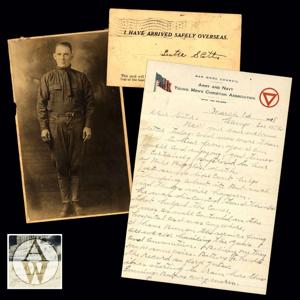
    "I have arrived safely overseas..."
    In what is essentially his thirty-seventh letter home, US Army Wagoner (mule team driver) Lester Scott, a World War I soldier from Wheeling, West Virginia, writes, this time courtesy a signed, Red Cross form postcard announcing his safe arrival in France addressed to his brother-in-law (his sister Minnie's husband Jame Riggle), "I have arrived safely overseas." The postcard was sent from Newport News, Virginia, but refers to Lester's arrival in France as a part of the American Expeditionary Force.
    On the same day that Lester Scott arrived on French soil, the French army repulsed a German attack on the Reims front and the Russian battleship Svobodnaya Rossiya was scuttled in the Black Sea to avoid being captured by the Germans. Meanwhile, the German submarine U-151 fired torpedoes at the British flagged merchant ship, SS Dwinsk near Bermuda, badly damaging her. The U-151 then fired two torpedoes at the USS Von Steuben, which was attempting a rescue. The Von Steuben was able to outmaneuver the torpedoes and avoid being hit.
    Lester Scott was drafted in 1917 and trained at Camp Lee, where so many Wheeling soldiers were trained. And, like so many of his Ohio Valley comrades, he served in the 314th Field Artillery Supply Company, Battery “A,” 80th (Blue Ridge) Division in France. This is his thirty-seventh letter home, dated 100 years ago today, June 18, 1918.
    Digital scans and a transcript of Lester Scott's June 18, 1918 postcard can be viewed at: http://www.archivingwheeling.org/blog/from-camp-lee-to-the-great-war-june-18-1918-podcast
    Credits:
    "From Camp Lee to the Great War: The letters of Lester Scott and Charles Riggle" is brought to you by http://archivingwheeling.org in partnership with the Ohio County Public Library (http://www.ohiocountylibrary.org) and the WALS Foundation (http://walswheeling.com).
    Jeremy Richter is the voice of Lester Scott. The letters of Lester Scott and Charles Riggle were transcribed by Jon-Erik Gilot. This podcast was edited and written by Sean Duffy, audio edited by Erin Rothenbuehler.
    Music: "Over There," Cohan, George M. (composer), Murray, Billy (performer), 1917, courtesy Library of Congress: https://www.loc.gov/item/ihas.100010567/
    Many thanks to Marjorie Richey for sharing family letters and the stories of her uncles, Lester Scott and Charles “Dutch” Riggle, WWI soldiers from West Virginia.

    3 min
  • From Camp Lee to the Great War: Episode 52 [The Cleo Episode]
    "My own darling Less, How can you doubt my love for you?"
    Who the heck is Cleo?!
    That was a question from a listener who said he's heard every episode of "From Camp Lee to the Great War," but still can't figure it out.
    If you've also been listening but not necessarily reading all of the accompanying blog posts on Archiving Wheeling dot org, you might have the same question: Who the heck is Cleo?
    Well, the short answer is that Cleo Hewitt is Wagoner Lester Scott's girlfriend back in Wheeling. We don't know a great deal about her, but to remove some of the mystery, we've created this special edition of "From Camp Lee to the Great War." Let's just call it, "The Cleo Episode."
    As you know, we publish the letters of US Army privates, Lester Scott and his brother-in-law Charles "Dutch" Riggle, 100 years to the day after each was penned by our soldiers and mailed from Camp Lee, Virginia, back to family in Wheeling. We've chosen to publish the Cleo Episode today because it was 100 years ago last week, on May 23, 1918, that Lester Scott wrote to his sister Minnie Riggle, "please write and tell Cleo Good Bye for me."
    The reason is, Les knew he was leaving for France. And for reasons that will become apparent, Les wasn't sure Cleo wanted to hear from him. But since his sister was Cleo's good friend, he asked her to convey his goodbye message.
    After listening today's podcast, you will know as much as we do about the mysterious Cleo.
    Digital scans and a transcript of Cleo Hewitt's letters can be viewed at: http://www.archivingwheeling.org/blog/from-camp-lee-to-the-great-war-the-cleo-episode
    Credits:
    "From Camp Lee to the Great War: The letters of Lester Scott and Charles Riggle" is brought to you by http://archivingwheeling.org in partnership with the Ohio County Public Library (http://www.ohiocountylibrary.org) and the WALS Foundation (http://walswheeling.com).
    Jeremy Richter is the voice of Lester Scott. Liz Richter is the voice of Cleo Hewitt. Sean Duffy is the voice of Christopher Columbus Scott. The letters of Lester Scott and Charles Riggle were transcribed by Jon-Erik Gilot. This podcast was edited and written by Sean Duffy, audio edited by Erin Rothenbuehler.
    Music for May 23, 1918 episode: “Poor butterfly,” Jaudas, Eugene. (performer)Jaudas’ Band (performer), 1917, courtesy the Library of Congress: https://www.loc.gov/item/00694036/
    Many thanks to Marjorie Richey for sharing family letters and the stories of her uncles, Lester Scott and Charles “Dutch” Riggle, WWI soldiers from West Virginia.

    10 min
  • From Camp Lee to the Great War: Episode 51 [May 23, 1918]
    "Please write and tell Cleo Good Bye for me...Well Boss, all I can say is, Good Bye and Good Luck..."
    In his thirty-sixth letter home from Camp Lee, Virginia, to his sister Minnie Riggle, US Army Wagoner (mule team driver) Lester Scott, a World War I soldier from Wheeling, West Virginia, says he weighs 172 pounds. Dutch is in good spirits and nearly as heavy as Les. The boys are in good spirits. He sends best regards to every one of his friends, to Minnie and Jim, to Dad, and to Cleo [link to Cleo Episode]. It's clear that Les knows he's going to France soon. He tells Minnie she should not worry about him. He'll be alright. She will hear from him before too long.
    Elsewhere on the same day, Arabs successfully attack the Ottoman Turks near Abu Naam, and the British armed mercantile cruiser "Moldavia", carrying American troops, was torpedoed and sunk, killing 56. Costa Rica declared war on Germany in an effort to gain favor from Woodrow Wilson for its new leader who had taken power after a coup. The gesture was ineffective.
    Lester Scott was drafted in 1917 and trained at Camp Lee, where so many Wheeling soldiers were trained. And, like so many of his Ohio Valley comrades, he served in the 314th Field Artillery Supply Company, Battery “A,” 80th (Blue Ridge) Division in France. This is his thirty-sixth letter from Camp Lee, dated 100 years ago today, May 23, 1918.
    Digital scans and a transcript of Lester Scott's May 23, 1918 letter can be viewed at: http://www.archivingwheeling.org/blog/from-camp-lee-to-the-great-war-may-23-1918-podcast
    Credits:
    "From Camp Lee to the Great War: The letters of Lester Scott and Charles Riggle" is brought to you by http://archivingwheeling.org in partnership with the Ohio County Public Library (http://www.ohiocountylibrary.org) and the WALS Foundation (http://walswheeling.com).
    Jeremy Richter is the voice of Lester Scott. The letters of Lester Scott and Charles Riggle were transcribed by Jon-Erik Gilot. This podcast was edited and written by Sean Duffy, audio edited by Erin Rothenbuehler.
    Music: "Hail Columbia ; Star Spangled Banner," 1914, courtesy Library of Congress: www.loc.gov/item/ihas.100010368/
    Many thanks to Marjorie Richey for sharing family letters and the stories of her uncles, Lester Scott and Charles “Dutch” Riggle, WWI soldiers from West Virginia.
    4 min
  • From Camp Lee to the Great War: Episode 50 [May 19, 1918]
    "We han't allowed to write any military information anymore, and you see a fellow hasn't got much to write"
    In his fifteenth letter home from Camp Lee, Virginia, dated May 19, 1918, PFC Charles “Dutch” Riggle, a WWI soldier from Wheeling, WV, tells his brother James “Abe” Riggle that he's still in Battery F but doesn't know for how much longer. He's drilling a great deal but he can't talk about the military anymore. He had his picture taken and he'll send one home. That's about it!
    Elsewhere on the same day, German planes raided London and bombed British hospitals outside the war zone, killing or wounding hundreds. Airman Gervais Raoul Victor Lufbery, who served in both the French Air Force and the U.S. Army Air Service, was killed in aerial combat. Meanwhile on the home front, the Washington Senators Walter Johnson pitched a grueling 18 innings to beat the Cleveland Indians (whose pitcher also went the distance) 1-0.
    Charles “Dutch” Riggle was drafted into the US Army in 1917 and trained at Camp Lee, Virginia, where so many Wheeling draftees and volunteers—including his sister-in-law Minnie Riggle’s brother, Lester Scott—were trained. Dutch Riggle was a Private First Class in Battery F of the 314th Field Artillery Supply Company, in France. Riggle was a farm boy with little formal education who grew up in the hills of Pennsylvania and West Virginia. He spelled many of his words phonetically. His letters have been transcribed exactly as they were written. This is his fifteenth letter from Camp Lee, dated 100 years ago today, May 19, 1918.
    Digital scans and a transcript of Charles Riggle's May 19, 1918 letter can be viewed at: www.archivingwheeling.org/blog/from-camp-lee-to-the-great-war-may-19-1918-podcast
    Credits:
    "From Camp Lee to the Great War: The letters of Lester Scott and Charles Riggle" is brought to you by archivingwheeling.org in partnership with the Ohio County Public Library (www.ohiocountylibrary.org) and the WALS Foundation (walswheeling.com).
    Vince Marshall is the voice of Charles Riggle. The letters of Lester Scott and Charles Riggle were transcribed by Jon-Erik Gilot. This podcast was edited and written by Sean Duffy, audio edited by Erin Rothenbuehler.
    Music: Castle's half and half | James Reese(composer), 1916, courtesy Library of Congress: www.loc.gov/item/ihas.100010646/
    Many thanks to Marjorie Richey for sharing family letters and the stories of her uncles, Lester Scott and Charles “Dutch” Riggle, WWI soldiers from West Virginia.
    3 min
  • From Camp Lee to the Great War: Episode 49 [May 18, 1918]
    "What has become of Cleo?"
    In his thirty-fifth letter home from Camp Lee, Virginia, to his sister Minnie Riggle, US Army Wagoner (mule team driver) Lester Scott, a World War I soldier from Wheeling, West Virginia, says he's done some excellent firing at rifle practice, hitting four bulls eyes from 100 yards left-handed. Then he got seven out of ten hits right-handed. They have to shoot different distances from different positions. He shoulder was sore the next day. He got 18 out of 60 total shots in the bullseye. Les is unsure if he'll get that furlough. Les now has a helper who has to do whatever Les tells him. He talks too much. Les says Jim is welcome to wear any clothes he left behind. Les wants to know what has become of his girlfriend Cleo.
    Two days earlier on May 16, 1918, the U.S. Congress passed the Sedition Act, which prohibited "any disloyal, profane, scurrilous, or abusive language about the form of government of the United States ... or the flag of the United States, or the uniform of the Army or Navy." A serious challenge to the First Amendment, the Sedition Act was repealed in 1921. Elsewhere on May 18, 1918, British planes made air raids against German towns and a TNT explosion at the Aetna Chemical Co. in Oakdale, Pennsylvania killed 200 people.
    Lester Scott was drafted in 1917 and trained at Camp Lee, where so many Wheeling soldiers were trained. And, like so many of his Ohio Valley comrades, he served in the 314th Field Artillery Supply Company, Battery “A,” 80th (Blue Ridge) Division in France. This is his thirty-fifth letter from Camp Lee, dated 100 years ago today, May 18, 1918.
    Digital scans and a transcript of Lester Scott's May 18, 1918 letter can be viewed at: http://www.archivingwheeling.org/blog/from-camp-lee-to-the-great-war-may-18-1918-podcast
    Credits:
    "From Camp Lee to the Great War: The letters of Lester Scott and Charles Riggle" is brought to you by http://archivingwheeling.org in partnership with the Ohio County Public Library (http://www.ohiocountylibrary.org) and the WALS Foundation (http://walswheeling.com).
    Jeremy Richter is the voice of Lester Scott. The letters of Lester Scott and Charles Riggle were transcribed by Jon-Erik Gilot. This podcast was edited and written by Sean Duffy, audio edited by Erin Rothenbuehler.
    Music: "Hungarian Rag," New York Military Band (performer), 1914, courtesy Library of Congress: www.loc.gov/item/00694028/
    Many thanks to Marjorie Richey for sharing family letters and the stories of her uncles, Lester Scott and Charles “Dutch” Riggle, WWI soldiers from West Virginia.
    6 min
  • From Camp Lee to the Great War: Episode 48 [May 12, 1918]
    "I am going to send some money home before long. Maybe you can use it now to buy cows with. I only have two more months to pay my liberty bonds out in..."
    In his thirty-fourth letter home from Camp Lee, Virginia, to his sister Minnie Riggle, US Army Wagoner (mule team driver) Lester Scott, a World War I soldier from Wheeling, West Virginia, says he's been busy packing mule harnesses and drilling. He's qualified on gas mask school. He refers to Minnie's "new separator" [probably a cream separator, a common tool on dairy farms]. He says he'll be sending money how so Minnie can buy cows. He's paying on his liberty bonds and took out $5000.00 in insurance. He's ready to go over seas anytime.
    In this letter, Les asks Minnie if she knows what their father, Christopher Columbus Scott, meant in his May 10 letter, when he wrote, "I was talking to Cleo Hewett and she says she is afraid she is left on you now." In response, Les wrote to Minnie, "if you know what he meant about Cleo, he has me guessing." This happens to be the only instance in which we actually have a letter from home to pair with a soldier's letter. You can see a photograph of Christopher and an image of his letter as well as the transcription below. His words are also included in the podcast. And he finally reveals the mysterious Cleo's surname. Look for a future podcast dedicated to Cleo and Les, coming May 23.
    The "Liberty Bonds" Les refers to were sold to raise money for the war effort. Marketed as a patriotic duty, the bonds were essentially loans to the government that were to be repaid with interest added after a specified time had passed. Despite these efforts, U.S. debt grew to more than $25 billion by war's end.
    Elsewhere on the same day, Julius Rosenberg, who would be executed along with his wife Ethel 35 years later as Soviet spies, was born in New York City.
    Lester Scott was drafted in 1917 and trained at Camp Lee, where so many Wheeling soldiers were trained. And, like so many of his Ohio Valley comrades, he served in the 314th Field Artillery Supply Company, Battery “A,” 80th (Blue Ridge) Division in France. This is his thirty-fourth letter from Camp Lee, dated 100 years ago today, May 12, 1918.
    Digital scans and a transcript of Christopher Columbus Scott May 10, 1918 letter and Lester Scott's May 12, 1918 letter can be viewed at: http://www.archivingwheeling.org/blog/from-camp-lee-to-the-great-war-may-12-1918-podcast
    Credits:
    "From Camp Lee to the Great War: The letters of Lester Scott and Charles Riggle" is brought to you by http://archivingwheeling.org in partnership with the Ohio County Public Library (http://www.ohiocountylibrary.org) and the WALS Foundation (http://walswheeling.com).
    Sean Duffy is the voice of Christopher Columbus Scott. Jeremy Richter is the voice of Lester Scott. The letters of Lester Scott and Charles Riggle were transcribed by Jon-Erik Gilot. This podcast was edited and written by Sean Duffy, audio edited by Erin Rothenbuehler.
    Music: "Love Will Find A Way," The Seven Black Dots (performer), 1921, courtesy Library of Congress: www.loc.gov/item/ihas.100010774/
    Many thanks to Marjorie Richey for sharing family letters and the stories of her uncles, Lester Scott and Charles “Dutch” Riggle, WWI soldiers from West Virginia.
    5 min
  • From Camp Lee to the Great War: Episode 47 [May 6, 1918]
    "P.S. Boss don't you worry while me and Less is gone, for we will be back in about a year from now. Ha Ha!"
    In his fourteenth letter home from Camp Lee, Virginia, dated May 6, 1918, PFC Charles “Dutch” Riggle, a WWI soldier from Wheeling, WV, tells his brother James “Abe” Riggle that he's as well as ever and having a good time eight miles from Camp Lee on military police duty. They are guarding an electrical power plant, a waterworks, and a bridge across the Appomattox River. It's a dandy place to fish. The plant supplies electricity and water for Camp Lee. It's "90 degrees in the shade," but they have a swing to jump in the river. He says Les [Lester Scott] is "driving mules every day." If Charles Gettings is sent to Camp Lee, Dutch wants him to look him up. He's still with Tub Meriner, a "dandy good fellow." Dutch supposes Walter Toland is showing his courage now in France. He thinks we've got a good Army of a million men in France and even though they are not fighting much now, the Germans will get licked soon.
    Just a few days prior on May 2, 1918, British and French military leaders argued at a meeting in Abbeville over the entry of U.S. troops into the conflict. American soldiers were arriving at the rate of 120,000 per month, but as Charles Riggle noted in his letter, very few were yet involved in fighting despite the ongoing German Spring Offensive. General John J. Pershing, commander of the American Expeditionary Force (AEF), resisted giving the Allies power to command his troops. Pershing reached a compromise, allowing one third of U.S. troops to join the effort by July. The remainder would benefit from more training. These decisions would have important repercussions for Wheeling PFCs Charles Riggle and Lester Scott and their comrades in arms.
    Charles “Dutch” Riggle was drafted into the US Army in 1917 and trained at Camp Lee, Virginia, where so many Wheeling draftees and volunteers—including his sister-in-law Minnie Riggle’s brother, Lester Scott—were trained. Dutch Riggle was a Private First Class in Battery F of the 314th Field Artillery Supply Company, in France. Riggle was a farm boy with little formal education who grew up in the hills of Pennsylvania and West Virginia. He spelled many of his words phonetically. His letters have been transcribed exactly as they were written. This is his fourteenth letter from Camp Lee, dated 100 years ago today, May 6, 1918.
    Digital scans and a transcript of Charles Riggle's May 6, 1918 letter can be viewed at: www.archivingwheeling.org/blog/from-camp-lee-to-the-great-war-may-6-1918-podcast
    Credits:
    "From Camp Lee to the Great War: The letters of Lester Scott and Charles Riggle" is brought to you by archivingwheeling.org in partnership with the Ohio County Public Library (www.ohiocountylibrary.org) and the WALS Foundation (walswheeling.com).
    Vince Marshall is the voice of Charles Riggle. The letters of Lester Scott and Charles Riggle were transcribed by Jon-Erik Gilot. This podcast was edited and written by Sean Duffy, audio edited by Erin Rothenbuehler.
    Music: "Junk Man Rag," Roberts, [Luckyeth] (composer), Victor Military Band (performer), 1913, courtesy Library of Congress: www.loc.gov/item/ihas.100010646/
    Many thanks to Marjorie Richey for sharing family letters and the stories of her uncles, Lester Scott and Charles “Dutch” Riggle, WWI soldiers from West Virginia.
    5 min

About From Camp Lee to the Great War: The Letters of Lester Scott & Charles Riggle

From the publisher's feed

World War I soldiers from Wheeling, West Virginia, Lester Scott and Charles "Dutch" Riggle were drafted in 1917 and trained at Camp Lee, Virginia. Lester Scott served as a Wagoner (mule team driver) in the 314th Field Artillery Supply Company, Battery “A,” 80th (Blue Ridge) Division in France. Dutch Riggle was a PFC with the same unit. These are their letters home.