
Sign up to save your podcasts
Or



Ft. Ian Jones systems and design thinker, co-founder of (among many other things) Agri House, an innovation impact venture working with marginalized communities to overcome food and financial insecurity in Cambodia.
Listen to our conversation to know more about Cambodian cricket farmers of all abilities, inclusive venture and adapting financing.
"If we can create an enabling and supportive environment for entrepreneurs of all abilities, then the success is built upon the abilities of the entrepreneur, and not how society defines or shapes them."
Agri House is a Khmer women owned and women led registered company. Cricket production represents one of the best alternative livelihoods in Cambodia. As a replacement or complement to rice cultivation, it is a stable production that provides a margin and a regular income. Which can quickly exceed the income of a rice farm. Requiring little space and initial investment. Agri House developed climate-resilient solutions for marginalized communities promoting inclusion, alternative livelihoods and good nutrition for youth.
Hosted on Acast. See acast.com/privacy for more information.
Hosted on Acast. See acast.com/privacy for more information.
Featuring Emilie Devic (AFFIA vice secretary), Martin Zorrilla (General Chair of the IFW2024 Local Organizing Committee) and IAN JONES (Agri House).
We talked about the South Est Asian context, networking and secrecy, the next Insects To Feed the World, which will take place in Singapore, in 2024, and about the role of insect farming in marginalized communities in Cambodia.
Hosted on Acast. See acast.com/privacy for more information.
“We’re really quickly approaching a sort of tipping point where the broader agribusiness community, livestock community, and sustainable food community are recognizing insect agriculture as one of a variety of solutions. And it’s one that really elevates and increases the efficiency of other operations”, RNA (Robert Nathan Allan) executive director of the FUTURE of FOOD event series, cofounder and board member of NACIA, and founder of “Little Herds”.
With RNA we talked especially about food, education, frame & reframe, derisk, sushi, gas stations, chapulines overharvesting and a lot of joy.
Hosted on Acast. See acast.com/privacy for more information.
Con la participación de Karol Barragán Fonseca, profesora en la Universidad Nacional de Colombia y fundadora y de “Insects For Peace” y Julieth Rodriguez, Erika Perez, Martha Nelly Castañeda, Juan de la Cruz Vega, Juan Antonio Castro y Alberto Ocampo que viven en el AETCR Jaime Pardo Leal.
“Este es un proceso que puede independizar a las comunidades de la compra de insumos externos y por otro lado, puede fortalecer sus economías locales.”
“Insects For Peace” es una iniciativa que implementa la producción de insectos en comunidades rurales de firmantes de paz y comunidades que han sido afectadas por el conflicto armado en Colombia. Promoviendo en esta manera la soberanía alimentaria y la agricultura circular.
Hosted on Acast. See acast.com/privacy for more information.
Featuring Jeffrey Tomberlin (Texas A&M University), Christine Picard (The Indiana University and Purdue University Indianapolis), Heather Jordan (Mississippi State University), Patrick Crowley (Chapul Farms), Christopher Warburton (Entosystem), Cheyrl Preyer, (CEIF industry liason officer).
“Universities are often looking further out and they dive deeper. Industries have to be more short sighted in terms of where the research is going. In the case of insect agriculture we’re in the dark ages, just jumping into applied research would be a shallow way to develop a body of knowledge.”
We talked about the insect frontier today, dark ages, highest priorities, aquaponics, fast food, microbs, revalorizing food waste, bubbles and counteropinions.
Hosted on Acast. See acast.com/privacy for more information.
“It was amazing when Black Soldier Fly kind of presented themselves as a vehicle to finally put my money where my mouth was, and try and do something other than just understand things for myself, or maybe my family and friends: it’s an opportunity to create a better and more resilient food system”.
"I like to think of myself as a scientific philosopher, critiquing the process, the speed, the priorities, the funding. With something so new and powerful and broadly applicable as insect agriculture, we have to make sure we don't bring the baggage of the systems we're trying to steer in a much better direction. We have to take this where it truly can go, which, to be honest, certainly goes well beyond our business model".
Micheal Place, Chapul Farms CTO.
With Micheal we talked about insect agriculture, broken systems, biomimicry, aquaculture, dancing with the devil and a personal journey around nutrition that ends up with clarity of thinking.
Hosted on Acast. See acast.com/privacy for more information.
In this episode of Get The Bug, I chat with Dennis Oonincx, a researcher for the Animal Nutrition Group at the Department of Animal Science of Wageningen University, one of the best universities worldwide in the field of Life Sciences.
We delve into the topic of sustainability and explore the potential of insects as a sustainable food and feed source. Dennis talks about the inputs and outputs of insect farming, their nutritional composition and benefits, and their role in reducing greenhouse gas emissions.
Join me for this insightful conversation on the potential of insects to make the world a better place, and the lessons we can learn from nature to build a more sustainable future for generations to come.
Check out www.gtbpodcast.com for more details.
Hosted on Acast. See acast.com/privacy for more information.
Featuring Dennis Oonincx: researcher for the Animal Nutrition Group at the Department of Animal Science of Wageningen University.
Wageningen University is one of the best universities worldwide in the field of Life Sciences, and with Dennis we talked about nutritional value of insects, mealworm farming, vitamin D, outputs, inputs, ammonia, bacon and crickets.
Join me for this insightful conversation on the potential of insects to make the world a better place, and the lessons we can learn from nature to build a more sustainable future for generations to come.
Check out www.gtbpodcast.com for more details.
Hosted on Acast. See acast.com/privacy for more information.
In this episode of Get The Bug Podcast, I speak with Arnold Van Huis, emeritus professor of Wageningen Agriculture University, pioneering researcher in the field of entomology, and author of "Edible Insects: Future Prospects for food and feed security" which everyone refers to THE book on this topic.
Professor Van Huis shares some of his eye-opening pioneering experiences and his insights into the potential of edible insects as a sustainable food and feed source.
Join me for this insightful conversation on the potential of insects to make the world a better place, and the lessons we can learn from nature to build a more sustainable future for generations to come.
Check out www.gtbpodcast.com for more details.
Hosted on Acast. See acast.com/privacy for more information.
From the publisher's feed
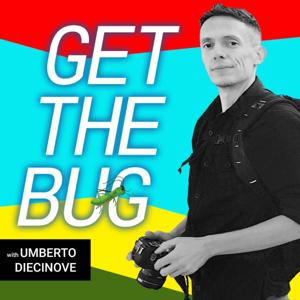
I’m Umberto Diecinove, I am a documentary photographer and a filmmaker. And – for a while now – I’ve been investigating the potential role of insects in the solution of some of the global…
To do this, I’ve been traveling around the world, taking photographs and talking to world experts, visionary entrepreneurs, activists and people working in the field.
Welcome to Get the Bug Podcast, where you can listen to the conversations I recorded during my journey.
Farming insects could reduce the agriculture need for land and overfishing in the oceans, but also lower greenhouse emissions and help smallholder farmers, in developing economies, to depend less on expensive imported feed.
So… what if insects are the next game changers?
Join me for this insightful conversation on the potential of insects to make the world a better place, and the lessons we can learn from nature to build a more sustainable future for generations to come.
Check out www.gtbpodcast.com for more details.
Hosted on Acast. See acast.com/privacy for more information.