
Sign up to save your podcasts
Or



The World Health Organization is at the centre of a growing geopolitical power struggle, and the race for its next Director-General is about far more than who gets the top job. As multilateralism faces mounting pressure, major powers shift allegiances, and global health funding comes under strain, WHO finds itself navigating an increasingly contested international landscape. With the United States and Argentina withdrawing, new players challenging its influence, and seven candidates competing for leadership, the question is no longer just who will lead the organization, but who gets to shape the future of global health.
Joining us is Priti Padnaik, investigative journalist and founder of the Geneva Health Files, for an inside look at the politics of global health governance and what this leadership race reveals about who really holds the power in the institutions shaping our world.
We unpack the politics, power plays and shifting alliances behind the race for WHO's next Director-General. From the growing influence of Gulf states and China's ambitions to Europe's fight to retain its traditional leadership and Indonesia's claim to represent the Global South, this contest offers a revealing glimpse into the changing dynamics of the global order. We explore the challenges awaiting the next leader, from unfinished pandemic agreements and disease outbreaks to contentious debates over the organization's mandate and relevance.
Global Order is a project of the Georgetown University Center for Global Health Policy & Politics, hosted by Dr. Matthew Kavanagh. Global Order is produced by The Dr Tlaleng Mofokeng Network. Our producers are Pheello Mofokeng and Herriet Hita. Content was researched and produced by Dr. Sanjana Mukherjee, Gabriella Lipari and Josuna Kinsey. Kgomotso Mashego does our graphics and Oliver Aplin and Alana McGrath is our communications managers.
You can find out more at https://ghpp.georgetown.edu/globalorder/
For four decades, neoliberal economic thinking has ordered the global economy—shaping how governments, corporations, and communities function. That order is now showing serious signs of cracking. Is neoliberalism dying? Or is ti morphing to become something new? And how does that matter for the wellbeing of people around the world?
Professor Jayati Ghosh, leading Indian economist who taught economics at Jawaharlal Nehru University and is now at the University of Massachusetts Amherst joins us to talk about power, the global economy, and its effects on human health. We explore what the COVID pandemic revealed about the limits of the neoliberal order, power in the global trading system, and limited fiscal space for countries to respond to health crises.
If the global economy is shaped in ways that leave so many countries unable to protect their populations' health, what would it take to redesign it so the next pandemic doesn't reproduce the inequalities of the last?
Global Order is a project of the Georgetown University Center for Global Health Policy & Politics, hosted by Dr. Matthew Kavanagh. Global Order is produced by The Dr Tlaleng Mofokeng Network. Our producers are Pheello Mofokeng and Herriet Hita. Content was researched and produced by Dr. Sanjana Mukherjee, Anmol Mathur, Gabriella Lipari and Rhea Shetty. Kgomotso Mashego does our graphics and Oliver Aplin is our communications manager.
You can find out more at https://ghpp.georgetown.edu/globalorder/
The COVID-19 panemic disrupted economies at a global scale as governments shut down travel, businesses, restaurants, nightlife, schools. Office buildings emptied out and air travel slowed to a trickle.
The UN estimates about 70 million people were pushed into poverty by the pandemic. We will probably never fully know in numbers all those who died, became sicker, poorer, hungrier not from the direct effects of the terrible virus, but from what it took to try to stop it. It does not feel like we are grappling with the long-lasting effects of the pandemic—on our health but also on our society and our politics. And that is dangerous.
Few journalists had a closer view of the COVID-19 pandemic as it unfolded than Jason Gale of Bloomberg. As a biosecurity and global health reporter, Jason followed the COVID-19 pandemic from its earliest days, documenting the decisions, debates, and human stories behind the headlines. His reporting took him from the early outbreaks in Italy to the politicization of treatments, the rise of misinformation and disinformation, and the long-term health consequences of teh virus that continue to unfold. Jason joins us for a conversation about what he saw while reporting from inside the pandemic and his new book After Covid: The Health Impacts That Will Last Generations.
At a moment when the world is trying to prepare for the next pandemic, what can the stories of COVID-19 teach us about the vulnerabilities we still haven’t addressed and what would it take to ensure we don’t repeat the same mistakes?
Global Order is a project of the Georgetown University Center for Global Health Policy & Politics, hosted by Dr. Matthew Kavanagh. Global Order is produced by The Dr Tlaleng Mofokeng Network. Our producers are Pheello Mofokeng and Herriet Hita. Content was researched and produced by Sanjana Mukherjee, Anmol Mathur, and Rhea Shetty. Kgomotso Mashego does our graphics and Oliver Aplin is our communications manager.
You can find out more at https://ghpp.georgetown.edu/globalorder/
Pandemics do not affect everyone equally. Who gets sick, who survives, who provides care, and whose needs are prioritized are shaped by the inequalities that already exist in society. Past and current Ebola outbreaks in Africa have made this painfully clear, with women bearing a disproportionate share of deaths, caregiving responsibilities, and economic and social disruption.
Dr. Tlaleng Mofokeng just concluded her time as UN Special Rapporteur on the Right to Health. She joins us for a conversation about Ebola through an intersectional and human rights lens. We explore how gender, race, poverty, disability, and political and socioeconomic conditions are shaping vulnerability during infectious disease outbreaks and the often-overlooked role of women and community caregivers in pandemic response.
If pandemic vulnerability is shaped by inequality, what would it take to build pandemic responses that protect not only populations, but also the people who are most often left behind?
Global Order is a project of the Georgetown University Center for Global Health Policy & Politics, hosted by Dr. Matthew Kavanagh. Global Order is produced by The Dr Tlaleng Mofokeng Network. Our producers are Pheello Mofokeng and Herriet Hita. Content was researched and produced by Sanjana Mukherjee, Anmol Mathur, and Rhea Shetty. Kgomotso Mashego does our graphics and Oliver Aplin is our communications manager.
You can find out more at https://ghpp.georgetown.edu/globalorder/
We are living in an age of polycrisis, where pandemics, climate change, conflict, and widening inequality are converging to undermine collective well-being and societal resilience. Yet the systems of multilateral cooperation and global governance designed to help us navigate these crises are increasingly struggling to deliver.
COVID-19 exposed just how fragile these systems are. The world developed vaccines in record time, but failed to ensure equitable access. Institutions mobilized, but too slowly. And years later, countries are still negotiating the rules that will govern the next pandemic.
Helen Clark is the former Prime Minister of New Zealand and former Administrator of the United Nations Development Programme. She joins us for a conversation about the state of global governance of pandemics, what COVID-19 revealed about the global governance systems, the future of the global pandemic architecture, the contentious negotiations over the Pandemic Agreement, and how inequality shapes our vulnerability to pandemics.
At a moment of deep geopolitical fragmentation, can multilateralism still deliver when the next crisis arrives?
Global Order is a project of the Georgetown University Center for Global Health Policy & Politics, hosted by Dr. Matthew Kavanagh. Global Order is produced by The Dr Tlaleng Mofokeng Network. Our producers are Pheello Mofokeng and Herriet Hita. Content was researched and produced by Sanjana Mukherjee, Anmol Mathur, and Rhea Shetty. Kgomotso Mashego does our graphics and Oliver Aplin is our communications manager.
You can find out more at https://ghpp.georgetown.edu/globalorder/
The numbers are stark. Nearly a quarter of the world's nations are sliding toward authoritarian rule and autocracies now outnumber democracies. This has serious implications for the health and wellbeing of people across the planet. At the same time for forty years, even as elections spread across the globe, more and more of the decisions that actually shape lives were lifted out of democratic reach.
In this moment of global disruption, it seems these forces matter--they are reshaping the health of people today and the policy options available.
Winnie Byanyima is the Executive Director of UNAIDS, former head of Oxfam International, and a long-time democracy activist. She joints us to reflect on democracy, health, inequality, and power drawing from her experience in Uganda’s pro-democracy struggle to her work leading the global response to HIV/AIDS. We discuss how political systems shape health outcomes, what happens when wealth and political power become concentrated in the hands of a few, and whether the international system itself needs to be democratized.
Global Order is a project of the Georgetown University Center for Global Health Policy & Politics, hosted by Dr. Matthew Kavanagh. Global Order is produced by The Dr Tlaleng Mofokeng Network. Our producers are Pheello Mofokeng and Harriet Hita. Content was researched and produced by Sanjana Mukherjee, Anmol Mathur, and Rhea Shetty. Kgomotso Mashego does our graphics and Oliver Aplin is our communications manager.
You can find out more at https://ghpp.georgetown.edu/globalorder/
The numbers are stark. Nearly a quarter of the world's nations are sliding toward authoritarian rule and autocracies now outnumber democracies. This has serious implications for the health and wellbeing of people across the planet. At the same time for forty years, even as elections spread across the globe, more and more of the decisions that actually shape lives were lifted out of democratic reach.
In this moment of global disruption, it seems these forces matter--they are reshaping the health of people today and the policy options available.
Winnie Byanyima is the Executive Director of UNAIDS, former head of Oxfam International, and a long-time democracy activist. She joints us to reflect on democracy, health, inequality, and power drawing from her experience in Uganda’s pro-democracy struggle to her work leading the global response to HIV/AIDS. We discuss how political systems shape health outcomes, what happens when wealth and political power become concentrated in the hands of a few, and whether the international system itself needs to be democratized.
Global Order is a project of the Georgetown University Center for Global Health Policy & Politics, hosted by Dr. Matthew Kavanagh. Global Order is produced by The Dr Tlaleng Mofokeng Network. Our producers are Pheello Mofokeng and Herriet Hita. Content was researched and produced by Sanjana Mukherjee, Anmol Mathur, and Rhea Shetty. Kgomotso Mashego does our graphics and Oliver Aplin is our communications manager.
You can find out more at https://ghpp.georgetown.edu/globalorder/
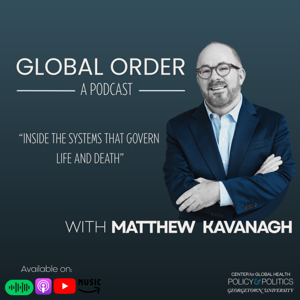
The rules that governed geopolitics for eighty years are unraveling, and what replaces them will decide the health and wellbeing of people around the world. Global Order, from Georgetown University's Center for Global Health Policy & Politics, brings host Professor Matthew Kavanagh together with the people working to shape what comes next, on health, power, and the systems that govern life and death.