
Sign up to save your podcasts
Or

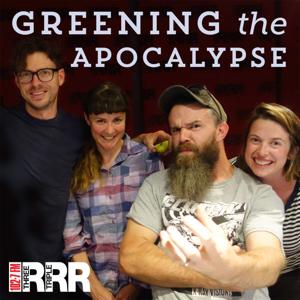


We talk with environmental lawyer Ariane Wilkinson about what's so bad with the proposed Adani Carmichael coal mine. In summary it's really extraordinarily bad on a both economic and environmental levels. This is a clench your fists episode.
Return guest Simplicity Institute founder Dr Samuel Alexander ponders whether the environment can survive the human brain's emotional biases, and what can the environmental movement can do to get a message out in a 'post-truth' era?
And we talk lessons from the dirty ol' bastard of ancient greek philosophers: Diogenese.
Sam's latest books are Just Enough is Plenty: Thoreau's Alternative Economics and Deface the Currency: The Lost Dialogues of Diogenes. He also mentions The Dark Cellars Project in which artists submit images that make the messages of voluntary simplicity a bit more visceral and visual.
Return guest Simplicity Institute founder Dr Samuel Alexander ponders whether the environment can survive the human brain's emotional biases, and what can the environmental movement can do to get a message out in a 'post-truth' era?
And we talk lessons from the dirty ol' bastard of ancient greek philosophers: Diogenese.
Sam's latest books are Just Enough is Plenty: Thoreau's Alternative Economics and Deface the Currency: The Lost Dialogues of Diogenes. He also mentions The Dark Cellars Project in which artists submit images that make the messages of voluntary simplicity a bit more visceral and visual.
Why are Melbourne apartment complexes so expensive and soulless? What can we learn from Germany and the Netherlands, and from the few interesting projects around Melbourne to have cheaper, more liveable and less environmentally destructive buildings? Our wonderful guests exploring this topic are Katherine Sundermann, an Associate at MGS Architects and Assemble Papers, and Andy Fergus, an Urban Designer at the City of Melbourne. They mention 'deliberative development' models in which a group of intending owner-occupiers work with funders and architects to build it their way, rather than going through a property developer.
Here's a recent article from Katherine and Andy: Learning from Berlin: lessons for emerging collective housing.
We talk about the future, and different scenarios for how we might just survive it in some style, with Philippa Chandler from the Victorian Ecoinnovation Lab (VEIL) and their project Scenarios 2040 project.
Later, Kate talks about My Year Without Matches by Claire Dunn.
We speak with Adrian Hearn, Associate Professor of Anthropology at Melbourne University. He has been going to Cuba every year of the last 16 and has recently received funding from the Australian Government (DFAT - COALAR) for a project looking at urban agricultural practices between Melbourne, Havana, and other cities in Latin America and China. He says Latin America has some of the best practices in the world in resilient and sustainable urban farming, and in Cuba during the stressful period following the fall of the Soviet Union, urban agriculture was necessary for survival.
Later in the show we talk with favour makers Ru Norbury and Conor O'Hanlon from Favours who offer *free* services to anyone who just needs a little help!
We're joined by 10 year Triple R veterans (from whom we inherited the Tuesday 7pm time-slot), the architects formerly known as "The Architects": Simon Knott and Stuart Harrison; along with someone who's had an immeasurable effect on the shape and culture of Melbourne: architect and planner Rob Adams. Cohost Kate Dundas leads a discussion on urban planning, sustainability and liveability, corruption and retrofitting the suburbs.
Nikki Valentini of Growing Abundance tells us about the culture clash at the heart of the transition from dim sims and Pepsi to organic local food in a Castlemaine high school. Later in the show we consider the unintended consequences of green planning and gentrification. We also mention Annie Raser-Rowland and Greening the Apocalypse's Adam Grubb's new book: The Art of Frugal Hedonism.
We talk about everything from bike policy to autonomous cars and robotaxis, as we consider the future of transport, with Elliot Fishman, Director of the Institute of Sensible Transport.
Later in the show, we pay homage to that iconoclast, raconteur and the godfather of permaculture, Bill Mollison who passed away on Sat 24th Sept at the age of 88.
Meg Ulman is co-author with her partner poet Patrick Jones of The Art of Free Travel, about their adventures with kids and a terrier riding bikes up and down the east coast for 14 months. All together they make up the entity known as The Artist As Family. We spoke with them about that trip in a previous episode, but this time we find out about their continuing adventures while living a more settled lifestyle, including homeschooling son Zephyr, and the Hepburn Relocalisation Network. In the latter part of the show we talk about how someone working a 9-5 job might take on some of the simpler life!
Humans have been making use of fire for around a million years, but what if we've been doing it wrong? In the first half of the episode we talk how to do it right, with rocket stoves and biochar, with appropriate technologist Joel Meadows.
Where there is smoke there is fire, but the reverse need not be true says Joel. Smoke is merely inefficiently burnt wood, and all those coughs, cancers and deforestation through the eons were sadly for nought. Rocket stoves are almost smokeless and can be built from scrap.
In the second half of the show we talk with climate scientist Professor David Karoly. He and fellow Climate Change Authority member Professor Clive Hamilton recently released an unprecedented Minority Report arguing that the Authority's latest majority report is politicised and its recommendations lead towards dangerous warming rather than minimising climate change.
From the publisher's feed

1 Listeners
0 Listeners

0 Listeners

1 Listeners
0 Listeners

0 Listeners
0 Listeners

0 Listeners
0 Listeners