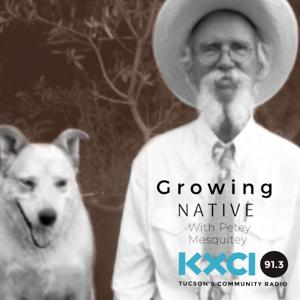
Growing Native with Petey Mesquitey

Growing Native with Petey Mesquitey

By Petey MesquiteySociety & CultureEducation
Download on the App Store

Growing Native with Petey Mesquitey episodes

  • Petey's Sleep Patterns
    Even as a child I was astounded by the silence of snow. I wonder if there is a name for silent snow? Around our little homestead it’s called, “the snow that helps Petey sleep.”
    The plant that helped me sleep one recent winter night is Arizona rosewood. I first saw Arizona rosewoods growing among the oaks around Molino Basin in the Catalina Mountains near Tucson. That was around 1968 or ’69. Yikes!!!
    Later in the 1980s when I was working at a wholesale nursery in Tucson we grew and offered rosewoods as an oleander substitute. It still is and here’s the good news; there are are several species of rosewoods available in the horticulture trade. Hmm, I should say, species, subspecies and in the case of pauciflora, variety. Around us in the borderlands of southeastern Arizona we have 2 named rosewoods; Arizona rosewood and let’s call the variety pauciflora Guadalupe Mountain rosewood. Go west to Texas or south into Mexico and you can start adding other rosewoods. Is that cool? Very.
    There are some nice rosewood descriptions, photographs and landscape uses in a couple of favorite books found on my book shelf; Cool Plants for Hot Gardens (revised) by Greg Starr and Native Plants for Southwestern Landscapes by Judy Mielke. Judy’s book is still as useful as when it came out 30 years ago and I suspect Greg’s book will be the same in 30 years, but no need to wait.
    The photos are mine and taken this winter at our little homestead.
    5 min
  • A Chicken Love Song
    I revealed most of my personal chicken history in this episode. It’s an ongoing saga, though I am much more in control of my crazy love for chickens. I finally recycled all my old hatchery catalogs. Okay that’s not quite true, as I kept one Murray McMurray catalog…just for reference…really. I did love to look at the pictures of the different breeds in those catalogs. Almost always paintings, by the way, and no, I didn’t read them at night under the covers with a flashlight, but oh my gosh, Australorps, Delawares, Wyandottes, Polish, Cornish and Buff Orpingtons! You know what I’m talking about!
    If you like chickens too and would like to add a book about the history of chickens to the shelf where you keep your “raising chickens the right way” books and all of your hatchery catalogs, I recommend Why Did the Chicken Cross the World by Andrew Lawler.
    The photos are mine.
    5 min
  • Winter Calligraphy
    After I produced this episode we were driving in the desert outside Bisbee, AZ marveling the silhouettes of viscid acacia and I realized I had written and jabbered about the winter silhouettes of deciduous trees and shrubs several times in the past… like every winter for 30 years. Oh well, the outlines of naked branches against our huge borderlands sky are glorious.
    The photos are mine and taken of desert willows very near our home.
    Oh, my pronunciation of the genus Chilopsis got me thinking; botanical Latin is not the language of the Roman Empire, the Latin that I endured for 2 years in middle school. The Latin that’s used to name organisms has been used in science since the middle ages…I know, science was studied in the middle ages?… Latin was the common language shared, the linqua franca and the organisms’ names were long rambling descriptions in Latin. Then a few hundred years later along comes Carl Linnaeus and the binomial system…2 names, a genus and a species for each organism. Thank you, Carl!
    A couple more things; folks tend to pronounce Latinized names in their own language or vernacular. I swear I can tell if someone attended catholic church by the way they pronounce Latinized scientific names…they sound like they’re singing in Italian. And one last thing; there are a bunch of books about all of this. If you’re crazy serious then there is William Stearn’s Botanical Latin. Learn about reformed academic or traditional English pronunciations among other things and good luck to you! But for considerably more fun I recommend The Naming of the Shrew by John Wright. It’s really a fun read.
    Now, aren’t you glad I mispronounced Chilopsis?

    5 min
  • The Spotted Towhee
    I remembered that one spring when we were up in Santa Fe visiting family and out on a hike it seemed there was a spotted towhee noisily foraging in every shrub. Noisily! Sometimes you will hear them rustling around before you see them and like all towhees they are busy rascals!
    The genus name Pipilo for towhees was created by Louis Jean Pierre Vieillot in 1816 when he described the eastern species. I’ve found his name associated with a bunch of bird species. He was an early birder…ha, ha.
    The 2 legged back hop scratch is little more difficult than some of my other dance moves like the twist or the jitterbug, but I’m getting it. I think I will shorten the name to “the towhee.” I’m already visioning folks circling me and shouting “Do the towheee, Petey. Do the towhee!”
    Oh, and the photo is by Laura Hughes. Thank you to her!
    5 min
  • Amen Anemone
    Desert anemone (Anemone tuberosa) is in the Buttercup Family. Buttercups are the genus Ranuculus and the family name is Ranunculaceae. It’s probably just me, but that is a marvelous name to write and pronounce. Kearney and Peebles’ Arizona Flora lists three species of Anemone , but the taxonomy has changed (a lot!) and there are now two species listed for Arizona. Desert anemone is one of the first wildflowers to bloom in the spring and to see it you’ll need to head to a rocky slope or  canyon sometime in February and that’s where you’ll find it hiding among the rocks. It has a short bloom period, so don’t tarry! Oh, and on our hike in the hills above Fort Bowie National Monument we also saw pointleaf manzanita blooming, ’cause it’s an early bloomer too. Whoa, now you have two good reason to head for the hills!
    The featured photo is from the SEINet site and taken by Max Licher. Thank you, Max. The photo with the hand is mine…I tend to stick my hand in flower photos for some scale. By the way, look at those rocks. Limestone!
    5 min
  • Wandering Thrushes
    American robins, Turdus migratorius, are common summer residents in the pine forests of southeastern Arizona. In the winter they move lower to the mixed pine and oak woodland or sometimes much lower, ending up in nearby cities and towns foraging for fruit. Pyracantha plants are a common landscape plant throughout the region and they set an abundance of bright red fruit. Just like fruit on native plants in the wild the pyracantha fruit ferments and yes, birds can get quite inebriated. Party time! Come spring the wandering thrushes remove the lampshades from their heads and return to the pine forests and the sober life. Sorry, but time to build a nest and raise a family.
    It was in Pliny the Elder’s encyclopedia Naturalis Historia that the name Turdus was given to the thrush. Several centuries later taxonomist Carl Linnaeus applied it to the genus. I sort of regret not having more fun with the robin’s scientific name, but perhaps one does get wiser with age.
    The silhouettes are inside the cover of my old Peterson Guide. Check out number 15…oh yeah.
    5 min
  • Creamcup Spring
    When we first moved out to Cochise County we were so lucky to have a few springs with abundant Mexican poppy (Eschscholzia mexicana) displays. Distant hills and nearby fields glowed golden with a kazillion blooming poppies. Over the years, dry winters made those floriferous springs less common, but in 2020 there was an incredible wildflower display all around us. I remember standing out in some rolling hills at the base of the Pinaleño Mountains and shouting out plant names…well, at least the ones I could remember… it was that day we saw creamcups (or cream cups, your choice) in the wildflower mix. We even came across some pure stands of Platystemon californicus. Yay!
    Oh for goodness sake, I forgot to mention that creamcups’ flowers are white, but the photos show that!  Now you know.
    Anyway, here’s hoping we get a floriferous spring thanks to winter rain and snow.
    The photos are mine.
    5 min
  • Wild Contentment
    I could be over thinking the feeling I got when I saw that lone coati from the now named coati mundi bluff, but it was wonderful. The other flora and fauna mentioned in this episode make me feel awfully good. I’ll leave it at that and hope you have plants or critters that make you very happy as well and that 2023 is a year full of wild contentment.
    Hmm, I’m missing a kangaroo rat photo, but all the photos are mine. Box turtles visit our back yard all summer and that’s Ms. Mesquitey admiring a Toumey oak.
    5 min
  • Breaking the Habit
    The botanical name of our 3 needle per fascicle (bundle) Chihuahuan pine is Pinus leiophylla var. chihuahuana. Further south into Mexico where the 5 needle version occurs it becomes Pinus leiophylla var. leiophylla. Some botanists, by the way, list the variety as a subspecies. Well, either way it’s really a neat native pine here in the borderlands.
    The photos are mine and taken in the Chiricahua Mountains where we were wandering around looking for a Christmas tree. Below is a photo of large sprout coming off a pine trunk. It was an area that burned during the 2011 Horseshoe Two Fire and some of the surviving fire damaged trees put out large crown-like sprouts. That’s fascinating and unusual for a pine species. And now you know.
    5 min

About Growing Native with Petey Mesquitey

From the publisher's feed

Petey Mesquitey is KXCI’s resident storyteller. Every week since the spring of 1992 Petey has delighted KXCI listeners with slide shows and poems, stories and songs about flora, fauna, and family and…

More shows like Growing Native with Petey Mesquitey

On the Media by WNYC Studios

On the Media

9,191 Listeners

The Daily by The New York Times

The Daily

111,852 Listeners

Up First from NPR by NPR

Up First from NPR

56,426 Listeners