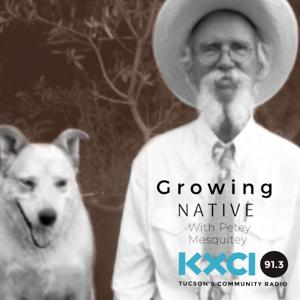
Growing Native with Petey Mesquitey

Growing Native with Petey Mesquitey

By Petey MesquiteySociety & CultureEducation
Download on the App Store

Growing Native with Petey Mesquitey episodes

  • Coral Bells in the Hills
    Heuchera is found in the saxifrage family, Saxifracaceae, with 80 other genera that includes the genus Saxifraga and its 400 species. Yikes!
    My old (1976) Hortus Third says that there are about 35-50 Heuchera species found in North America and they are largely western. Well, there are 8 species found in Arizona and Heuchera sanguinea is found in Arizona, New Mexico and southward…of course.
    And a reminder that if you are interested in medicinal plants, then this is a good genus to look up in an herbal or two or three.
    The photos are mine. The flowers are beautiful, but check out the basal leaves as well. Pretty cool.
    6 min
  • Far Out Seed Capsules
    The glossary in the back of a flora is full of wonderful words that you may never had heard or seen before, especially if you’re not a botanist. I tend to wander up and down a page perusing other words and descriptions after I’ve found the explanation I was looking for. Sad, but true. Oh, and I can now say loculicidal rapidly 3 times in a row!
     
    The photos are mine. I love the seed capsules with the oak stump behind. You can see the leaves aren’t really triangles, but hastate. Uh-oh, open up the glossary.


    The photo taken on the flora page illustrates how the top of the seed capsule weakens and opens displaying the small black seed.
    6 min
  • Gregg's Mistflower
    I originally learned the botanical name of this native plant as Eupatorium greggii, but it is now Conoclinum dissectum. It’s neat that the tribute to Josiah Gregg, an adventurer, explorer, naturalist and plant collector of the early 1800s, is still part of the common name Gregg’s mistflower.
    The photos were taken at a marvelous rocky plain near the Dragoon Mountains. It’s an area where I find all sorts of interesting plants and this large stand of Gregg’s mistflower was fabulous. I believe that’s a Painted Lady butterfly visiting the flowers. That’s only one of several species of butterflies seen on the flowers. Oh, and that bouquet on our table lasted several days!
    6 min
  • The Mother of All Chiles
    The photos are mine of a chiltepin at our our home. It’s one of several we have in pots. They are great in the ground too, but I love the way they look in a pot. Look at all that fruit. Hotcha!
    5 min
  • Autumnal Asteraceae Festival
    I concentrated on a few fall bloomers in the Aster family that have yellow flowers and I bet you thought of other species that should have been included. It will be one huge Autumnal Asteraceae Festival!
    I have a tinge of guilt leaving out plants like the Baccharis species I mentioned, but I will give them a celebration later this fall…at least Baccharis sarothroides (desert broom), right?
    I believe that the genus name Aldama honors Juan Aldama who fought in the Mexican War of Independence and is a national hero. I learned that many towns and places are named in his honor, so maybe the plant name is in his honor or a place named in his honor. Either way, that’s pretty cool.
    The photos are mine of Aldama cordifolia, the former Viguiera cordifolia, but still heartleaf goldeneye.

    5 min
  • Stinging Serpent
    I like the phrase in Arizona Flora about the Loasa family Loasaceae ; it is “remarkable for the diversity and peculiar structure of the hairs.” And I love the name Cevallia. Well, the whole name just has a great sound and feel to it; Cevallia sinuata. You say the name and folks will think you really know what you’re talking about.
    Oh, I meant to mention that I found the etymology of the name on the SEINet web site, so now you know.
    The photos are mine. The butterfly atop the flowers is a Southern Dogface. You can see the eye but not the “dogface” that gives it the name, because the wings aren’t open. When photographing butterflies I often catch myself muttering, “open your damn wings.” Patience, Petey.
    6 min
  • Flora and Fauna Report
    Here are some morning glory photos. Above is Ipomoea ternifolia var. leptotoma and the photo below is of some floral chaos featuring the red flowering Ipomoea cristulata among others in the midst. You can see an Apache plume flower making an appearance in there too. Oh my!
    For photos and more information about the white lined spinx moth caterpillar and adult check out the very cool site BugGuide.Net.
    6 min
  • Solidago missouriensis
    I grew up in Kentucky where the state flower is goldenrod. The particular species that has that honor is Solidago gigantea. I wonder how it was chosen as there are 30 species of goldenrod found in the state. In the vacant lots of my childhood neighborhood tall goldenrods towered over me in glorious bright yellow bloom every fall and I remember that sneezing and watery eyed Kentuckians would blame goldenrod for their terrible allergies. Even nowadays when I mention that I grow goldenrod, folks will respond with stories of their terrible goldenrod allergies. I try to explain that Solidago pollen is not wind born, and only spread by pollinators and that their allergies are from other fall bloomers that have wind born pollen. In Kentucky as elsewhere, that would be species of Ambrosia or ragweed. My defense of goldenrod falls on deaf ears and I don’t sell many goldenrod, but I sure do plant them around our place, especially Solidago missouriensis.
    There are eleven species of goldenrod found in Arizona and you can find a species almost anywhere in the state from 2,000’ to 9,500’ in elevation. So no matter where you live in the state you can blame your fall allergies on a Solidago species. Ha!
    The photos are by Max Licher at SEINet and me here at home. His is the better photo of the flowers, but you can see in my photo that Solidago missouriensis spreads from the roots and becomes quite a clump …a golden flowering clump.
    6 min
  • Childhood Wildhood
    This episode is a reminiscence sparked by some old photos. I’m pretty sure my father took the photos, because I can’t remember him ever being without a camera. So, thanks dad, I love these. I only wish you were around so I could tell you.
    And of course thanks to Cricky for the friendship so many years ago and to Ms. Mesquitey for the friendship now and onward.
    5 min

About Growing Native with Petey Mesquitey

From the publisher's feed

Petey Mesquitey is KXCI’s resident storyteller. Every week since the spring of 1992 Petey has delighted KXCI listeners with slide shows and poems, stories and songs about flora, fauna, and family and…

More shows like Growing Native with Petey Mesquitey

On the Media by WNYC Studios

On the Media

9,191 Listeners

The Daily by The New York Times

The Daily

111,852 Listeners

Up First from NPR by NPR

Up First from NPR

56,426 Listeners