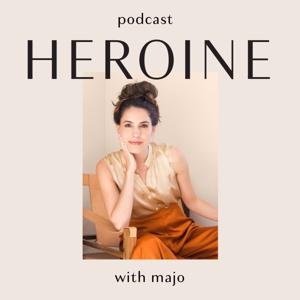
Heroine

Heroine

By HeroineArtsDesign
Download on the App Store

Heroine episodes

  • Carving Your Own Path — Ann Shen
    Discover your creative, feminine power with my free online quiz at http://majo.co

    Have you ever had the urge to follow the opposite of what you learned in school? That’s a theme for my guest Ann Shen – an illustrator and author of Bad Girls Throughout History and Legendary Ladies, books that depict women as they are: complex, funny, dark and everywhere in between. In fact, her book Bad Girls Throughout History resonated so much that it has even been picked up by Universal Cable Productions to become a show.

    A daughter of Taiwanese immigrants, Ann calls herself a reformed goody two shoes who creates art that empowers women to be their authentic badass selves. She combines incredible artistic talent with a high degree of business sense and shows us that choosing your own path does not have to mean depending on your parents, spouse, or whoever to survive. While her professors in art school pushed the students to all create very masculine, serious art, she went in the opposite direction – her own style that markets to women in a really fun, whimsical way, and of course in the time of Instagram, this style blew up. You can find her empowering, delightfully illustrated, books on Amazon and in stores like Target so definitely check them out after you hear her story.

    Also as a heads up, Ann and I met and recorded at the lovely all-female co-working space The Wing in Los Angeles so the audio is a little busy and echo-ey at times and I apologize in advance, but I have a feeling that you’ll be so engaged in our conversation, you will barely notice! Plus, y’all know me: progress over perfection.

    Highlighted Excerpt
    Ann: The art school I chose to go to was very militant and demanding.

    Majo: Okay so what were people telling you was the right kind of work and what did you discover?

    Ann: So in school, it was very trendy at the time to think about editorial illustration as the career, like the ultimate career. And you do like New York editorial illustration stuff that’s like in the New York Times, The New Yorker, like just very serious, beautiful. A lot of it is conceptual or just technically very, it just looks a certain way. And most of it was a very male-dominated view.

    Majo: Okay, and what did you discover was like what you really wanted to do and move into?

    Ann: That’s my favorite question because it wasn’t something that was really presented to me as an option and then I discovered this later was I just wanted to do stuff for women. Stuff that I was interested in, stuff that was floral or decorative or representative. Like just having something that’s like “oh, this is just a beautiful painting”. It either had to be a beautiful fine art oil painting or it had to have like a really brilliant concept behind it for it to be considered “good” in school. And then I left and I was like “Oh, it’s good enough for it just to be a beautiful thing that brings people joy”.

    Discover your creative, feminine power with my free online quiz at http://majo.co
    41 min
  • Fall Season [teaser]
    I’m so excited to be back and running for this Fall season. We have a lot of exciting interviews for you with incredibly creative, badass women including an extremely gifted illustrator Ann Shen who wrote Bad Girls Throughout History, as well as a renowned astro loger and businesswoman Debra Silverman here to ground astrology for us, and make it super practical and applicable to our lives as creative women. AND we’ll be continuing with the archetype series, looking at two archetypes that exist with yourself, including my favorite the Wtich. Also, doing something I have never done in three years of running the show. My editor Anne is going to interview ME for an episode. A lot of you have been asking me about my story, and who I am, and what I’ve been up to, and it’s true I haven’t really shared, I’m an introvert, I’m private, I’m a mysterious Scorpio you’ll always feel is a little inaccessible, so we thought it would be a fun experiment, plus she’s journalist and knows how to ask questions. So stay tuned for that!

    The new season will kick off next Thursday on September 26th and run until mid-November and I’ll also be sprinkling some bonus episodes throughout.

    Until then!
    Majo

    Oh wait! Heroine, before you go, I have a really important question for you: Do you want to look back on your life in 40 years from now and feel like you didn’t live up to your greatest, creative potential? I’m pretty sure the answer is no. Yet perhaps you know in your heart of hearts that you are currently holding back your voice and gifts, that you aren’t as expanded as you could be, and frankly you’re feeling overwhelmed, exhausted, and confused. You’re certainly not alone. Well, I want to help, and the first step I propose is you taking a free quiz that is on my website right now, that I’m really excited about cause I haven’t offered anything like this in the past, but what it’s going to do is help you identify your unique, feminine, creative power and give you one practical action step to channel this power in a way that elevates your leadership. It’s a quiz that’s going to give you something really tangible and a ton of clarity, I know that a bunch of lightbulbs and connections will set off for you when you take it so go ahead and take the free quiz at majo.co (MAJO.CO), discover your creative, feminine power, and how to best leverage it, because the world needs more women’s voices, perspectives, and above all, creativity, so after this is announcement is done, type this into your mobile or desktop browser MAJO. CO and I’m so curious and excited for you! Onwards.
    5 min
  • Boundaries with Tech & Social Media (Bonus)
    This is our summer bonus episode!

    Last month I moderated a panel at The Assembly in San Francisco. I interviewed two guests: Adereni Fashokun - a Life Coach, Co-Founder and Sr. HR Business Partner at Amazon AND Lauren Harper - the Director of Marketing at Palm.

    The topic? Technology and mental wellness.

    Does that sound like a contradiction to you, heroine? Sometimes it does to me, too.

    Technology is increasingly a part of our lives. It can feel impossible to get away from it.

    A friend of mine once had her phone break down for an entire weekend. At first she was furious, and then fearful. But she and her husband had plans that weekend, and as she immersed herself in what they were doing, she forgot about her phone. She was able to lose herself in activities. To let go. It was a kind of mental recharge she didn’t know she needed. Once her phone was fixed, she reflected that she had felt better that weekend than she had in a long time.

    So how do we set limits with technology, so we too can experience this kind of mental recharge…. and still stay connected to the world?

    The guests on today’s show offer ideas you may have never thought about. I’ll share just one: turn off all of the alerts on your phone. All of them. No beep for a text. No on screen notification that you just got an email. My editor Anne is doing this now, and she says it’s made a huge difference in her ability to focus on what’s happening in the moment.

    Stay tuned as the Fall season will pick up in September. In the meantime, you can always connect with me on my website majo. Co (MAJO.CO) or on Instagram majo.heroine!
    48 min
  • Feeding Your Own Longing — Lynsey Addario
    Earlier in this season we talked about fairy tales. Queens, specifically…. and waifs. The waif is a passive figure, like the stereotypical vision of Rapunzel. She sits, in a tower, waiting for someone to come and rescue her.

    (Quick note: This episode is from the archive and available when you subscribe to the podcast on ApplePodcasts.com/Heroine or wherever you get your podcasts. You can also stream it live from any browser on spreaker.com/heroine).

    As the writer and cultural critic Gloria Anzaldúa once said, “Nobody’s going to save you. No one’s going to cut you down, cut the thorns thick around you. No one’s going to storm the castle walls nor kiss awake your birth, climb down your hair, nor mount you onto the white steed. There is no one who will feed the yearning. Face it. You will have to do, do it yourself.”

    Some women seem to understand this inherently, and live their lives accordingly. Some of us struggle a bit more to accept this.

    American Photojournalist and New York Times Best Selling Author Lynsey Addario falls into that first camp. She’s a war photographer who works in conflict zones all over the world.

    Throughout her entire career, Lynsey has been willing to risk her life, her safety, and her creature comforts to pursue what makes her feel alive.

    She’s photographed women under the Taliban, documented misogyny in the Congo and been kidnapped in Libya. And she has also found love and become a mother.

    Lynsey’s story reminds me to choose to do what is meaningful …. To feed the yearning, as Gloria Anzaldúa says.

    Also, heroine, today’s episode wraps up the Spring season, though keep your ear open for a bonus episode or two dropping this summer. And don’t worry, we’ll pick back up in the Fall. Also, this episode happens to be the 100th episode of the podcast. Can you believe it? I write about my top ten learnings since I started the show three years ago on my blog and Instagram – tips that will help you, in starting to share your voice and becoming more visible. So make sure to check that out on my blog (majo.co – MAJO.co) AND on my instagram @majo.heroine. Remember that Majo is spelled with a “j” that Spanish “j’ as in José!

    A BIG THANK YOU & SHOUT OUT TO OUR BADASS PATRONS ESPECIALLY: 

    Bianca Wendt, an award-winning art director and graphic designer based in San Francisco and London. Learn more about Bianca and her work here.

    Pssst....don't forget to follow me on Instagram @majo.heroine for more goodies, inspiration, and updates when episodes drop – yay!

    Want to support women's voices? Go to patreon.com/heroinefm & become a bigger part of the Heroine community. Check out our rewards for supporters.

    MUSIC:

    Carolyn Pennypacker Riggs
    36 min
  • Eileen Fisher on Embodied Leadership
    Eileen Fisher is more than a strong, female leader. Eileen Fisher is an icon. Her clothes - and her signature style - soft, elegant, warm - are an entire way of life. But unlike many famous leaders, and especially many famous FASHION leaders, Eileen is not driven by ego. She is humble. Midwestern. The Devil Wears Prada...she is decidedly, NOT. Throughout our interview, I wondered, how can such a strong leader speak with such a down to earth realness?

    Perhaps it’s because Eileen is an example of how to succeed well. As her brand continues to grow, she continues to reinvent. Instead of defining her business by how much money it makes, her company’s new parameter of success…. is sustainability. Her new mantra is do the most good instead of make the most money.

    In a world where our political leaders deny climate change...and other painful truths such as a woman’s right to make decisions about her own body...all to hold on to power...I think we can all take something from Eileen’s example.

    Live your values, show up, try. And remember that integrity is the only real currency we have in this world.

    Alright, on to the show.

    A BIG THANK YOU & SHOUT OUT TO OUR BADASS PATRONS ESPECIALLY: 

    Bianca Wendt, an award-winning art director and graphic designer based in San Francisco and London. Learn more about Bianca and her work here.

    Pssst....don't forget to follow me on Instagram @majo.heroine for more goodies, inspiration, and updates when episodes drop – yay!

    Want to support women's voices? Go to patreon.com/heroinefm & become a bigger part of the Heroine community. Check out our rewards for supporters.

    MUSIC:

    Carolyn Pennypacker Riggs
    34 min
  • Disrupting the Fairy Tale — Justine Musk
    What happens when you marry someone who becomes rich and famous? Perhaps you find yourself becoming a bit blonder, a bit more stylish, and less, well, you - to fit into his life. I think we’ve all done this to a certain extent. Changed ourselves to fit the needs of someone we wanted to fit with.

    (Quick note: This episode is from the archive and available when you subscribe to the podcast on ApplePodcasts.com/Heroine or wherever you get your podcasts. You can also stream it live from any browser on spreaker.com/heroine).

    But let’s say this all happens in the public eye. You and this man start a family. And after all this stretching and shifting, tragedy strikes. Nothing can insulate us from that.

    And then, he breaks up with you. And quickly takes up with someone new.

    That’s what happened to Justine Musk. She’s a writer, speaker and soul-blogger. She is also the ex-wife of tech billionaire and provocateur Elon Musk.

    When I interviewed Justine, I was reminded of why I do this podcast. Justine experienced something in the Heroine’s journey called the descent. In crude terms, Justine was kind of a starter wife. She herself has said this in an article she wrote for Marie Claire. But as we’ve seen with our examination of archetypes in fairy tales at the beginning of the season, this one is woefully inadequate. It’s an oversimplification as they do little to reveal the soul of the person.

    And the origins of Justine’s story don’t define her. It’s what she chose to do with her story...that does.

    And it’s the descent - the darkness in her life that revealed the light of who she is. Which I think...is the truth for all great heroines. As the Sufi mystic Rumi once said, be patient where you sit in the dark, the dawn is coming.

    References:
    Check out Justine's blog at http://justinemusk.com/

    A BIG THANK YOU & SHOUT OUT TO OUR BADASS PATRONS ESPECIALLY: 

    Brigid Cabry Nelson leads Lettershop, an award-winning creative studio that serves a wide range of clients—from boutique retailers to large corporations—approaching each and every project with vigor and enthusiasm. Learn more about Brigid and her work here.

    Bianca Wendt, an award-winning art director and graphic designer based in San Francisco and London. Learn more about Bianca and her work here.

    Pssst....don't forget to follow me on Instagram @majo.heroine for more goodies, inspiration, and updates when episodes drop – yay!

    Want to support women's voices? Go to patreon.com/heroinefm & become a bigger part of the Heroine community. Check out our rewards for supporters.

    MUSIC:

    Carolyn Pennypacker Riggs
    32 min
  • How To Create Your Own Myth — Roz Savage
    I can’t believe it’s been about three years since I first aired this episode with Roz Savage, the first woman to row solo across three oceans. Honestly, I remember feeling so nervous, not so much during the conversation, but more so in sharing the interview, as it was the first show that launched the podcast. Today, my editor, Anne, recut this so it’s lively, fresh and even more revelatory.

    (Quick note: This episode is from the archive and available when you subscribe to the podcast on ApplePodcasts.com/Heroine or wherever you get your podcasts. You can also stream it live from any browser on spreaker.com/heroine).

    Give yourself a second to really think about the fact that Roz rows across oceans alone. She sits in a small boat, day after day, with little besides the cold waves for company and the sea mist hitting her face. This is a woman who is comfortable with solitude….and freedom.

    But when Roz started rowing, she was, in her words, “just a management consultant” from the UK.

    So...how did she get to that wide, open ocean? What drives someone to leave everything they’ve known for so long to achieve a distant goal? In a way, that’s really the central question of this podcast. How do we stop being good girls and start being the heroines we’re meant to be? How do we write our own stories, create our own myths? How do we activate our own potential - even when it goes against all of our social conditioning?

    Roz ended up leaving her ordinary life because she sat down one day and wrote herself two obituaries. It sounds morbid, but for Roz it was clarifying. In one version, she had lived life as a business woman, in control and with fancy clothes. In the other, well, I won’t give too much away. Let’s just say, in the other obituary, her clothes didn’t matter.

    References:
    Roz Savage’s book, "Rowing the Atlantic: Lessons Learned on the Open Ocean."
    Roz Savage’s website, http://www.rozsavage.com/

    A BIG THANK YOU & SHOUT OUT TO OUR BADASS PATRONS ESPECIALLY: 

    Brigid Cabry Nelson leads Lettershop, an award-winning creative studio that serves a wide range of clients—from boutique retailers to large corporations—approaching each and every project with vigor and enthusiasm. Learn more about Brigid and her work here.

    Bianca Wendt, an award-winning art director and graphic designer based in San Francisco and London. Learn more about Bianca and her work here.

    Pssst....don't forget to follow me on Instagram @majo.heroine for more goodies, inspiration, and updates when episodes drop – yay!

    Want to support women's voices? Go to patreon.com/heroinefm & become a bigger part of the Heroine community. Check out our rewards for supporters.

    MUSIC:

    Carolyn Pennypacker Riggs
    40 min
  • On Rapunzel, Feeling Trapped, & Healing (Part 2)
    Today, we’re going to sink deeper into the waif archetype to understand the true essence of the powerful fairytale and heroine Rapunzel.

    This episode is available when you subscribe to the podcast on ApplePodcasts.com/Heroine (or wherever you get your podcasts). You can also stream it live from any browser here.

    Let’s bring back Kate Forsyth – an incredible novelist and fairy tale connoisseur – from the last episode. Kate argues the motifs we believe are passive in the tale, or that look passive at first glance, really aren’t. Here’s our convo.

    Majo: Yeah, I mean on the one hand her hair is kind of passive because it's dropping off the side of the building and it's being climbed on or it's being used but on the other hand –

    Kate: See I don't think that is a symbol of passivity, her own hair is the only form of ingress to her, it's the only way that people can reach her in her isolated state and in the end try and think of it more her hair is actually a symbol of her own strength that is being used against her. And once she's freed from that that is when she comes into her true power. It's not necessarily a symbol of passivity, in fact Rapunzel is not a passive figure, she sings with all of her strength and that draws the prince to her, she allows herself, she takes control of her life even though she is trapped against her will in this confined space. It's a misunderstanding of the fairy tale to use her as an example of female passivity.

    Majo: Yeah, that's really helpful, I love what you wrote, "Rapunzel's no passive maiden awaiting rescue. She was an active agent in events, an empowering figure. Though later versions increasingly drain the tale of it's subversive power."

    Kate: I mean that is exactly right, so the earliest versions are when she's at her most active.

    So what happened? Turns out the Grimm brothers, who were telling these tales in a very religious society, received a ton of backlash for the Rapunzel story. The story of lovers having sex in a tower was too racy (especially for children), so they stripped away the eroticism, darkness, and violence out of the original story. As Kate shares,

    The Grimm's were trying to make their stories more suitable for children but Rapunzel was never meant for children, it was always meant for young women on the verge of their own sexual lives.

    Because the truth is Rapunzel was proactive, clever, and resourceful. She was not waiting around. In one older version of the tale by Italian folk collector Giambattista Basile, Rapunzel is even more fierce, as she finds three acorns from the witch she then uses against her. Each acorn becomes an animal ally of sorts – first a dog, then a lion, and finally a wolf that devours and kills the witch. I was super into this version, and was going to go with it and be like, “See Rapunzel’s a warrior!” until I met Kate, who brought way more refinement to the conversation.

    Kate was attracted to the version written by 18th Century French, female writer Charlotte Rose De La Force. Because in that version, it is Rapunzel who heals the prince with her tears. The more I reflect on both versions, I do love what De La Force did to the tale...Rapunzel’s tears are not a sign of weakness, but of power. This got me thinking about something a friend once told me, “healing doesn’t happen through force, or action, it happens through relaxation, opening…release.” Tears are a form of release, sacred tears are the release that, like the rain, allow for new growth to happen. For centuries, we’ve been shamed for having tears, for being emotional, we’re called hysterical, when our feelings are a source of our intelligence as women, and I think that’s what Rapunzel is truly all about. Feelings, sadness, grief, and tears, allow us to release and move on, allow us and others to heal. Tears are a sign of compassion. In fairy tales, we’re so used to good versus evil, but Rapunzel not only heals the Prince, but she redeems the witch. Rapunzel moves the witch to remorse for what she’s done, essentially saving the old, magical woman in the process. In other words, it isn’t about dominance and winning, but about harmony. I don’t know about you, but I can feel my entire body go into a deep sigh of relief when I hear that one.

    I’m only scratching the surface of our conversation in this post, as you’ll need to listen to the episode ( ApplePodcasts.com/Heroine and here) to get the full picture of Kate’s work and the real depth of this tale and heroine.

    So now it’s your turn: What tears are you holding back, when, and with whom? Who do you need to have a good cry with? And who do you need to nurture and forgive? Big questions, and I don’t have the answers for you, but that’s the power in the waif archetype, that’s what lies truly underneath her, and that is maybe even how we change the world.

    Thanks for tuning in, this has been a really amazing series for me, and I enjoyed every second of this experiment of examining fairy tales. To be honest, it has rejuvenated my love for this podcast and strengthened my conviction in the power of stories and female-drive narratives with heroines at the center, battling their inner and outer shadows.

    Alright, heroine, til next time!

    xx

    Majo

    P.S. As a reminder, next episodes, we’re going to be going back into the archive while throwing a fresh perspective on each interview, with a new setup and new cut, so you can really let their stories sink in, in relationship to the work we’ve explored with fairy tales and myths.

    A BIG THANK YOU & SHOUT OUT TO OUR BADASS PATRONS ESPECIALLY: 

    Brigid Cabry Nelson leads Lettershop, an award-winning creative studio that serves a wide range of clients—from boutique retailers to large corporations—approaching each and every project with vigor and enthusiasm. Learn more about Brigid and her work here.

    Bianca Wendt, an award-winning art director and graphic designer based in San Francisco and London. Learn more about Bianca and her work here.

    Pssst....don't forget to follow me on Instagram for more goodies, inspiration, and updates when episodes drop – yay!

    MUSIC:

    Carolyn Pennypacker Riggs

    Blue Dot Sessions, Album: Duck Lake, track: "Stately Shadows"

    Blue Dot Sessions, Album: Resolute, track: "Greyleaf Willow"
    9 min
  • On Rapunzel, Feeling Trapped, & Healing (Part 1)
    Today, we’re kicking off the first part of exploring the waif archetype, also know as the very passive maiden in the tower, the princess waiting to be rescued, and the good girl – an archetype I’ve long been fascinated with and am even writing a whole book about (coming out next year, still can’t believe it!).

    Today’s episode is available when you subscribe to the podcast on ApplePodcasts.com/Heroine (or wherever you get your podcasts). You can also stream it live from any browser here.

    Some of you may be wondering why I’m focusing on fairy tales, when most of us haven’t thought about them since we were children. What do they have to do with you now? To help me answer this question, I invited Australian author Kate Forsyth onto the show. Kate has retold many fairy tales through her novels, including Sleeping Beauty, Beauty and the Beast, and Rapunzel. I asked Kate if she thinks that reading fairy tales as little girls actually affects us as adult women. Kate says that yes, fairy tales help prepare us for what’s to come:

    I mean in a way the witches and the dragons and the ogres, these are metaphors that allow us to examine things like fear of abandonment, fear of not being loved, fear of failure, fear of death, fear of harm. And because they're generally told in a safe place in a circle of light around a fire, in the comfort of a mothers lap, while tucked up in bed, because the person listening to the story is safe, it enables them to for a while in their imagination do battle with these witches and these monsters and triumph over them. Now we know, neurologically speaking, that anything that we experience in our imagination acts in the brain as if it has actually happened. So when we feel that thrill of triumph at having outwitted the witch well our brain processes it as if we had actually done it.

    So these stories help us learn emotional resilience and intelligence, and if we were fed wonky stories, or if we didn’t fully integrate them as little girls, that will affect how we live and lead down the road. A few years ago, Kate completed her PhD on reimagining the Rapunzel archetype, which is why I specifically reached out to her. I thought she could better help me understand this maiden in the tower.

    In this episode, we go over the Rapunzel tale together, which is super important because some of you may remember it differently (I was shocked by the ending, which I had no memory of whatsoever). In her more reduced interpretation (as a trope for female passivity), Rapunzel represents this idea of feeling trapped, which is symbolized by the tower in the tale, as Kate shares:

    I mean fairy tales work at this kind of metaphorical or archetypal level and it's a rare human that does not find themselves trapped and disempowered by their circumstances in some way. And so in Rapunzel the tower stands in for anything that is tying back the human spirit, it might be fear, it might be an unhappy relationship, it might be ones own parents, it might be the school that you are forced to go to against your will, it might be a job that is making you deeply unhappy. It's a metaphorical tower and so for that reason it is the most memorable motif in the fairy tale.

    So what’s your tower right now? It could be internal or external. That’s my question to you. Or let me put it this way: what is the story you’re telling yourself, about how you’re trapped, and you have no choice to be doing this or that. Remember, an uncomfortable situation and relationship can be bizarrely comfortable because it’s familiar, so we forget amidst that cozy comfort, that we still have choice. Every day, every second, we are making choices. The first step to getting out of your tower is taking back your agency by seeing that you have choice. Rapunzel made choices. She was far more proactive than we think.

    I’m only scratching the surface of our conversation in this post, as you’ll need to listen to the episode ( ApplePodcasts.com/Heroine and here) to get the full picture of Kate’s work and the real depth of this tale and heroine.

    xx

    Majo

    P.S. In the next episode, we’re going to explore the possibility and power of healing and redemption in Rapunzel (seeing her beyond her usual interpretation, and what we can learn from her). It’s super fascinating, so stay tuned for Part II coming out next week!

    A BIG THANK YOU & SHOUT OUT TO OUR BADASS PATRONS ESPECIALLY:
    Brigid Cabry Nelson leads Lettershop, an award-winning creative studio that serves a wide range of clients—from boutique retailers to large corporations—approaching each and every project with vigor and enthusiasm. Learn more about Brigid and her work here.

    Bianca Wendt, an award-winning art director and graphic designer based in San Francisco and London. Learn more about Bianca and her work here.

    Pssst....don't forget to follow me on Instagram for more goodies, inspiration, and updates when episodes drop – yay!

    MUSIC:
    Carolyn Pennypacker Riggs
    Blue Dot Sessions, Album: Duck Lake, track: "Stately Shadows"
    Blue Dot Sessions, Album: Resolute, track: "Greyleaf Willow"
    12 min
  • Understanding Your Inner Queen (Part 2)
    For the first four episodes of this season, we’re exploring the female archetypes (and stereotypes!) in old fairy and folk tales. First up – the Queen. To quickly recap – in the last episode, we learned about the sequel to Sleeping Beauty’s “happily ever after” in which she has to deal with her mother-in-law –  the evil Queen Mother – an ogre and wants to eat her twin babies. If you haven’t listened to that episode, go back and do so, otherwise this second part won’t make sense. Today, we’re going to sink deeper into this archetype to understand what’s going really going on – and in the process, learn more about ourselves.  

    Episodes are available when you subscribe to the podcast on ApplePodcasts.com/Heroine (or wherever you get your podcasts). You can also stream it live from any browser here.

    So, I came across a 17th Century version of Sleeping Beauty called Sun, Moon, and Talia, and oh heroine, did this really put the Queen in perspective for me. It helped me see her in a completely different light.

    In this other version, the evil Queen isn’t the King’s mother, but get this, she’s the King’s wife. Yes, Sleeping Beauty– or Talia – is actually the “third” woman in this tale. That’s right, our homeboy King is a player. He already had a wife before he met Sleeping Beauty – it’s the part Disney doesn’t mention. He’s just doing what Kings did back then, sleep with whoever they wanted.

    So we begin to see that there’s a complicated relationship between the King and the Queen. At one point in the tale, when The Queen thinks he’s eating one of his own kids (the kids he would have had with another woman), she tells him, and I quote “"Eat away! for you eat what is your own." What the King replies is fascinating, and I quote “"Ay, I know well enough that what I eat is my own, for you brought nothing to the house." Oh snap. That’s a rude response. The tale writes, “And at last getting up in a rage, he went off to a villa at a little distance to cool his anger.”

    In other words, the King is annoyed that the Queen isn’t contributing “bread” to the table. This line could be interpreted many ways. Either he’s mad she hasn’t brought home the bacon or he could be shaming her for coming with a small dowry. But what options does a Queen have, locked in a Kingdom, in a patriarchal society, to go out and bring something to the house? Very little. In fact, in most of these fairy tales, the King is always quite mobile of course, traversing stretches of land, while the Princesses and Queens are confined within walls, or being ordered around to go from place A to B. It’s clear that the Queen is powerless in the patriarchy with her lead patriarch, very literally the King. At one point, when she confronts Talia who we know as Sleeping Beauty – the woman her husband is having an affair with –  she says, “Are you the weed that has caught my husband’s eye and given me all this trouble? So so, you are come at last to purgatory, where I'll make you pay for all the ill you have done me." Obviously, Talia’s not the problem – the King is the main issue here, lest this becomes an episode of Jerry Springer. Both Talia and the Queen are powerless in different ways.

    So, it’s obvious and quite justified – one of the ways the Queen has responded to betrayal, hurt, and feelings of powerlessness is to become a total Queen. Duh. In other words, she claims control because she’s been badly hurt. She’s wounded! When we see the full context of the Queen, we can see how she’s very connected to the inner victim...underneath Queen behavior is a feeling (and perhaps even a reality) of victimhood.

    Ok, now it’s our time to turn it to you. How have you felt out of control in your life, and how has that made you double down on becoming more controlling? For some of us, we grow up in chaotic households, so we turn to controlling what we eat. In my case, I grew up moving around a lot, not having control in where I’d live or what community so I doubled down by becoming an hyper-achiever. Perhaps we’ve been emotionally, sexually, or physically betrayed or hurt by others, and as a way to defend ourselves, we turn up our inner Queens, and it works. The Queen is fierce.

    She also has her merit. Yah! Let’s talk about her merit. One of the major strengths I see in women who have and own this archetype fully is that they know what they want, aren’t afraid to ask for it, and aren’t afraid to go for it. That’s the blessing of the Queen. Sure, in the fairy tale, that desire is directed towards evil, or fear, instead of good, or love – but this character is not a passive, floating character, waiting to be rescued. She’s a bad bitch.

    Remember my friend Dionna, from last episode? She shared how being a Queen does help her own her womanhood and power. Here she is again, talking about what she actually likes about being a Queen:

    Dionna: I went to West Point and so to be one of the few women in an environment, it'd be easy to shrink in that environment and take on really masculine energy. And so I think being able to stay in your womanhood but stand still as a leader among leaders, I think that's definitely a showcase of that part of me for sure.

    I think in the end, the key is to direct this energy of desire – this flavor of Queen – towards authentic goals, and not ones that come from our wounds and feelings of powerlessness (many of which are subconscious). Now that’s a life long journey, if you ask me.

    Don’t forget to tune into the episode on ApplePodcasts.com/HEROINE (or wherever you get your podcasts) to dive deeper, and let this one really sink in. The Queen is far more complex than she looks like on the outside. By understanding stories, we can begin to understand ourselves a little bit more.

    Majo

    P.S. Next episode, we’re going to explore her opposite – the Waif – the Passive Princess, the Good Girl...and archetype I’ve long been fascinated with and am even writing a whole book about, yes a book that’s coming out next year (May 2020, HarperOne).

    A BIG THANK YOU & SHOUT OUT TO OUR BADASS PATRONS ESPECIALLY: 

    Brigid Cabry Nelson leads Lettershop, an award-winning creative studio that serves a wide range of clients—from boutique retailers to large corporations—approaching each and every project with vigor and enthusiasm. Learn more about Brigid and her work here.

    Bianca Wendt, an award-winning art director and graphic designer based in San Francisco and London. Learn more about Bianca and her work here.

    Pssst....don't forget to follow me on Instagram for more goodies, inspiration, and updates when episodes drop – yay!

    MUSIC:

    Carolyn Pennypacker Riggs
    Blue Dot Sessions, Album: Duck Lake, track: "Stately Shadows"
    Blue Dot Sessions, Album: Resolute, track: "Greyleaf Willow"
    Blue Dot Sessions, Album: Azalai, track: "Alustrat"

    8 min

About Heroine

From the publisher's feed

Eavesdrop on real, vulnerable, intimate conversations with award-winning artists, best-selling authors, CEOs and execs you can’t get anywhere else – like listening to two good friends talking over a…