
Sign up to save your podcasts
Or

By JLE
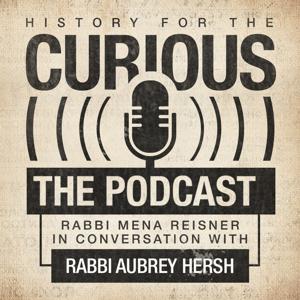
History for the Curious
The most talked-about Jewish History Podcast
History for the Curious features the dynamic historian and famous tour guide & lecturer: Rabbi Aubre


4.9
222222 ratings


The podcast currently has 204 episodes available.
The most played episodes among Podcast App listeners.
Join our WhatsApp group for weekly exclusive content: https://chat.whatsapp.com/FEgoaCOQoyU2VX49SwA8Aw?s=cl&p=a&ilr=4 This 2-part series discovers the dramatic life of Rabbi Yosef Karo, which was lived far beyond the pages of his famous legal code, the Shulchan Aruch. Born into the upheaval of the 1492 Spanish Expulsion, he fled across borders from Lisbon to Cairo to Greece and eventually to Eretz Yisrael and was instructed by a spiritual maggid. But the 16th century of mass migrations threatened to fracture Jewish tradition into "countless Torahs". So he embarked on a monumental mission to write a master legal framework and unite the diaspora, which fundamentally reshaped our lives. His story included an attempt to hasten the Messianic era, that led to him being banned from the main synagogue of Tzfas and a son born to him in his old age. Timestamps: 00:00 Intro & dedication 02:20 Who was Rabbi Yosef Karo? 05:57 Tzfas: The rise of a holy city 16:46 Karo’s authority in Tzfas 21:08 What was Smicha and why revive it? 26:25 The 1538 Smicha controversy 35:44 Challenges to reviving Smicha 40:57 Rabbi Yosef Karo and Smicha 45:29 Why Karo wrote the Beis Yosef & Shulchan Aruch 50:19 Why the Tur? Karo’s method of codification 54:33 Ashkenazi vs Sephardi practice & local Minhag 57:38 Modern implications & the post-Holocaust world 1:00:23 Closing & Part 2

Rabbi Chaim Yosef David Azulai traversed Europe, the Middle East, and North Africa on behalf of his brethren in Eretz Yisrael. His missions raised vital funds, to keep the Jews from being driven out of town, whilst facing bandits, maritime disasters, and oppressive authorities along the way. With the aid of his diary, this episode gives a vivid first-hand account of his challenges, deprivation, triumphs and breadth of travel. Beyond his journeys, the Chida's genius is seen through his prolific writings. Author of 100 different sefarim on Halacha, Tanach, Kabbala & Talmud, they continue to guide Judaism today. Shem HaGedolim, remains a monumental encyclopedia of rabbinic authors and works, which reflect his incredible memory and knowledge. Birkei Yosef and Yosef Ometz are cornerstones of psak, written as he travelled thousands of miles over many decades. But the final act was written in 1960. Timestamps: - 0:00 — Intro mention of Shem ha‑Gdolim editions - 0:21 — Podcast intro by Mena Reisner - 1:00 — Hosts reconnect; travel note and dedication - 2:32 — Episode topic: life & travels of Rabbi Chaim Yosef David Azulai (the Chida) - 3:01 — Family origins; great‑grandfather and signature story - 4:13 — Birth in Jerusalem, early life, prodigy and writings - 7:53 — Teachers, Kabbalistic training, reason for emissary mission - 10:26 — Language issues, letters of recommendation, mixed receptions in Europe - 15:04 — Collection logistics, contacts with non‑Jewish authorities, successes - 18:46 — Travel hazards and accidents; manuscript research in libraries - 22:32 — England/France encounters and sightseeing - 26:29 — Return to Eretz Yisrael (1758), political troubles, five‑year stay in Egypt - 31:05 — Tunis episode, personal losses, diary entries - 35:49 — Second mission, Livorno quarantine, composing Shem ha‑Gdolim - 39:05 — Scope of travels, settlement in Livorno, later life and death (1806) - 42:23 — Burial details, estate instructions, study practices, halachic/Kabbalistic approach - 48:55 — Stories/legends (attempts to hasten redemption, miracles) - 55:07 — Reburial efforts to Jerusalem; episode closing and contact info
Join our WhatsApp group for weekly exclusive content: https://chat.whatsapp.com/FEgoaCOQoyU2VX49SwA8Aw?s=cl&p=a&ilr=4 Be Courageous, be Honest, be a Jew. Those were the words with which a parent took leave of his son during the Holocaust. However much we are aware of the terrible years that befell our People, the words and testimonies shake us and make us rethink Faith & Suffering Mrs Zahava Ungar & Mr Yisrael Diamond are living proof to the tragedies and perseverance that took them through 5 years of torment. They are both heads of a families today which have continued the Yiddishkeit of pre-war generations. Their words need to be heard. Timestamps: [0:00:00] – Survivor vignette: sneaking out for water, sister taken [0:00:38] – Podcast introduction and dedication [0:01:50] – Framing the episode: from numbers to personal stories; link to Tisha B’Av [0:03:33] – Reading and discussion of the three Holocaust letters (to ~[0:07:30]) [0:07:37] – Introduction to Mrs. Sahava Unger [0:08:17] – Early life, Nazi occupation, father taken to labor [0:10:28] – Ghetto, deportation to Auschwitz [0:13:47] – Birkenau, living conditions, selection, loss of sister [0:18:47] – Liberation, aunts in “Canada,” uncle in Sonderkommando, journey after the war ~[0:24:27]–[0:29:00] – Reflections on fear, hunger, cold; her later life and family [0:29:00] – Introduction to Mr. Yustral Diamond [0:29:23] – Leaving Antwerp; journey to Montpellier, south of France [0:31:08] – Round-up orders; warning and help from French gendarmerie chief [0:38:21] – Hiding in villages, resistance environment, daily terror [0:45:32] – Post-war: yeshiva, return to Antwerp, move to Golders Green, religious perseverance [0:48:07] – Introduction to Rav Yeshua Grunwald [0:49:57] – Excerpts from his writings; Holocaust suffering as “mizbeach” / Kodesh Kodashim [0:53:29] – His closing prayer for justice and redemption [0:54:17]–end – Host’s closing words and Tisha B’Av message
The date of the Expulsion in 1492 is infamous. Less known or understood is the historical context that led there. How did a 1,000-year-old community lose its status and power? The answer lies in the ferocious and sudden impact of 1391. With 100,000 conversions to Christianity, Jewish kehillos were left reeling and families were torn apart. Rebuilding became virtually impossible, and a new way of life was created for the Jews in Spain. Jews were still part of society, but rising Church pressure forced many into hiding. And the urgent question arose of how to deal with conversos amid instability, the Tortosa disputation and hostility from ‘Old Christians’. But the writing was still not on the wall. Timestamps: - 0:00 — Converts’ next-generation issue introduced - 0:42 — Podcast intro and host - 1:24 — Email about Radzivin/Vatican anecdote - 2:24 — Recap: Jewish history in Spain; Golden Age → decline - 4:20 — 14th-century status: wealth, roles, rising anti-Jewish politics - 7:17 — Civil war in Castile; Henry II’s measures; Ferran Martínez’s preaching - 12:45 — Martinez’s actions, weak government, lead-up to 1391 - 16:20 — June 1391 pogroms begin (Seville) - 19:33 — Scale of conversions; conversos’ motives and consequences - 23:00 — Rav Crescas’s account and leadership role - 27:32 — Rebuilding efforts and royal interactions - 32:21 — Conversos’ social ascent; community tensions - 37:22 — Tortosa disputation lead-up; Vincent Ferrer’s influence - 43:07 — Tortosa debate outcomes and further conversions - 50:10 — Fragile recovery; papal/royal reversals - 57:32 — 1449 Toledo unrest; purity-of-blood measures begin - 1:02:16 — Long-term social exclusion of conversos; legacy and summary
Over a period of 30 years, Rav Yosef Karo wrote of his encounters with a divine messenger, an angel which identified itself as the living essence of the Mishna. The most public manifestation took place on an extraordinary night of Shavuos in Salonika in 1533. 19th-century critics dismissed the mystical journal as a complete fabrication, but ground-breaking research and archaeological evidence have vindicated its authenticity. The personal side of his halachic decision making is clearly evident throughout his numerous responsa, whereas the Printing Press allowed his Shulchan Aruch to become available across the Jewish world, despite various omissions - when publishers cut introductions to save space ! Timestamps: 00:00 – Printing omissions and errors in early Jewish texts 00:32 – Introduction to History for the Curious 01:12 – Episode dedication and sponsorship 01:40 – Return from Radin and introduction to Part 2 02:33 – Pronouncing Rabbi Yosef Karo’s name and the episode’s main topics 03:07 – The Maggid Mesharim: Rabbi Yosef Karo’s private spiritual diary 03:37 – What is a Maggid? 05:23 – How Rabbi Yosef Karo’s Mishnah study led to revelation 06:10 – The Maggid’s guidance on Torah study and daily life 08:02 – Other rabbis associated with Maggidim and heavenly revelations 08:32 – The contents of the Maggid Mesharim 09:25 – Using the Maggid’s teachings in public sermons 10:24 – Practical halachic rulings attributed to the Maggid 14:09 – Why Rabbi Yosef Karo recorded the Maggid’s words 14:35 – The famous Shavuot-night revelation in Salonica 16:24 – How the group recognized the Maggid’s voice 16:51 – Can heavenly revelation influence halachic decisions? 18:46 – The Maggid’s authority outside practical halacha 19:30 – Chronological problems created by early editors 21:00 – Claims that the Maggid Mesharim was a forgery 24:37 – Manuscript evidence supporting the work’s authenticity 26:07 – Why Rabbi Yosef Karo did not cite the Maggid in his main legal works 26:30 – Joy, fear and fasting on Rosh Hashanah 29:30 – The three major authorities behind the Shulchan Aruch 31:09 – Resolving contradictions between the Beit Yosef and Shulchan Aruch 32:11 – The first printing of the Shulchan Aruch 33:39 – Missing introductions and mistakes made by printers 34:22 – Early editions and the monthly Shulchan Aruch study cycle 36:40 – The Rema’s additions to the Shulchan Aruch 38:15 – Rabbi Yosef Karo’s responsum concerning decorative images 40:30 – A disputed religious image on a gold object 41:32 – Rabbi Yosef Karo’s strict response and textual reasoning 43:15 – Eyewitness descriptions of Rabbi Yosef Karo and his yeshiva 44:20 – A modern controversy about truth, plagiarism and academia 46:48 – Aseret Yemei Teshuvah: confronting truth and reality 48:28 – Closing thanks, listener feedback and the next episode
The podcast currently has 204 episodes available.

551 Listeners

332 Listeners

470 Listeners
1,986 Listeners
236 Listeners

667 Listeners

312 Listeners

1,225 Listeners

3,164 Listeners

1,069 Listeners

819 Listeners

1,117 Listeners

326 Listeners

1,066 Listeners

919 Listeners