Holocaust Audio Tour

Holocaust Audio Tour

By National Museum of the U.S. Air Force
Download on the App Store

Holocaust Audio Tour episodes

  • Holocaust Audio Tour 02: Introduction
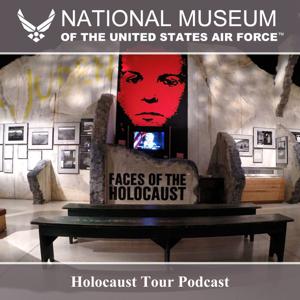
    “Prejudice and Memory: A Holocaust Exhibit” is made up of the photographs, artifacts and memories of people who live in the Dayton, Ohio, area. Among the contributors are concentration camp survivors and their families, liberators – soldiers who helped to free those held in concentration camps – and “righteous Gentiles” – non-Jews who helped Jews during the Holocaust. It is one of the few exhibits in the U.S. compiled to demonstrate one community’s connection with this terrible event and to affirm the belief that learning about the Holocaust is the first step toward preventing its recurrence.
    1 min
  • Holocaust Audio Tour 12: The Violin
    Move to the violin on exhibit to learn Robert Kahn’s history. Mr. Kahn recounted his experience in a letter: “59 years ago on November 9, 1938, a teenager 15 years old, experienced the most violent, barbaric display of anti-Semitic acts ever recorded in history. I was that teenager! The day began by witnessing the purposeful destruction of the only Jewish school in the area, while people cheered and applauded. It was my school. Then, as I hurried home on my bike, I arrived to see a mob of Nazis, in brown and black uniforms throwing our furniture and other belongings through windows which had been smashed, and off the balcony. In the yard below, a huge bonfire consumed everything that was dear to us, while the Nazi hoards and mob of onlookers sang and shouted insults at us, the Jews. While our apartment was being destroyed and ransacked, mother was locked up in one room, crying loudly. My father was being beaten up in the hallway, begging for mercy. When I told them to stop, they took me into my room, threw my violin at me, took me to the balcony and ordered me to play happy German songs. I was scared, crying, in agony but play I did to the amusement of the crowd. My father was taken to Dachau concentration camps. Our two beautiful synagogues were destroyed. Before I fled Germany, and eventual freedom in America, I hid the violin in the attic of our apartment. When I returned from military service in the U.S. Army and the war was won over Hitler, I wrote to the janitor of our apartment in Mannheim, Germany. He found the hidden violin and sent it to me in America. This is the violin which shares all the memories of the past with me. At one time it could vibrate to imitate the happy flight of song birds; today it is only a reminder of a once dehumanized and terrified Jewish boy.” - Signed, Robert Kahn, September 15, 1997
    3 min
  • Holocaust Audio Tour 13: A Child’s Prized Possession
    The next artifact is an accordion contained in a glass exhibit case. This artifact introduces us to the Kindertransport, a program created in 1938 that allowed 10,000 predominantly Jewish children from Nazi Germany, Austria and Poland to flee to the United Kingdom. Those children were placed in foster homes, hostels and schools. They were often the only members of their families to survive the Holocaust. This accordion allows the museum to share the story of Gertrude Wolff, one of those 10,000 children. Children leaving on the Kindertransport train could only take two medium-sized suitcases, but 14-year-old Gertrude Wolff boarded the train with her little sister on May 17, 1939, with one suitcase and one accordion. The accordion on display was a gift from her parents. Refusing to leave her prized possession behind, Gertrude used the accordion as her second suitcase. Gertrude’s parents managed to escape Germany, but her father was interned by the British. She came to the United States with her sister and mother in 1939. After World War II, she married Robert Kahn, whose violin is also on display in this exhibit.
    2 min
  • Holocaust Audio Tour 14: Henry Wyrobnik
    Go to the photo cut out of the man showing a concentration camp tattoo on his forearm. This man is Henry Wyrobnik. Henry was born in Lodz, Poland. He, his parents, siblings and many other family members were put into the Lodz Ghetto by the Nazis until August 1944, when he and his family were sent to Auschwitz. Henry shared some reflections of his experiences. As the Allied Armies approached, he and thousands of others were taken on a Death March beginning on Jan. 15, 1945. They were given only small amounts of bread. They marched for two weeks, day and night. If someone lagged behind or walked out of line, they were shot immediately by German soldiers. They were put on open coal trains, other trains were hooked on, and they spent two weeks on the train. They had nothing to eat but snow. In Czechoslovakia, people threw food to the trains as they went through the countryside, but the Czech people were shot by the SS, a quasi-military unit that serviced as Hitler’s personal guard, if they were caught throwing food. One hundred eight people were on Henry’s train, “packed like sardines,” and at the end only 35 remained. The train finally took them to Mauthausen. There they were forced to bury bodies in mass graves. In Mauthausen, they had no clothes, no food and were sitting in crowded barracks. At the end of three or four weeks, they were sent to Gunskirchen, a sub-camp of Mauthausen. At the end, Henry says they “spent three weeks without water to drink, living in the woods with mud so deep if you stepped into it, you would sink in.” Many people from other countries were also imprisoned there. They built barracks for 500 people, which were actually a gas chamber. On May 5, 1945, Gunskirschen was liberated and Henry was freed and eventually sent to a hospital to recuperate. He had lost his whole family, including his parents, one brother and two sisters. Henry met his wife, Dora, also a survivor, in a Displaced Persons (DP) Camp at Feldafing, Germany. They came to the U.S. in 1949, and he worked for Shillitos, a department store in Cincinnati. Later, he owned his own business and came to Dayton.

    3 min
  • Holocaust Audio Tour 15: Parallel Tracks to Germany
    On the wall you will see photos of railcars. These are called “forty and eights.” During World War I, many American “Doughboys” traveled to the front in French railcars displaying the notice that each car could carry 40 men or eight horses. Therefore, they quickly became known as “forty and eight” railcars. In World War II, “forty and eights” again transported supplies and troops to the front, but they also carried new cargo. Millions of Holocaust victims were herded into similar railcars on their way to concentration camps. Many Allied prisoners of war, or POWs, rode to German POW camps in them – sometimes with as many as 90 men forced into each car. “Forty and eight” railcars carried 168 Allied POWs from Paris to Buchenwald concentration camp in August 1944. You will find a “forty and eight” railcar located in our World War II Gallery. This artifact was delivered to the museum in 2001 from Istres Air Base in France.
    2 min
  • Holocaust Audio Tour 16: Conclusion
    Thank you for taking your time to learn about the Holocaust and those persons living in the Dayton area who were affected by this historic and tragic event. Please check the museum’s website to listen to oral histories from people who witnessed these events first-hand. We hope that the sharing of this knowledge will ensure that a similar event is prevented in the future.
    1 min

About Holocaust Audio Tour

From the publisher's feed

This tour explores the "Prejudice and Memory: A Holocaust Exhibit," which is made up of photographs, artifacts and memories of people who live in the Dayton, Ohio, area.

More shows like Holocaust Audio Tour

Air Force Radio News by Defense Media Activity - Air Force

Air Force Radio News

21 Listeners

NATO Review by Natochannel

NATO Review

13 Listeners

The Air Force Podcast by Air Force Television Pentagon (SAF/PAI)

The Air Force Podcast

30 Listeners

The Contracting Experience by Air Force Materiel Command

The Contracting Experience

48 Listeners

Eagles, Globes, and Anchors by U.S. Marine Corps Training and Education Command

Eagles, Globes, and Anchors

20 Listeners

The Air Force Starts Here by Air Education and Training Command

The Air Force Starts Here

36 Listeners

Air Force Handbook 1 by Air Education and Training Command

Air Force Handbook 1

64 Listeners

DIA Connections by Defense Intelligence Agency

DIA Connections

87 Listeners

Inside the Castle by U.S. Army Corps of Engineers Headquarters

Inside the Castle

33 Listeners

Get to Know TRICARE by Defense Health Agency

Get to Know TRICARE

27 Listeners