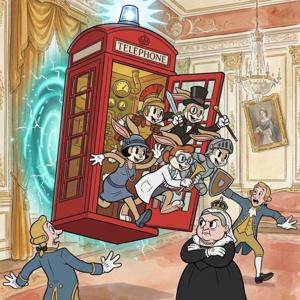
Horde of Rabbits

Horde of Rabbits

By Atween StudiosHistory
Download on the App Store

Horde of Rabbits episodes

  • Wrong Resistor
    In 1956, engineer Wilson Greatbatch was building an oscillator to record heart sounds at the University of Buffalo. He accidentally grabbed the wrong resistor from his parts box. Instead of recording heartbeats, the circuit produced electrical pulses that mimicked the heart's rhythm. Greatbatch immediately recognized the potential: a small, implantable device that could regulate irregular heartbeats. He spent two years perfecting the design in his barn workshop, and on June 6, 1960, the first successful implantable pacemaker was installed in a patient. The device worked for 18 months. Today, over 3 million people worldwide depend on pacemakers, with more than a million implanted each year.

    Hosted on Acast. See acast.com/privacy for more information.

    12 min
  • Tooth Demon
    The tooth worm myth is one of humanity's most persistent medical beliefs. From ancient Sumeria to 18th-century Europe, every civilization independently concluded that toothaches were caused by tiny worms eating through teeth from the inside. Elaborate treatments were developed: smoke fumigation to drive them out, heated probes to kill them, even exorcisms. Dentists claimed to extract them and show them to patients (usually small fibers or debris). The myth only died when microscopy revealed bacteria and the chemistry of tooth decay was understood—but it took until the late 1800s.

    Hosted on Acast. See acast.com/privacy for more information.

    13 min
  • The Giraffe That Fooled an Emperor
    In 1414, Admiral Zheng He's treasure fleet — the largest wooden ships ever built, dwarfing anything Europe could produce — encountered envoys from the East African city-state of Malindi (in modern Kenya) while anchored in Bengal. The Malindi ambassadors had brought a gift: a giraffe. Zheng He's diplomats persuaded them to present it to Emperor Yongle. A second giraffe followed. When the animals arrived at the imperial court in Beijing in 1415, they caused a sensation. Chinese scholars consulted their texts and concluded that the giraffe was a qilin — a mythical unicorn-like creature whose appearance, according to Confucian tradition, signified the presence of a sage of utmost wisdom and benevolence. In other words: the giraffe proved that Emperor Yongle was a great and virtuous ruler. The emperor himself, to his credit, was sceptical — he issued a statement playing down the qilin interpretation, saying good government mattered more than supernatural signs. But he didn't stamp out the rumour entirely. The giraffes were painted by court artists and became the most celebrated animals in Chinese history. The episode captures a moment when the world's greatest maritime power was trading with East Africa, centuries before Europeans arrived — and when a confused taxonomy turned a large spotted animal into political propaganda.

    Hosted on Acast. See acast.com/privacy for more information.

    13 min
  • Revolutionary Stamp
    In 1765, the British Parliament passed the Stamp Act, requiring colonists to pay a tax on every piece of printed paper they used—newspapers, legal documents, playing cards, even dice. The tax was tiny, but the fury was enormous. Britain needed money after the expensive Seven Years' War, and thought the colonies should help pay. The colonists disagreed violently. 'No taxation without representation!' became the rallying cry. Protests erupted, tax collectors were threatened, and stamps were burned in the streets. Within a year, Britain repealed the act—but the damage was done. The colonists had tasted resistance, and eleven years later, they declared independence. A small stamp tax became the spark that lit a revolution.

    Hosted on Acast. See acast.com/privacy for more information.

    12 min
  • Pirate Admiral
    Born around 1775 in Guangdong Province, possibly working on a floating brothel (花船, 'flower boat'), she married powerful pirate Zheng Yi in 1801. When he died in 1807, she took command of his massive pirate confederation—the largest in history. She commanded a fleet of approximately 400 junks with an estimated 40,000–80,000 pirates (a contemporary East India Company officer estimated 80,000 in 1809), far larger than most national navies. She created a strict code of laws for her fleet, including rules about treatment of captives and division of plunder. The Chinese government sent fleets against her but failed repeatedly—after one defeat in 1808, the Chinese admiral committed suicide. In 1810, after Portuguese naval pressure combined with Chinese amnesty offers, she negotiated brilliantly: keeping her loot, securing government and military positions for her officers, and marrying Zhang Bao (Cheung Po Tsai), the pirate commander of the Red Flag Fleet who subsequently became a Qing naval officer. She lived peacefully for another 34 years, running a gambling house in Canton, and died around 1844.

    Hosted on Acast. See acast.com/privacy for more information.

    13 min
  • Hope Will Never Be Silent: Harvey Milk
    In November 1977, Harvey Milk was elected to the San Francisco Board of Supervisors — the first openly gay man to hold elected office in California. He celebrated. He also, about ten days after his election, recorded a tape in his camera shop on Castro Street. He said it was to be played only in the event of his death by assassination. 'Knowing that I could be assassinated at any moment or any time,' he said, 'I feel it's important that some people know my thoughts.' He had spent years being told to stay quiet, to work within the system, to not make it about being gay. He refused every time. In his almost eleven months in office, Milk sponsored and passed San Francisco's gay rights ordinance — banning discrimination based on sexual orientation in housing, employment, and public accommodations. He defeated Proposition 6, a California ballot measure that would have banned gay teachers from public schools. On 27 November 1978, he was shot and killed in City Hall by a disgruntled former supervisor. The killer was convicted of manslaughter and served five years. The night of the verdict, 40,000 people marched through San Francisco in the White Night Riots. Milk's recorded voice still plays: 'You gotta give 'em hope.'

    Hosted on Acast. See acast.com/privacy for more information.

    12 min
  • Hoard in the Field
    Terry Herbert had been metal detecting for 18 years and never found anything valuable. In July 2009, he was searching a ploughed field in Staffordshire when his detector went off. He found gold. Then more gold. Then more. Over five days, he uncovered over 3,500 pieces of Anglo-Saxon gold and silver—sword fittings, helmet fragments, crosses—dating from the 7th century. The Staffordshire Hoard is the largest collection of Anglo-Saxon gold ever found, worth £3.3 million. Nobody knows why it was buried or who buried it. But a retired man with a £2.50 metal detector found one of the most important archaeological discoveries in British history under a farmer's field.

    Hosted on Acast. See acast.com/privacy for more information.

    13 min
  • Flat Earth Myth
    Here's a myth about a myth: most people believe that medieval Europeans thought the Earth was flat until Columbus proved them wrong. This is completely false—educated people had known Earth was spherical since ancient Greece, and medieval scholars never forgot it. The flat-earth myth was actually invented in the 19th century to make religious people look stupid. The real history is more interesting: ancient Greeks calculated Earth's circumference with remarkable accuracy, medieval navigators used spherical Earth in their calculations, and the debate wasn't about shape but about size (Columbus thought Earth was smaller than it actually is).

    Hosted on Acast. See acast.com/privacy for more information.

    13 min
  • Emperor in 690
    Wu Zetian entered the Tang court as a 14-year-old concubine. Through decades of political maneuvering, she rose to become empress consort, then regent, and finally — in 690 CE — she declared herself Emperor, founding the brief Zhou dynasty. She was ruthless: she eliminated rivals, created a secret police force, and may have killed her own infant daughter to frame a rival. But she also reformed the civil service examination system, promoted talented officials regardless of birth, expanded the empire, and patronized Buddhism. Her legacy is deeply contested — vilified by Confucian historians, reassessed by modern scholars.

    Hosted on Acast. See acast.com/privacy for more information.

    12 min
  • Blow-Up Army
    The US Army's 23rd Headquarters Special Troops was made up of artists, sound engineers, and designers. Their job: create a phantom army to fool the Nazis. They used inflatable tanks and planes, fake radio transmissions, recorded battle sounds played through loudspeakers, and even costume changes to impersonate different divisions. Before D-Day, they staged elaborate deceptions to make Hitler think the invasion would land at Calais, not Normandy. It worked. German forces stayed in the wrong place, waiting for an army that didn't exist. Artists and theater designers helped win World War II—with rubber and imagination.

    Hosted on Acast. See acast.com/privacy for more information.

    11 min

About Horde of Rabbits

From the publisher's feed

The true, strange, whimsical, overlooked stories from across all of human history — the bits that didn't make the textbooks. Join the rabbits as they discover those nuggets of history that you…