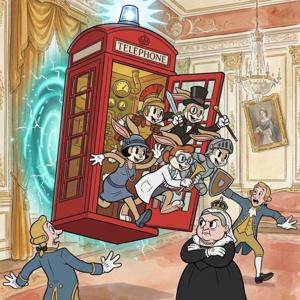
Horde of Rabbits

Horde of Rabbits

By Atween StudiosHistory
Download on the App Store

Horde of Rabbits episodes

  • Tape That Could
    After the oxygen tank explosion on Apollo 13, the three astronauts had to shelter in the lunar module—designed for two people for two days. The carbon dioxide was building up to lethal levels. The command module had spare filters, but they were square. The lunar module's sockets were round. Engineers on Earth had to figure out how to fit a square peg in a round hole using only materials on the spacecraft. They grabbed everything the astronauts had—duct tape, plastic bags, cardboard from manuals, a sock—and built an adapter. Instructions were radioed up, and the crew assembled it in space. It worked. The improvised air scrubber kept them alive for the four-day journey home. Sometimes the most sophisticated space mission in history depends on duct tape.

    Hosted on Acast. See acast.com/privacy for more information.

    13 min
  • Mauve Measles
    In 1856, during the Easter holidays from London's Royal College of Chemistry, 18-year-old William Henry Perkin was attempting to synthesise quinine — the antimalarial drug derived from cinchona tree bark — from coal tar. He failed. But when he cleaned out his flask with alcohol, a vivid purple solution formed. Perkin recognised something extraordinary. He sent a sample to a dyer in Perth, who confirmed it could colour silk beautifully. Perkin patented his discovery on 26 August 1856 and opened a factory the following year. The colour, named 'mauveine' or 'aniline purple', became a sensation. Queen Victoria wore it to the 1862 International Exhibition. Empress Eugénie of France adopted it as her signature shade. The craze became known as 'mauve measles.' But the real significance ran deeper: Perkin's accidental discovery launched the synthetic dye industry, which in turn created the modern pharmaceutical and plastics industries. A failed experiment to cure malaria ended up being the foundation of almost everything.

    Hosted on Acast. See acast.com/privacy for more information.

    13 min
  • Archimedes Palimpsest
    In 1906, a scholar discovered that a 13th-century prayer book in a Constantinople monastery had been made by scraping off and overwriting a much older text — a 10th-century copy of works by Archimedes. The palimpsest contained seven treatises, including "The Method of Mechanical Theorems," which was otherwise completely lost. In this work, Archimedes described techniques remarkably similar to integral calculus — 1,800 years before Newton and Leibniz. The manuscript was stolen, forged, and nearly destroyed before being auctioned in 1998 and subjected to advanced imaging that finally revealed its full contents.

    Hosted on Acast. See acast.com/privacy for more information.

    13 min
  • Magnus Hirschfeld and the Institute That Knew Too Much
    In 1897, a German Jewish doctor named Magnus Hirschfeld founded the Scientific-Humanitarian Committee — the world's first organisation dedicated to LGBTQ+ rights. By 1919, he had opened the Institut für Sexualwissenschaft in Berlin: a clinic, research centre, archive, and refuge that housed the world's most extensive collection of material on human sexuality. It offered gender-affirming care decades before the term existed. It employed trans people. It campaigned for the decriminalisation of homosexuality. It was extraordinary. On 6 May 1933, the Nazi German Student Union raided and occupied the Institut. Four days later, on 10 May 1933, students and SA members carried 20,000 books from the Institut to the Opernplatz and threw them onto a bonfire. The famous photographs of Nazi book burnings? That's Hirschfeld's library. He was in Paris when it happened — he watched his own library burning in a cinema newsreel — and never returned to Germany. He died in exile in Nice on 14 May 1935, his 67th birthday. Decades of research, thousands of patient records, irreplaceable archives — gone in an afternoon.

    Hosted on Acast. See acast.com/privacy for more information.

    12 min
  • Backwards Medicine
    The Weapon Salve (or Powder of Sympathy) was a widespread medical practice from the 16th to 18th centuries. Instead of treating a wound directly, physicians would apply a special ointment or powder to the weapon that caused the injury—the sword, knife, or arrow. The treatment was based on sympathetic magic: the belief that things once connected remain connected. Remarkably, patients often did recover better than those receiving conventional treatment. The reason? By leaving the wound alone and keeping it clean (rather than applying the era's toxic salves, poultices, and poking), the weapon salve accidentally stumbled into effective wound care through complete nonsense.

    Hosted on Acast. See acast.com/privacy for more information.

    12 min
  • Emus 1, Australia 0
    After WWI, Australian veterans were given farmland in Western Australia. Then 20,000 emus migrated through, destroying crops. The government sent soldiers with machine guns to kill the emus. The emus proved surprisingly difficult to kill—they scattered when attacked, could run at 30 mph, and seemed to have tactical awareness. After weeks of fighting and thousands of rounds of ammunition, the military gave up having killed only a fraction of the emus. The 'war' became a national embarrassment. One soldier remarked that if the emus had a military division, they'd face any army in the world. Australia eventually solved the problem with a bounty system instead.

    Hosted on Acast. See acast.com/privacy for more information.

    12 min
  • The Well of Loneliness: How to Make a Book Famous by Banning It
    In 1928, Radclyffe Hall published The Well of Loneliness, a novel about a lesbian woman. It was not explicit — the most controversial line was 'and that night, they were not divided.' The Sunday Express demanded it be banned: 'I would rather give a healthy boy or a healthy girl a phial of prussic acid than this novel.' The Home Secretary agreed. The book was prosecuted for obscenity. At the trial, the judge refused to hear any witnesses in its defence — including Virginia Woolf and E.M. Forster, who had come to testify. The book was found obscene and ordered destroyed. The result? It became an international sensation. Published in France, America, and across Europe, it sold in hundreds of thousands. Every attempt to suppress it created more readers. It remained the most widely read lesbian novel in the world for decades. Radclyffe Hall — who wore men's clothes, used masculine pronouns with intimates, and called herself 'John' — became an unlikely celebrity. The prosecution had achieved the exact opposite of what it intended.

    Hosted on Acast. See acast.com/privacy for more information.

    13 min
  • I, Rigoberta Menchú: Voice of the Maya
    Rigoberta Menchú was born in 1959 in Laj Chimel, a remote highland village in Guatemala's Quiché department. She was K'iche' Maya, one of the Indigenous peoples who make up 60 per cent of Guatemala's population but have been systematically dispossessed and persecuted since the Spanish conquest. In 1980, her father Vicente was killed when the Guatemalan army stormed the Spanish Embassy in Guatemala City, burning it to the ground with 37 people inside. Her mother was kidnapped, tortured, and murdered by the army. Her teenage brother was killed. Rigoberta fled to Mexico in 1981. In Paris in 1983, she dictated her life story to anthropologist Elisabeth Burgos-Debray. The resulting book, 'I, Rigoberta Menchú,' was translated into more than a dozen languages and brought global attention to the genocide being carried out against Guatemala's Indigenous population. An estimated 200,000 people were killed during the Guatemalan Civil War, the majority Indigenous Maya. In 1992 — the 500th anniversary of Columbus's arrival in the Americas — Rigoberta Menchú was awarded the Nobel Peace Prize. She was 33. The committee said the prize recognised her 'work for social justice and ethno-cultural reconciliation based on respect for the rights of indigenous peoples.' She accepted it on behalf of 'the indigenous people of all America.'

    Hosted on Acast. See acast.com/privacy for more information.

    12 min
  • Inventing Nothing
    The idea of "nothing" as a number seems obvious today, but it took millennia to develop. While the Babylonians and Maya used zero as a placeholder, it was Indian mathematician Brahmagupta who first treated zero as a number in its own right around 628 CE, defining rules for arithmetic with zero. The concept traveled to the Islamic world via al-Khwarizmi and eventually to Europe through Fibonacci in the 13th century. Without zero, there would be no binary code, no computers, no modern mathematics. The symbol "0" we use today evolved from a dot used in Indian manuscripts.

    Hosted on Acast. See acast.com/privacy for more information.

    13 min
  • The Movement That Pushed Her Out
    On 28 June 1969, police raided the Stonewall Inn in Greenwich Village, New York — a routine harassment of queer people that happened to go spectacularly wrong. Marsha P. Johnson, a Black transgender woman and street activist, was among those who fought back. Eyewitnesses place her at the front of the resistance, throwing a shot glass at a mirror in defiance — the 'shot glass heard round the world.' She became a tireless activist, co-founding STAR (Street Transvestite Action Revolutionaries) with Sylvia Rivera to house homeless queer youth. But as the gay rights movement became more respectable, it quietly pushed Marsha — Black, trans, poor, mentally ill — to the margins. She was found dead in the Hudson River in 1992. Police ruled it suicide; her community said otherwise. The investigation was reopened in 2012. History is finally putting her name back where it belongs.

    Hosted on Acast. See acast.com/privacy for more information.

    12 min

About Horde of Rabbits

From the publisher's feed

The true, strange, whimsical, overlooked stories from across all of human history — the bits that didn't make the textbooks. Join the rabbits as they discover those nuggets of history that you…