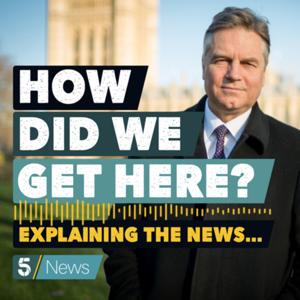
HOW DID WE GET HERE? Explaining The News

HOW DID WE GET HERE? Explaining The News

By 5 NewsNewsPolitics
Download on the App Store

HOW DID WE GET HERE? Explaining The News episodes

  • This is how Donald Trump could still remain US President through legal challenges | A 5 News Podcast
    The results of the US Election have been called across the world, announcing Joe Biden officially as President-Elect. However, President Donald Trump has so far refused to concede, insisting that various attempts at electoral fraud have changed the outcome of the vote - he says he can prove it in court. Carol Laham is a constitutional lawyer and political campaigns expert, she spoke with Andy Bell from her home in Chevy Chase, explaining on what grounds Donald Trump could bring a case.
    13 min
  • Is winning in Florida the key to becoming President? Donald Trump and Joe Biden both visit Tampa
    Florida has backed the winning presidential candidate in every election since 1996 - but what makes the state the most likely to elect a leader? President Donald Trump and former vice president Joe Biden have both made Florida a battleground in the final few days of the election campaign. The area is known as a swing-state and the Trump campaign has been keen to target voters in what the President refers to as his 'home state'. Dr Susan MacManus is a political analyst at the University of South Florida, she was born and raised just outside Tampa and spoke to Andy Bell from the house her grandfather built in the 1920s. She says it's not only Florida's 29 electoral votes that make the state such a key focus point for candidates. The state is home to a rich diversity of age, race, politics and occupation which leads to a lot of difference in opinion and voting intentions - meaning it really can all come down to the wire. In 2000, it did exactly that. Just 537 votes were the difference between Republican George W. Bush and Democrat Al Gore, resulting in President Bush taking his place in the White House. How did we get here? Explaining the news is a podcast from 5 News. Join Andy Bell as he explains the world's biggest news stories through interviews with politicians, experts and analysts.
    15 min
  • David Lammy on Black Lives Matter, George Floyd and why pulling statues down won't change history
    Shadow Justice Secretary David Lammy served as a Minister for Culture in Tony Blair's government and has always spoken proudly about his black British background. David has commented on Britain's history of slavery and has been vocal over the Windrush scandal which affected a generation of people who were born British subjects and had made Britain their homes. He tells Andy Bell that these things should be taught in schools to help society change the culture around race and educate people on Britain's colonial history. He believes that year on year things are progressing, but that more needs to be done. How did we get here? Explaining the news is a podcast from 5 News. Join Andy Bell as he explains the world's biggest news stories through interviews with politicians, experts and analysts.
    28 min
  • President Donald Trump vs. Joe Biden: Who won the first debate? | A 5 News Podcast
    The US presidential debate between President Donald Trump and Democratic challenger Joe Biden was eagerly awaited around the world - but did it deliver? Laura Schwartz served as an adviser to the President during the Clinton administration, she also served as a senior advisor to the 2004 Presidential campaign of former Senator John Kerry. She speaks with Andy Bell about the bad-tempered TV stand-off and sets out the pathway that each candidate will now have to walk to find themselves sitting in the White House. How did we get here? Explaining the news is a podcast from 5 News. Join Andy Bell as he explains the world's biggest news stories through interviews with politicians, experts and analysts.
    23 min
  • The rise of fake news: How disinformation is winning elections and spreading hate | A 5 News Podcast
    How do we monitor and tackle fake news, hate speech and extremism on the internet? And what happens when the messages being promoted start to have an effect on elections, protests, or government policy for fighting the Covid pandemic? Chloe Colliver leads the Digital Research Unit at the Institute of Strategic Dialogue, a specialist team that analyses malign influence campaigns online - from debates over postal voting in elections to spreading false information about how the Covid pandemic began - Chloe's team spots the false information and tries to do something about it. Chloe shares her insight into the rapid growth of this dangerous phenomenon and raises red flags on its impact on the approaching US presidential election. How did we get here? Explaining the news is a podcast from 5 News. Join Andy Bell as he explains the world's biggest news stories through interviews with politicians, experts and analysts.
    27 min
  • Coronavirus: Here's how the UK Government can avoid a second wave and a second lockdown | 5 News
    The rate of coronavirus infection in the UK is rapdily increasing and the UK government is having to decide on which measures it will bring in. Currently vast areas of the north of England, and Wales, have local lockdown restrictions in place, but the data shows it hasn't currently had an immediate impact on the spread of Covid-19. Prof Christina Pagel sits on the Independent SAGE committee, where she collates and analyses various data, from testing to hospitalisation, and offers informed comment and guidance while holding the Government to account over it's handling of the pandemic. She is a mathematician and professor of operational research at University College London, where she is also the first female director of the Clinical Operational Research Unit, which applies operational research, data analysis and mathematical modelling to problems in health care. Professor Pagel warns that Boris Johnson's government have to "act smart and act now" to save lives and curb the spread of Covid. How did we get here? Explaining the news is a podcast from 5 News. Join Andy Bell as he explains the world's biggest news stories through interviews with politicians, experts and analysts.
    28 min
  • Could UK Government's Brexit tactics break international law AND the union? | A 5 News Podcast
    Officially the UK is no longer a member of the EU, Brexit happened on 31st January, in theory the two sides are trying to find an agreement that covers everything from trade to fishing, immigration to security. But what chance of a deal when the EU is accusing the UK government of breaking its word over the divorce deal signed in January. Boris Johnson says he's sticking to his plans to change the Withdrawal Agreement, but Brussels says he must drop it or any deal is off. Is it a battle over principle or just brinkmanship? Anand Menon is one of the leading authorities on the UK and the EU. He is professor of European Politics and Foreign Affairs at King's College London, and heads up the thinktank 'UK in a Changing Europe'. He can be found tweeting at @UKandEU. How did we get here? Explaining the news is a podcast from 5 News. Join Andy Bell as he explains the world's biggest news stories through interviews with politicians, experts and analysts.
    23 min
  • The rise of Cyber Crime: How can you protect your data and privacy? | A 5 News Podcast
    As data becomes more valuable than oil - how are we able to protect ourselves and our nations from would-be hackers and cybercriminals? Dr Jessica Barker is a co-founder of the Cyber Security company, Cygenta, and author of 'Confident Cyber Security'. She specialises in the human nature of cybersecurity and discusses the level of targeted cybercrimes on individuals. Dr Barker talks to Andy Bell about cybersecurity ranging from the daily assault on personal inboxes to state-on-state threats. How did we get here? Explaining the news is a podcast from 5 News. Join Andy Bell as he explains the world's biggest news stories through interviews with politicians, experts, and analysts.

    26 min
  • Can Lebanon recover from the Port of Beirut explosion and who is really to blame? | A 5 News Podcast
    On Tuesday 4th August 2020, the city of Beirut was devastated by a catastrophic explosion. The blast killed over a hundred people, injuring thousands and leaving many more homeless. A large fire had broken out in the Port of Beirut and as it spread from warehouse to warehouse a small explosion was witnessed, before what were seemingly fireworks being lit by the flames. Moments later there was a large explosion, which formed a mushroom cloud in the air and sent a shockwave through the city and surrounding area. Lebanon's President, Michel Aoun, has said the source of the explosion was 2,750 tonnes of ammonium nitrate that was being stored unsafely in one of the port's warehouses. President Aoun has now promised an investigation into the catastrophe. Tom Fletcher formerly served as the UK's Ambassador to Lebanon from 2011-2015 - an experienced British Diplomat, Fletcher had previously advised Tony Blair, Gordon Brown and David Cameron on Foreign Policy. During his time as Ambassador, the UK government budget for Lebanon grew from £2m to £200m, and Tom led a huge partnership between the two countries. His transparent and open diplomacy style is now world-renowned and brought him a lot of attention, through his blogs and his obvious admiration for Lebanon. Tom Fletcher speaks to Andy Bell about the fragility of the Lebanese state and how it came to be through civil war. He discusses the challenges Beirut may now face after the smoke and rubble of the explosion has cleared. How did we get here? Explaining the news is a podcast from 5 News. Join Andy Bell as he explains the world's biggest news stories through interviews with politicians, experts, and analysts.
    23 min
  • The man Russia wants dead: Bill Browder warns of Russian interference in the UK | A 5 News Podcast
    Bill Browder is an American-born British financier who in the 90s was one of the largest foreign portfolio investors in Russia during a period of mass privatisation after the fall of the Soviet Union - he says the change from communism to capitalism was ruled by "the law of the jungle". After a decade of business deals in Russia, Bill Browder was blacklisted by the Russian government as a "threat to national security" and denied entry to the country. He says this came because he had exposed corruption and corporate malfeasance in partly state-owned companies. It put him on the wrong side of oligarchs and Vladimir Putin. His offices were raided and those of his lawyers. Browder's friend and auditor Sergei Magnitsky was arrested and died in prison - where he logged reports of abuse and even torture. The European Court for Human Rights ruled that Magnitsky was detained in conditions that amounted to "inhuman and degrading treatment" which combined with negligence, lack of adequate medical care and ill-treatment led to his death. As a result of the controversy surrounding Sergei Magnitsky's death, the Magnitsky Act was signed into law by President Barack Obama, which allows a government to sanction those who it sees as human rights offenders, freeze their assets, and ban them from entering the country. Bill Browder speaks to Andy Bell about his experience with the Russian State and what he thinks the recent intelligence and security committee revealed in its 'Russia Report', warning about Russia's interference with UK politics. How did we get here? Explaining the news is a podcast from 5 News. Join Andy Bell as he explains the world's biggest news stories through interviews with politicians, experts, and analysts.
    31 min

About HOW DID WE GET HERE? Explaining The News

From the publisher's feed

Join Andy Bell as he explains the world's biggest news stories through interviews with politicians, experts, and analysts.

