Human Rights a Day

Human Rights a Day

Download on the App Store

Human Rights a Day episodes

  • March 21, 1966 - Sharpeville, South Africa
    Commemoration date to eliminate racial discrimination. For decades, black South Africans had to carry identification papers known as “passbooks” anywhere they went. Passbooks formed a central part of the country’s racist apartheid system by placing severe restrictions on their holders. For blacks, needless to say, passbooks were a constant source of anger and resentment. On March 21, 1960, a large crowd gathered in Sharpeville, South Africa to peacefully protest the laws requiring passbooks. South African police opened fire on the group, killing 69 people. That date became associated with racial discrimination, and in 1966, the United Nations proclaimed it the International Day for the Elimination of Racial Discrimination. Twenty years later, South Africa repealed the passbook requirement and later abolished the apartheid system. The commemoration of the 1960 tragedy will continue, however, as long as racial discrimination contributes to violence and death somewhere in the world.

    Hosted on Acast. See acast.com/privacy for more information.

    2 min
  • March 20, 1985 - Libby Riddles
    Libby Riddles makes history for women in winning Iditarod Trail dogsled race. In 1925, a diphtheria epidemic required medical supplies to be rushed to Nome, Alaska. Traditional methods of transport could get no goods further than within 674 miles of the site. Teams of dogsleds rushed the precious medicine the rest of the way. In 1973, Alaskan officials decided to memorialize this traipse by turning the 1,150-mile Iditarod Trail between Anchorage and Nome into an official race. Soon, hardy drivers (mushers) and their dog teams from around the world were flocking to the gruelling event. In 1980, a young woman who had moved from Wisconsin to Alaska at the age of 16 entered her first Iditarod race and placed 18th. After landing 20th the following year, she knew she needed a new approach, so she teamed up with Joe Garnie to breed and train her own dogs. On March 20, 1985, through a blinding blizzard, Riddles crossed the finish line after 18 days, 20 minutes and 17 seconds on the trail. She became the first woman to win the race and its $50,000 purse, and cashed in on her victory by becoming an author and public speaker besides a race-dog breeder.

    Hosted on Acast. See acast.com/privacy for more information.

    3 min
  • March 19, 1990 - Women's Hockey
    Canadian women take gold at first Women’s Ice Hockey World Championships. Given the popularity of women’s ice hockey today, it’s hard to believe that prior to 1990, it had a very low profile. Not until March 19, 1990 did the International Ice Hockey Association open a World Championship to women. On that date, Ottawa played host for three days to nine teams from Canada, the United States, Finland, Sweden, Switzerland, Norway, West Germany and Japan. Canada clinched gold, the U.S. took silver, and the Fins claimed the bronze. Canada’s women players maintained their gold winning streak in every World Championships to follow through 2004. This level of women’s hockey lead to even greater heights. In 1997 there was great excitement among female hockey players when the International Olympic Committee ruled the top five women’s teams in the sport’s World Championships would become the qualifiers for the Olympics in Nagano, Japan the following year. They’d be the first women Olympic hockey players in history. So, on February 8, 1998, six women’s teams (Japan became the additional automatic qualifier as the Olympics’ host country) battled it out for medals. Juan Antonio Samaranch, president of the International Olympic Committee, was the force behind the decision; he wanted to get as many women as men into sports. At Nagano, the United States won gold, Canada clinched silver and Finland took home bronze. China came in fourth, Sweden fifth and Japan last. Canada’s women’s team did one better in the next Olympic round by capturing the gold at the Salt Lake Olympics in 2002. Perhaps more importantly, the excitement the women’s games generated served as a catalyst for Canada to create and expand girls’ teams and leagues coast to coast.

    Hosted on Acast. See acast.com/privacy for more information.

    3 min
  • March 18, 1992 - Apartheid Ends
    White South Africans vote to end apartheid. International pressure against South Africa’s ongoing white-minority rule and apartheid system had by the 1980s brought boycotts against South African products and sports teams. The result was a deteriorating economy. Clearly, something had to change. When F.W. de Klerk became president of South Africa in 1989, he worked swiftly to shift more power to the black majority. In 1990, he lifted the four-year-old state of emergency that still existed in most provinces. He also began negotiating the end of apartheid with the once-outlawed African National Congress (ANC) and leader Nelson Mandela, who had been imprisoned for 27 years. On March 18, 1992 an overwhelming majority of whites in South Africa voted in a referendum to end their oppressive and racist system. It would be up to parliamentarians to vote themselves out of existence. The last few days of the apartheid countdown were particularly difficult, as right-wing white parliamentarians and the leader of the Zulus took exception to some of the conditions. However, on December 22, 1993, Parliament finally adopted an interim constitution that would stay in place until a new one was created. Free elections were held, electing the ANC government with President Mandela. However, this was an interim process allowing for a balance of powers between blacks, whites and mixed-race constituents. A few years later, the country adopted a new constitution that went into legislative effect on December 10, 1996. The new constitution did away with the power sharing, replacing it with a democratic-style system of government.

    Hosted on Acast. See acast.com/privacy for more information.

    3 min
  • March 17, 1912 - Bayard Rustin
    Future behind-the-scenes civil rights activist Bayard Rustin is born. Bayard Rustin was born in West Chester, Pennsylvania on March 17, 1912 and raised by a Quaker grandmother. A bright student and accomplished athlete, he formed an early understanding about racism. His involvement in the Young Communist League between 1936 and 1941 would later be used against this great civil rights leader, but it was probably his homosexuality that robbed him of the prominence he deserved. Rustin was credited with great ideas and organizational skills as a behind-the-scenes worker in the American civil rights movement. He called on his Quaker principles of non-violent resistance when imprisoned for disobeying federal laws regarding service in World War II. On his release, he turned to teaching this method in India and Africa for a number of years. That experience served him well as the chief organizer of the 1963 “March on Washington” – the protest during which Martin Luther King Jr. gave his “I have a dream” speech. During his lifetime, Rustin was denounced for many things, including his liberal views and unwavering support of Israel. Following a human rights expedition to Haiti, Rustin fell ill. He died in New York City on August 24, 1987.

    Hosted on Acast. See acast.com/privacy for more information.
    3 min
  • March 15, 1990 - Baltej Singh Dhillon
    RCMP Sikhs allowed to wear turbans. Baltej Singh Dhillon was born in Malaysia in 1966 and immigrated to Canada at the age of 16. He trained to be an officer with the RCMP, but as a baptized Sikh, was required to wear a turban as a tenet of his religion. This precluded him from wearing the hat that formed part of the RCMP’s ceremonial uniform. In this he shared a dilemma with many Canadian Sikhs who felt under pressure to comply with regulations against their beards and turbans. Dhillon chose to challenge the regulation – an act that generated severe criticism, petitions, court challenges and even a death threat. But his perseverance paid off and on March 15, 1990, Canada’s Solicitor General Pierre Cadieux announced that Sikhs in the RCMP were welcome to wear their turbans and other religious symbols as part of their uniform. Dhillon became an RCMP officer with the city of Surrey, British Columbia, where he worked on the case of Air India flight 182 in which a bomb exploded mid-flight, killing 329 people, 280 of which were Canadian citizens.

    Hosted on Acast. See acast.com/privacy for more information.

    2 min
  • March 16, 1968 - My Lai
    U.S. soldiers massacre 500 civilians at My Lai, Vietnam. While serving in Vietnam in late 1967, a U.S. Army regiment named Charlie Company suffered one casualty and several injuries from a Viet Cong booby trap in Quang Ngai province. Captain Ernest Medina, set on revenge, gave the men a pep talk and plotted the destruction of the village known as My Lai 4. At 7:22 a.m. on March 16, 1968, U.S. Army helicopters stormed the village of 700. Their mission was to root out the Viet Cong, and despite a lack of evidence that the village was harbouring enemy soldiers, the troop proceeded to murder men, women and children of all ages. Many who offered no resistance were shot in the back or at close range, regardless. One group was in a drainage ditch as the soldiers fired on them. When a two-year-old boy rose to run from the ditch, platoon leader William Calley threw him back in and shot him. In the end, 500 civilians were killed and a cover-up ensued that took months to bring to light. When the Pentagon’s General William Peers completed his closed-door investigation, he recommended action be taken against the enlisted men and officers for rape, murder and the cover-up. In the end, only Calley was convicted of murder, and President Nixon’s secretary of the Army released him on parole. However, the public’s outraged reaction to the massacre was instrumental in turning American public opinion against the war.

    Hosted on Acast. See acast.com/privacy for more information.

    3 min
  • March 14, 1868 - Emily Murphy
    Future suffragist, journalist and judge Emily Murphy is born. Emily Ferguson was born into a wealthy and influential Canadian family on March 14, 1868 in Cookstown, Ontario. Years later, she and her Anglican minister husband, Arthur Murphy, moved to Alberta, where she took up the cause of women’s equality. Her constant pressure led the Alberta government to pass the Dower Act in 1911, ensuring the right of a wife to one-third of her husband’s property. When Alberta’s attorney general made Murphy an Edmonton magistrate in 1916, she was the first woman in the British Commonwealth to hold such a position. She pushed for the abolition of drugs and narcotics. Articles she wrote under the pen name Janey Canuck were full of stereotypes and prejudice against racial and ethnic minorities.On her first day as a magistrate, a lawyer challenged her authority, saying women were not “persons” under the British North America Act, and therefore ineligible for appointment to the bench or the Senate of Canada. To silence such opinion, Murphy became one of the “Famous Five” (Nellie McClung, Louise McKinney, Irene Parlby and Henrietta Muir Edwards being the other four) who challenged women’s lack of status. Although the Famous Five lost their case at Canada’s Supreme Court, the judicial committee of the Privy Council of the House of Lords in England ruled in their favour on October 18, 1929. Months later, on February 15, 1930, Cairine Wilson was appointed Canada’s first woman senator for Ontario. Murphy died on October 27, 1933.

    Hosted on Acast. See acast.com/privacy for more information.

    3 min
  • March 13, 1885 - Chinese Restriction Act
    British Columbia passes the Chinese Restriction Act. In the late 1800s, Chinese people wishing to immigrate to Canada were welcomed into the country because they offered cheap (and in some cases, disposable) labour for building Canada’s Canadian Pacific Railroad (CPR). Once the railroad was completed, however, CPR reneged on its pledge to pay their passage back to China. Incidents of discrimination and resentment quickly escalated. On March 13, 1885, British Columbia passed the Chinese Restriction Act, preventing Chinese immigrants from entering the province. Since immigration was under federal jurisdiction, the Canadian government initially disallowed the act and similar BC legislation. But it wasn’t long before the Canadian government implemented its own restrictions – imposing a head tax on Chinese immigrants that started at $5 and rose to a peak of $500. This stopped the flow of Chinese immigration until the exclusionary parts of the Immigration Act were changed in 1947.

    Hosted on Acast. See acast.com/privacy for more information.

    2 min
  • March 12, 1999 - Florence Bird
    Florence Bird Memorial Library opens at Status of Women Canada office. Florence Rhein was born in 1908 in Philadelphia and brought up in a privileged family that believed in gender equality. After marrying journalist John Bird, she moved with him to Montreal, then Winnipeg. While her husband worked for the Winnipeg Tribune, Bird wrote articles under the pen name Anne Francis and took up radio broadcasting. Shortly after World War II, when the couple moved to Ottawa, she became a women’s rights activist. By 1967, Bird was chair of the Canadian Royal Commission on the Status of Women, where she released a study that led to the creation of the Canadian government’s Status of Women, dedicated to the equality of women and men. In recognition of her work, Bird was appointed a Companion of the Order of Canada in 1971, and a senator in 1978. She died in Ottawa in July 1998. On March 12, 1999, the Canadian Status of Women offices in Ottawa honoured her by opening the Florence Bird Memorial Library, which boasts more than 20,000 publications and documents concerning women’s and equality issues.

    Hosted on Acast. See acast.com/privacy for more information.

    2 min

About Human Rights a Day

From the publisher's feed

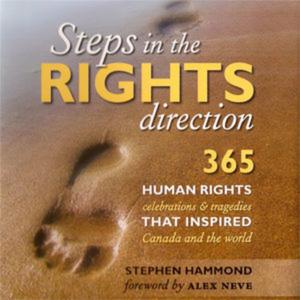
Join me every day for Human Rights a Day. It's a journey through 365 Days of Human Rights Celebrations and Tragedies That Inspired Canada and the World. The short 2 minute readings are from my book…