
Sign up to save your podcasts
Or

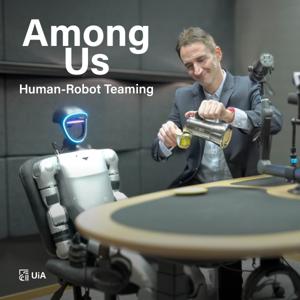


This episode explores how tactile feedback can make teleoperation more natural, safer, and more effective, and why touch is becoming central to human-robot teaming. Host Filippo Sanfilippo speaks with Guido Gioioso, CEO and co-founder of WEART, about moving haptic interfaces from university research into real products for XR, teleoperation, and shared autonomy.
GuestsGuido Gioioso00:00 - Introducing the podcast and today’s guest, Guido Gioioso
03:03 - WEART’s roots in Siena and the move from research to company building
04:53 - Starting in XR before returning to teleoperation and robotics
08:16 - Why touch adds essential information in remote manipulation
10:29 - Embodiment as the difference between a tool and a body
14:24 - TouchDiver Pro: a five-finger glove with six haptic contact points
15:25 - Using force, vibration, and thermal cues together in teleoperation
17:16 - How teleoperation helps train robots for autonomy
19:03 - Remote work in hazardous environments where autonomy is not enough
20:37 - Shared forces, shared space, and shared decisions in teaming
21:57 - Why shared autonomy is more realistic than perfect replication
23:48 - Using tactile feedback for informed, natural control loops
24:42 - Technical challenges: sensors, actuators, latency, and network quality
27:07 - Why comfort, ergonomics, battery life, and repeatability matter most
31:02 - A future of robots as extensions of human bodies
32:28 - Social and environmental benefits of remote physical work
33:53 - Closing thoughts on teaming and human-machine coexistence
Notable quotes“The sense of touch was the missing part.”
“Embodiment means transforming something from a tool to be used to a body that you can inhabit.”
“We believe in robots that are extensions of human bodies, not replications of human bodies.”
WEART:https://weart.it/
This episode explores how mechanical design can do more than support robotics, it can shape intelligence, adaptability, and even communication in human-robot teaming (HRT). Professor Filippo Sanfilippo is joined by Dr. Monica Malvezzi, professor of applied mechanics at the University of Siena, for a conversation about contact-rich interaction, embodied intelligence, and why robots should be designed to work with humans rather than around them.
Key topics00:00 - Welcome to Human-Robot Teaming and introduction of Monica Malvezzi
01:17 - Monica's academic background and research across mechanics and robotics
03:16 - Soft hands, wearable robotics, and physical augmentation
05:11 - From avoiding contact to exploiting contact in teamwork
06:56 - Why robots should be designed as interacting team members
11:20 - Embodied intelligence and moving complexity into mechanics
13:25 - Structure and controller as a blended system
14:20 - New materials, design strategies, and 3D printing
16:48 - Sharing autonomy between human and machine
18:11 - Handshaking as mutual exchange rather than fixed leadership
19:09 - Dance-inspired interaction and shared responsibility
20:34 - Adaptive roles in unpredictable human-robot teams
21:02 - Why human psychology and stress matter in robot teaming
23:36 - Three ingredients for human-robot teaming: mechanics, actuators, algorithms
24:26 - Monica's vision for the future of robotics
27:37 - Final thanks and Monica's closing remarks
Notable quotesIn this episode, Filippo Sanfilippo is joined by Claudio Pacchierotti, a CNRS researcher at IRISA and an expert in haptics, wearable interfaces, robotic teleoperation, and shared control. They explore how touch can become a communication channel between humans and machines, and why haptic feedback matters for safer, more intuitive human-robot teaming.We discuss how autonomy can shift fluidly between humans and robots depending on task difficulty, confidence, and environmental uncertainty, plus where wearable haptics are heading next and which applications stand to benefit most.
Key topics00:00 - Introducing Claudio Pacchierotti and the idea of human-robot teaming
00:32 - Claudio’s background in haptics, wearable interfaces, and shared control
01:31 - Why touch matters in human-machine interaction
03:05 - From human-robot collaboration to shared space, forces, and decisions
04:09 - Haptics as a communication channel between humans and robots
06:26 - Shared control for complex systems like humanoid robots and drone fleets
08:26 - How haptic feedback improves situational awareness during control
09:56 - Why touch can convey physical and abstract information without visual overload
11:15 - Shifting autonomy based on task difficulty and confidence
13:10 - Using shifting autonomy for training and complex robotic systems
15:17 - Cutaneous haptics, safe teleoperation, and keeping dexterity intact
17:22 - Combining vibration, pressure, skin stretch, and temperature
18:48 - Where human-robot teaming matters most in real-world applications
21:05 - Better actuators, sensors, algorithms, and haptic interfaces for teaming
23:13 - Why rich feedback improves trust, acceptance, and collaboration
24:56 - “Just enough haptics” and the future of wearable interfaces
27:12 - Human-centered robotics that empower rather than replace people
30:07 - Why the field is broad, multidisciplinary, and still expanding
Notable quotes“Haptics as a way of communication between humans and cyber-physical systems.”
“We believe in robots that can empower humans, not replace humans.”
“Just enough haptics.”
In this episode, Filippo Sanfilippo speaks with Professor Svein Olav Nyberg from the University of Agder about how statistics and probability sit at the center of human-robot teaming. They connect robotics to bachata dancing, human movement prediction, teaching, machine learning, and even dreams and consciousness.The conversation is wide-ranging, but the through line is clear: humans are not perfectly predictable, and good systems need to handle uncertainty rather than pretend it does not exist.
Key topics00:00 - Opening the episode and introducing the guest 01:21 - Why statistics matters for human-robot teaming 03:21 - From human-robot interaction to shared space, force, and intention 04:20 - Bachata as a metaphor for leader-follower control 05:47 - Swapping roles with AI during dance instruction 06:46 - The autonomy slider, alpha, in human-robot teaming 10:03 - Modeling human trajectories in industrial environments 11:00 - Generating synthetic humans instead of collecting exhausting real-world data 12:57 - Ornstein-Uhlenbeck motion modeling for position and velocity 14:23 - Using the same data for robot adaptation, identification, and anomaly detection 16:57 - Randomness, heart rate variability, and healthy human rhythms 19:42 - Random teaching, dice-based exams, and student engagement 21:29 - Why interest improves memory retention 23:30 - Statistics as the bridge between theory and practice in AI 24:56 - Why uncertainty matters more than a single machine learning output 27:24 - Bridging traditional robotics with statistics and machine learning 28:14 - Randomness in cryptography and pseudo-random number generators 30:26 - A football example that unexpectedly became a teaching tool 33:11 - Dreams, hallucinations, and whether machines can interpret or have dreams 34:49 - Blade Runner, consciousness, and synthetic beings 37:26 - The future is more open because systems must handle the unexpected 39:10 - Closing thoughts, karaoke, and the episode sign-off
Key frameworks"The future is far more open than we actually believe it is."
"Statistics is the engine" behind machine learning.
"We share space, we share forces, and we finally also share intention."
Join us for an enlightening discussion with PhD candidate Martin Økter about the forefront of human-robot teaming (HRT). We delve into how touch, machine learning, simulation, and safety are shaping the future of robotics across industries such as automotive recycling, healthcare, and space exploration.
Main Topics:00:00 - Introduction to human-robot teaming and Martin Økter
00:30 - The significance of haptics and the senses in robotics
01:02 - Applications of HRT in battery disassembly processes
01:33 - The shift from humans teaching robots to joint teamwork
02:02 - Using machine learning and imitation learning in robots
02:31 - The importance of tactile feedback and learning through testing
03:01 - Augmented surgical aid: reducing reliance on cadavers
03:30 - Designing scalable robotic systems with ROS
04:11 - Modular control architectures for complex disassembly tasks
04:49 - Simulation environments like Nvidia's IsaacSim for training robots
05:20 - Safety constraints and merging traditional control with machine learning
06:00 - Challenges and opportunities in long-term robot deployment
06:45 - Future scenarios: robotic applications in medical and industrial sectors
07:30 - The importance of continuous learning and exploration in robotics
08:10 - Advice for young researchers: passion, curiosity, and perseverance
08:50 - The societal role of collaborative robots and ethical considerations
09:40 - Concluding thoughts: a future driven by human-robot collaboration
Resources & Links:Join us on this journey to the future of collaborative robotics, where humans and machines support each other, overcoming challenges and unlocking new potentials!
Human-Robot Teaming, Artificial Intelligence, Perception, Art and Mathematics, Unsupervised Learning, Future of Robotics, Art and AI, Perception and Language, Creativity in AI
Exploring Human-Robot Teaming, Perception, and Artistic Innovation with Professor Marius LeordeanuDive into a thought-provoking conversation with Professor Marius Leordeanu as he discusses the intersection of robotics, perception, art, and mathematics. Discover how AI is transforming our understanding of perception, elevating human creativity, and inspiring new ways to live and collaborate with machines.
Main Topics Covered:Join us for a visionary exploration into how AI is transforming perception, art, and human-robot collaboration, and what this means for our future society. Don't miss the final inspiring message from Professor Marius Leordeanu about elevating humanity through technology.
Explore how advanced robotics, soft actuators, and intuitive haptic interfaces are revolutionizing healthcare, rehabilitation, and industrial environments through collaborative human-robot teaming. In this episode, Professor Mihai Dragusanu shares insights into developing wearable exoskeletons, integrating AI for intention detection, and envisioning the future of multi-agent robotics.Key topics
Timestamps
00:00 - Introduction to Professor Mihai Dragusanu and the theme of human-robot teaming
02:41 - Mihai’s research background in exoskeletons and soft robotics
04:37 - Achievements and recognition at ICRA for innovative exoskeleton research
07:01 - Core enabling technologies: sensors, actuators, and adaptive algorithms
09:02 - How personal disability experiences drive Mihai’s research focus
11:18 - Transition from rigid to soft exoskeletons and the development of twist string actuators
14:41 - Combining soft and rigid elements for powerful, lightweight exoskeletons
17:25 - Disabling vs. augmenting capabilities through wearable technology
19:17 - The significance of intuitive haptic interfaces for trust and control
20:09 - Personal experience with haptic feedback during robotic demonstrations
26:37 - Rehabilitation applications: modular, personalized, AI-driven exoskeletons
29:13 - Tele-rehabilitation and AI for intent recognition in therapy
31:20 - Wearable haptics and tactile feedback in healthcare and industrial tasks
33:04 - Future visions: environment-aware, multi-user, and community-based exoskeleton systems
35:44 - Shifting paradigms from one-to-one to many-to-many human-robot collaboration
40:20 - Envisioning a future where disabilities are integrated into the technological fabric of society
43:01 - Final reflections and upcoming collaborations, including conferences and esteemed colleaguesResources & Links
Connect with Mihai Dragusanu
This episode delves into cutting-edge research, philosophical reflections, and future visions that underscore the transformative potential of collaborative robotics rooted in soft, intuitive, and adaptive systems. Whether in healthcare or industry, the message is clear: technology today aims to extend human capabilities and foster inclusive, dynamic, and resilient team environments.
In this special episode recorded for the 40th ECMS International Conference on Modelling and Simulation (ECMS) in Grimstad, Norway, we bring together three perspectives on the future of simulation, AI, and human-centered robotics. From supply chain digital twins and agentic AI to wearable robotic devices and human-robot teaming in battery disassembly, this episode highlights how modeling and simulation are shaping practical innovation across research and industry.
Featured TalksProf. Dr. Dr. habil. Dmitry IvanovThis episode is connected to the proceedings of the
40th ECMS International Conference on Modelling and Simulation, Grimstad, Norway, June 23rd to 26th, 2026.CreditsECMS
Join us in this inspiring episode where art meets AI, as Cristina Lazăr shares her visionary projects that integrate creativity, emotion, and advanced technology. Discover how her innovative work is reshaping human-machine interactions and pushing the boundaries of artistic expression.
Main Topics Covered:00:00 - Introduction to Cristina Lazăr and her artistic environment
00:48 - Connecting art, science, and AI through human-robot teaming
01:33 - Cristina Lazăr’s background as an artist and researcher in human-AI interaction
02:48 - Cristina’s previous projects and recent exhibitions in Norway
03:53 - Collaborations with European robotics communities and other scientists
05:10 - The "Maya" project: non-verbal, real-time communication system
06:25 - Artwork as an interactive, sensorized entity that responds to human emotions
07:54 - The integration of mathematics, algorithms, and art in Cristina’s practice
09:34 - The role of emotion, expression, and trust in AI-enabled art
11:06 - The use of convolutional neural networks to make paintings "see" and respond
12:48 - Art as a mirror of the human soul and the importance of tactile interaction
14:20 - Elevating traditional art techniques with multisensory, sensor-based technology
16:48 - The significance of non-verbal languages, mirroring, and emotion recognition
18:08 - Neural networks and AI systems perceiving and reacting to human gestures
19:01 - The importance of trust, presence, and acknowledgment in human-AI interactions
21:42 - Summarizing Cristina’s vision: eyes, brain, and emotion in art
23:46 - The "Paint with Me" project and the fusion of classical painting with AI-driven responses
25:17 - Cultural and historical allusions, like the civilization of Maya, in human-AI emotional exchange
27:08 - The potential to use sensors and AI for emotion detection and adaptation in art
28:40 - The role of art and AI in creating meaningful stories connected to our past and future
30:36 - Art as a tool to evoke emotions and reflect the human condition
35:47 - The journey from curiosity to mastery in art and robotics over decades
38:50 - Returning to non-verbal, embodied, and multi-sensory forms of communication in art and research
41:50 - The philosophical insights: art, research, and the human soul as expressions of the divine
44:55 - The evolution of the expression of human feelings through neural networks and AI
48:50 - Vision for future human-robot teaming: sharing feelings, physical collaboration, and emotional resonance
53:29 - The spiritual dimension in Cristina Lazăr’s work: love, life, and connection to the universe
54:42 - Closing thoughts: art as a divine act, inspiration, and ongoing collaboration
Connect with Cristina Lazăr:This episode celebrates the harmony between creativity and technology, and how emotional intelligence shapes the future of human-robot collaboration. Expect insights into how art can serve as a bridge to understanding ourselves and each other in this evolving digital era.
Episode Overview:
Join Professor Filippo Sanfilippo as he takes a guided tour of an exciting robotics exhibition at ICRA 2026 in Vienna, Austria. This special episode showcases groundbreaking demonstrations and cutting-edge research from leading experts in robotics, human-robot interaction, and AI-driven automation.
Featured Guests & Highlights:
What You’ll Learn:
Event Details:
Tune in to experience the intersection of research, innovation, and real-world robotics demonstrations, all captured during this premier robotics event.
From the publisher's feed