Hume

Hume

By La Trobe UniversityEducation
Download on the App Store

Hume episodes

  • Inter-Species Sympathy/Empathy
    According to Hume, many nonhuman animals (or beings whom he sometimes calls 'sensible creatures') are analogous to human beings in respects of the body and the mind. We are able to sympathise with an animal in similar ways we sympathise with another human being.
    Copyright 2013 La Trobe University, all rights reserved. Please contact for permissions.
    47 min
  • Inter-Species Sympathy/Empathy (handout)
    According to Hume, many nonhuman animals (or beings whom he sometimes calls 'sensible creatures') are analogous to human beings in respects of the body and the mind. We are able to sympathise with an animal in similar ways we sympathise with another human being.
    Copyright 2013 La Trobe University, all rights reserved. Please contact for permissions.
    0 min
  • Sympathy/Empathy
    ‘Sympathy’ (or what is now often called ‘empathy’) is in Hume’s view a complex mechanism of the human mind which relies on the combined operation of three more fundamental principles: the ‘copy principle’, principle of ‘association of ideas’, and the principle of more vivid perceptions ‘enlivening’ less vivid associated perceptions.
    Copyright 2013 La Trobe University, all rights reserved. Please contact for permissions.
    48 min
  • Sympathy/Empathy (handout)
    ‘Sympathy’ (or what is now often called ‘empathy’) is in Hume’s view a complex mechanism of the human mind which relies on the combined operation of three more fundamental principles: the ‘copy principle’, principle of ‘association of ideas’, and the principle of more vivid perceptions ‘enlivening’ less vivid associated perceptions.
    Copyright 2013 La Trobe University, all rights reserved. Please contact for permissions.
    0 min
  • What Can we Know?
    According to Hume, all the objects of human inquiry and knowledge can be divided into two kinds (and only two kinds). They are 'relations of idea' on the one hand, which are discoverable by reason independent of real existence in the universe, and 'matters of fact' on the other, which are discoverable by experience.
    Copyright 2013 La Trobe University, all rights reserved. Please contact for permissions.

    51 min
  • What Can we Know? (handout)
    According to Hume, all the objects of human inquiry and knowledge can be divided into two kinds (and only two kinds). They are 'relations of idea' on the one hand, which are discoverable by reason independent of real existence in the universe, and 'matters of fact' on the other, which are discoverable by experience.
    Copyright 2013 La Trobe University, all rights reserved. Please contact for permissions.
    0 min
  • Association of Ideas
    What Hume calls the ‘association of ideas’ is a fundamental operating ‘principle’ (i.e. mechanism) of the human mind. The principle operates by resemblance, by contiguity, and by causes and effect.
    Copyright 2013 La Trobe University, all rights reserved. Please contact for permissions.
    48 min
  • Association of Ideas (handout)
    What Hume calls the ‘association of ideas’ is a fundamental operating ‘principle’ (i.e. mechanism) of the human mind. The principle operates by resemblance, by contiguity, and by causes and effect.
    Copyright 2013 La Trobe University, all rights reserved. Please contact for permissions.

    0 min
  • Impressions and Ideas
    Hume divides all 'perceptions' (i.e. experiences) into 'impressions' and 'ideas'. This theory device gives him a more finely grained account of the operations of the mind than either Locke or Descartes have. Impressions are original 'perceptions of the human mind' which are vivid, forceful, strong or lively. Ideas are the 'faint images' of the original impressions.
    Copyright 2013 La Trobe University, all rights reserved. Please contact for permissions.

    54 min
  • Impressions and Ideas (handout)
    Hume divides all 'perceptions' (i.e. experiences) into 'impressions' and 'ideas'. This theory device gives him a more finely grained account of the operations of the mind than either Locke or Descartes have. Impressions are original 'perceptions of the human mind' which are vivid, forceful, strong or lively. Ideas are the 'faint images' of the original impressions.
    Copyright 2013 La Trobe University, all rights reserved. Please contact for permissions.

    0 min

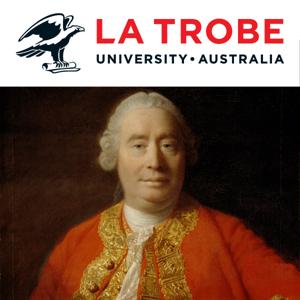
About Hume

From the publisher's feed

If Descartes is the father of modern philosophy, Hume is the person who gave shape to the contemporary philosophical world. First by querying Descartes' theories about knowledge, and then developing…

More shows like Hume

Ancient Greece: Myth, Art, War by Professor Chris Mackie and Dr Gillian Shepherd

Ancient Greece: Myth, Art, War

36 Listeners

Epics of Rome by Dr Rhiannon Evans

Epics of Rome

9 Listeners

History of Children's Literature by David Beagley

History of Children's Literature

37 Listeners

Genres in Children's Literature by David Beagley

Genres in Children's Literature

18 Listeners

Diet and Nutrition by La Trobe University

Diet and Nutrition

97 Listeners

Early Imperial Russia by Dr Adrian Jones

Early Imperial Russia

26 Listeners

Ancient Greece: City and Society by Dr Gillian Shepherd

Ancient Greece: City and Society

15 Listeners

Australian Aboriginal History by Professor Richard Broome

Australian Aboriginal History

6 Listeners

The Philosophy of Descartes by La Trobe University

The Philosophy of Descartes

3 Listeners

Biography by La Trobe University

Biography

3 Listeners