
Sign up to save your podcasts
Or



For a brief moment after the murder of George Floyd, I had the sense that our country was coming together. But things have definitely shifted. I don’t know about you, but that video required me to see things I didn’t want to see. It exposed me to the reality that the injustices I desperately wanted to believe were in the past are actually alive and well in the present.
It brought me face to face with myself in relation to the three words:
Black.
Lives.
Matter.
It required me to stop avoiding the confusion they have been creating inside of me.
So here I am, navigating my own confusion. At the same time, angry voices swirl all around me. They are from the mouths of people I respect on both sides of the issue (culture war). As you know, it’s been intense. When I process threads on Facebook, I get a picture of us playing tug of war with black lives. We say we are fighting for them, each in our own ways…but it feels like we might tear our black friends apart. We might be sacrificing real people on the field of battle. It feels like the fight is not even about black lives anymore.
What I’m sharing is my own journey with the three words: Black Lives Matter
I’m doing it even though I know that …
… it will prove to some of those who live around me, that I am one of those people (evangelicals) they have always suspected I am,
… it will create concern in others (evangelicals) that I am no longer who they thought I was.
I share my journey in the hope that engaging together, we might influence each other along the way.
I share my journey because I really want to be a bridge, and maybe sharing the journey together IS the bridge.
The hard part of being a bridge is that you actually have to touch both sides while extending across the risky middle ground.
These three words have dotted the landscape of my life for the last four years. More recently, they’ve dominated.
I don’t go out for a walk without seeing them in my neighbor’s windows. In the beginning, I received them as a slap in the face, an unfair accusation against me and others like me. They often come as part of a list of statements that starts with “In this house… or in this city we…”
They scream out, “We actually care about black lives and you don’t. You white Christians say you love people but you don’t. Liberals are the only ones who actually care about people.”
My own heart knows, and my experience with others tells me that this implied accusation simply isn’t true. I think I was mostly frustrated because I wanted those words in my own window, but not as the political or social statement it has become. I just wanted to identify my heart with the most pure meaning of those three words My false accusers make me feel like I can’t.
I began to realize that the words:
black lives matter
are actually begging questions that go beyond the worth of black lives. As a label for a political movement, it now includes questions about, among other things,
the dignity of women, and LGBTQ rights.
What about the lives of the LGBTQ community?
When the rainbow became a symbol for this community, it felt like a takeover of a universal sign of hope. It had one message and was off-limits for use by anyone other than for LGBTQ issues. Then it became a social/political line in the sand forcing me to “choose sides.” I didn’t want to choose because I didn’t want to abandon either. But I’m on the side of love, and love is on both sides! The line drew up sides between so-called “biblical morality,” and so-called “secular morality.” There was no place for a person who believes that to love God IS to honor people with or without full understanding or agreement.
What about the dignity of women?
For too long a patriarchal society has demanded women deny themselves and fall in line with the duties of childbearing, homemaking, and the sexual pleasure of men It was required that we carry huge weight, without a voice. Was that really the intention of God? Were we meant to be seen and not heard? Were we given a free will and the ability to reason without holding the kind of dignity those same abilities offered men?
What if a Christian actually does care about honoring women and members of the LGBTQ community? What if the healthiest perspective is the one having discovered it doesn’t have to be one or the other? What if we are sabotaging ourselves when we don’t deeply respect both from the deepest level of our being? What if it all matters too much for us to divide and fight?
All of this reminds me of King Solomon’s ruling between two women, both claiming the same child. Splitting the child only brings death, while making the decision to keep the child whole might mean sacrificing part of oneself. His ruling was designed to flush out the truest love.
It leaves me knowing and not knowing.
From this blip on my journey, I have full freedom and deep conviction before God to embrace and to own these three words:
Black. Lives. Matter.
and the message they bring to my heart, in spite of anything they might mean in our volatile social/political climate. I am falling deeply in love with the goodness of black skin and all that it means to the God who gifted black skin to the world. I am allowing my soul to marinate in the pure and inherent significance of black lives. I long to be changed in my insides. I am so much less concerned about what happens in the United States of America than I am about the beauty of the Kingdom of Heaven rising upon this earth. (I think my God is too.)
From this place in my journey, I am not free from wrestling with all of this. I still find all kinds of resistance rising up in me when I listen to what feels like nothing more than fighting words coming from both sides in a determined effort to be right, and to prove others wrong.
What I am most concerned about is the way the church seems to be fighting against the world we live in and our fellow humans. That is not our calling.
Where we all find ourselves.
We all have to wrestle with the question, “Does my black life matter to you?” Could it be any more important that we face it?
What is triggered inside of you when you own that question? What kind of resistance rises up inside of you with the words “black lives matter?” What is it really about?
Maybe like me, you will find yourself wanting to take back your freedom to care for the lives of real people and to bring the heart of God to bear on our world.
Maybe like me, you want to let God be God and do the work of God among us, while we do the work he has given us to do.
Where can we all begin?
Regina’s words offered a start: 1) Proximity, and 2) Empathy. These are rising up as an answer to the desires in my heart.
There will be no empathy that lasts if there is no proximity. I choose proximity, period. With my fellow humans who are black, as well as my fellow humans who land on either side. I choose to stay authentically in the discomfort of all of it. I do so on purpose because I believe that either everyone matters to me, period, or no one actually matters to me.
A friend of mine actually started a YouTube channel for me several months ago. I think it’s time to start using it. I want to share more specifically the words of the Bible that are influencing a change in me (for those who think I have wandered from biblical authority in my life), and for those who find themselves curious about why the words of that book matter to me so much that I could never walk away from them.
Want to dialogue more? Join our Facebook group here.
Regina Robinson is a beautiful, competent, confident educated woman who happens to be black. She is a mother of four, a devoted follower of Jesus and the Dean of Student Affairs at Cambridge College in Boston. The last few months have rocked Regina’s world as she grapples with the reality that her black life doesn’t actually matter to many of her fellow humans. Never before has she felt the danger associated with her black skin. Hearing the heart behind her words will impact your perspective if you are willing.
Want to dialogue more? Join our Facebook group here.Much like Danté Upshaw and Neil Edwards, Jua Robinson is an African American who has chosen to live his life as a bridge. Not many will, and no one should be expected to. Maybe that’s what makes these men’s lives such a gift to all of us.
Jua lives in Boston with his wife Regina and their four kids. He works for an organization called the Boston Collaborative, serving the good of his city. As a follower of Jesus, His unique passion involves bridging the gap between a church he loves and his African American people.
I’m struck by his willingness to patiently work to create change in the context of the church; where disunity of any kind is incongruent with its very existence.
The hypocrisy of the church is on display in Jua’s story. So is the heart of a tired man, who graciously invites us to something better. We need to stop talking about unity in our gatherings and get ourselves out working alongside others for the sake of real change.
His willingness inspires mine. My wheels are already turning with thoughts about racism in the context of the evangelical church today.
Join me in contemplating this serious reality and let’s let this moment change us!
Want to dialogue more? Join our Facebook group here.
Any questions or comments? Email me directly here.
Ready to start transforming your relationships? Go to our website and check out the resources on my coaching page.
Right?
I don’t like to put labels on others or have them put on me. A person is so much more than any label they wear, and labels have different meanings to different people. I hate being defined by other people who wear the same label as me. Labels generate assumptions and are packed with ore conceived notions.
Right now we don’t even know how to feel about wearing the basic label connected to our skin color. It used to be just a description of our external appearance, and white was white. But now white is being labeled as so many different things, I just want to shake them all off in order to figure out who I am as a white person.
Unfortunately, it has always been that way for black Americans, and as a white person, I’m just getting a small taste of how it feels to have my skin color define me in a negative way.
My choice for today is to turn it around and embrace the label that is the most uncomfortable for me. It doesn’t feel to me like I have been infected with white supremacy, but I’m going to start assuming I have. I’m not doing it because I’m supposed to. I’m doing it because I want to make the most of this opportunity to explore what’s really going on inside of me and root out anything that keeps me from fully valuing myself and my fellow humans. I want to be someone who creates safety for people who can’t feel safe with me because of my skin color.
I am not ashamed of being white I just want to learn how to wear it better. I think step one for me in the long game is to put myself under that label and feel it.
I am embracing the adventure because I am ready to enjoy more of the untapped potential in my human relationships.
I am also embracing you and your journey, ready to let you be a different kind of white than me right now. This is a life long adventure that offers us all more, as we seek to be better people to our fellow humans who happen to be black.
What is step one for you?
Want to dialogue more? Join our Facebook group here.
Any questions or comments? Email me directly here.
Ready to start transforming your relationships? Go to our website and check out the resources on my coaching page.
Want to dialogue more? Join our Facebook group here.
Any questions or comments? Email me directly here.
Ready to start transforming your relationships? Go to our website and check out the resources on my coaching page.
At the root of racism and every other related “ism” is the presence of supremacy. Us humans dabble in it every day and some of us live with our feet firmly planted in it, almost like an anchor.
We naturally connect with people who share our opinions, lifestyles, beliefs, etc. just affiliating with a like-minded group of people creates a bias in our subconscious minds because we feel that our way of thinking is superior. That bias becomes prejudice when we highlight our way of thinking in comparison to others in our conversations. We still don’t even notice. Then when things heat up and controversy of some kind rises up between groups, disdain and disgust enter in.
Yesterday I heard the term anti-racism, racism. We all see it growing as whites go against whites in our efforts to sort out whose fault this really is.
Neil Edwards is a gift to The United States of America. His unique perspective based on his unique experiences up until he came to the US for college offers us a beautiful example and a powerful hope.
Neil has tasted a world that most of us haven’t. The world he grew up in involved racial diversity without the presence of racism. He has a vision that I want to borrow; hope that I want to embrace.
Neil has found a way to see himself in us white Americans, a group of people who have hurt him deeply. His anger is real and yet somehow clean. I think it’s because he keeps it within his highest value, which is love. It’s a hostile world right now and there is so much to be afraid of. I want to be like Neil Edwards.
Neil can see himself in you and I. That’s the most unique thing about him. What if all of us would choose to see ourselves in him today?
What if we became willing to see ourselves in everyone whose opinions make us fearful? What if we refuse to let the script of any one group divide us from our fellow humans?
What if each of us would get serious about seeing and dismantling our human supremely?
I’m in the thick of it and I would love for you to join me.
Want to dialogue more? Join our Facebook group here.
Any questions or comments? Email me directly here.
Ready to start transforming your relationships? Go to our website and check out the resources on my coaching page.
Want to dialogue more? Join our Facebook group here.
Any questions or comments? Email me directly here.
Ready to start transforming your relationships? Go to our website and check out the resources on my coaching page.
Want to dialogue more? Join our Facebook group here.
Any questions or comments? Email me directly here.
Ready to start transforming your relationships? Go to our website and check out the resources on my coaching page.
If you are not a believer, you are probably ready to give that question a wholehearted “yes.” That’s because you have felt it.
On the other hand, If you are a believer, you might be feeling the exact opposite and a bit defensive. I was utterly surprised when that question rose up in me this week. It happened as I listened, and listened again, to episode 28.
Whoever you are, I hope you can hear me describe my journey through this week without judgment or resistance. I can invite that now only because I made my way through some crazy feelings and landed in a place of gratefulness. I needed to be blindsided by some truth tucked away in Danté’s story.
In the 1960s the church actually believed and taught that slavery had to happen, because the African people were so horribly sinful. Their only hope was that we would go to them with the gospel and conform them to the ways of our faith. While I believe this was generated by people who truly cared and thought they had it “right,” I am sad about how wrong it was. I’m sad by the way it fostered racism as it unwittingly promoted both superiority and fear. In the church; evidenced in the way Danté experienced racism in the context of his Christian school.
When Danté described his perception of the sin of the American church, it exposed some things in my heart that were devastating. He named it as “Our efforts to conform people, who have been made in the image of God, to our own image.”
That’s was the goal of our missionary efforts because we failed to see God's image in people.
Today we see God's image. Now the goal to conform people to our image is more subtle, but it is still there.
The questions rising up for me today are these?
What else have we gotten wrong?
When did our invitation to explore the love of Jesus together change from, “Come be with us,” to “Come be like us.”
When did our posture change from humble delight that Jesus rose from the dead to a demand that the world conform to our beliefs and morals?
How can we be so certain that we are right?
How has it become so easy for us to put ourselves above our fellow humans as a judge?
How did we become so arrogant while living under a message that has no room for anything less than absolute humility?
I may not be a white supremacist, but I think I suffer from a brand of it that I’m calling “Christian supremacy.”
I listened to Dante’s story in a way that is requiring something huge from me. I‘m convicted and I am ready to change. How about you? Are you ready to join me in a conversation to explore what is behind all of our good efforts as a church?
Those of you outside the church will you support us in our desire to change and wonder about the possibility of another form of supremacy in you? Supremacy of so many varieties is alive and well among us in America, and I’m getting in touch with just how destructive it is.
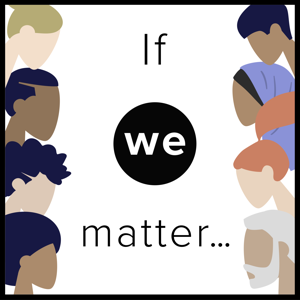
I also love to imagine what’s possible if we would choose to open ourselves up to the humility invited by the simple question of “If we matter...”
Want to dialogue more? Join our Facebook group here.
Any questions or comments? Email me directly here.
Ready to start transforming your relationships? Go to our website and check out the resources on my coaching page.