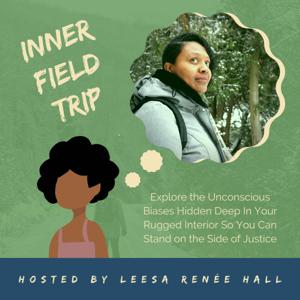
Inner Field Trip®

Inner Field Trip®

By Leesa Renée HallSociety & CultureRelationships
Download on the App Store

All Inner Field Trip® episodes

  • Using Emotional Intelligence to Lessen the Emotional Tax

    What is an emotional tax and how does it affect Black, Indigenous, and People of Colour (BIPOC)? In this episode, Karlyn Percil shares the concept of an emotional tax and how it creates an unsafe work environment for BIPOC. Karlyn also shares how to use emotional intelligence to stumble bravely in one’s quest to become anti-bias, anti-racist, and anti-oppressive.


    Karlyn Percil is a Certified Emotional Intelligence and Neuro-Life Coach with keen focus on diversity, inclusion, and belonging. She is the Chief Executive Officer of KDPM Consulting Group INC., and the Founder of SisterTalk Group Leadership and Wellness Academy, a group dedicated to amplifying the voices of Black, Indigenous, and WoC on leveraging personal narratives as a catalyst of success.

    She has served on the Board of the Black Business and Professional Association, as the Chair of The Harry Jerome Awards, and through SisterTalk Group, Karlyn mentored and supported the leadership development of young girls in North America, especially in her birth home of St. Lucia. Karlyn has also worked with UNICEF, the Toronto Police Service, and is a Guest Expert on Cityline, the longest-running daytime talk show for women.


    Here’s what you’ll learn in this episode:


    • The word obedient and how Karlyn reclaims that word so she can operate as an empowered woman
    • Seven times Britsh and second times French and how colonialism both shaped and harmed St. Lucia
    • Why Karlyn embraces her French Creole ancestry as an act of resistance despite what the European colonists tried to do
    • How her upbringing in St Lucia prepared her for life in Canada as a new migrant (and what she still needed to learn)
    • How to think of emotions so you include them when creating a culture that is truly inclusive and liberating
    • Why emotions are not bad and how to use them as a guide when exploring unconscious biases


    Click here for show notes and lighted edited episode transcript

    Hosted on Acast. See acast.com/privacy for more information.

    59 min
  • 3 Step Process to Take A.I.M. At Your Unconscious Biases

    After becoming aware of how harmful the system of oppression is towards marginalized groups, too many jump right into action. They attend marches, burden Black, Indigenous, and People of Colour (BIPOC) in their companies to lead and sit on Diversity, Equity, and Inclusion (DEI) committees, go on hiring sprees to hire more BIPOC, and overwhelm anti-racism educators with their rush to appear NOT oppressive.


    The problem with rushing from awareness to action is that it creates even more harm for BIPOC – and white people, too. In this episode, Leesa Renée Hall shares more about the 3 step process that you should follow when unpacking and exploring your unconscious biases so you can reclaim your sensitivities.


    Here’s what you’ll learn:


    • Origins of the Inner Field Trip and how it evolved from a viral blog post to the community it embodies today
    • Why Leesa is NOT an anti-racism educator and the words she uses to characterize her body of work
    • How going on a multi-city tour helped me get clear that I wanted to go on more field trips (and the historical landmarks I wanted to visit to help patrons explore the origins of our biases)
    • How hiking is related to exploring your rugged interior and finding your Inner Oppressor
    • Why trying to fight, hide from, or suppress your Inner Oppressor is a bad strategy (and what to do instead)
    • The A in A.I.M. (and the various scripts used to raise your attention to the A)
    • The harm created when jumping over the I and moving quickly to the M in A.I.M.
    • How doing the Inner Field Trip can help you find your unique ancestral signature
    • Why donating to a racial justice charity or buying an anti-racism book is NOT paying reparations (and how to know the difference)
    • Four other ways to explore unconscious biases in addition to participating in the Inner Field Trip


    Click here for show notes and lighted edited episode transcript


    Hosted on Acast. See acast.com/privacy for more information.

    52 min
  • How Parents, Teachers & Caregivers Can Raise Anti-Racist, Anti-Bias Children

    With the return back to school, I thought it’d be important for teachers, parents, guardians, and others who have children in their care to get tips on how to raise them in an anti-oppressive and anti-bias way. I reached out to Tiffany M. Jewell, an anti-racist and anti-bias educator, for her guidance on this topic.


    Tiffany is a Black biracial writer, twin sister, first generation American, cisgender mama, anti-bias antiracist (ABAR) educator, and consultant. She is the author of the #1 New York Times and #1 Indie Best Seller, This Book Is Anti-Racist, a book for young folks [and everyone] to support waking up, taking action, and doing the work of becoming antiracist.


    She has been working with children and families for over eighteen years and worked as a Montessori educator for fifteen years. She enjoys exploring social justice with young folks, especially the history of racism and resistance, economic justice, and socially and personally constructed identities. Tiffany enjoys working with educators and supporting them building strong, authentic communities in which every child can be seen and valued. She is the co-founder, alongside Britt Hawthorne, of ABARatHome/ABARAtSchool, an organization that strives to support educators and caregivers in their anti-bias anti-racist journeys. She also served as the president of the founding board of the national organization, Montessori for Social Justice- seeing it through to completing nonprofit status and creating a strong mission to support and amplify Montessorian of the Global Majority across the country.


    Tiffany lives on the homeland of the Pocumtuc and the Nipmuck with her two young storytellers, husband, and a turtle she’s had since she was nine years old.


    Here’s what you’ll learn:


    • How Tiffany navigates having light-skin privilege and identifying with a marginalized group
    • How Tiffany’s white mom prepared her for the anti-racism and anti-bias work she does today
    • What other influences guided Tiffany into creating anti-bias curriculum for teachers, parents, and caregivers
    • Why white children are never too young to learn about racism, sexism, and other oppressive behaviour
    • The ways in which adultification makes classrooms unsafe for Black children
    • How the Montessori pedagogy helps children co-create an anti-racist, anti-bias curriculum, and what parents
    • 3 tips on how parents, teachers, and caregivers can get started in teaching/raising anti-oppressive, anti-racist, and anti-biased children


    Click here for the show notes and lightly edited episode transcript

    Hosted on Acast. See acast.com/privacy for more information.

    54 min
  • Introduction to the Inner Field Trip Podcast

    After a 13-year hiatus from podcasting, Leesa Renée Hall is back with the Inner Field Trip podcast. In this episode, Leesa shares what’s to come in Season 1. She shares what the Inner Field Trip is and who benefits the most going on one. In particular, here’s what you’ll learn:


    • How Leesa’s background in podcasting prepared her for the work she does today
    • The reason why her work is directed to Highly Sensitive People and Deep Feelers
    • Why marches, protests, and sit-ins don’t work for Highly Sensitive People and what they can do instead
    • The reason why anti-racism or anti-bias work cannot be undone in one meeting or workshop
    • Why #BlackLivesMatter doesn’t mean painting the words on a city street and what people of African descent are truly asking for
    • Why Leesa is NOT an anti-racism educator and why her body of work encompasses more than just critiquing skin colour privilege
    • What perspective Leesa uses to help us understand the origins of our unconscious biases (including the two educators who helped create her deep interest in this discipline)
    • How a teacher’s denial of chattel slavery in Leesa’s Grade 10 American history class influenced her to be #SilentNoMore
    • Why uncovering how her mother got a French last name on an English-speaking Caribbean island sparked Leesa’s deep interest in uncovering her lineage
    • The nuance of Leesa’s complex ancestry and how she resolved being the child of the oppressed and the oppressors
    • Why having NO biological children is NOT an excuse not to have 7th generation thinking, as coined by the Iroquois people
    • How the tragedy of Hurricane Hazel that hit Toronto in 1954 changed a bylaw that generations today benefit from (an example of 7th generation thinking)
    • Why the inner work of exploring unconscious biases is neither glamourous or pretty, and why you need to have the courage to get messy


    Click here for show notes and lighted edited episode transcripts

    Hosted on Acast. See acast.com/privacy for more information.

    54 min